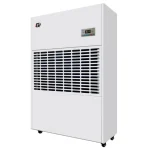
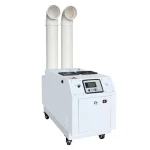
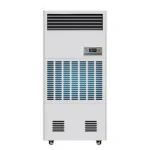
When people ask whether an industrial dehumidifier is energy efficient, they usually want a practical answer. They want to know whether the system can control humidity well without creating unnecessary running costs. That is why this question cannot be answered by power draw alone.
A unit may use more power than another model and still be the better choice if it removes moisture faster, reaches the target condition more reliably, and avoids unnecessarily long operating hours. A lower-power unit may still become the weaker choice if it cannot keep up with the moisture load and has to run for too long.
So the real question is not just how much electricity the machine uses. The real question is whether that energy is being used to deliver effective humidity control, because dehumidifier efficiency is measured by how much water is removed per kilowatt-hour.
Why Power Draw Alone Does Not Define Efficiency
A common mistake in industrial applications is to treat input power as the same as efficiency. That usually leads to the wrong conclusion. Power draw only tells you how much electricity the machine uses while running. It does not tell you how much moisture the system removes, how fast it reaches the target humidity, or how stable the room stays afterward.
That is why a higher-power unit is not automatically inefficient. If it can remove more moisture in less time and hold the target condition more steadily, it may give a better overall result. The opposite can also happen. A lower-power unit may look attractive at first, but if it removes moisture too slowly or struggles to maintain the target humidity, it may end up running longer and performing worse.
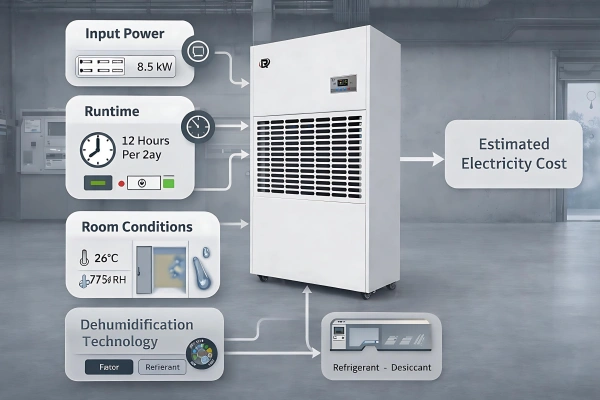
If runtime cost is still a key concern, you can also look at this guide on how much electricity an industrial dehumidifier uses. In this case, the more useful question is whether the energy going into the machine is producing the right dehumidification result.
What Energy Efficiency Means in Industrial Dehumidification
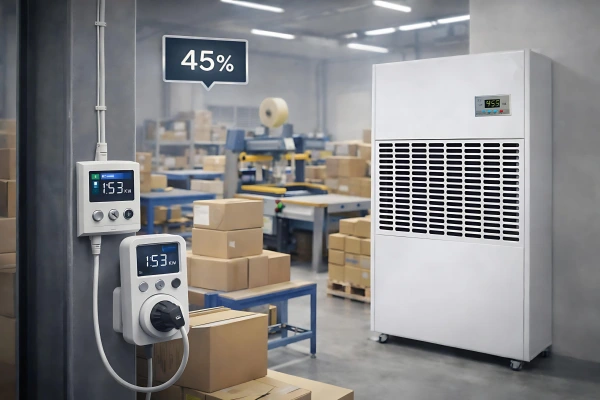
An energy-efficient industrial dehumidifier is not simply a unit with low power consumption. A better way to judge it is this: can it remove enough moisture while using a reasonable amount of energy? In real projects, an efficient unit usually does three things well:
- It reaches the target humidity.
- It keeps the humidity stable.
- It avoids unnecessary long-hour operation.
That is why efficiency should be judged by both dehumidification performance and energy use. One unit may use less power but remove moisture too slowly or fail to hold the target humidity. Another unit may use more power but control humidity faster and more steadily. In that case, the second unit may deliver better overall efficiency for the job.
Manufacturer performance data also needs context. A unit can look efficient under one test condition and much less impressive under another, because capacity and efficiency ratings depend on the test conditions.
| What to look at | Why it matters |
|---|---|
| Moisture removal result | Shows how much drying work the system actually does |
| Energy input | Shows how much energy is used to do that work |
| Humidity target | Affects how hard the unit needs to work |
| Runtime behavior | Shows whether the unit is well-matched or constantly struggling |
| Operating conditions | Help you judge whether the published data fits the real project |
If you want a broader overview first, this complete guide to industrial dehumidifiers explains the main types, basic working principles, and common industrial uses.
Why the Same Dehumidifier Can Perform Differently Across Projects
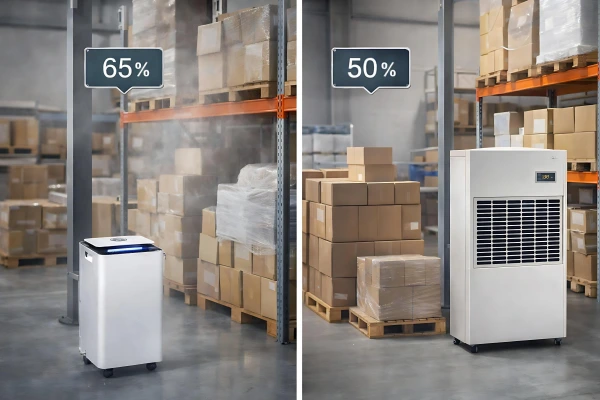
- Temperature and humidity affect performance
Different operating conditions change how easily moisture can be removed. - Moisture load is not always the same
Outside air leakage, frequent door opening, wet materials, and process moisture can all increase the load on the system, which is consistent with industrial humidity loads such as infiltration and process moisture. - Sizing affects efficiency
A unit that is too small may run longer and still fail to hold the target condition. If capacity is still unclear, the industrial dehumidifier sizing guide provides a more direct way to estimate the required removal rate before comparing efficiency. - System setup also matters
Airflow, control settings, and maintenance all influence real operating performance. - Efficiency should be judged by the application
The same machine may perform well in one project and less efficiently in another.
Refrigerant vs Desiccant: Which Type Is More Energy Efficient?
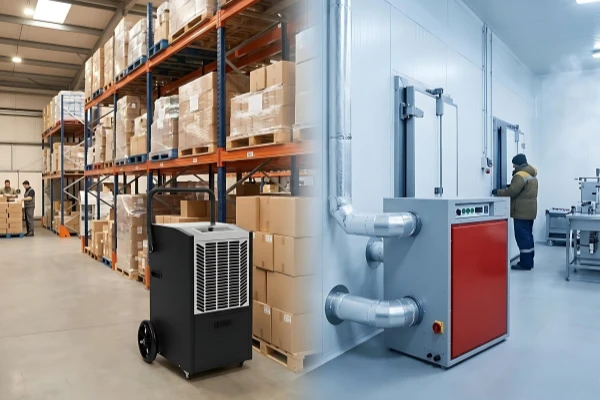
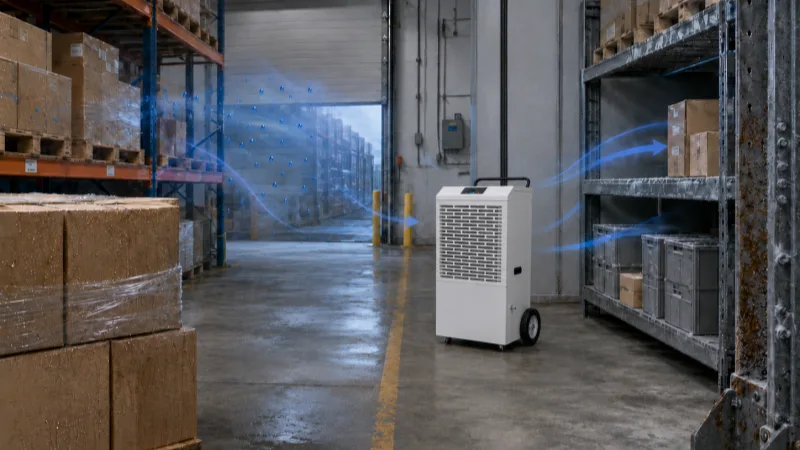
Refrigerant dehumidifiers usually perform more efficiently in warm and humid conditions. They are commonly used in warehouses, production areas, and packaging spaces where temperature and humidity support effective condensation.
Desiccant dehumidifiers work differently. They require regeneration energy, so total energy input is often higher. Even so, they are more suitable for lower-temperature environments or applications that require lower humidity or lower dew point, and desiccant systems are widely used for low dew point and cold-condition applications.
Refrigerant and desiccant systems should be compared under the same operating conditions, not by power use alone. The better choice depends on temperature, humidity target, and application requirements.
If the project involves lower-temperature drying or lower-humidity control, this desiccant dehumidifier page gives more detail on this type of system. A simple comparison is shown below:
| Application condition | Refrigerant dehumidifier | Desiccant dehumidifier |
|---|---|---|
| Warm warehouse | Often the stronger efficiency choice | Possible, but not always necessary |
| Standard production room | Often a strong fit | Depends on the humidity target |
| Low-temperature area | May become less effective | Often the better fit |
| Low dew point requirement | Usually limited | Usually the better fit |
What Buyers Should Check Before Choosing an Energy-Efficient Industrial Dehumidifier
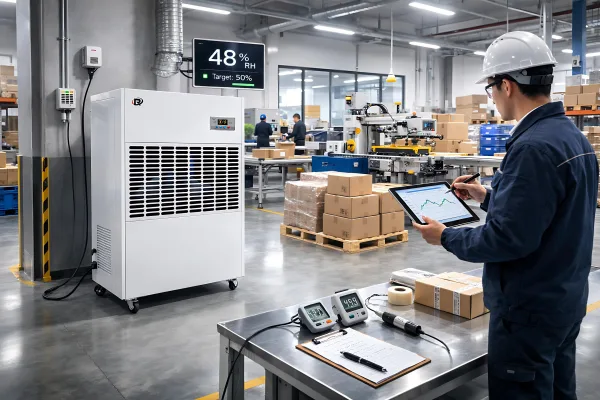
Before comparing models, buyers should start with the application and then review the manufacturer’s performance data. A machine can only be considered efficient if those figures are relevant to the real project conditions.
Check these points before making a comparison:
- Check the rating condition behind the capacity figure
Many industrial dehumidifiers are published at 30°C/80% RH. If another unit is rated at a different temperature or humidity point, the figures are not directly comparable, because capacity and efficiency ratings depend on the test conditions. - Check capacity and power at the same conditions
Capacity alone is not enough. If moisture removal is shown at one condition and power is shown at another, the efficiency result is not useful for comparison. - Check whether the technology matches the application
Refrigerant systems usually suit warm and humid conditions better. Desiccant systems are more suitable for lower-temperature or lower-dew-point applications. - Check whether the unit can hold the target humidity
A unit is not efficient if it only reaches the setpoint by running too long or if humidity keeps fluctuating. - Check whether the selected capacity matches the real moisture load
Outside air leakage, frequent door opening, wet materials, and process moisture can all increase the actual load on the system.
A dehumidifier can be considered efficient when it matches the application, reaches the target condition, and maintains it with reasonable energy use.
If model selection is still unclear, this guide on how to choose an industrial dehumidifier provides a more detailed selection framework.
Industrial dehumidifier efficiency should be evaluated by moisture removal performance relative to energy use, not by power rating alone. As outlined in the U.S. Department of Energy’s dehumidifier test procedure, efficiency is assessed through performance metrics that relate water removal to energy use under defined test conditions. A useful comparison therefore, depends on moisture removal performance, target humidity, temperature range, and operating load rather than power rating alone.
FAQ
What makes a dehumidifier energy efficient?
An energy-efficient dehumidifier removes more moisture per unit of electricity. Capacity, humidistat control, compressor efficiency, fan design, and correct sizing all affect the result.
What is the most efficient type of dehumidifier?
It depends on the operating conditions. Compressor or refrigerant units are generally more efficient in warmer, wetter conditions, while desiccant units are more effective in colder or drier environments.
How long should a dehumidifier run per day?
Runtime depends on humidity level, room conditions, and unit capacity. General guidance often ranges from 8 to 12 hours daily, with longer operation in very damp spaces.
Do dehumidifiers use a lot of electricity?
They can use a noticeable amount of electricity because they often run for long hours. Actual consumption depends on wattage, runtime, humidity level, and the size of the unit.
What size dehumidifier do you need?
The right size depends on both area and dampness level. Room size alone is not enough, because higher humidity and heavier moisture load usually require more capacity.