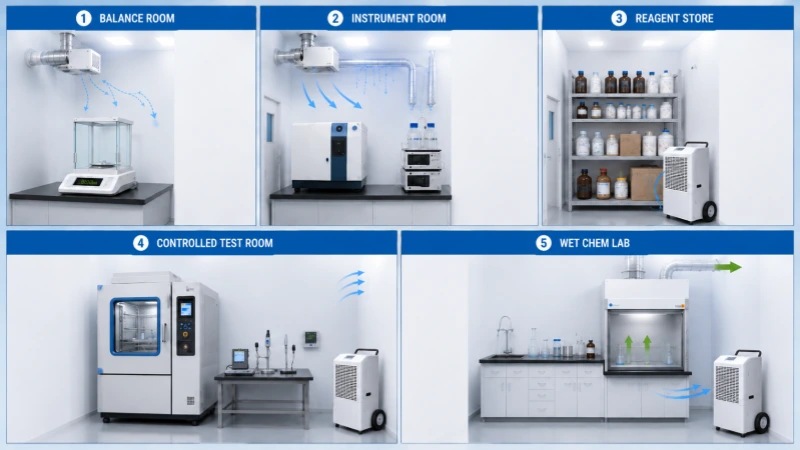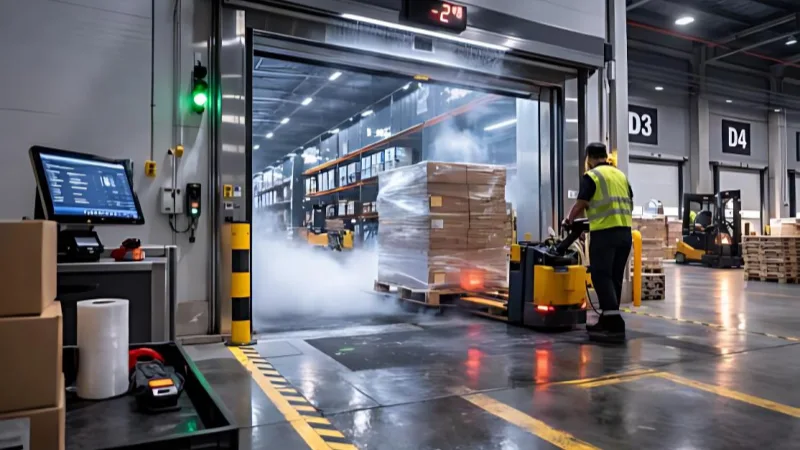
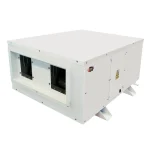
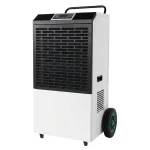
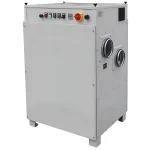
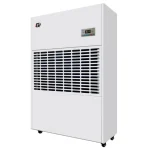
In a cleanroom, humidity problems usually show up as process problems.
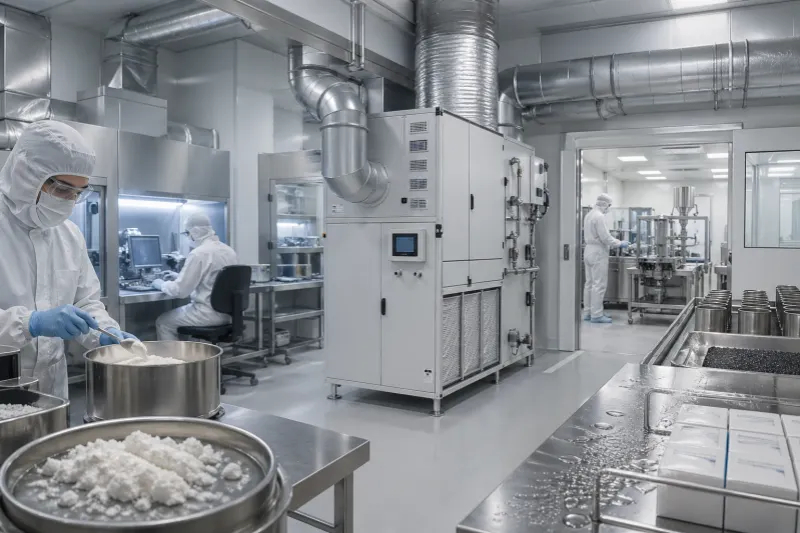
Pharmaceutical powders may cake during weighing or filling. Semiconductor parts may face higher static or corrosion risk. Lithium battery materials may react with moisture. Aseptic packaging areas may see damp cartons, wet floors, or condensation near cold surfaces.
A standard dehumidifier may lower RH in a general room. A cleanroom dehumidifier must do more. It needs to support stable RH or dew point, controlled airflow, pressure balance, filtration compatibility, monitoring, and HVAC integration.
Compared with many industrial dehumidifier applications, cleanrooms place more pressure on humidity stability, clean airflow paths, pressure control, and documentation. For buyers and facility teams, the right selection starts with the required RH or dew point, then moves to airflow, HVAC integration, construction, monitoring, and documentation needs.
What Makes Cleanroom Humidity Control Different?
Humidity Must Work With the Whole Cleanroom System
In a normal industrial space, the main goal may be simple: lower the humidity.
In a cleanroom, the goal is more specific. The room must hold humidity without disturbing cleanliness, airflow, temperature, pressure, or process stability.
ISO 14644-1 classifies cleanrooms by airborne particle concentration, not by one fixed humidity value. That means the cleanroom class helps define particle cleanliness, while the RH or dew point target usually comes from the product, process, URS, GMP requirement, or project specification.
| Control Factor | Why It Matters in Cleanrooms |
|---|---|
| Temperature | RH changes when temperature changes |
| Airflow | High air change rates can increase moisture load |
| Pressure | Positive pressure needs treated makeup air |
| Filtration | Air must stay compatible with cleanroom cleanliness goals |
| Door zones | Airlocks and pass-throughs can bring humidity spikes |
| Process exhaust | Exhausted air must be replaced with conditioned air |
| Data records | GMP and QA teams may need traceable environmental data |
Poor Humidity Control Can Create Production Risks
Cleanroom humidity problems are often visible before they become measurable quality issues.
You may see damp packaging near a door zone. Operators may report static shocks. A QA team may find unstable environmental records. In a battery dry room, dew point may rise after airlock traffic. In a packaging area, cartons may soften during rainy seasons.
Common risks include:
- Powder caking in pharmaceutical processing
- Microbial growth risk in GMP or food environments
- Static discharge in electronics and semiconductor areas
- Condensation on cold surfaces, coils, tools, or packaging
- Moisture reaction in lithium battery materials
- Corrosion on sensitive metal parts
- Unstable test results in laboratories and precision manufacturing
For drug manufacturing, FDA 21 CFR § 211.46 requires appropriate control of air pressure, microorganisms, dust, humidity, and temperature where needed for manufacturing, processing, packing, or holding drug products.
Humidity control should be treated as part of process risk control, not only facility comfort.
Cleanroom Humidity and Dew Point Targets by Industry
There is no single humidity level for every cleanroom.
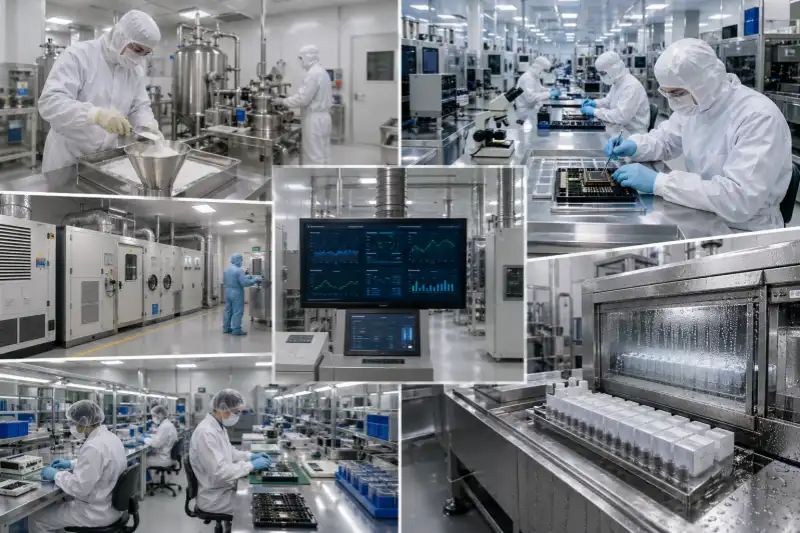
A pharmaceutical powder room, semiconductor cleanroom, lithium battery dry room, medical device assembly area, and aseptic packaging zone may all be controlled environments. But they do not use the same humidity target.
The right target depends on:
- Product sensitivity
- Process step
- Cleanroom class
- Temperature range
- Material behavior
- QA or validation requirements
- Local climate and outdoor air load
- Whether RH or dew point is the better control parameter
Typical Humidity Control Targets by Application
| Industry / Application | Common Control Direction | Main Risk | Dehumidifier Focus |
|---|---|---|---|
| Pharmaceutical cleanrooms | Often project-specific RH range, such as 30–50% RH | Powder caking, microbial risk, unstable records | Stable RH, alarms, validation support |
| Sterile filling areas | Validated environmental range | Contamination risk, unstable process conditions | HVAC-integrated humidity control |
| Semiconductor cleanrooms | Narrow RH range based on process need | ESD, corrosion, process drift | Precision RH and dew point control |
| Lithium battery dry rooms | Very low RH or low dew point | Moisture reaction with materials | Multi-stage desiccant dehumidification |
| Medical device assembly | Controlled RH based on product and packaging | Packaging stability, material performance | Cleanroom-compatible structure |
| Optical and precision manufacturing | Stable RH, often moderate range | Condensation, coating defects, measurement drift | Fine humidity stability |
| Aseptic food packaging | Moderate RH with condensation control | Mold risk, damp cartons, wet floors | Hygienic dehumidification and airflow control |
How to Choose Between RH and Dew Point Control
Relative humidity changes with temperature. Dew point reflects the actual moisture content in the air more directly.
For moderate cleanroom humidity control, RH may be enough. For dry rooms, low-humidity manufacturing, lithium battery processing, or other moisture-sensitive operations, dew point is often the better control point.
A useful way to judge the target is simple:
- Use RH control when product stability depends on a moderate humidity band.
- Use dew point control when the process depends on very low moisture content.
- Review both when temperature, outdoor air load, and pressure balance change during operation.
Why Standard Dehumidifiers May Not Fit Cleanroom Projects
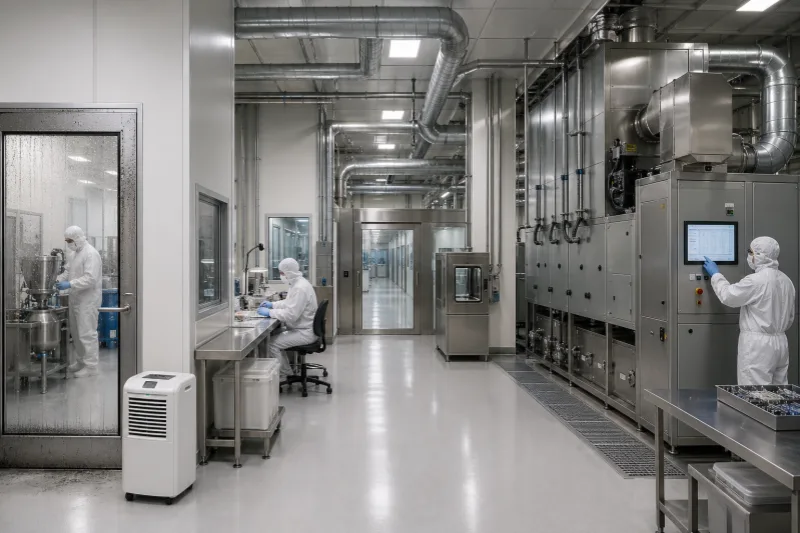
A standard dehumidifier may work well in a warehouse, archive room, or general production area. But cleanrooms have tighter control requirements.
Many cleanroom projects need ducted airflow, low dew point, pressure balance, cleanable surfaces, alarms, and data records. Basic rules for how to choose an industrial dehumidifier still apply, but cleanroom projects add stricter requirements around RH stability, dew point, airflow, filtration, and documentation.
The Unit May Not Reach the Required Dew Point
Refrigerant dehumidifiers work well in many warm and humid spaces. But when the room needs low RH, low dew point, or stable control at lower temperatures, refrigeration alone can hit practical limits.
This is a common issue in:
- Lithium battery dry rooms
- Pharmaceutical powder rooms
- Low-temperature controlled areas
- Semiconductor or precision process zones
- Cleanrooms with high fresh air load
If the target is only moderate RH, a refrigerant system may be enough. If the target is low dew point, a desiccant dehumidifier or hybrid system is usually more suitable.
Airflow and Static Pressure May Not Match the HVAC System
Cleanrooms often depend on AHUs, MAUs, return air paths, pressure cascades, and high air change rates.
A dehumidifier that is not matched to this system can create problems:
- Low process airflow
- Insufficient external static pressure
- Poor duct connection
- Uneven dry air distribution
- Humidity spikes near doors or pass-throughs
- Pressure imbalance between rooms
- Longer recovery time after door opening
The dehumidifier should be selected as part of the air system, not as a separate box.
Materials, Filtration, and Controls May Not Meet Project Needs
Some controlled environments need equipment surfaces that are easy to clean and less likely to trap dust or moisture.
For GMP or high-care areas, buyers may ask for:
- 304 or 316L stainless steel options
- Smooth external surfaces
- Corrosion-resistant components
- Sealed cabinet design
- Easy maintenance access
- HEPA downstream compatibility
- Condensate drainage planning
- Alarm records
- Sensor calibration support
- PLC control
- Modbus, BACnet, BMS, or SCADA connection
- FAT, SAT, IQ, or OQ support when required
The equipment structure can matter as much as the moisture removal capacity.
Desiccant vs Refrigerant Dehumidifier for Cleanrooms
Start with the process requirement before choosing the equipment type.
The basic refrigerant vs desiccant dehumidifier decision starts with temperature and moisture target. In cleanrooms, buyers should also consider dew point, validation needs, airflow path, and HVAC integration.
ASHRAE’s desiccant dehumidification guidance explains that air may be dehumidified by cooling it below its dew point or by removing moisture with a liquid or solid desiccant. Combined systems are also used where lower dew points are needed.
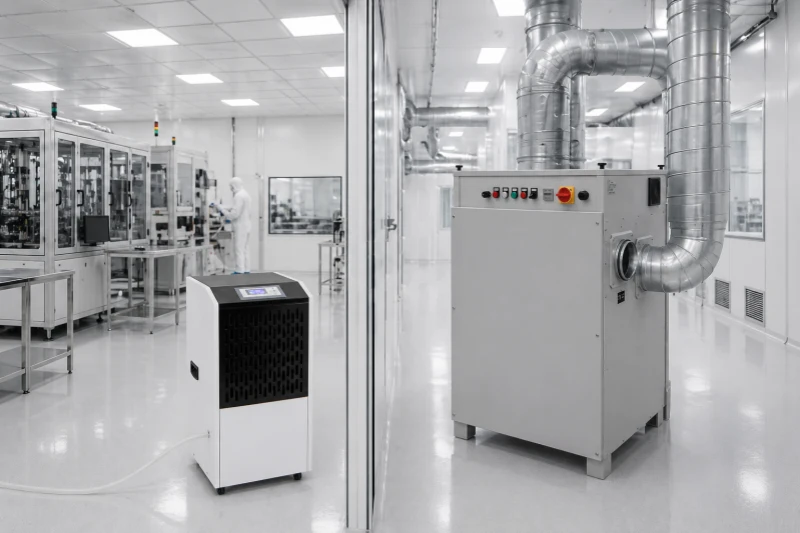
When a Refrigerant Dehumidifier Works
A refrigerant dehumidifier can be suitable when the cleanroom operates at normal temperature and does not need very low dew point control.
It may fit:
- General clean manufacturing areas
- Medical device packaging zones
- Some aseptic packaging rooms
- Controlled rooms with moderate RH targets
- Warm spaces where condensation removal is enough
The main limitation is that it may struggle when the project requires low RH, low-temperature operation, or deep drying.
When a Desiccant Dehumidifier Is Needed
A desiccant dehumidifier is often preferred when the room needs lower humidity than a refrigerant system can reliably maintain.
It is commonly used for:
- Lithium battery dry rooms
- Pharmaceutical powder handling
- Semiconductor and electronics areas
- Low-temperature cleanrooms
- High fresh air load projects
- Low dew point applications
For dry rooms, low-dew-point process areas, or projects below the practical range of refrigeration-based drying, buyers usually need custom desiccant dehumidifier systems rather than a standard portable unit.
The tradeoff is that desiccant systems need regeneration energy. That is why sizing, heat recovery, airflow design, and control strategy matter.
When a Hybrid System Makes Sense
A hybrid system combines pre-cooling and desiccant drying.
The logic is simple:
- Pre-cooling removes a large part of the moisture load.
- The desiccant rotor handles deeper drying.
- Reheat or post-cooling brings supply air to the required condition.
This approach can be useful in humid climates, cleanrooms with high outdoor air intake, and facilities that need stable low humidity without wasting energy.
| Project Need | Better Fit |
|---|---|
| 40–60% RH in a warm room | Refrigerant dehumidifier |
| RH below 35% | Desiccant dehumidifier |
| Low dew point control | Desiccant dehumidifier |
| High outdoor humidity and high fresh air load | Hybrid system |
| GMP records and alarms | Custom cleanroom dehumidifier |
| Central HVAC connection | In-duct or AHU / MAU integrated system |
Key Specifications for Cleanroom Dehumidifier Selection
A common selection mistake is comparing rated capacity without checking the actual entering air temperature, RH, fresh air load, and target dew point. A cleanroom dehumidifier should be selected by real operating conditions, not only by room area.
Where the project needs humidity control together with stable room temperature, temperature-resistant dehumidifiers may be considered as part of a wider cleanroom HVAC or laboratory control strategy.
Capacity at Design Conditions
A unit rated at a certain L/day or kg/h may not deliver the same capacity under your actual conditions. For cleanroom projects, capacity should be checked against:
- Entering air temperature
- Entering RH
- Outdoor design condition
- Target RH
- Target dew point
- Fresh air volume
- Process exhaust
- Door opening frequency
- Process moisture source
If a cleanroom has high fresh air intake, the outdoor air load may be more important than the room size.
Airflow, Static Pressure, and HVAC Interface
Cleanroom dehumidification is often an air-handling project.
The buyer should confirm:
- Process airflow
- Supply air volume
- Return air volume
- Fresh air percentage
- External static pressure
- Duct pressure loss
- AHU or MAU interface
- Installation location
- Service access
- Drainage or regeneration exhaust path
If the unit cannot move air through the duct system, the rated capacity on paper will not solve the room problem.
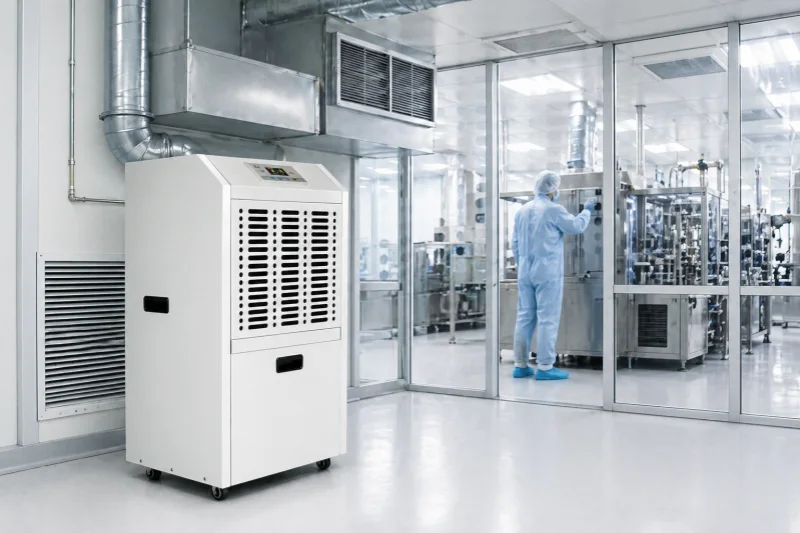
Control Accuracy, Sensors, and Data Records
Cleanroom buyers should ask how the system controls humidity during normal operation and after disturbance events, such as door opening, production exhaust, or outdoor weather changes.
Important points include:
- RH control accuracy
- Dew point stability
- Sensor location
- Sensor calibration
- Response time after door opening
- High humidity alarms
- Filter pressure alarms
- BMS or SCADA communication
- Data logging for QA review
- Alarm history and event records
For regulated pharmaceutical or medical projects, records and monitoring can matter as much as the equipment itself.
Cleanroom-Compatible Construction
A cleanroom-compatible dehumidifier should be easy to maintain without creating new contamination or cleaning problems.
Depending on the project, buyers may need:
- Powder-coated steel for general areas
- 304 or 316L stainless steel for GMP or corrosive environments
- Sealed panels
- Smooth surfaces
- Low-particle construction
- Corrosion-resistant coils or components
- Clean drainage design
- Filter access from the service side
- Remote monitoring
- Maintenance access outside the cleanroom where practical
The right construction depends on the process, cleaning method, installation location, and expected maintenance routine.
How to Size and Integrate a Cleanroom Dehumidifier With HVAC
Sizing and integration should be considered together.
A dehumidifier may have enough moisture removal capacity but still fail if it is placed in the wrong airflow path. It may also hold the supply air condition but fail to recover quickly after airlock traffic or production exhaust.
Standard methods used to size an industrial dehumidifier are only the starting point for cleanrooms. ACH, fresh air volume, pressure balance, and process moisture load can change the final capacity.
Cleanroom Sizing Inputs to Prepare
Before asking for a cleanroom dehumidifier quote, prepare these project details:
| Information Needed | Example |
|---|---|
| Room size | 500 m² cleanroom, 3 m ceiling height |
| Cleanroom level | ISO class or GMP grade |
| Target condition | 45% RH or specific dew point |
| Temperature range | 20–24°C or project-specific |
| ACH | Air changes per hour |
| Fresh air volume | m³/h of outdoor air |
| Return air volume | m³/h |
| Outdoor design condition | Summer temperature and RH |
| Door and airlock traffic | Low, medium, high |
| Process exhaust | Exhaust airflow and operating schedule |
| Moisture source | Washing, operators, materials, process air |
| Control system | Local PLC, BMS, SCADA |
A cleanroom dehumidifier should not be sized by floor area alone.
Floor area can be a starting point, but moisture load is driven by air volume, fresh air, exhaust, temperature, RH, door traffic, and process conditions.
Common HVAC Integration Methods
| Integration Method | Best For | Notes |
|---|---|---|
| Standalone unit | Small controlled rooms or retrofit spaces | Easy to install, but limited precision and integration |
| In-duct system | Existing HVAC upgrades | Needs airflow and static pressure matching |
| AHU / MAU integrated system | New cleanroom projects or high-precision rooms | Better for stable control, monitoring, and validation |
| Hybrid pre-cooling + desiccant | High fresh air load or low dew point projects | Helps balance energy use and deep drying |
Typical Air Treatment Sequence
A common cleanroom humidity control path may look like this:
- Outdoor air intake
- Pre-filter
- Pre-cooling coil
- Dehumidification section
- Reheat or post-cooling
- HEPA filtration
- Supply air to cleanroom
- Return air monitoring
In real projects, humidity control depends on the complete airflow path, not the dehumidifier alone.
Cleanroom Dehumidifier Applications by Industry
Different industries use cleanroom dehumidifiers for different reasons. The same system layout will not fit every cleanroom. The right configuration depends on process risk, moisture load, airflow path, and documentation needs.
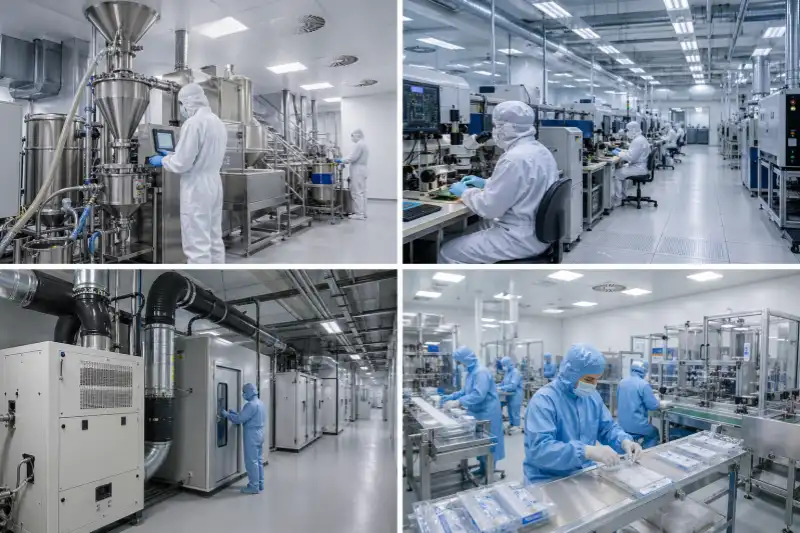
Pharmaceutical and Biotech Cleanrooms
Pharmaceutical cleanrooms often need stable humidity to support product quality and GMP records.
In tablet compression, capsule filling, powder transfer, or weighing rooms, excessive humidity can cause powder caking, poor flow, and inconsistent dosing. In sterile areas, humidity control must work with air filtration, airflow patterns, pressure control, monitoring, and cleaning procedures.
The FDA guidance on aseptic processing is a useful reference for sterile drug manufacturers working with cleanroom practices and CGMP expectations.
Cleanroom production areas should also be separated from pharmaceutical storage humidity control, because storage zones focus more on product holding, packaging stability, and warehouse monitoring rather than direct cleanroom process control.
Semiconductor and Electronics Cleanrooms
Semiconductor and electronics cleanrooms often need stable humidity to reduce ESD, corrosion, and process variation.
If the air becomes too dry, static risk can increase. If it becomes too humid, moisture can affect sensitive surfaces, metal parts, coating steps, or inspection stability.
The system should focus on narrow RH control, clean airflow integration, high-quality sensors, and connection to facility monitoring systems.
For broader production areas outside the cleanroom, humidity control in electronics manufacturing often focuses on stable RH around SMT, staging, storage, and packaging zones rather than pushing the whole plant as dry as possible.
Lithium Battery Dry Rooms
Lithium battery dry rooms are different from ordinary cleanrooms.
They often need low dew point rather than only moderate RH. The goal is to keep moisture content extremely low because battery materials can react with water vapor.
These projects often need multi-stage desiccant dehumidification, tight sealing, controlled airlocks, high fresh air moisture treatment, and strong monitoring.
For battery dry rooms, a standard dehumidifier is usually not enough.
Medical Device, Optical, and Aseptic Packaging Clean Zones
Medical device assembly, optical manufacturing, and aseptic food packaging often share similar humidity concerns.
Buyers may need to prevent damp packaging, condensation, unstable material behavior, surface defects, or hygiene risks.
In these areas, the cleanroom dehumidifier should support steady RH control, cleanable construction, airflow balance, and practical maintenance access.
For EU-regulated sterile manufacturing, EU GMP Annex 1 for sterile medicinal products is a relevant reference for cleanroom and contamination-control expectations in sterile medicinal product production.
Final Buyer Checklist Before Selecting a Cleanroom Dehumidifier
The lowest equipment price does not always create the lowest project cost.
In cleanrooms, the real cost includes energy use, filter replacement, maintenance access, calibration, downtime risk, rejected product, and possible compliance issues.
In 24/7 cleanroom operation, industrial dehumidifier power consumption depends on more than motor size. Target dew point, fresh air load, filtration resistance, regeneration heat, and control strategy all affect long-term cost.
Before comparing quotes, buyers should confirm these points:
| Buyer Question | Why It Matters |
|---|---|
| Can the supplier size the system based on design conditions? | Prevents wrong capacity selection |
| Can the unit meet target RH or dew point? | Confirms process fit |
| Does it match AHU / MAU airflow and static pressure? | Avoids integration failure |
| Can it support BMS or SCADA? | Helps monitoring and records |
| Are alarms and data logs available? | Supports QA review |
| Are FAT / SAT / IQ / OQ documents available if needed? | Helps regulated projects |
| Are 304 / 316L options available? | Supports GMP or corrosive environments |
| Is HEPA downstream compatibility considered? | Protects cleanroom air quality |
| Can voltage, airflow, duct interface, and layout be customized? | Fits real site constraints |
| Is there a spare parts and maintenance plan? | Reduces long-term downtime |
Common Buying Mistakes to Avoid
The most common mistakes are:
- Comparing only rated capacity
- Ignoring fresh air and outdoor design conditions
- Treating RH and dew point as the same
- Forgetting AHU or MAU integration
- Missing monitoring, alarm, or documentation needs
If the project is in a regulated or high-value production area, define the humidity target and integration method before comparing quotes.
FAQ
What humidity level should a cleanroom maintain?
There is no single humidity level for every cleanroom. The target depends on the product, process, cleanroom class, temperature, material sensitivity, and QA requirements. Low-humidity processes may need dew point-based control.
Does ISO 14644 specify cleanroom humidity levels?
No. ISO 14644-1 classifies cleanrooms by airborne particle concentration. RH or dew point targets usually come from the product, process risk, GMP requirements, or project URS.
Is a desiccant dehumidifier always better for cleanrooms?
No. A desiccant dehumidifier is usually better for low RH, low temperature, or low dew point projects. For moderate humidity control in warm spaces, a refrigerant or hybrid system may be more practical.
Can a portable industrial dehumidifier be used in a GMP cleanroom?
It is usually not recommended for critical GMP cleanrooms. Portable units may lack cleanroom-compatible materials, duct integration, stable control, alarm records, validation support, or BMS connection.
What is the difference between RH and dew point in cleanroom control?
RH changes with temperature. Dew point reflects the actual moisture content in the air more directly. For low-humidity manufacturing, such as lithium battery dry rooms, the dew point is often the better control parameter.
What information is needed to size a cleanroom dehumidifier?
Prepare the room size, target RH or dew point, temperature range, fresh air volume, ACH, exhaust volume, process moisture source, door traffic, and HVAC layout. These inputs help prevent capacity errors.
Choose the Cleanroom Dehumidifier Around Process Risk
A cleanroom dehumidifier should be selected around the process risk, not only the rated moisture removal capacity.
For controlled environments, the safest selection usually starts with process risk, target RH or dew point, fresh air load, HVAC layout, and documentation needs. These factors decide whether a refrigerant, desiccant, hybrid, or temperature-controlled system is the better fit.
For pharmaceutical, semiconductor, lithium battery, medical device, optical, and aseptic packaging projects, early parameter review can reduce redesign, energy waste, humidity excursions, and production risk.
For a new cleanroom or controlled environment project, prepare the room size, target RH or dew point, airflow, temperature range, fresh air volume, and industry requirements before requesting a project-level dehumidifier selection. These details help confirm the right capacity, HVAC integration method, and system configuration.