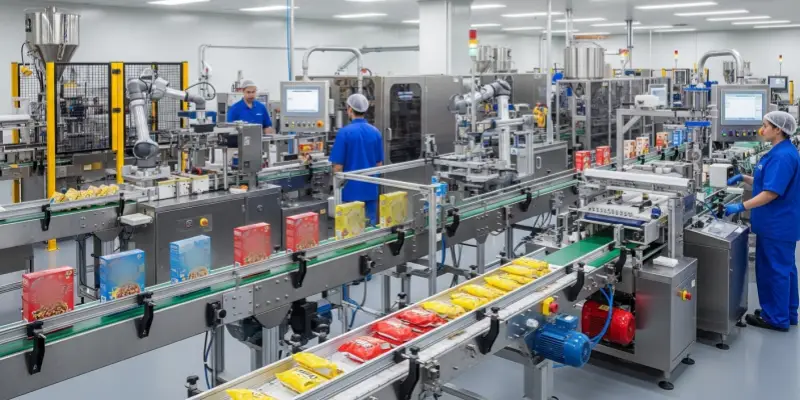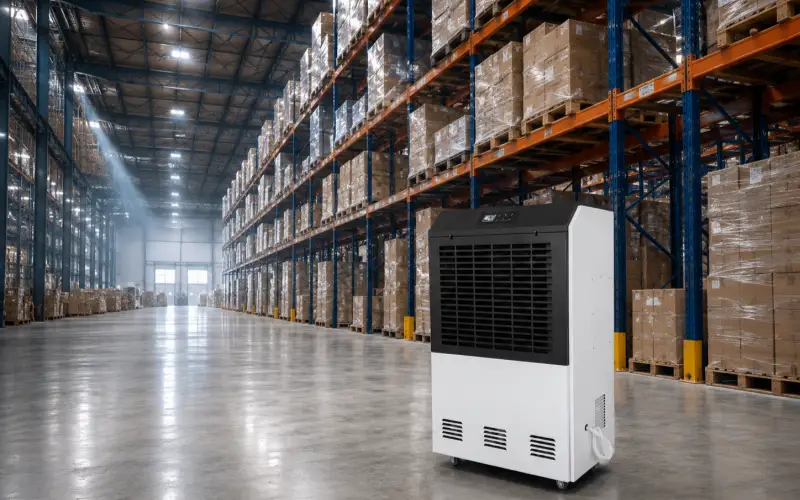
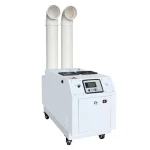
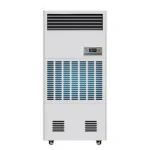
In printing plants and paper storage areas, humidity problems often show up through the paper first.
Sheets may curl, paper edges may become wavy, and stored stock may feel damp after a rainy weekend. On the production floor, static, double feeding, paper jams, slower drying, or unstable registration may appear before anyone notices a humidity issue in the room.
For a printing business, these problems affect more than comfort. They can increase paper waste, slow production, damage stored inventory, and create delivery delays.
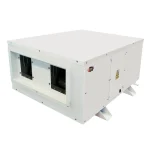
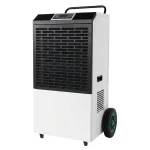
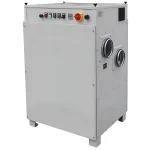
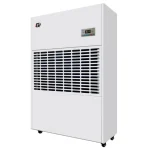
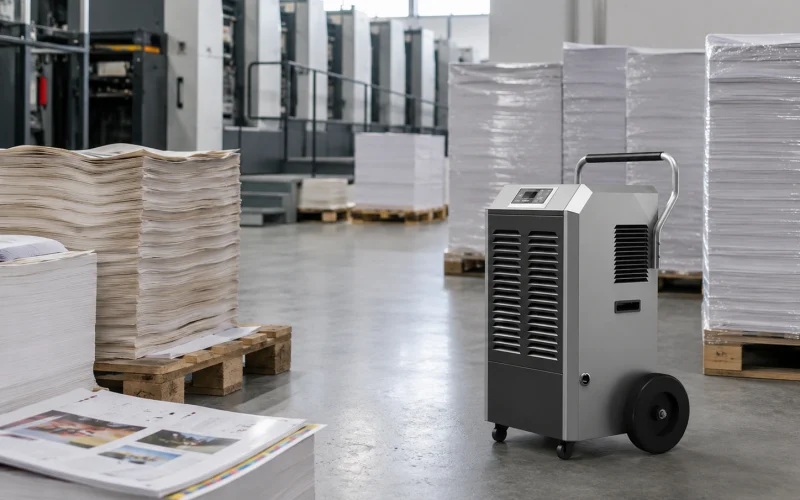
An industrial dehumidifier for printing and paper storage helps control relative humidity, reduce moisture fluctuation, and protect paper before, during, and after production. It is useful in pressrooms, paper warehouses, packaging plants, label printing workshops, and finished goods storage areas where moisture can affect paper condition and print stability.
Printing and paper facilities are part of the broader field of industrial dehumidifiers by application, but they need a narrower review than general storage spaces. Paper sensitivity, storage layout, pressroom airflow, production schedules, and RH stability all affect the final system choice.
Leading paper manufacturer Domtar recommends maintaining paper handling and storage areas between 35–55% RH to reduce problems caused by changing moisture levels.
Executive Summary: Fast Solutions for Printing Facilities
A printing plant or paper warehouse may need industrial dehumidification when paper edges become wavy, static causes double feeding, stored paper feels damp, RH changes after weekends, or HVAC cannot keep humidity stable.
For normal-temperature pressrooms and paper storage areas, a refrigerant dehumidifier is often the first option. For colder rooms, lower RH targets, or archive-like storage, a desiccant system may fit better.
The best setup depends on room volume, current RH, target RH, paper storage layout, loading-door frequency, airflow path, drainage, dust level, and operating schedule.
Why Paper Reacts Quickly to Humidity
Paper is not stable just because it looks dry.
Paper is made from fibers that absorb and release moisture from the surrounding air. When room humidity changes, paper tries to reach balance with the air around it. This is why paper stored in a damp warehouse, an open pallet area, or a poorly controlled pressroom can change shape before it reaches the printing machine.
Paper Absorbs and Releases Moisture
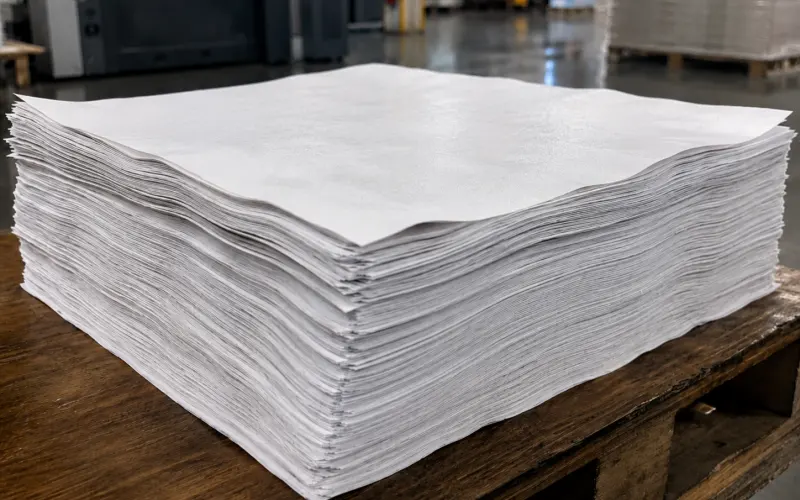
When relative humidity is high, paper absorbs moisture. It may become soft, swollen, wavy, or harder to feed.
When relative humidity is low, paper releases moisture. It may shrink, become brittle, and build static electricity.
The main risk is not only “too much humidity.” Humidity fluctuation can be harder to manage. Paper may absorb moisture during a humid weekend, then lose moisture when production restarts and HVAC dries the room. That repeated movement can create uneven paper moisture, edge deformation, and unstable sheet behavior.
Paper Edges Usually Change First
Paper edges often react faster than the center of the sheet, stack, or roll. This is why opened paper piles may show wavy edges, tight edges, or curl before the whole stock looks damaged.
PRINTING United Alliance explains that paper can become wavy and uneven when left uncovered in high humidity, which is why pressroom paper should stay protected until use.
A press operator may see the problem at the feeder, but the cause may come from storage, transport, open wrapping, or poor humidity control.
Common Humidity Problems in Printing and Paper Storage
Start with the visible symptom in the room, then connect it to paper condition and production impact.
| Humidity Condition | What Happens to Paper | Production or Storage Impact |
|---|---|---|
| High RH | Paper absorbs moisture and may wave or curl | Misfeeds, slow drying, mold risk, poor layflat |
| Low RH | Paper dries and static builds up | Double feeding, jams, dust attraction, brittle sheets |
| RH fluctuation | Paper expands or shrinks unevenly | Registration errors, color shift, waste |
| Poor storage control | Paper acclimates unevenly before use | Rejected stock before production |
| Weekend shutdown | RH rises or falls during non-production hours | Monday startup quality problems |
| Blocked airflow | Some paper zones stay damp | Local mold risk and uneven inventory condition |
High Humidity Problems
High humidity is common in rainy seasons, coastal regions, poorly ventilated paper warehouses, and areas near loading doors.
When paper absorbs moisture, it can become wavy, soft, or difficult to feed. Sheets may stick together. Cartons and corrugated board may lose stiffness. Stored paper may face mold risk if damp conditions continue.
In a pressroom, high RH can also affect drying behavior. Operators may see slow drying, set-off, smudging, or handling issues before the job is finished.
Low Humidity and Static Problems
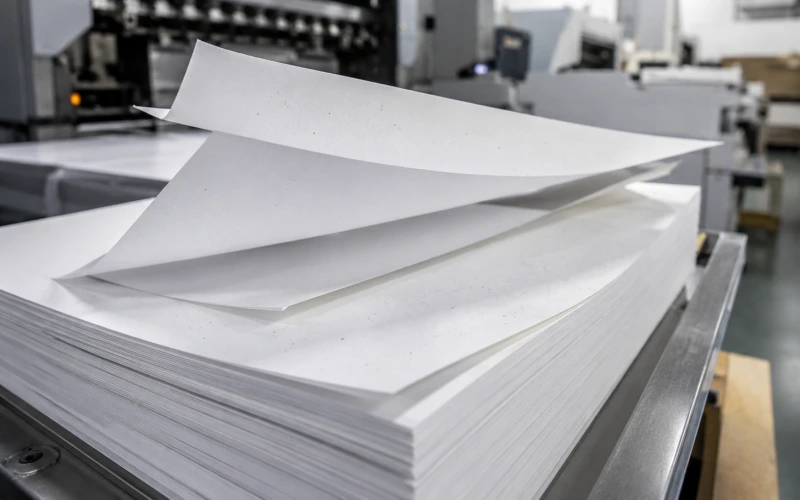
Low humidity is also a problem.
When air is too dry, paper may lose moisture and build static. Static makes sheets cling together, attract dust, and feed unevenly. This can create double feeding, jams, poor stacking, and more operator intervention.
PRINTING United Alliance notes that pressrooms and binderies should maintain 45–55% RH to reduce static buildup, especially where paper handling machines face double feeding and jams.
This issue is common in digital printing rooms, high-speed sheet handling areas, cutting zones, and winter production environments where heating reduces indoor RH.
RH Fluctuation Problems
A paper warehouse may look acceptable during daytime inspection, but RH may change heavily at night, during weekend shutdown, or after frequent loading door openings.
These changes matter because paper does not always respond evenly. The outer layers of a stack or roll may react first. The inner area may stay closer to its previous condition.
That difference can cause edge tension, curl, and unstable paper movement.
For printing manufacturers, the question is not only whether the room feels dry. The real goal is to keep RH stable around paper storage areas and production zones, so paper stays ready for printing.
Paper Warehouse vs. Pressroom: Different Control Goals
Paper storage and pressroom humidity control are related, but they are not the same job.
A paper warehouse protects inventory before production. A pressroom protects feeding, registration, drying, and uptime during production. A good system should consider both.
Paper Storage Areas: Keep Paper Ready for Printing
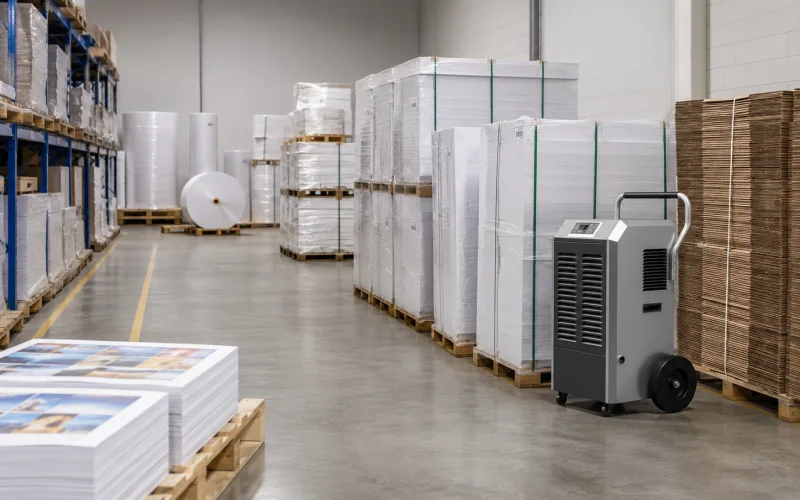
Paper rolls, sheets, cartons, corrugated board, and finished printed goods may stay in storage for days, weeks, or months.
The main risks are damp paper stock, wavy edges after opening, mold in long-term storage, softened cartons, warped corrugated board, unstable paper before production, and finished goods damage before shipping.
Paper storage shares some challenges with warehouse humidity control, but paper warehouses need closer attention to sheet flatness, moisture balance, wrapping condition, and print readiness.
The goal is to keep paper stable enough for printing, not just to keep the warehouse dry. RH control should reduce moisture fluctuation while keeping airflow steady around stored paper.
Pressrooms: Protect Feeding, Registration, and Uptime
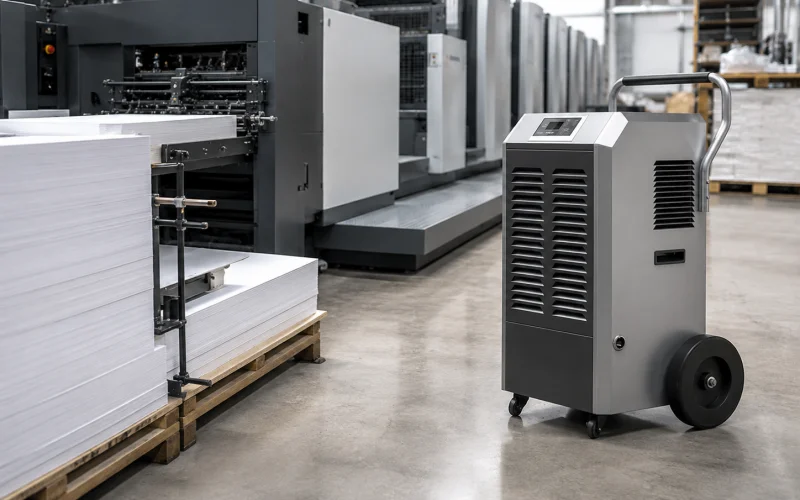
Pressrooms have different conditions.
Printing machines generate heat. Ventilation systems bring in fresh air. Doors open and close. Operators move materials. Paper may move quickly from stack to feeder to delivery.
Humidity control should support smooth feeding, lower static risk, better layflat, consistent registration, controlled drying, and fewer stops caused by jams or misfeeds.
In this space, the dehumidifier must work with the HVAC system, airflow path, room layout, and production schedule.
Paper Acclimation Before Printing
Paper should not always be opened immediately after transport or storage.
If cold paper is moved into a warmer pressroom and opened too soon, moisture may condense on the paper surface. That can create local dampness before printing starts.
Large paper batches, winter transport, cold storage, and cross-region shipping all increase this risk.
A simple rule helps: keep paper wrapped until it is ready to acclimate, and allow enough time for temperature and humidity balance before production.
RH Range and Control Focus by Printing Area
There is no single RH setting that fits every printing plant.
A paper warehouse, offset pressroom, digital printing room, packaging area, and archive storage room may need different control ranges. The table below gives practical planning references, not universal rules.
| Area | Practical RH Reference | Main Humidity Risk | Control Focus |
|---|---|---|---|
| General paper storage | 40–55% RH | Deformation, mold risk, moisture imbalance | Keep paper stable before production |
| Offset printing area | 45–55% RH | Registration shifts, slow drying, set-off risk | Maintain stable RH near paper staging and press areas |
| Digital printing area | 35–50% RH | Static, double feeding, fuser-related curl | Avoid overly dry air and maintain steady RH |
| Label printing | 40–55% RH | Flatness, adhesive behavior, die-cutting stability | Control RH around coated stock and label materials |
| Packaging / corrugated storage | 45–60% RH | Carton softening, warping, blocked airflow | Keep air moving around pallets and stored board |
| Finished printed goods storage | 40–55% RH | Post-production moisture absorption | Protect goods before packing and delivery |
| Archive or document storage | 30–50% RH | Mold risk or brittle paper | Maintain stable long-term RH with low fluctuation |
The correct setting depends on paper grade, printing method, ink or toner system, storage time, local climate, HVAC design, door activity, and quality requirements.
For archive-like storage, the Smithsonian Institution Archives recommends 30–50% RH for paper-based collections, while also warning that high RH can encourage mold and low RH can make paper brittle.
A dehumidifier for packaging factory or paper storage use should be planned by zone, especially when paper stock, gluing, coating, carton storage, and finished goods staging share the same building.
When an Industrial Dehumidifier Becomes Necessary
A printing facility may need industrial dehumidification when paper problems continue after basic storage and HVAC adjustments.
| What You See | What It Usually Means | What to Check Next |
|---|---|---|
| Paper edges become wavy after opening | Paper is absorbing moisture unevenly | Check paper storage RH and wrapping condition |
| Paper stock feels damp or soft | Storage RH may be too high | Check warehouse RH and airflow around pallets |
| Frequent double feeding | Low RH and static may be involved | Check pressroom RH and static-prone zones |
| Printed sheets curl or fail to lay flat | Paper moisture may be uneven | Check acclimation time and staging conditions |
| Registration changes by season | Paper dimensions may be shifting | Check RH stability around press and paper staging areas |
| Paper near loading doors performs worse | Outdoor air is affecting storage zones | Check door activity and airflow pattern |
| HVAC cannot hold RH stable | AC may not handle the moisture load well | Review dehumidification capacity and operation schedule |
| RH changes after weekend shutdown | Non-production hours may be creating moisture swings | Check night/weekend RH records if available |
A small commercial dehumidifier may help in a limited storage room, but it is usually not enough for a large paper warehouse or busy printing facility.
Industrial spaces need more than water removal. They need enough airflow, continuous drainage, filter access, stable controls, and installation flexibility.
A facility with frequent loading, dense paper storage, high ceilings, or strict RH control should first consider how to choose an industrial dehumidifier based on temperature, target RH, installation style, drainage, and real moisture load.
Refrigerant or Desiccant Dehumidifier: Which Fits Better?
The right dehumidifier type depends on room temperature, target RH, dew point needs, operating hours, and energy cost.
| Factor | Refrigerant Dehumidifier | Desiccant Dehumidifier |
|---|---|---|
| Best for | Normal-temperature print shops and paper warehouses | Low-temperature storage, low RH targets, archive-like spaces |
| Typical condition | Warmer spaces, moderate RH target | Cooler spaces, lower RH or dew point control |
| Energy profile | Often more economical in warm, humid conditions | Higher energy use due to regeneration heat |
| Risk point | Coil icing in low temperature | Higher initial cost and more technical setup |
| Printing / paper use | Standard pressrooms, paper stockrooms, packaging warehouses | Unheated storage, special paper, archives, low dew point needs |
When Refrigerant Works Better
A refrigerant dehumidifier is often a practical choice for normal-temperature print shops, paper warehouses, and packaging storage areas.
It is usually suitable when the room is warm enough for stable coil operation, the target RH is moderate, the facility mainly needs seasonal moisture removal, and energy efficiency in warm, humid conditions matters.
This type is common for standard paper storage and pressroom humidity control.
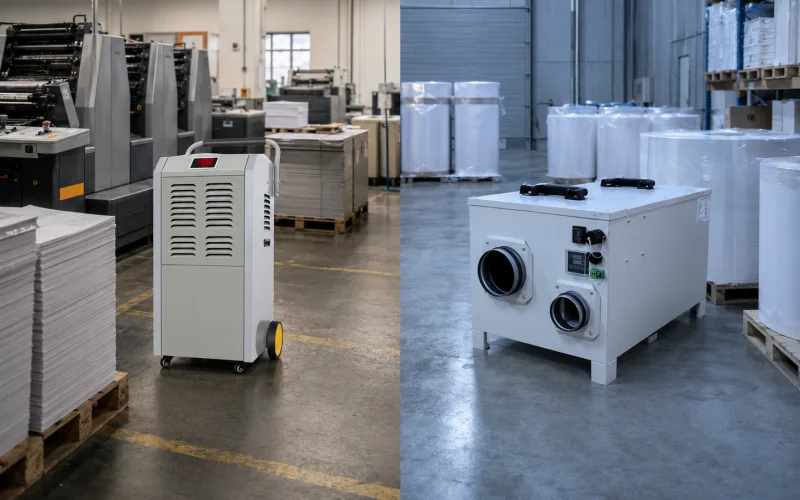
When Desiccant Works Better
A desiccant dehumidifier may be a better fit when the space is cooler or the RH target is lower.
It may be used for low-temperature paper storage, unheated warehouses, archive-like rooms, special paper storage, low dew point requirements, or rooms where refrigerant coil icing is a concern.
Desiccant systems often cost more to buy and operate, but they can give better stability in low-temperature or low-RH applications.
Quick Decision Table
Use the room condition as the starting point.
| Facility Condition | Better Starting Point |
|---|---|
| Warm pressroom, moderate RH target | Refrigerant dehumidifier |
| General paper warehouse, normal temperature | Refrigerant dehumidifier |
| Cold or unheated paper storage | Desiccant dehumidifier |
| Archive or lower RH target | Desiccant dehumidifier |
| Large warehouse with blocked airflow | Ducted system or multiple units |
| High dust printing area | Strong filtration and easy maintenance access |
Temperature, target RH, energy cost, and installation layout usually decide whether a refrigerant vs desiccant dehumidifier setup makes more sense for a printing or paper storage facility.
Size and Layout the System Around Paper Zones
Sizing is one of the most common failure points in industrial humidity control.
Do not choose the system by floor area only. Two facilities may both be 1,000 m², but they may need very different equipment. One may be a sealed paper warehouse with low traffic. Another may be a packaging plant with loading doors, machine heat, wet outdoor air, and dense paper pallets.
The better question is:
How much moisture enters this space, and how evenly can dry air reach the paper zones?
If the room has high ceilings, frequent dock-door opening, dense paper pallets, or several damp zones, buyers should evaluate what size industrial dehumidifier you need based on moisture load and airflow, not floor area alone.
Key Engineering Variables for Accurate Sizing
| Sizing Variable | What to Check |
|---|---|
| Room volume | Floor area plus ceiling height |
| Current RH and target RH | How far the system must reduce moisture |
| Room temperature | Affects refrigerant or desiccant selection |
| Outdoor air condition | Humid climate increases moisture load |
| Door opening frequency | Loading docks add moisture quickly |
| Paper stock volume | Large paper mass reacts slowly and stores moisture |
| Pallet or rack layout | Dense storage blocks airflow |
| HVAC fresh air volume | Fresh air may bring in latent load |
| Production schedule | Night and weekend shutdowns may change RH |
| Drainage conditions | Continuous drainage prevents overflow risk |
Airflow and Ducting Layout
In paper warehouses, airflow matters as much as capacity.
Paper pallets, tall racks, and dense storage can block return air and create damp zones. A dehumidifier placed in a corner may lower RH near the machine but fail to control the paper area.
For larger facilities, consider multiple units, ducted supply and return air, high-airflow units, multi-zone RH monitoring, proper sensor placement, and clear air channels between pallets and racks.
Match the Setup to Your Facility Type
| Facility Type | Better Setup Direction | What to Check |
|---|---|---|
| Small paper storage room | Compact unit with automatic RH control | Drainage, filter access, seasonal RH changes |
| Medium printing plant | Higher-airflow industrial unit | Production schedule, paper dust, drainage route |
| Packaging workshop | Zone-based humidity control | Paper stock, cartons, glue/coating areas |
| Large paper warehouse | Ducted or multiple-unit system | Pallet layout, airflow zones, monitoring points |
| Low-temperature storage | Desiccant system | Temperature, lower RH target, energy cost |
| Archive-like room | Stable low-fluctuation control | RH records, mold risk, paper preservation needs |
For large paper roll storage or carton-heavy warehouses, an industrial dehumidifier for warehouse may be a practical starting point when the project requires high airflow, continuous operation, automatic RH control, and drainage planning.
Operating hours, moisture load, airflow design, and defrost frequency all affect industrial dehumidifier electricity use, so energy cost should be checked after the RH target and room conditions are clear.
What Rinwang Engineers Usually Check Before Sizing
Before recommending a model, engineers need to confirm the site conditions that affect moisture load and airflow.
For printing and paper facilities, the most useful project details include:
| Project Detail | Why It Matters |
|---|---|
| Room size and ceiling height | Defines air volume |
| Current RH and target RH | Shows how much moisture control is needed |
| Minimum and normal room temperature | Helps choose refrigerant or desiccant technology |
| Paper storage layout | Shows where airflow may be blocked |
| Loading-door frequency | Affects outdoor moisture load |
| Paper stock volume | Shows how much material may absorb or release moisture |
| Drainage path | Helps prevent tank overflow or water damage near paper |
| Dust level | Affects filter access and maintenance frequency |
| Ink mist or solvent exposure | May require coil protection or material review |
| Need for ducted airflow | Helps avoid damp zones behind pallets or racks |
For paper-dust rooms or solvent-heavy printing areas, filter access, cabinet material, coil protection, and drain design should be checked before quotation.
Installation, Drainage, and Maintenance Checks
A good dehumidifier can underperform if it is placed, drained, or maintained poorly.
Printing and paper environments are harsher than many normal warehouses because paper dust, ink mist, pallets, and machine zones all affect operation.
Placement and Airflow Tips
Use these checks before installation:
- Do not block return air with pallets, racks, or paper rolls.
- Avoid direct dry airflow onto opened paper stacks.
- Place sensors where paper is stored, not only near the unit.
- Watch unstable door zones during rainy seasons.
- Leave airflow channels between pallets.
- Consider ducting or multiple units for large rooms.
A dehumidifier should not only dry the air near itself. It should support the paper storage and production zones.
Drainage, Filter, and Corrosion Checks
Industrial paper facilities should avoid manual tank emptying. Continuous drainage, gravity drain lines, or condensate pumps are usually better for long operating hours. Drain routes should stay away from paper pallets, cartons, and finished goods.
Paper dust and dirt may also enter drain pans and pipes. Check the drain pan, hose, pump, slope, and nearby floor drain regularly, especially when paper dust or ink mist is present.
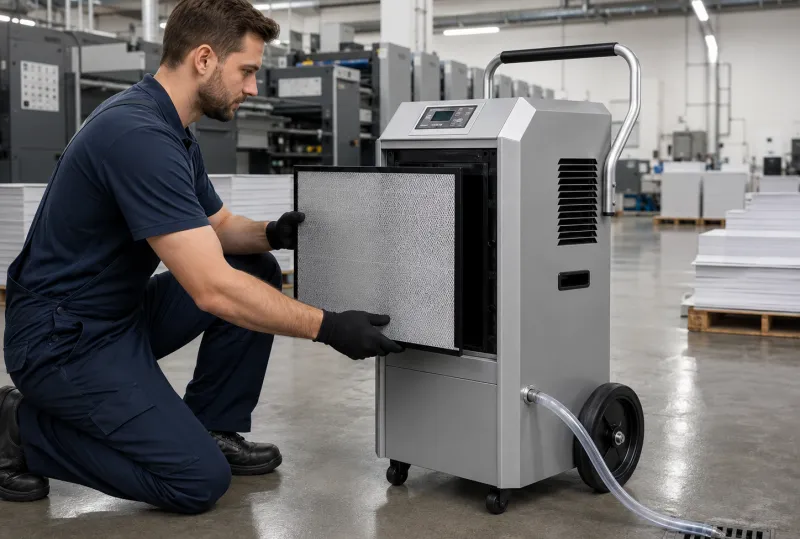
In paper-dust environments, teams may need to clean an industrial dehumidifier filter more often because clogged filters reduce airflow, slow moisture removal, and increase coil icing risk.
Some printing environments may also contain ink mist, solvent vapors, coating chemicals, or cleaning agent fumes. For solvent-heavy printing, coating, or packaging lines, material selection should be confirmed before choosing the cabinet, coil protection, and filter configuration.
Common Mistakes to Avoid
| Mistake | Why It Causes Problems |
|---|---|
| Controlling only the pressroom | Paper may already be unstable before production |
| Opening wrapped paper too early after cold transport | Condensation or uneven acclimation may occur |
| Blowing dry air directly onto opened paper stacks | Local moisture imbalance may increase curl |
| Ignoring paper dust when planning filter access | Airflow and moisture removal may decline |
| Choosing by floor area only | Moisture load and airflow path may be misjudged |
Buyer Checklist Before Selecting a Dehumidifier
Use this checklist before asking for a quotation. It helps the supplier judge capacity, airflow, drainage, and configuration more accurately.
| Buyer Question | Why It Matters |
|---|---|
| What RH range does the paper or process need? | Prevents over-drying or under-control |
| Is the room warm, cool, or unheated? | Guides refrigerant vs desiccant selection |
| How often do loading doors open? | Defines outdoor moisture load |
| Is paper stored in dense pallets or racks? | Affects airflow layout |
| Does the room have paper dust or ink mist? | Affects filter and material selection |
| Can the system drain continuously? | Prevents tank overflow and water damage |
| Does RH change during weekends? | May require continuous operation |
| Is one unit enough? | Large rooms may need ducting or multiple units |
FAQ
What humidity level is best for a printing room?
Most printing rooms use a stable mid-range RH, often around 40–55%. The right setting depends on paper grade, printing method, equipment, drying behavior, and static risk.
Should paper storage and pressroom areas use the same RH setting?
Not always. Paper storage focuses on keeping stock stable before production, while pressrooms focus on feeding, registration, drying, and static control. Some facilities may need separate monitoring or zone-based control.
Can humidity control reduce paper waste in printing plants?
It can help reduce waste linked to moisture imbalance, curl, static, damp storage, and poor feeding. It will not remove every print defect, but stable RH can make paper behavior more predictable.
Does low humidity cause static in printing?
Yes. Low RH can increase static because dry air does not dissipate electrical charge well. Static may cause double feeding, poor stacking, paper jams, dust attraction, and unstable sheet movement.
Can a regular commercial dehumidifier work in a paper warehouse?
A small commercial unit may help in a limited room. Large paper warehouses usually need industrial airflow, continuous drainage, larger capacity, and stable control based on room volume, door activity, and paper stock volume.
Is refrigerant or desiccant dehumidification better for paper storage?
Refrigerant systems are often suitable for normal-temperature paper warehouses and print shops. Desiccant systems may fit low-temperature storage, lower RH targets, or archive-like spaces.
Stable Humidity Protects Paper, Print Quality, and Production Flow
For printing and paper storage, humidity control is not only about making the air feel dry.
It affects paper condition, print stability, inventory value, machine uptime, and delivery reliability. A good solution should consider target RH, room temperature, paper stock volume, airflow path, drainage, filtration, and maintenance needs.
A standard room unit may help a small stockroom, but printing plants, packaging facilities, and paper warehouses often need an industrial system planned around real moisture load and facility layout.
Share your room size, paper storage layout, current RH, target RH, room temperature, and loading-door frequency with Rinwang. The team can help review whether your printing plant or paper warehouse needs a refrigerant unit, desiccant system, ducted layout, or multi-unit setup.