Indoor pool
Hotel
Museum
Pharmaceutical
Water damage
B2B installations across regions
From concept design to mass production
Per industrial unit custom configurable
Fully certified for international compliance
These failure modes appear across every industry we serve. If your claims team is loggingany of the below, the root cause is almost always uncontrolled humidity.
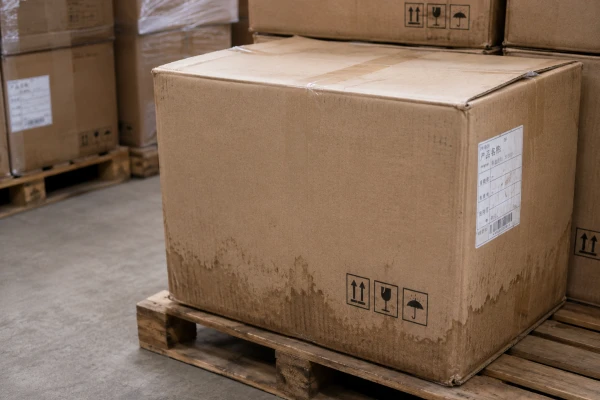
Corrugated cartons absorb moisture progressively over weeks, losing stacking strength before any visible damage appears. Sizing must account for cumulative moisture load, not peak humidity events, so your shipments arrive with full stacking strength and no claims.
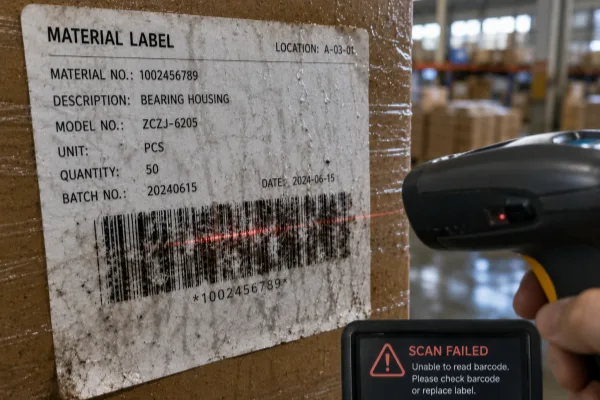
Adhesive labels lose tack and thermal prints smear when surface RH crosses critical thresholds — usually 65%+ for sustained periods. We specify dew-point-based control for high-volume dispatch zones, so dispatch scanning works on the first pass, every time.
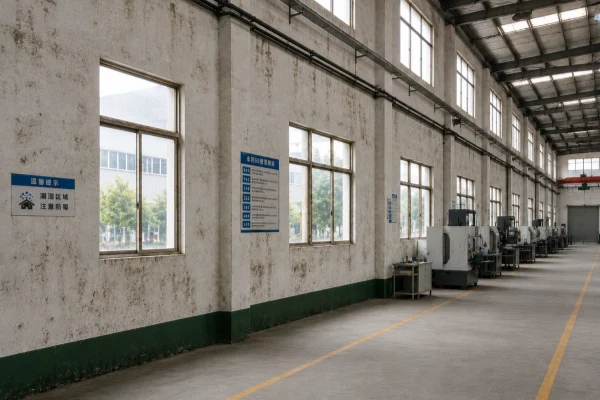
Mold colonies establish in zones where RH stays above 70% for over 48 hours. The fix is uniform air distribution, not just overall capacity — which is why our sizing accounts for dead-zone risk, so your facility passes audits without surprise mildew findings.
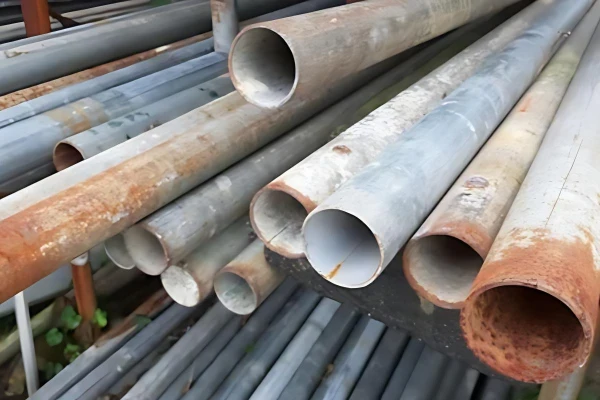
Bare ferrous parts oxidize within weeks above 60% RH, especially in coastal and tropical climates. We typically pair our industrial range with VCI packaging recommendations for long-term storage clients, so your steel and hardware ship without warranty deductions.
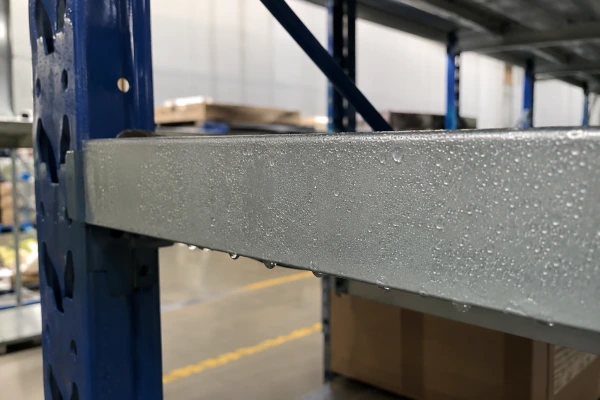
Cold steel surfaces hit dew point faster than ambient air, creating localized condensation even when overall RH seems acceptable. We address this by sizing for surface temperature differentials, not just room averages, so your inventory stays dry even in zones where general RH meters read fine.
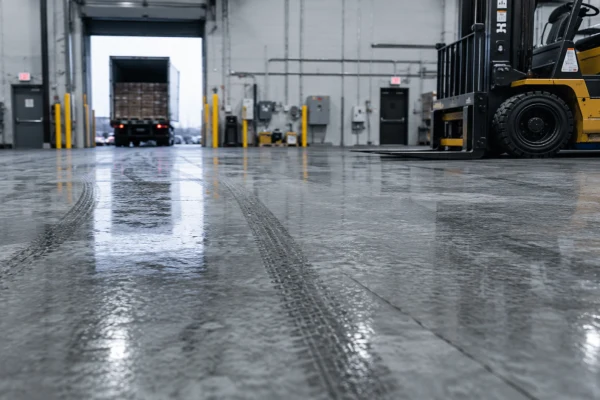
Condensate pooling near dock doors creates forklift safety risks and OSHA exposure. Strategic dehumidifier placement near loading zones is part of our standard layout recommendation, so your forklift operations stay safe and OSHA-compliant.
Setpoints, equipment class and installation logic change with what you store. Below are theranges we design to most often, based on field data across 50+ markets.
Microbial growth, mold, and premature spoilage all accelerate above 60% RH — and HACCP, FDA, and BRC compliance all require documented humidity control. Most food warehouses target 45–60% RH to balance microbial suppression with packaging integrity (corrugated cartons collapse below 35% RH from over-drying). We typically specify continuous-drainage industrial units with stainless drain trays for food-zone deployments.
Hygroscopic agricultural commodities absorb ambient moisture rapidly, risking mold, mycotoxins, and flavor degradation. Coffee and tea: 50–60% RH preserves aroma, dry weight, and cupping value. Tobacco: 55–65% RH maintains leaf pliability without fungal growth. Mountain or remote-region warehouses often need voltage-stabilized dehumidifiers to handle unstable grid supply — a configuration we've delivered in coffee-growing regions.
GMP and WHO-GDP compliance mandate documented temperature and humidity logs, usually with continuous data integration. Active pharmaceutical ingredients (APIs) degrade or clump in humid conditions, and ambient warehouses targeting 45–75% RH still need precision control to 50–60% for API stability. We support BMS / Modbus integration and audit-trail-ready data logging — specified for GDP-compliant regional distribution centers in our deployment library.
Moisture triggers oxidation on PCB pads, leads, and connector pins, while ESD risk increases sharply below 30% RH — making the balance critical. General electronics storage typically targets 30–60% RH. Sealed dry-storage rooms for moisture-sensitive devices (MSDs) often require precision control to ±5% RH. Our industrial range supports PLC-integrated humidity setpoint logging for IPC/JEDEC-compliant storage — deployed in component warehouses across Southeast Asia electronics hubs
Iron, steel, and alloy parts corrode rapidly above 60% RH, especially in coastal and tropical climates. Industry standard for ferrous parts storage is 50% ±20% RH — practically a 30–50% target during humid seasons. Anti-corrosion coatings extend protection but cannot substitute for environmental control. We typically combine continuous dehumidification with VCI packaging recommendations for high-value tooling and precision parts.
Hygroscopic materials expand and contract with humidity shifts, causing dimensional instability and quality issues. Paper warehouses: 45–60% RH prevents warping and archival degradation. Textiles: mold and mildew above 65% RH causes staining and fiber breakdown. Leather: 45–55% RH prevents both mold growth and desiccation cracking. We specify uniform airflow distribution to eliminate dead-zone risk for stacked storage.
Low temperatures can cause ice formation on standard evaporator coils, requiring anti-frost dehumidifier design with electric heating defrost. Condensation from cold surfaces and frequent door openings often creates continuous moisture loads that standard refrigerant units struggle to manage below 15°C. Our low-temperature models operate reliably from 2°C with built-in heating defrost, helping reduce ice buildup on floors, racks, and equipment — proven in cold-chain warehouses and freeze-adjacent staging areas
See low-temperature range →Middle East, Southeast Asia, and African warehouses face year-round heat and humidity challenges. High-temperature environments reduce standard refrigeration efficiency and place extra stress on motors, coils, and electrical systems. High-temperature dehumidifiers with reinforced copper tubing and high-airflow fans maintain performance in demanding conditions — with active deployments in UAE, Saudi Arabia, and tropical Southeast Asia warehouse environments
See high-temperature range →Sizing is never just volume x coefficient. The inputs below are the same dataset ourengineers will ask for when scoping your project.
Example: 300 m² × 30% gap = 900 L/day baseline.
Example: 3,000 m³ = 1,500 L/day baseline.
Within 24 hours, our engineering team returns:
For most warehouse projects, industrial refrigerant dehumidifiers are the primaryrecommendation. Sub-scenarios below cover temperature extremes and installationconstraints.
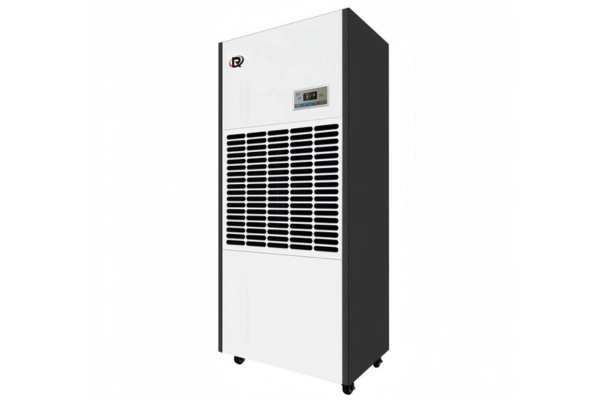
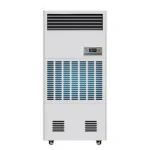
168–2400 L/day capacity, 2–60°C operating range, 24/7 continuous drainage with auto defrost.
Warehouse < 500 m², single-zone storage, lower 24/7 demand, or staging/buffer rooms requiring lower noise.
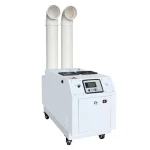
60–158 L/day · Compact footprint · Built-in pump drain · Hygrostat control
Learn more →Ambient temperature regularly exceeds 35°C — common in Middle East, sub-Saharan Africa, and tropical SE Asia warehouses.
5–60°C operation · Reinforced copper tubing · Hydrophilic fins · Sustained 45–60°C performance
Learn more →Cold-storage or freezer-adjacent zones operating between 2–15°C where standard units would ice over.
2–35°C operation · Electric hot-gas defrost · Anti-frost evaporator · Stainless steel drain tray
Learn more →High-density storage, low-clearance ceilings, or aesthetics-sensitive zones (showroom-attached warehouses, retail backstock).
Zero floor footprint · Top-mounted airflow · Discreet installation · Suitable for laminar flow areas
Learn more →Client requested 25–30% RH — well below typical 50–60% coffee storage range — to suppress fungal risk during off-season storage. We confirmed the target was correct for green coffee preservation, not over-specified.
Volume × moisture-load coefficient: 600 m³ × 2.0 = 1,200 L/day baseline. Hygroscopic cargo multiplier (+40%) → 1,680 L/day. Aggressive RH target multiplier (additional +20%) → ~2,000 L/day.
Specified 3 × low-temperature refrigerant units operating in parallel — providing capacity headroom and redundancy. Single larger unit rejected due to grid power instability and field serviceability.
Paired each unit with external voltage stabilizer (AVR) to survive under-voltage events. Specified continuous-drainage pump configuration to handle high condensate load without operator intervention.
Proposal demonstrated a complete assessment flow — scope, sizing, environmental risk, electrical risk — that we apply to every warehouse RFQ. This is how we evaluate, not just what we sell.
No middlemen, no markup layers. ISO-certified manufacturing for OEM/ODM orders means you can validate quality on a sample order before scaling to container volumes — a procurement reality most B2B factories ignore with high MOQ requirements.
Our units operate in warehouses across Asia, Middle East, Europe, Africa, and the Americas. We've handled 110V/220V/380V configurations, single-phase generator setups, tropical-climate field issues, and cold-chain installation challenges. Your local conditions are probably already in our deployment library.
Voltage / phase / frequency adjustments. Custom plugs and cable configurations for regional codes. High-corrosion coatings for salt-air and chemical environments. Modbus / Wi-Fi / BMS integration. Branded touch panels and packaging. We modify what your project needs — not just sticker placement.
Continuous-run defrost cycles tested for 24/7 duty. Scale-resistant drainage for hard-water environments. Branded compressors (Panasonic / Copeland) rated for industrial duty cycles. Proven performance in 45–60°C Middle East deployments and sub-5°C cold-chain installations. Standard warranty: 1 year unit / 3 years compressor.
Manufacturing
Compliance
Industry Experience
Custom Solutions
We size by warehouse volume, moisture sensitivity, loading frequency, target RH gap, and climate conditions, not only floor area. Experience in 35+ countries helps calibrate each project. Complex warehouses may need extra data for detailed modeling.
The right RH depends on stored goods. Food, paper, textiles, and pharmaceuticals often need 45–60% RH. Metals may need 30–50% RH, while electronics often require 30–60% RH. We help confirm the suitable range.
A 1,000 m² warehouse with 6 m height may need 1–2 industrial units around 960–1920 L/day. Final quantity depends on height, loading frequency, target RH, climate, and airflow layout.
Industrial models are built for large warehouses, 24/7 operation, heavy-duty use, BMS integration, and multi-unit control. Commercial models suit smaller warehouses, buffer rooms, staging areas, and flexible temporary humidity control.
Stock models usually take 2–15 days ex-factory. OEM orders usually take 15–30 days. Container projects may take 25–40 days. FOB, CIF, and DDP shipping terms are available for global orders.
Please provide warehouse size, current RH, target RH, stored goods, temperature range, loading frequency, voltage, phase, destination port, and order quantity. A floor plan helps us recommend model, quantity, lead time, and freight.
+86-571-8805-3366
+86-153-0581-0157
Zhengtai Road, Chongwen Street, Weifang, Shandong, China
Business Hours
Monday - Friday: 9:00 AM - 6:00 PM (CST)
24/7 Emergency Support Available
Response Guarantee
✓ Engineers respond within 24 hours
✓ No spam, no sales calls
✓ NDA signed on request
✓ Free of charge, no commitment
By submitting this form, you agree to receive communications from RW Machine. We respect your privacy and will never share your information.
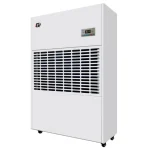
168–2400 L/day. Primary recommendation for large warehouse projects.
View Range →Your information will be kept strictly confidential.
Our team would be happy to meet you and learn all about your business, requirements and expectations.