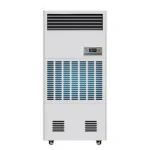
When industrial buyers evaluate dehumidification equipment, electricity use is often one of the first cost questions after capacity. A unit may look suitable from a performance standpoint, but its real value also depends on how much power it will consume in day-to-day operation. There is no single fixed answer.
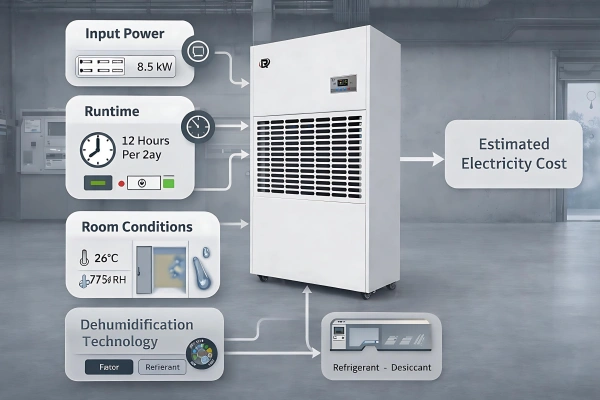
An industrial dehumidifier does not use a standard amount of electricity across all projects. Actual power use depends on four things working together: input power, runtime, room conditions, and dehumidification technology. That is why two projects of similar size can end up with very different monthly electricity costs.
This guide shows how industrial buyers can evaluate power consumption, estimate running costs, and compare system options more realistically.
Why Running Cost Matters as Much as Purchase Price
When buyers compare industrial dehumidifiers, purchase price is only part of the decision. Electricity cost can have a direct impact on the total cost of using the equipment over time. A lower-priced unit may look attractive at the quotation stage, but it may become the more expensive option later if it runs for too many hours, struggles to maintain the target humidity, or is not well matched to the actual application.
Electricity use should be considered together with capacity, operating conditions, and humidity requirements. The more useful question is not only how much power the unit uses, but whether that power use is reasonable for the humidity control result it delivers.
kW vs kWh: How to Read Industrial Dehumidifier Power Use Correctly
Before estimating cost, it helps to separate power draw from energy use.
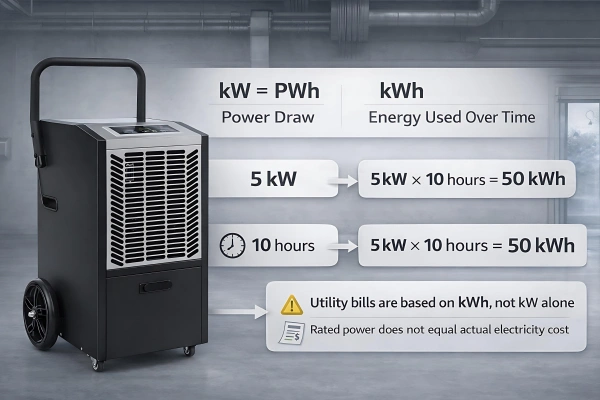
A kilowatt (kW) measures how much electrical power the equipment draws while operating. A kilowatt-hour (kWh) measures how much electricity it actually uses over time. Utilities bill electricity use in kWh, not in kW alone. So if an industrial dehumidifier draws 5 kW and runs for 10 hours, the estimated energy use is:
5 kW × 10 hours = 50 kWh
What matters more in practice is this: rated power is not the same as actual electricity cost.
The published input power is only a starting point. It does not tell you how long the machine will run each day, how often it will cycle, or how hard the room conditions will make it work. In real projects, the system may run harder during pull-down, cycle less after stabilization, or stay active much longer if outside moisture keeps entering the space. The table below shows the difference more clearly:
| Term | What it means | Why it matters |
|---|---|---|
| kW | Instant power draw | Helps estimate operating load |
| kWh | Electricity used over time | Determines actual power cost |
| Rated power | Published input value | Good for comparison, not final cost |
| Runtime | Hours the unit operates | Strongly affects total electricity use |
What Can Make the Same Dehumidifier Use More Power in One Project Than Another?
Industrial dehumidifier electricity use depends on project conditions, not just on the machine itself.
Temperature and humidity conditions matter because they affect how much moisture must be removed from the air and how efficiently the system can do that. Runtime matters because a unit with moderate power draw can still create a high monthly bill if it operates for long hours every day. Moisture load matters because the equipment is often dealing with ongoing humidity entering through doors, leakage points, goods movement, fresh-air intake, or production activity. ASHRAE notes that infiltration, indoor storage, and process moisture are common reasons industrial spaces need dedicated dehumidification rather than normal comfort cooling alone.
Sizing and maintenance condition matter too. A smaller unit may look cheaper on paper, but it may not lower operating cost if it has to stay near full load for too many hours. That is also why industrial dehumidifier size should be judged by moisture load, not floor area alone. Dirty filters, reduced airflow, or poor maintenance can also make the equipment consume more energy to achieve the same result.
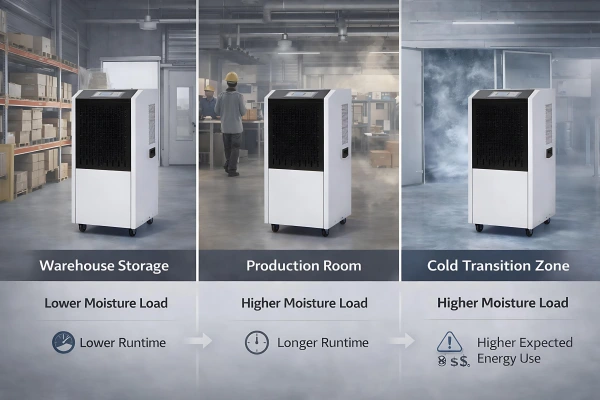
If you compare warehouse storage, production rooms, and cold transition zones side by side, the difference in moisture load becomes much easier to see, which is why an industrial dehumidifier guide by application is a useful reference when evaluating expected runtime and electricity cost.
In other words, nameplate power alone does not tell you what the monthly electricity cost will look like in a real facility.
A Simple Way to Estimate Industrial Dehumidifier Electricity Cost
For early budgeting, the most useful method is usually the simplest one.
Basic formula
Energy use (kWh) = Power draw (kW) × Runtime (hours)
Then: Electricity cost = kWh × Local electricity rate
This is not a full engineering model, but it gives buyers a practical first estimate.
Example
Assume an industrial dehumidifier has a running power draw of 4.5 kW.
If it runs 12 hours per day at $0.12/kWh:
- Daily electricity use: 54 kWh
- Daily running cost: $6.48
- Monthly estimate: $194.40
If the same unit runs 18 hours per day because of heavier infiltration:
- Daily electricity use: 81 kWh
- Daily running cost: $9.72
- Monthly estimate: $291.60
The same unit can produce very different electricity costs under different operating conditions. To make rough budgeting easier, you can use the calculator below as a quick starting point.
Dehumidifier Running Cost Calculator
This kind of estimate is useful for a first budget check, but the actual running cost still depends on project conditions. In warehouse projects, electricity cost often changes most when door opening, outside air infiltration, and stock protection requirements increase the runtime, so buyers comparing this type of application may want to review a more specific industrial dehumidifier for warehouse solution page.
Cost comparison also depends on the type of dehumidification technology being considered, especially when buyers are deciding between refrigerant and desiccant systems.
Which Type Uses More Electricity: Refrigerant or Desiccant?
In general, desiccant dehumidifiers usually use more electricity than refrigerant dehumidifiers. That is because desiccant systems often require additional energy to regenerate the desiccant wheel, while refrigerant systems usually operate more efficiently in warm and humid environments. However, that does not mean refrigerant is always the better choice. ASHRAE notes that conventional coil-based dehumidification has a practical lower limit, and when lower humidity is required for process applications, desiccant dehumidification is needed.
The better comparison is not just which type uses less electricity, but which type can hold the required humidity under your actual operating conditions.
Refrigerant dehumidifiers are usually the better fit when:
- Warm and humid conditions
- Moderate humidity targets rather than very low humidity
- Warehouses, general storage areas, packaging rooms, or standard production spaces
- Lower running costs in conventional industrial conditions are a priority
Desiccant dehumidifiers are usually the better fit when:
- Low-temperature operation is required
- The project requires lower humidity or a lower dew point
- The environment includes cold storage transition zones or low-humidity process rooms
- holding a stable condition matters more than choosing the lowest power draw on paper
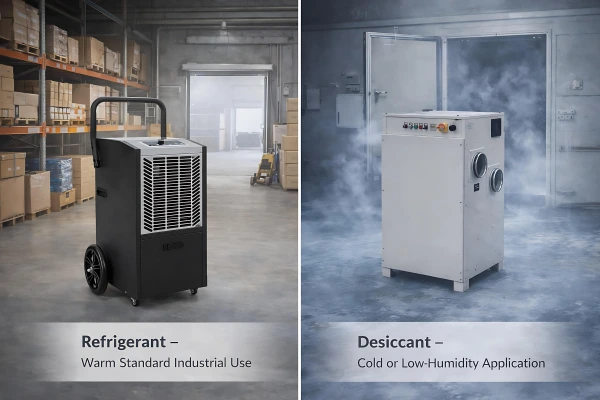
In many standard industrial environments, refrigerant systems are often the more energy-efficient and lower-cost option. But in low-temperature or low-dew-point projects, a desiccant system may still be the better investment because it is more capable of holding the required condition. In those cases, higher power use may still lead to better overall project value.
In chilled spaces, cold-chain storage, or near-freezing environments, a low-temperature dehumidifier designed to keep working at around 2°C may be a more realistic basis for comparison than a standard unit rated only for moderate room conditions. Likewise, if the project requires stronger low-humidity performance, a desiccant dehumidifier system built for low-temperature and low-dew-point performance may be more suitable than choosing only by lower nameplate power.
| Type | Usually uses more electricity? | Best fit conditions |
|---|---|---|
| Refrigerant dehumidifier | Usually lower | Warm, humid, standard industrial environments |
| Desiccant dehumidifier | Usually higher | Low-temperature or low-dew-point applications |
How to Lower Running Costs Without Sacrificing Humidity Control
Lower running costs do not come from simply choosing a smaller unit or cutting operating hours. In industrial projects, the better approach is to reduce unnecessary runtime while keeping humidity stable.
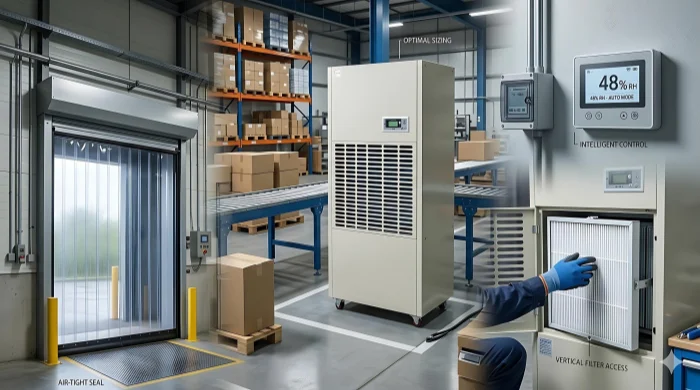
1. Choose a unit that can reach the target humidity without running nonstop
A unit that is too small may need to run almost nonstop and still struggle to hold the target humidity. That usually increases electricity cost instead of lowering it. Buyers should focus on whether the unit matches the actual room condition and humidity demand, rather than assuming a smaller model will automatically be cheaper to run. For a broader step-by-step explanation, this guide on how to choose an industrial dehumidifier is a useful next reference.
2. Use proper humidity controls
A humidistat or control system helps the unit run only when the room actually needs dehumidification. This reduces unnecessary runtime and helps keep humidity more stable.
3. Reduce moisture entering the space
Frequent door opening, poor sealing, and uncontrolled outside air can all increase runtime. Reducing infiltration often lowers electricity costs more effectively than focusing on wattage alone.
4. Keep the system clean and operating efficiently
Dirty filters, blocked airflow, and poor maintenance can raise power use without improving results. Regular maintenance helps the unit remove moisture more efficiently.
In most projects, lower running costs come from reducing unnecessary runtime, not from simply choosing a smaller unit.
The same industrial dehumidifier can produce very different electricity costs in different projects. The key question is not only how much power the unit draws, but whether it can maintain the required humidity at a reasonable running cost.
FAQ
How much does it cost to run a dehumidifier?
Running cost depends on wattage, runtime, and local electricity price. Multiply kW × hours × electricity rate to estimate daily or monthly cost.
Are Energy Star dehumidifiers worth it?
They often are for long-running applications. More efficient models usually use less electricity for the same moisture removal, which can lower operating cost over time.
What is the most energy efficient dehumidifier?
The most efficient units remove more moisture per kWh, not simply the ones with the lowest wattage. Efficiency should be judged by moisture removal performance under rated conditions.
How can I make my dehumidifier more efficient?
Use a realistic humidity setting, reduce air leaks, clean filters regularly, and avoid oversizing or undersizing. Runtime control and maintenance both affect real electricity use.
What uses more electricity AC or dehumidifier?
In many cases, air conditioners use more power than dehumidifiers. But the better choice depends on whether the main problem is humidity control or full temperature cooling.