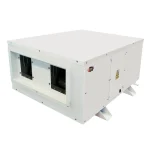
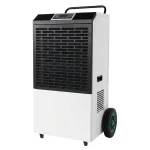
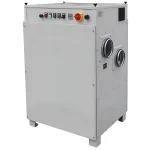
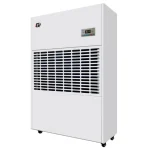
Textile and fabric storage is not the same as storing general warehouse goods. Cotton, wool, silk, yarn, fabric rolls, and finished garments can absorb or release moisture as the surrounding air changes. When RH stays too high, warehouses may face mold, musty odor, damp packaging, and rejected shipments. When RH drops too low, synthetic fabrics may build up static, while some natural fibers may become brittle.
For textile warehouses, humidity control is not only about keeping the air dry. It is about protecting inventory value, reducing avoidable returns, and keeping fabric quality stable before cutting, sewing, packing, or shipping.
Textile storage is one of the more moisture-sensitive cases among broader industrial dehumidifier applications because the stored material itself reacts to RH changes.
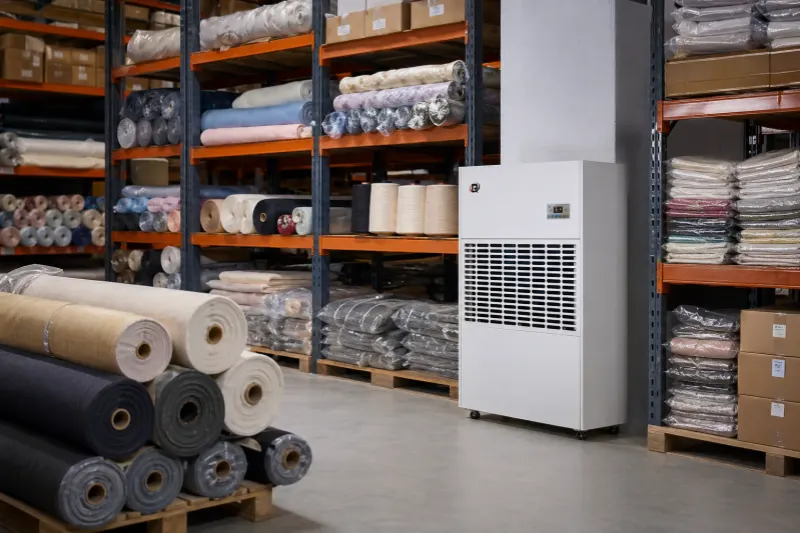
Why Textile Storage Needs Stable Humidity
Fabric Reacts to Humidity Changes
Stored fabric does not stay unchanged when warehouse humidity rises or falls.
Cotton, wool, silk, and linen can absorb moisture from the air. When the air becomes dry, they release moisture again. This movement can affect fabric feel, size stability, odor, and handling.
Synthetic fabrics such as polyester and nylon absorb less moisture, but dry air can increase static and dust attraction.
The Smithsonian Museum Conservation Institute explains that natural textile fibers are hygroscopic, so they absorb moisture quickly and dry slowly. This is why textile storage areas need stable RH, not just occasional dehumidification.
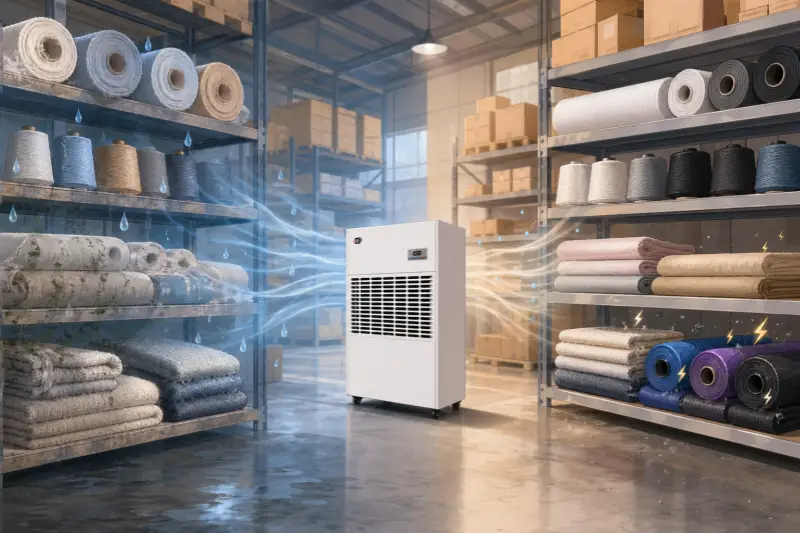
Textile Storage Is More Sensitive Than General Warehouse Storage
General warehouse humidity control often focuses on floors, cartons, pallets, labels, and corrosion.
Textile storage adds material-related risks because the stored goods react to RH changes. Fabric rolls, sealed cartons, dyed materials, light-colored textiles, garment accessories, and textile lint all affect how the humidity-control system should be selected and operated.
If cartons, labels, dock doors, and wet floors are the main concern, the problem is closer to general warehouse humidity control. In textile storage, the fabric itself also needs to be part of the humidity-control decision.
What Can Go Wrong in a Fabric Warehouse?
High RH: Mold, Odor, Yellowing, and Dye Migration
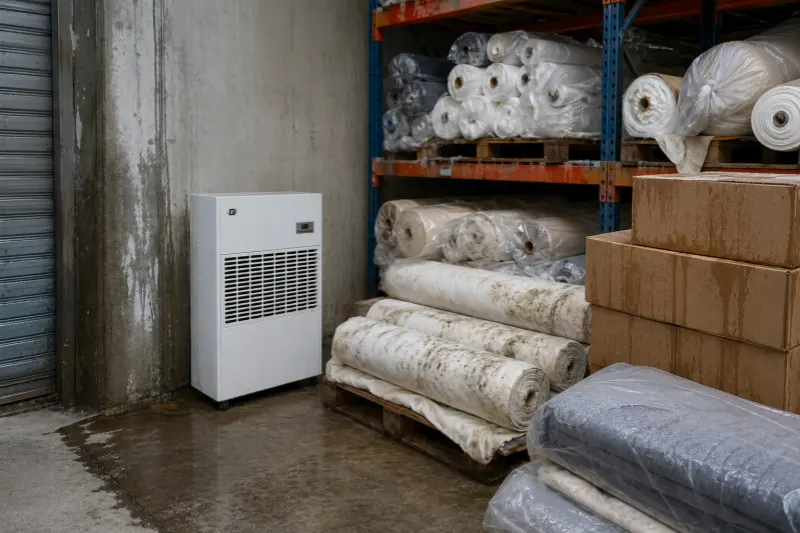
High RH often shows up first in hidden or poorly ventilated areas.
Common risk zones include:
- Corners
- Exterior walls
- Loading doors
- Ground-level pallets
- Tightly packed fabric rolls
- Sealed cartons
- Poorly ventilated shelves
The first sign may be damp packaging or a musty smell. If the condition continues, the fabric may develop mold spots, discoloration, or stale odor that is difficult to remove.
The Canadian Conservation Institute notes that mould growth on textiles can cause staining, weakening, or even destruction of fibers. Once mold appears on stored fabric, the buyer may reject the carton, request rework, or downgrade the shipment.
Damp Packaging and Metal Accessory Damage
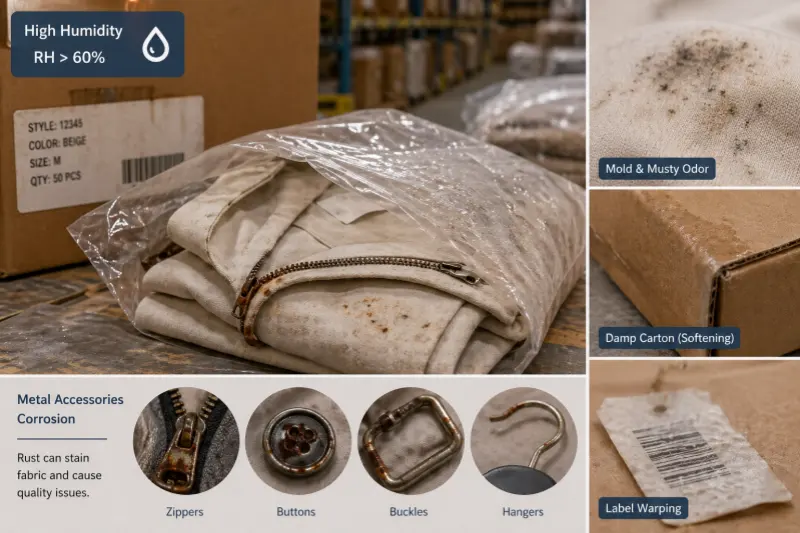
Textile warehouses often store more than raw fabric.
Finished garments may include zippers, buttons, metal buckles, hangers, printed labels, cartons, plastic bags, and paper tags.
When humidity remains high, metal accessories can rust. Rust can stain nearby fabric and may be difficult to remove. Cartons may soften. Labels may warp. Damp packaging can create problems when goods arrive at the buyer’s warehouse.
The Canadian Conservation Institute’s textile environment guidance notes that high RH allows mould to grow on textiles and can accelerate corrosion of associated metal elements such as buttons, hooks, eyelets, and zippers.
In export garment storage, private-label apparel, home textiles, and seasonal stock, damp packaging or rust-stained accessories can delay inspection and create avoidable claims.
Low RH: Static, Dust Attraction, and Brittle Fibers
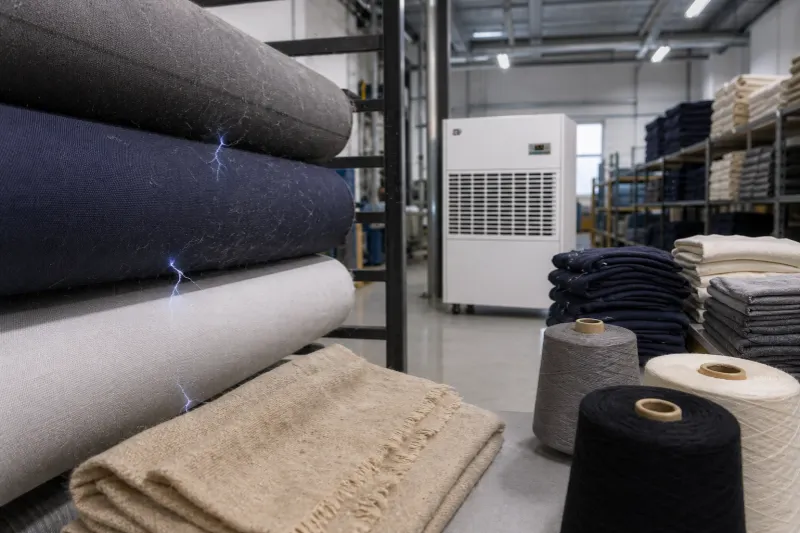
Textile storage should not be too dry either.
When RH falls too low, some natural fibers may become brittle. Synthetic fabrics such as polyester and nylon may develop static electricity. Static can attract dust, lint, and small particles, creating handling and cleanliness problems.
A warehouse that is too dry may solve one problem while creating another. For synthetic fabrics, low RH can mean more static and dust attraction. For some natural fibers, it can make handling more fragile.
The target is stable humidity, not maximum dryness.
What Relative Humidity Is Best for Textile Storage?
A Practical RH Range for Most Fabric Storage Rooms
For most textile and fabric storage rooms, a practical target is usually around 45%–60% RH.
This range helps reduce mold risk while avoiding overly dry conditions that may increase static or fiber stress.
The exact setting should depend on:
- Fabric type
- Storage duration
- Packaging method
- Warehouse temperature
- Local climate
- Door opening frequency
- Customer quality requirements
The U.S. EPA states that moisture control is key to mold control and recommends keeping indoor RH below 60% where possible. Although this guidance is written for general indoor environments, the moisture-control principle is useful when planning fabric storage conditions.
Suggested RH and Temperature by Fabric Type
| Storage Material or Scenario | Suggested RH | Suggested Temperature | Main Risk to Control |
|---|---|---|---|
| Cotton and cotton blends | 50–60% RH | 18–25°C | Mold, odor, yellowing |
| Linen and plant fibers | 50–60% RH | 18–25°C | Mildew, stiffness |
| Wool fabric | 45–60% RH | 15–22°C | Odor, pest risk |
| Silk and delicate fabrics | 45–55% RH | 18–22°C | Yellowing, deformation |
| Polyester and nylon | 40–60% RH | 18–25°C | Static, dust attraction |
| Finished garments | 45–60% RH | 18–24°C | Odor, packaging damage |
| Fabric roll warehouse | 45–60% RH | 18–25°C | Internal moisture, uneven RH |
These ranges are practical starting points, not fixed rules. A humid coastal warehouse, a dry inland warehouse, and a high-value silk storage room may need different settings even when the target range looks similar.
Why Textile Testing RH Is Not Always Storage RH
Some textile testing and conditioning environments use around 65% RH. That does not mean 65% RH is always the best long-term storage target.
Testing conditions and storage conditions serve different purposes.
The ISO 139 standard atmospheres for conditioning and testing textiles are designed for textile testing consistency. Long-term storage should be set based on fabric type, mold risk, packaging conditions, warehouse temperature, and inventory value.
Why Standard Dehumidifiers Are Not Enough for Textile Warehouses
Capacity, Continuous Drainage, and 24/7 Operation Matter
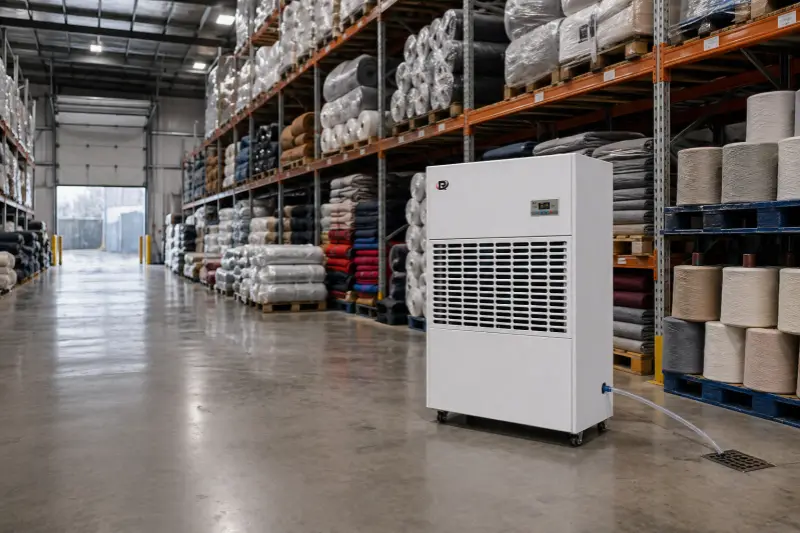
A small dehumidifier may work in a small office or storeroom. It is not designed for a large textile warehouse.
Textile warehouses often have a higher moisture load because of:
- Large room volume
- High ceilings
- Frequent door opening
- Outdoor humid air infiltration
- Wet or semi-conditioned goods entering storage
- Dense fabric rolls
- Seasonal humidity peaks
A unit that is too small may run all day but still fail to bring the RH down to the target range.
The key question is not:
“Can the machine remove water?”
The better question is:
“Can the system maintain the target RH across the full storage area during the most humid season?”
This is where industrial dehumidifier basics matter: capacity, continuous drainage, airflow, controls, and duty cycle all affect whether the system can protect a full textile storage area.
Dense Fabric Storage Blocks Airflow
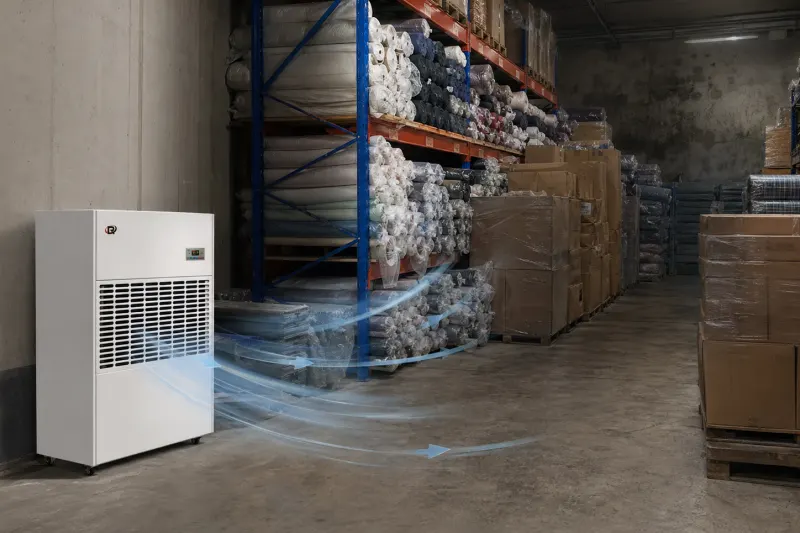
Fabric rolls, cartons, pallets, and racks can block air movement.
This creates uneven humidity:
- The aisle may feel dry.
- The machine area may show normal RH.
- The back of the rack may still stay damp.
- Ground-level pallets may hold moisture longer.
- Wall-side storage may face condensation risk.
For large textile warehouses, airflow design is as important as machine capacity. A larger machine alone may not solve the problem if dry air cannot reach the storage zones.
Textile Lint Makes Filtration More Demanding
Textile storage areas often contain lint, fly, and fiber dust.
These particles can block filters, coils, and air passages. When airflow drops, the machine removes less moisture and uses more energy.
In lint-heavy textile storage areas, restricted airflow can mean slower moisture removal, longer runtime, and more frequent service work.
Textile storage buyers should look for:
- Easy-access filters
- Sufficient filter area
- Coil protection
- Simple cleaning design
- Maintenance space around the unit
- Clear filter cleaning schedule
How to Choose an Industrial Dehumidifier for Textile Storage
Start with Warehouse Volume and Target RH
Do not choose a dehumidifier only by floor area.
A textile warehouse should be evaluated by:
- Room length, width, and height
- Target RH
- Current RH
- Temperature
- Outdoor climate
- Door opening frequency
- Storage density
- Fabric type
- Air leakage
- Ventilation rate
- Drainage conditions
A 500 m² warehouse with a low ceiling and sealed doors is not the same as a 500 m² warehouse with high ceilings, loading bays, and dense fabric rolls.
Textile-specific checks should be combined with the broader process of how to choose an industrial dehumidifier, including room volume, moisture load, drainage, controls, and service access. When the warehouse volume, target RH, and door traffic are clear, the next step is to calculate what size industrial dehumidifier you need for the actual moisture load.
Check Fabric Type and Storage Density
Fabric type affects the humidity-control strategy.
For example:
- Cotton and linen need mold and odor prevention.
- Wool needs stable storage and pest-risk management.
- Silk and delicate fabrics need tighter RH control.
- Synthetic fabrics need static and dust control.
- Finished garments need packaging and accessory protection.
- Fabric rolls need airflow around and between stored goods.
Storage density also matters. If fabric rolls are tightly packed against walls or stacked without airflow gaps, some zones may remain humid even when the dehumidifier is running.
Estimate Door-Zone and Climate Moisture Load
Loading doors are one of the biggest humidity challenges.
Each opening can bring humid outdoor air into the warehouse. This is more serious in:
- Coastal regions
- Rainy seasons
- Monsoon climates
- Hot and humid areas
- Warehouses with frequent truck loading
- Buildings with weak sealing
If the door zone stays unstable, buyers may need larger capacity, better zoning, air curtains, improved sealing, or local monitoring near the loading area.
Choose Refrigerant, Desiccant, or Ducted Setup
For most normal-temperature textile warehouses, refrigerant dehumidifiers are often the practical option.
They are commonly used in:
- Fabric roll storage
- Garment warehouses
- Apparel distribution centers
- Packaging rooms
- General textile storage areas
A desiccant dehumidifier may be better when the project needs:
- Low-temperature operation
- Lower dew point
- Stricter RH control
- Wool or sensitive material storage
- Stable performance in colder spaces
Low-temperature fabric rooms should be checked with a refrigerant vs desiccant dehumidifier comparison before the buyer decides on equipment type.
Some textile warehouses need more than a single portable unit. A ducted or engineered system may be suitable when racks are dense, zones are separated, loading doors open often, or RH must be documented.
Recommended Setup by Storage Scenario
| Storage Scenario | Recommended Setup | Buyer Focus |
|---|---|---|
| Small fabric storeroom | Portable industrial refrigerant dehumidifier | Continuous drainage, stable RH |
| Medium garment warehouse | High-capacity refrigerant unit | Airflow, odor control, packaging protection |
| Large fabric roll warehouse | Multi-unit or ducted system | Zoning, airflow balance, sensor placement |
| Wool or low-temperature storage | Desiccant or low-temperature unit | Low-temperature operation |
| High-lint textile area | Strong filtration and easy-clean design | Filter cleaning, coil protection |
| Export garment storage | RH monitoring, alarm, and records | Inspection and shipment stability |
| Sensitive silk or high-value fabric | Tight RH control system | Smaller RH fluctuation |
Where to Place the Dehumidifier in a Textile Warehouse
Keep Airflow Paths Open
The best location is not always the nearest wall or the easiest corner.
A dehumidifier should be placed where air can move freely through the storage area.
Avoid placing the unit:
- Behind fabric rolls
- Directly against a wall
- Inside a blocked corner
- Behind dense cartons
- Near dust-heavy operations without filtration planning
- Where the outlet air blows only into one narrow area
The inlet and outlet need enough space. The unit also needs maintenance clearance for filter cleaning, coil inspection, and drainage checks.
Use Multi-Zone Placement for Large Warehouses
Large textile warehouses often have uneven humidity.
One zone may be close to the loading door. Another may be near an exterior wall. A third may be packed with dense fabric rolls.
In this case, one large unit may not solve the problem. Multi-zone placement can help keep RH more stable across the warehouse.
For bigger projects, buyers can consider:
- Multiple units
- Ducted supply air
- Return air planning
- Local sensors
- Separate monitoring for high-risk zones
For larger fabric roll warehouses, a warehouse-grade industrial dehumidifier may be more suitable than a small portable unit because airflow coverage and continuous operation matter.
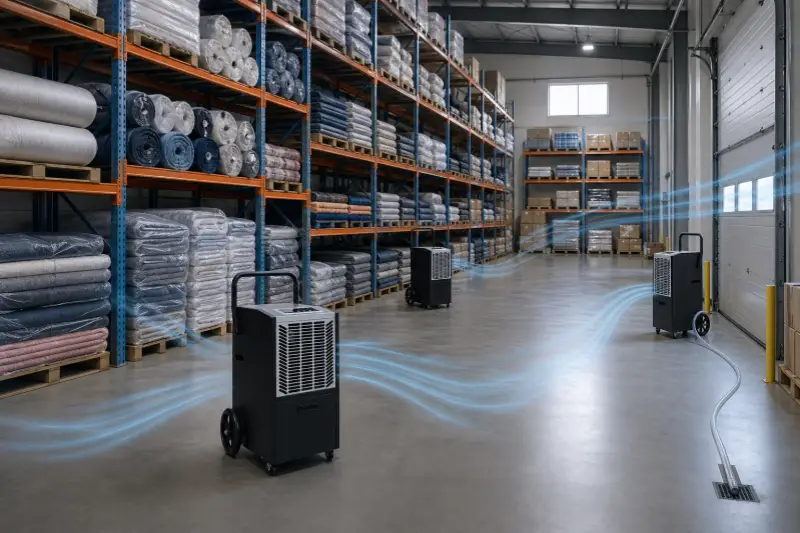
Keep Fabric Away from Walls and Floors
Walls and floors are common moisture-risk areas.
Fabric rolls should not sit directly against exterior walls or damp floors. Pallets and racks should allow air movement around stored goods.
Practical steps include:
- Keep gaps between racks and walls.
- Avoid direct floor contact.
- Raise goods on pallets.
- Leave airflow paths between fabric roll rows.
- Check wall-side storage more often during rainy seasons.
Plan Drainage Before Operation
Drainage should be planned before the dehumidifier is installed.
Check:
- Is there a nearby floor drain?
- Can the drain pipe slope downward?
- Is there a risk of backflow?
- Can the drain line be cleaned?
- Is leakage detection needed?
- Will maintenance staff check the water tray?
If drainage fails during rainy seasons, the unit may stop or leak water while the warehouse RH rises again.
How Much Does a Textile Storage Dehumidifier Cost to Run?
Main Running Cost Factors
Running cost depends on more than machine wattage.
Key factors include:
- Dehumidifier capacity
- Power input
- Daily running hours
- Local electricity rate
- Target RH
- Outdoor humidity
- Door opening frequency
- Warehouse sealing
- Filter cleanliness
- Sensor accuracy
- Control method
A machine may use more power if the filter is blocked, the warehouse leaks humid air, or the target RH is set lower than necessary.
For textile storage buyers, electricity cost should be checked together with runtime, humidity load, and how much electricity an industrial dehumidifier uses under real operating conditions.
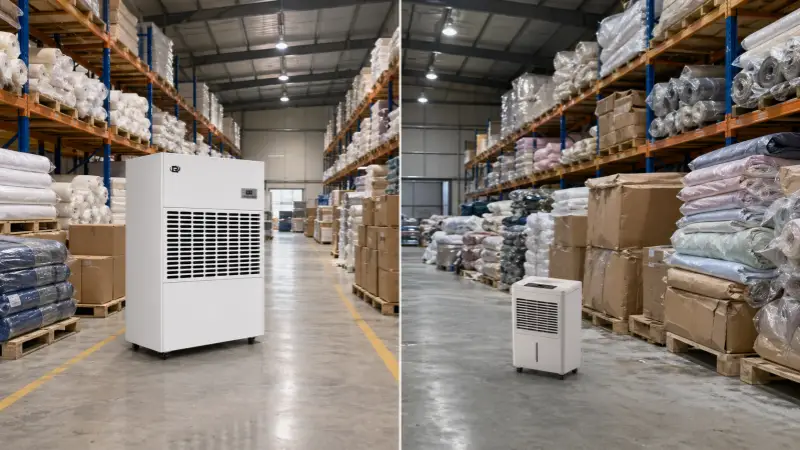
Purchase Price vs Inventory Risk
A low-cost machine can become expensive if it cannot maintain RH.
Possible hidden costs include:
- Longer running time
- Higher electricity use
- More filter cleaning
- More downtime
- Poor humidity stability
- Mold-related rework
- Rejected goods
- Customer claims
For textile buyers, the better question is not only:
“How much does the dehumidifier cost?”
It is also:
“How much inventory risk can it reduce?”
Simple ROI Checklist
| Cost or Saving Item | What to Check |
|---|---|
| Equipment cost | Purchase price, installation, accessories |
| Energy cost | Power input, operating hours, electricity rate |
| Maintenance cost | Filters, cleaning, service, spare parts |
| Avoided loss | Mold, odor, yellowing, returns, rejected cartons |
| Operational value | Better inspection results, more stable shipping quality |
A practical formula:
ROI = avoided inventory loss + reduced rework + fewer claims − equipment cost − energy and maintenance cost
The actual result depends on warehouse size, inventory value, climate, historical damage rate, and operating hours.
Quick Checks Before Upsizing a Textile Storage Dehumidifier
Check Airflow Around Fabric Storage Areas
If RH stays high in some areas, the first issue may not be equipment size. Dense fabric rolls, blocked aisles, exterior walls, and loading-door zones can all create local humidity pockets.
Before choosing a larger unit, check whether dry air can actually reach:
- Wall-side pallets
- Ground-level fabric rolls
- Sealed carton zones
- Dense rack areas
- Loading-door areas
In some warehouses, moving fabric rolls away from walls, opening airflow paths, or adding sensors inside dense storage areas can improve control before adding more equipment.
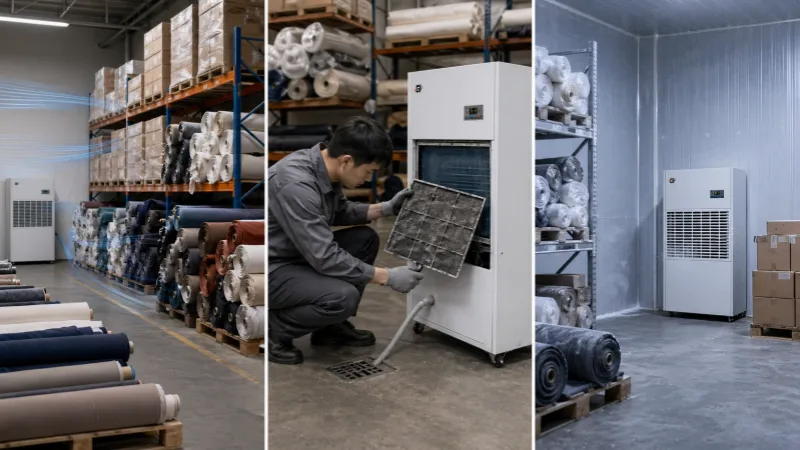
Check Filters, Coils, and Drainage
Textile lint can reduce airflow through filters and coils. If airflow drops, the dehumidifier may run longer but remove less moisture.
Check:
- Filter blockage
- Coil dust or lint buildup
- Drain line blockage
- Water tray overflow
- Sensor location
- RH set point
For textile storage, this check should stay simple. For routine service planning, a basic industrial dehumidifier maintenance checklist can help teams decide how often to inspect filters, coils, drainage, and sensors.
Check Low-Temperature Conditions
If a refrigerant dehumidifier runs in a cool fabric room, icing may reduce performance.
This can happen when:
- The room temperature is low
- Airflow is weak
- Filters are dirty
- The evaporator coil is blocked
- The unit is not suitable for low-temperature operation
For cool wool storage, winter warehouse conditions, or low-temperature fabric rooms, buyers may need to compare refrigerant, desiccant, or low-temperature dehumidifier options before changing equipment size.
FAQ
What RH is best for fabric storage?
Start with 45%–60% RH, then check whether wall-side pallets, sealed cartons, and loading-door zones stay within range. If those areas remain damp, the issue may be airflow or sizing, not only the set point.
Does a dehumidifier help prevent mold on stored fabric?
Yes, but it does not remove existing mold. A dehumidifier helps reduce the damp conditions that support mold growth. Affected fabric should be isolated, inspected, cleaned, or handled according to quality procedures.
What information is needed to size a textile warehouse dehumidifier?
Prepare warehouse dimensions, current RH, target RH, temperature, door opening frequency, fabric type, storage density, and drainage conditions. These details help suppliers estimate moisture load more accurately.
Should fabric storage use refrigerant or desiccant dehumidification?
Normal-temperature textile warehouses often use refrigerant dehumidifiers. Low-temperature rooms, wool storage, low-dew-point projects, or sensitive fabric storage may need desiccant dehumidification. The choice depends on temperature, target RH, and running cost.
Where should the unit be placed in a fabric warehouse?
Place it where air can circulate through the storage area. Avoid blocked corners, dense fabric stacks, and locations where inlet or outlet air is restricted. Large warehouses may need multiple units or ducted airflow.
Conclusion
Textile and fabric storage needs stable humidity, not simply dry air. High RH can damage stored goods through mold, odor, damp packaging, color issues, and accessory corrosion. Low RH can create static, dust attraction, and handling problems for some materials. For B2B warehouses, these issues can affect inspection results, shipment quality, and inventory value.
For textile storage projects, prepare your warehouse size, target RH, fabric type, storage density, door opening frequency, drainage conditions, and local climate before choosing a unit. Rinwang can review these details and recommend a suitable industrial dehumidifier setup based on warehouse volume, airflow layout, and storage conditions.