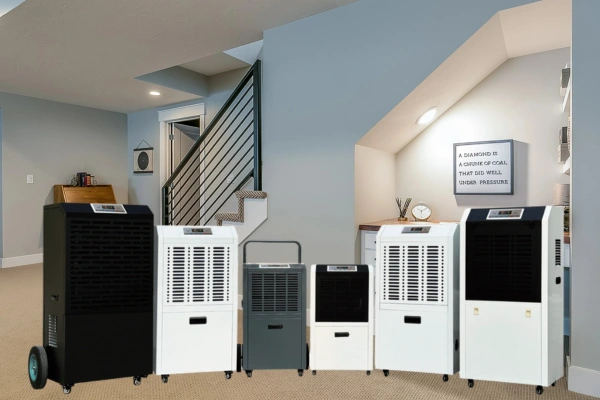
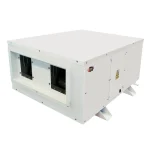
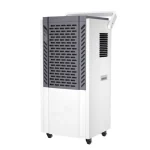
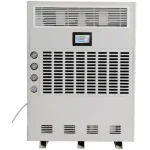
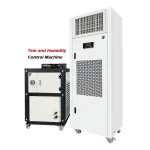
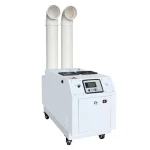
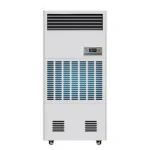
Excess moisture affects different industrial environments in unique ways. In this guide, we break down how industrial dehumidifiers are applied across various settings – from vast warehouses to damp crawl spaces – and what to consider in each scenario. (If you need a primer on industrial dehumidifier basics, see our [ Complete Guide to Industrial Dehumidifiers ] for an in-depth overview.) Each section below explores a specific application, highlighting the humidity challenges, recommended conditions, and dehumidifier solutions for that environment.
Application-Based Environmental Comparison
Industrial environments differ significantly in:
- Moisture generation source
- Temperature range
- Required humidity stability
- Air circulation pattern
- Regulatory or quality constraints
The table below compares key environmental variables across applications:
| Corrosive air/condensation control on glazing | Primary Moisture Source | Typical Temperature | Humidity Stability Requirement | Key Design Constraint |
|---|---|---|---|---|
| Warehouse | Outdoor air infiltration | Moderate | Medium | Large air volume / frequent air exchange |
| Greenhouse | Plant transpiration & irrigation | Warm | High | Continuous internal moisture generation |
| Indoor Pool (Natatorium) | Surface evaporation | Warm & humid | High | Corrosive air / condensation control on glazing |
| Crawl Space | Ground vapor diffusion | Cool | Medium | Low clearance / limited drainage options |
| Basement | Soil moisture transmission | Cool | Medium | Restricted ventilation / below-grade envelope |
| Manufacturing | Process-generated moisture | Variable | High | Process-sensitive RH tolerance / HVAC integration |
Because moisture sources, temperature conditions, and control tolerances vary by application, dehumidifier selection should be based on environmental requirements rather than capacity alone.
Warehouse & Storage Environments
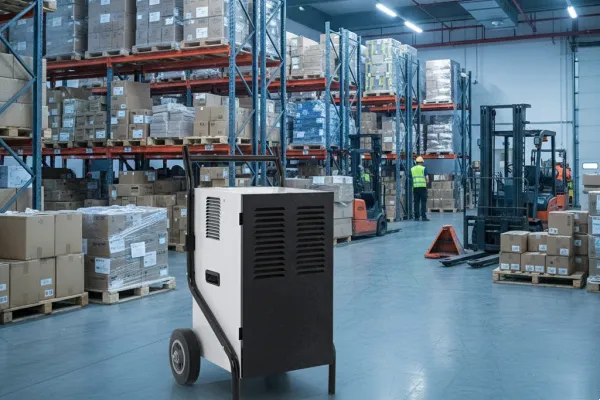
Warehouses, distribution centers, and long-term storage facilities are highly sensitive to ambient humidity conditions. In most general storage scenarios, maintaining relative humidity between 30% and 50% is widely recommended to protect goods and infrastructure. Operating within this range significantly reduces the probability of mold growth, metal corrosion, packaging deformation, and moisture-related material degradation.
Environmental Challenges in Warehouses
Warehouse environments present several structural and operational characteristics that increase moisture risk:
- Large internal air volume with high ceilings
- Frequent air exchange through loading docks and access doors
- Seasonal infiltration of humid outdoor air
- Moisture release from stored products, such as textiles, wood products, or packaged goods
- Temperature fluctuations that can create surface condensation
When humidity is not controlled, condensation may form on cold surfaces, particularly during overnight temperature drops. Sustained relative humidity above 60% increases the likelihood of:
- Mold growth on pallets and cartons
- Corrosion of racking systems and machinery
- Structural steel oxidation
- Deformation of paper-based packaging
- Increased pest activity in humid zones
These risks are amplified in coastal or high-humidity climates.
Dehumidification Strategies for Warehouse Applications
Industrial dehumidification systems must be selected based on:
- Total cubic volume of the space
- Moisture load (infiltration + product evaporation)
- Operating temperature range
- Air circulation patterns
For warehouses operating above approximately 15°C, refrigerant-type industrial dehumidifiers are commonly used due to their energy efficiency in moderate conditions. In cold storage areas or facilities requiring lower humidity setpoints, desiccant dehumidifiers are often preferred because they maintain performance at low temperatures and can achieve lower dew points.
Large facilities frequently require multiple units distributed by zone to ensure uniform humidity control and eliminate stagnant air pockets. Systems should include:
- High static pressure airflow capacity
- Automatic humidistat control
- Continuous drainage (gravity drain or condensate pump)
- Corrosion-resistant internal components
Water removal rates in warehouse-scale applications can reach dozens or even hundreds of liters per day, depending on environmental conditions, making continuous drainage essential for uninterrupted operation.
For detailed configuration guidance, refer to our technical resource on [Industrial Dehumidifier for Warehouse], which outlines capacity calculation, airflow planning, and installation considerations specific to large-scale storage environments.
Greenhouses & Indoor Agriculture
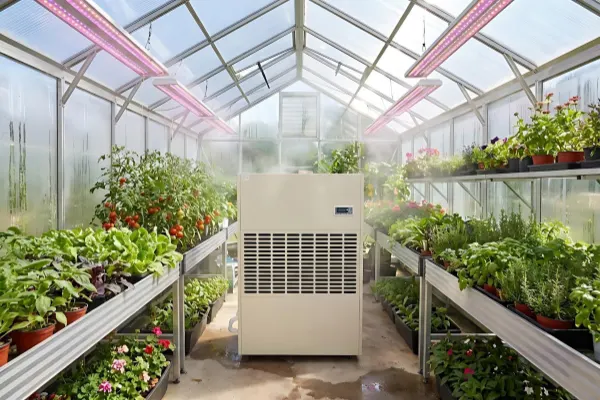
Commercial greenhouses and indoor cultivation facilities operate in environments with continuously elevated moisture loads. Plant transpiration, irrigation, and evaporation from growing media introduce significant quantities of water vapor into the air. Without humidity control, relative humidity (RH) inside a greenhouse can rise to 80–90% during nighttime periods when ventilation is reduced.
Sustained high humidity increases the likelihood of:
- Fungal diseases such as powdery mildew and Botrytis
- Leaf surface condensation
- Reduced nutrient uptake efficiency
- Structural condensation on glazing and framing
- Corrosion of metal components
Optimal Humidity Range for Greenhouse Operations
Unlike dry storage facilities, greenhouse environments require moderate humidity levels to support plant physiological processes. For many commercial crops, a relative humidity range of 50%–70% is commonly maintained to balance transpiration and disease prevention.
Humidity requirements vary depending on:
- Crop species
- Growth stage (seedlings vs. mature plants)
- Air temperature
- Ventilation strategy
As a general guideline, maintaining RH below approximately 80% is critical to reducing fungal outbreak risk. When humidity exceeds this threshold for extended periods, leaf wetness duration increases, creating favorable conditions for pathogen development.
Dehumidification Strategy in Controlled Agriculture
Industrial dehumidifiers provide a mechanical method of moisture removal without relying solely on air exchange. Refrigerant-based systems condense water vapor from the air and discharge slightly warmed, dried air back into the space. This can help maintain temperature stability during nighttime operation.
In large-scale greenhouse facilities, dehumidification systems are typically selected based on:
- Total greenhouse volume
- Estimated moisture load from transpiration
- Crop density
- Internal temperature setpoints
- Air circulation patterns
Common installation configurations include:
- Ceiling-mounted ducted units to distribute dry air above the canopy
- Floor-standing industrial units positioned in designated zones
- Integration with environmental control systems for automated RH management
Condensed water collected during operation can be filtered and reused for irrigation, depending on local agricultural standards and water management practices.
Structural and Operational Impact
Maintaining RH within the recommended range contributes to:
- Reduced fungal disease pressure
- Controlled leaf surface moisture
- Stabilized transpiration rates
- Decreased structural condensation
- Extended service life of greenhouse components
Lower condensation levels on glazing and framing reduce corrosion and minimize water dripping onto plants. Controlled humidity reduces variability in vapor pressure deficit (VPD), which supports consistent transpiration conditions.
Equipment Considerations
When selecting a greenhouse dehumidification system, technical specifications should include:
- High moisture removal capacity (liters/day or kg/h)
- Corrosion-resistant coils and housings
- Continuous drainage system
- Automatic humidistat control
- Compatibility with integrated climate control systems
Because greenhouse environments are continuously humid and may contain fertilizer residues, protective coil coatings or stainless steel components are recommended to maintain long-term operational reliability.
For additional technical selection guidance, refer to the [ Industrial Dehumidifier for Greenhouse Humidity Control ] resource, which outlines system sizing and configuration considerations specific to indoor agricultural environments.
Indoor Swimming Pools & Spas
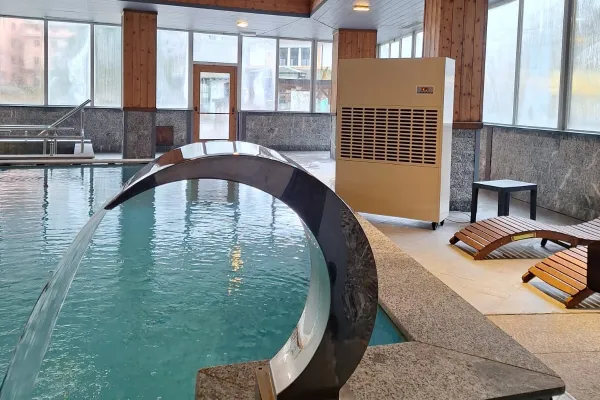
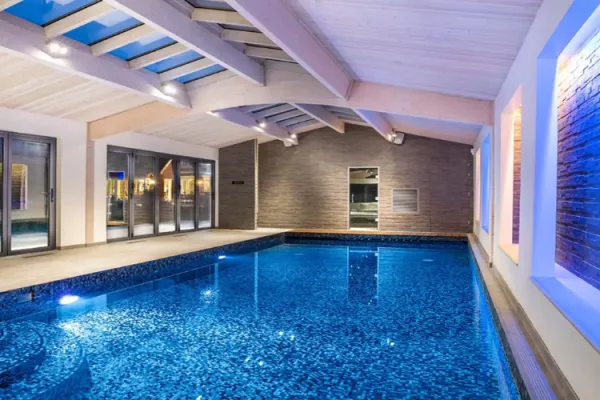
Indoor swimming pools (natatoriums) generate continuous moisture due to evaporation from the water surface. Warm water and elevated air temperatures increase evaporation rates, resulting in high indoor humidity if not mechanically controlled.
Without dehumidification, sustained high relative humidity can lead to:
- Condensation on windows, ceilings, and structural surfaces
- Corrosion of metal fixtures, ducts, and structural components
- Mold growth in concealed areas
- Degradation of paint and building finishes
- Increased concentration of chloramine byproducts in stagnant air
Recommended Humidity Range
For most indoor pool environments, maintaining relative humidity between 50% and 60% RH is standard practice. This range reduces surface condensation while limiting excessive evaporation from the pool.
Humidity levels above 60% significantly increase the risk of structural condensation and corrosion. Excessively low humidity is generally avoided because it increases evaporation rates and associated heating loads.
Dehumidification Systems for Natatoriums
Standard HVAC systems or residential units are not designed to manage the continuous moisture load present in pool environments. Dedicated swimming pool dehumidifiers are typically required for long-term structural protection and stable environmental control. A detailed technical breakdown of system structure, airflow design, and capacity calculation can be found in our guide on [dehumidifiers for indoor swimming pools].
These systems commonly use a refrigeration (heat pump) cycle to:
- Condense and remove airborne moisture
- Recover latent heat generated during condensation
- Reintroduce conditioned air into the space
In many configurations, recovered heat can be redirected to warm supply air or assist pool water heating, improving overall system efficiency.
Commercial pool dehumidifiers are typically designed with:
- Corrosion-resistant coils and internal components
- Ducted or ceiling-mounted installation options
- Continuous drainage systems
- Integrated humidity control sensors
System Design Considerations
Effective humidity control in indoor pool facilities depends on:
- Pool surface area
- Water temperature
- Room air temperature
- Ventilation rate
- Building envelope insulation
Dehumidification systems are typically sized based on the calculated evaporation rate (mass of water vapor per hour) under peak operating conditions. Higher water and air temperatures increase evaporation and system capacity requirements.
Maintaining controlled humidity in natatorium environments reduces corrosion risk, limits structural moisture accumulation, and supports stable indoor air conditions.
Crawl Spaces and Low-Clearance Areas
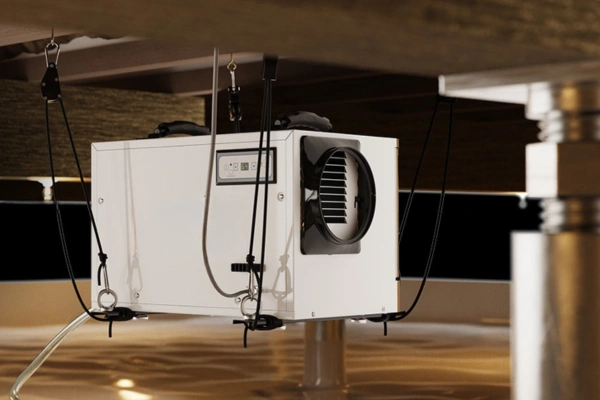
Crawl spaces are shallow, enclosed areas beneath buildings that commonly experience elevated humidity due to ground moisture, limited ventilation, and temperature differentials. Moisture accumulation in these spaces can result in:
- Mold growth on wooden structural components
- Wood decay and subfloor deterioration
- Insulation damage
- Increased pest activity
- Migration of humid air and spores into occupied areas
Because crawl space air often exchanges with indoor living or working spaces, unmanaged humidity can influence overall indoor air quality.
Humidity Control Targets
To reduce mold and structural deterioration risk, crawl space relative humidity should be maintained below 60% RH, with many building professionals targeting approximately 50% RH for an additional safety margin.
When RH remains above 60% for extended periods, wood framing and soil surfaces retain sufficient moisture to support fungal growth. In warm seasons, unconditioned crawl spaces frequently exceed 70–80% RH, particularly where vapor barriers or drainage systems are inadequate.
Mechanical dehumidification is commonly used to maintain stable humidity levels in encapsulated or semi-sealed crawl spaces. Dehumidification is typically most effective when combined with a ground vapor barrier and sealed vents to reduce external moisture ingress and limit soil vapor diffusion.
Operational Challenges
Crawl spaces present unique constraints:
- Limited vertical clearance (often 2–4 ft)
- Lower ambient temperatures compared to occupied areas
- Absence of floor drainage
- Restricted service access
Standard upright residential dehumidifiers are typically unsuitable due to height limitations, reduced cold-weather performance, and manual drainage requirements.
Technical Requirements for Crawl Space Dehumidifiers
Industrial-grade crawl space units are designed to address these constraints. Key specifications typically include:
Low-Profile Configuration
Horizontal or compact designs allow installation in confined areas or between floor joists.
Integrated Condensate Pump
Built-in pumps enable vertical drainage discharge where gravity drainage is unavailable.
Low-Temperature Operation
Automatic defrost systems support operation in cool environments, including temperatures just above freezing. This allows year-round performance in unheated crawl spaces.
Corrosion-Resistant Construction
Powder-coated housings and epoxy-coated coils help protect internal components in persistently damp conditions.
Adequate Airflow Capacity
Sufficient CFM ensures full air circulation within enclosed areas, reducing stagnant moisture pockets.
Detailed product specifications and installation considerations are available on our [Industrial Dehumidifier for Crawl Space] page. In addition to crawl spaces, these units are suitable for other confined areas such as utility rooms, pump chambers, and low-clearance equipment spaces.
Basements and Underground Areas
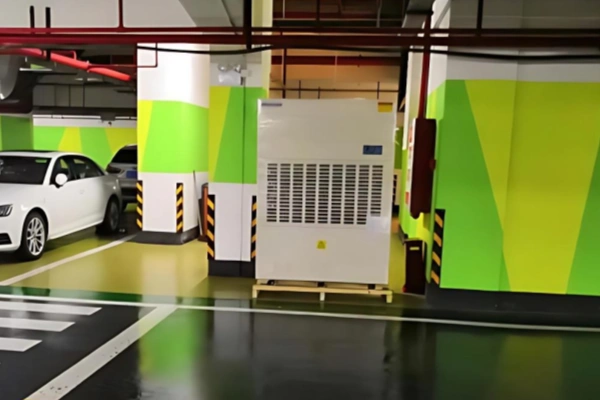
Basements and below-grade spaces are prone to elevated humidity due to soil moisture transmission, limited ventilation, and lower ambient temperatures. In commercial and industrial buildings, basements are often used for archives, storage areas, electrical rooms, or auxiliary workspaces.
Moisture accumulation in these environments can result in:
- Mold growth on walls and stored materials
- Corrosion of metal shelving and equipment
- Damage to paper records and textiles
- Electrical system deterioration
- Paint and surface finish degradation
Unconditioned basements may exceed 70–80% relative humidity during humid seasons, particularly when drainage or vapor barriers are insufficient.
Recommended Humidity Levels
For storage or occupied basement areas, relative humidity should generally be maintained at 50% RH or lower, with 60% RH considered the upper limit to reduce mold growth risk.
Archival or document storage areas may require tighter control (typically 30–50% RH), depending on material sensitivity. Because basements typically operate at cooler temperatures (15–21°C / 60–70°F), dehumidifiers must support stable operation in lower ambient conditions.
Dehumidification Solutions
Commercial and industrial basement applications typically use:
- Portable industrial dehumidifiers for flexible placement
- Ceiling-mounted or fixed systems for permanent installation
- Units equipped with continuous drainage (gravity drain or condensate pump)
Continuous drainage is essential for uninterrupted operation. Without it, collection tanks require manual emptying, which can interrupt humidity control.
Capacity selection should be based on:
- Total square footage
- Ceiling height
- Moisture infiltration rate
- Seasonal humidity conditions
- Presence of water intrusion risk
After flooding or leakage events, high-capacity restoration-grade dehumidifiers may be required for rapid moisture removal. For ongoing humidity management, units sized for steady-state moisture load are typically sufficient.
For technical sizing guidance and selection criteria, refer to our resource on [how to choose the right dehumidifier for your basement].
Manufacturing & Industrial Production Areas
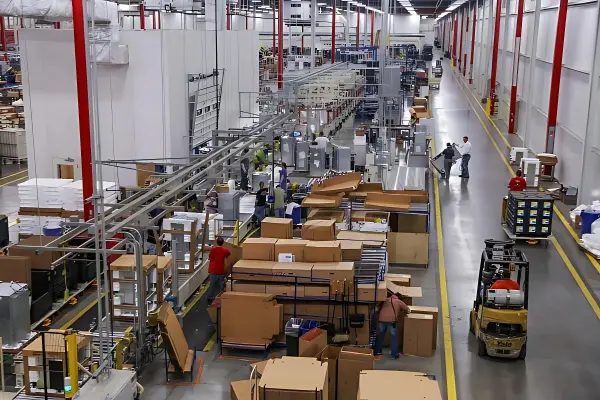
Manufacturing facilities operate under controlled environmental requirements to protect product quality, process stability, and equipment performance. Industries such as food processing, pharmaceuticals, electronics assembly, metal fabrication, and precision engineering often define specific humidity parameters as part of operational standards.
Humidity Risks in Production Environments
Excess humidity in manufacturing areas can lead to:
- Corrosion of machinery and metal components
- Condensation on equipment and structural surfaces
- Clumping or degradation of hygroscopic materials
- Reduced coating adhesion
- PCB corrosion and electronic defects
- Increased microbial growth in food or pharmaceutical production
In metal processing environments, corrosion rates increase significantly as relative humidity rises. Sustained high RH levels also increase the risk of condensation near electrical systems.
Conversely, excessively low humidity may increase static electricity in electronics manufacturing environments, potentially damaging sensitive components.
Recommended Humidity Range
Many general manufacturing environments operate within 40%–60% RH, with 45%–50% RH commonly targeted to balance corrosion prevention and static control.
Certain processes require stricter parameters:
- Pharmaceutical storage: 20%–30% RH
- Calibration labs: 50% ±5% RH
- Hygroscopic material processing: low dew point control
Humidity specifications are typically defined by product standards, regulatory compliance requirements, or process engineering constraints.
Dehumidification Systems in Manufacturing
Industrial dehumidification systems are often integrated with HVAC or facility process control systems. Configurations may include:
- Floor-standing industrial units
- Ceiling-mounted or ducted systems
- Centralized air-handling integration
- Dedicated process dehumidification chambers
Two primary technologies are used:
Refrigerant Dehumidifiers
Suitable for moderate humidity control in conditioned environments. Commonly applied in general production halls and machine shops.
Desiccant Dehumidifiers
Used when low dew points are required or in low-temperature environments such as cold storage. These systems maintain stable performance under conditions where refrigerant units become less efficient.
A technical comparison of system selection and sizing methodology is available in our [Industrial Dehumidifier Selection Guide].
System Integration Considerations
Effective humidity control depends on:
- Total facility volume
- Moisture generation rate
- Air exchange rate
- Building insulation performance
- Target dew point
Industrial systems often support:
- Remote monitoring and alarm functions
- Continuous operation
- Heat recovery configurations
- Automatic defrost systems
In regulated industries such as food and pharmaceuticals, maintaining specified humidity ranges supports compliance with quality control and environmental standards.
Conclusion: Tailoring Dehumidification to Your Needs
Humidity control requirements vary across applications, including warehouses, greenhouses, indoor pools, crawl spaces, basements, and manufacturing facilities. Each environment presents different moisture loads, temperature conditions, and operational constraints. Selecting the appropriate industrial dehumidification system requires aligning equipment specifications with these variables.
For application-specific configurations or system planning, you may also review our product portfolio under [Industrial Dehumidifier Manufacturer] or contact our engineering team for technical support.