Excess humidity in factories and warehouses causes corrosion, mould, electrical faults, and product defects. Most selection mistakes are not brand mistakes. They happen because a specification was accepted without asking what conditions it was measured under, or because a physical limit of the technology was never checked against the site.
This guide covers nine decision points in the order they actually matter, and the specific question to put to a supplier at each one. It does not recommend a model. If your conditions are already defined and you want to compare units, capacity bands, and temperature ranges directly, start from the industrial dehumidifier range instead.
Step 1: Understand the Temperature Limit Before You Pick a Technology
Most guides give one rule: above 15 °C use a refrigerant unit, below 15 °C use a desiccant unit. The rule is broadly right, but it is a summary of a physical limit — and knowing the limit is what tells you how much margin you have.
Why refrigerant units lose capacity as it gets colder.
A refrigerant dehumidifier removes water by cooling air below its dew point on an evaporator coil. Two things change as entering air gets colder or drier. First, the air holds less moisture to begin with, so each pass over the coil condenses less water — a rated capacity is a measurement at one condition, not a fixed output. Second, the coil surface approaches 0 °C and frost begins to form, insulating the coil and restricting airflow. The unit then spends part of every cycle defrosting instead of dehumidifying.
This is why the defrost method matters more than the 15 °C figure itself. Hot-gas bypass and reverse-cycle defrost clear frost by routing hot refrigerant through the coil and recover quickly. Electric defrost uses a heater element. Ask which method is fitted and whether defrost entry and exit points are field-adjustable — a fixed setpoint chosen for a mild climate wastes run time in a cold room.
Why desiccant units are not simply “the cold option”.
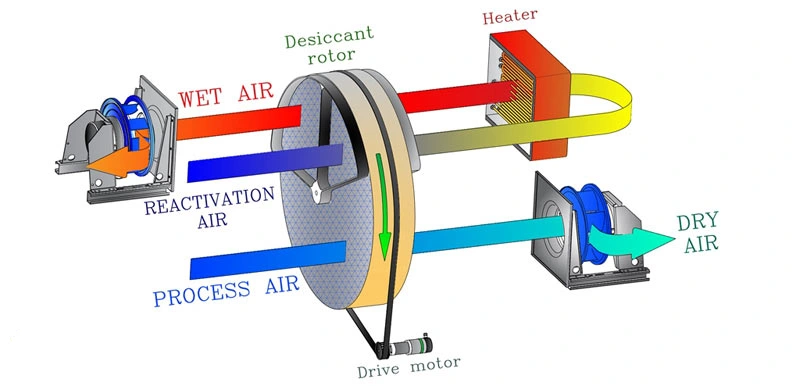
A desiccant unit adsorbs water vapour onto a rotor and drives it off with heat, so its performance does not depend on reaching a dew point. That is what allows operation at low temperature and at humidity levels a coil cannot reach. The trade-offs are real and should be priced in: energy is consumed for regeneration, and the process adds heat, so the discharge air is warmer.
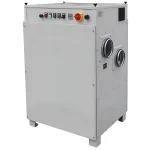
The practical boundary. A refrigerant system is limited by the dew point its coil can reach. When the requirement is a low dew point rather than simply “below 60% RH”, a larger refrigerant unit does not solve it — the technology does. Decide which of the two you are buying before comparing any capacity figures.
Ask the supplier: at what temperature and RH the quoted capacity was measured, the lowest ambient temperature at which the unit holds rated capacity, and which defrost method is fitted.
Step 2: Match the Installation Format to the Space
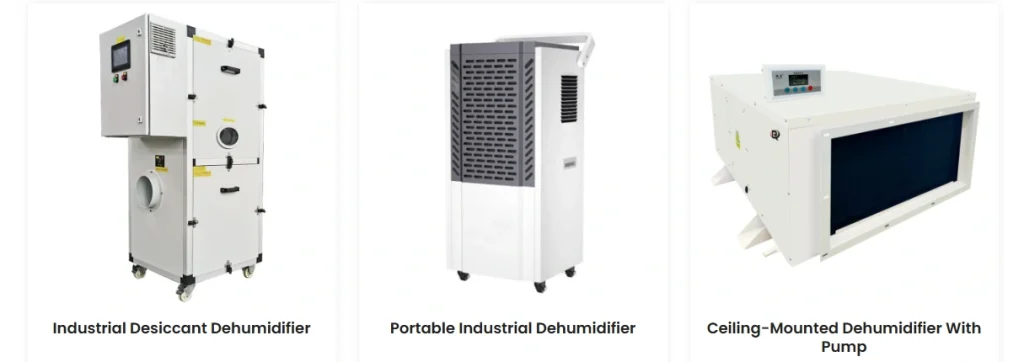
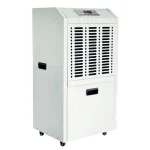
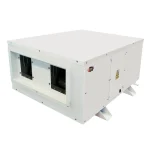
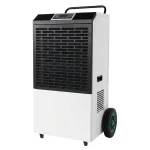
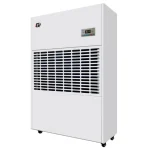
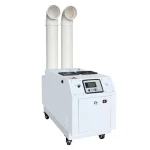
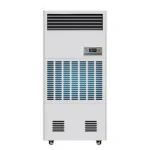
Three formats cover almost every industrial installation: portable units on casters for temporary or rotating use, floor-standing units for fixed general control in large spaces, and ceiling-mounted ducted units where floor area is expensive or air must be distributed to more than one zone. The format affects installation cost and service access more than it affects dehumidification performance.
Capacity bands, temperature ranges, and specifications for each format are listed on the industrial dehumidifier range.
Ask the supplier: what service clearance the filter and coil require. A ceiling unit installed above a fixed ceiling with no access panel will not be maintained, whatever the specification says.
Step 3: Size by Moisture Load, Not by Floor Area

Capacity is the input most often decided from a floor-area chart, and the input most often wrong. Required capacity is driven by the moisture entering and generated in the space — infiltration through doors, warm or wet goods, washdown, process steam — not by square metres. Two rooms of identical area routinely need capacity figures that differ by a factor of two.
The industrial dehumidifier sizing guide explains the calculation method, conversions between L/day, kg/h and PPD, rating conditions, and reference capacity bands by project type.
Ask the supplier: ask them to state the assumed infiltration rate and internal moisture load behind any capacity recommendation. A figure produced from floor area alone has not been calculated.
Step 4: Verify the Drainage Path Against the Building, Not the Brochure
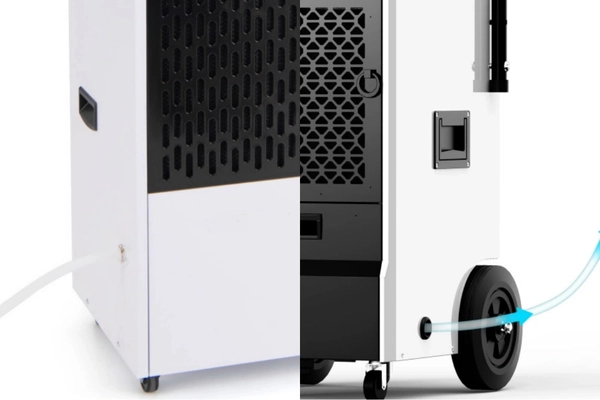
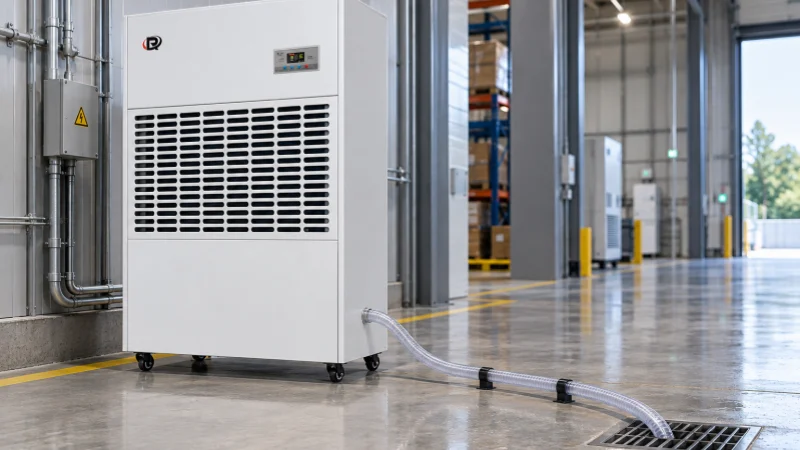
Industrial units produce condensate continuously, so drainage is a building question before it is a product question. Gravity drain to a floor drain or sump is the most reliable arrangement because nothing in it can fail. A built-in condensate pump is needed only where no low-level drain is within reach, and it adds a failure point that stops dehumidification when it clogs.
Two things get missed here. In cold rooms, an unheated drain line can freeze and back up while the unit itself is running correctly. And a drain pan that is not sloped toward the outlet holds standing water, which becomes a microbial problem in food and pharmaceutical spaces no matter how dry the air is.
Ask the supplier: whether the drain pan is sloped to the outlet, whether a heated drain line is available for sub-zero installation, and the maximum lift and horizontal run of the pump if one is fitted.
Step 5: Separate the Control Features You Need From the Ones You Are Being Sold
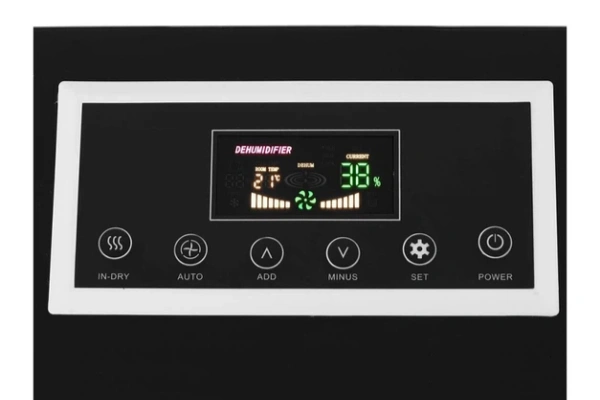
Automated control is what makes unattended operation possible, but the feature lists are long and only a few items change outcomes.
Two are load-bearing. A humidistat with a real setpoint lets the unit cycle to a target instead of running flat out, which is where most of the energy saving in a dehumidification project comes from. Auto-restart after power interruption matters in any unattended space — without it, a brief outage on a Friday means an uncontrolled weekend.
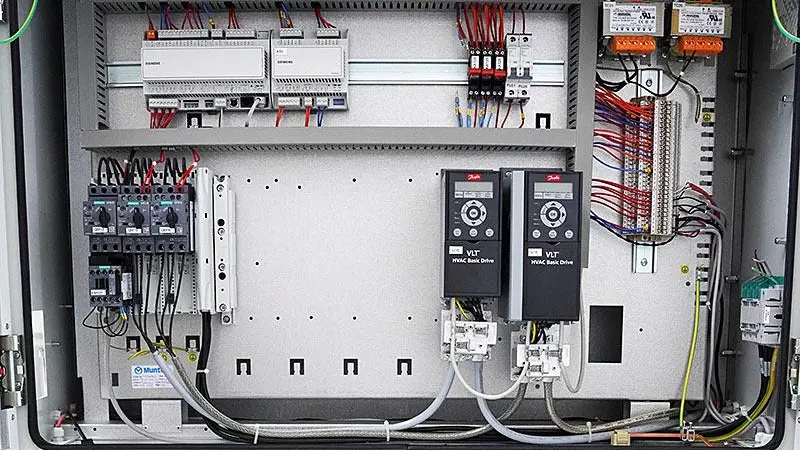
Remote monitoring and app control are useful in unmanned facilities and largely cosmetic in staffed ones. BMS integration over RS-485 or Modbus is a genuine requirement only where a BMS exists and someone reads it; specify it at order stage, because adding a communication port later is not always possible.
Ask the supplier: the humidistat control accuracy and deadband, whether the sensor reads return air or can be remote-mounted, and confirmation of the protocol against your BMS before the order is placed.
Step 6: Check Build Claims Against the Environment, Not the Adjective
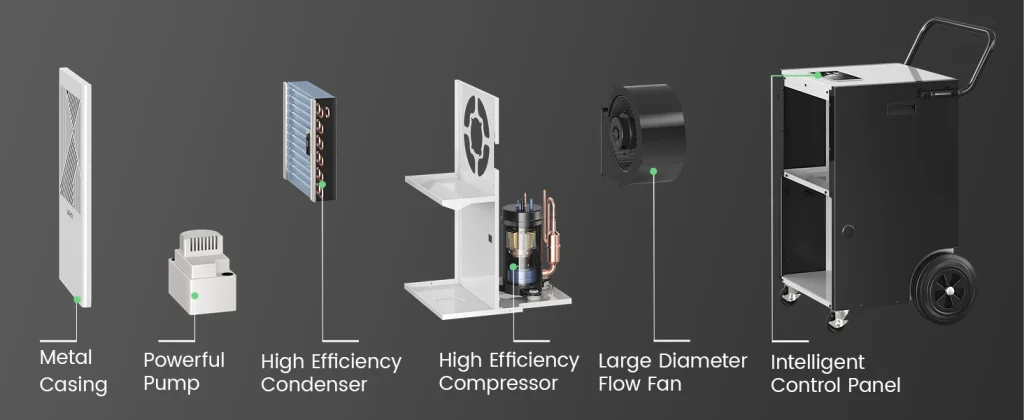
“Heavy-duty” and “industrial-grade” are not specifications. Three build attributes can actually be verified.
- Corrosion protection: Coastal air, natatoriums, and chemical plants attack the coil before the cabinet. Ask what the coil treatment is — a coating applied by full-immersion electro-deposition behaves differently from a sprayed one — and what the cabinet material is. Stainless options are normally 304 or 316L, and the grade matters where chloramines or salt spray are present.
- Enclosure rating: IP and NEMA ratings are defined test results, so ask for the rating and the standard it was tested to rather than a description of how sealed the enclosure looks.
- Hazardous locations: Where flammable gas, vapour, or combustible dust may be present, a rated explosion-proof unit is a legal requirement, not an upgrade. It cannot be added to a standard unit afterwards. This is the one item on this list where accepting an unrated machine is a safety failure rather than a performance compromise.
Ask the supplier: the coil treatment, the cabinet grade, the enclosure rating with its test standard, and — where relevant — the certificate for the hazardous-area rating rather than a statement that the unit is suitable.
Step 7: Compare Efficiency as Water Removed per kWh, Not as Power Draw
Power draw on its own says nothing about efficiency. A unit that draws more and removes proportionally more water is not less efficient. The comparable figure is water removed per unit of energy — litres per kWh — and it is comparable only when both figures come from the same rating condition, which returns to Step 1.
Two adjustments bring the comparison closer to reality. Correct sizing usually affects annual consumption more than the efficiency rating does, because an oversized unit short-cycles and an undersized one never stops. And in a desiccant system the regeneration heat is part of the energy cost of the water removed, so comparing compressor input alone understates it.
Ask the supplier: L/kWh with the rating condition stated alongside it, and the figure at the condition your site will actually operate at if that differs.
Step 8: Evaluate Ease of Maintenance
- Air Filter Access: Most dehumidifiers have an air intake filter to trap dust. This filter typically needs cleaning every couple of weeks in a dusty environment. Check that the filter is easy to access and remove. If it’s a simple slide-out mesh or foam filter that you can wash or replace quickly, you’re more likely to actually do it on schedule.
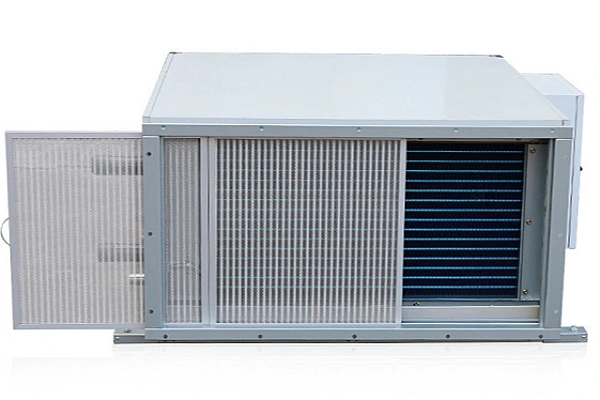
- Coil Cleaning and Drain Maintenance: The evaporator coils may accumulate dust or the condensate tray can get slime buildup. A good design will allow you to reach these parts for periodic cleaning; some dehumidifiers offer coil-cleaning modes. Similarly, the drain line or pump should be accessible to clear any clogs. If the dehumidifier has a built-in pump, check if it has a filter or is designed for easy flushing. Units that make you dismantle half the machine to clean a coil or unclog a hose will likely be neglected, shortening their lifespan.
- Indicators and Alerts: Some advanced models include maintenance reminders – like an indicator light when the filter needs cleaning or if the condensate pump is failing. While not necessary, these little features can be helpful in an industrial setting where you might forget maintenance until something stops working.
Step 9: Verify Warranty and Support
Warranty Length and Coverage: Industrial dehumidifiers aren’t cheap, and you’ll want assurance that your investment is protected. Check the warranty terms – many quality manufacturers offer 1 to 3 years of coverage, and some may have longer warranty on specific components, for example, a 5-year warranty on the compressor or evaporator coils is not uncommon for high-end units. Be sure to note what’s included: does the warranty cover both parts and labor? Is on-site service included or do you need to ship the unit for repairs?
Customer Support and Service: In industrial environments, downtime costs can be high, making after-sales support crucial. Look for manufacturers or suppliers that offer convenient customer service, whether it’s a technical support hotline, online chat, or a local service center. Knowledgeable customer service representatives can quickly help you troubleshoot problems or expedite spare parts delivery.
Our Commitment: We believe that reliable support is just as critical as the hardware itself. At Ruiwang, we are proud to provide the comprehensive, end-to-end after-sales service discussed above, ensuring your operation runs smoothly long after the initial purchase. For complete peace of mind and full transparency, we make our warranty policy clear and accessible. You can review and download our full warranty manual directly.
The Ruiwang warranty manual explains coverage and service terms.
FAQ
What information should I have ready before requesting a quote?
Five items let a supplier give a real recommendation instead of a guess: room length, width, and height; current and target humidity; operating temperature range including the coldest condition; the moisture sources present, such as door openings, warm goods, or washdown; and the drainage available at the intended location.
Can a supplier size a unit from floor area alone?
No. Floor area sets the air volume but not the moisture load, and moisture load is what determines capacity. A recommendation produced from area alone is a starting point to be checked, not a specification.
Is a larger unit safer than a smaller one?
No. An oversized unit reaches setpoint quickly and then short-cycles, which increases wear and reduces the run time available for moisture removal. Margin above the calculated load is sensible; multiplying the load is not.
If you still don’t know how to choose a suitable dehumidifier after reading this article, you can click on the business card below to contact us, and our sales staff will reply to you as soon as possible!