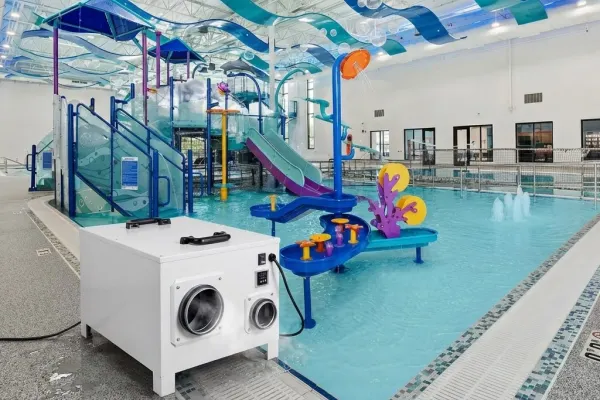
Indoor pool
Electronics
Construction
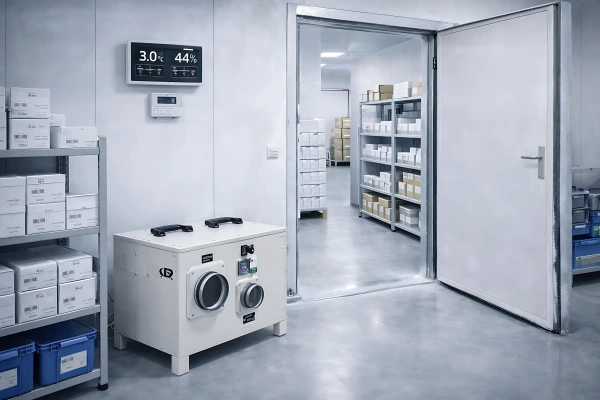
Pharmaceutical
Water damage
Airflow is what turns a desiccant dehumidifier’s rated capacity into the humidity level you actually need. At Ruiwang, we size process airflow to your moisture load, target dew point and duct resistance—not just to a nameplate number. Our electric-regeneration rotary desiccant dehumidifiers offer a standard process airflow range of 300–3,000 m³/h, with custom single units and built-up systems available above 3,000 m³/h for larger spaces and low-dew-point processes.
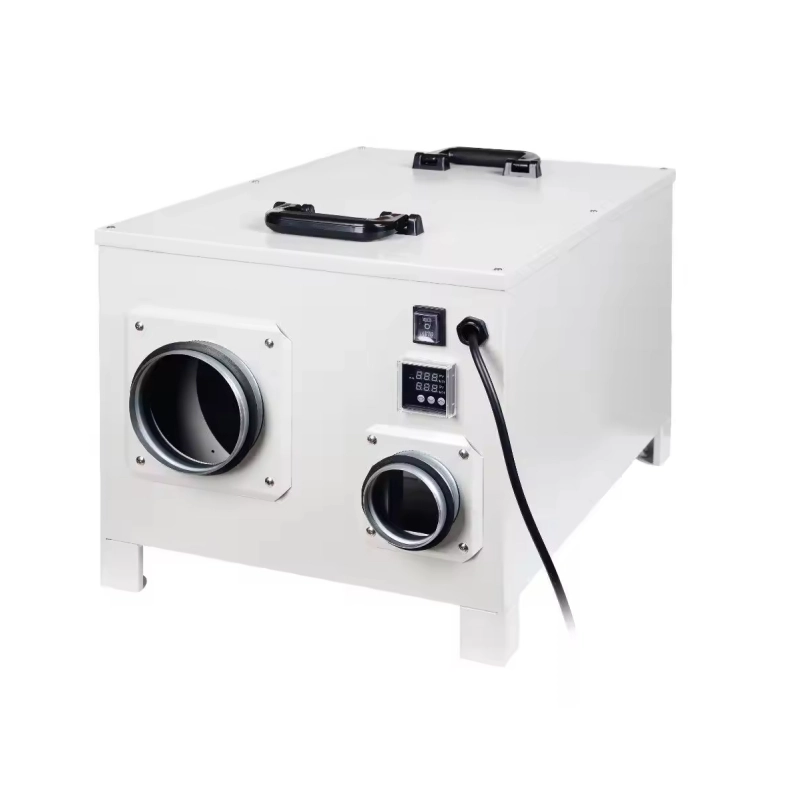
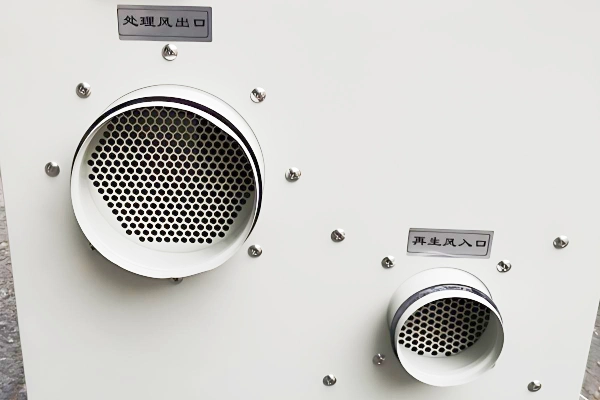
1. Process Air vs. Regeneration Air: A rotary desiccant unit runs two airstreams: the process (dry) air delivered to your space, and the regeneration air that drives moisture off the wheel and is exhausted. Regeneration air runs roughly a quarter to a third of the process airflow—on our RW-3000M, 3,000 m³/h process to 1,100 m³/h regeneration. The wheel is reactivated by electric heating as standard.
2. Right-Sized, Not Just Bigger: More airflow isn’t automatically better. Airflow has to match your moisture load and target dew point: too little and the unit never reaches your set point; too much wastes energy and makes humidity swing. We size to the conditions you actually run at—not a catalogue best case.
3. Delivered Airflow vs. Nameplate: Bends, dampers and filters close to the unit eat airflow before it reaches the room. Our standard units provide 80–400 Pa of external static pressure on the process air (model-dependent), so they push the rated airflow through real ductwork and filters—not just into open air.
4. Supply-Air Temperature: Desiccant drying is exothermic and the wheel carries heat from the regeneration side, so dry supply air leaves warmer than it entered. For temperature-sensitive rooms we can add a post-cooling coil—air that’s dry and tempered, instead of a hidden load on your cooling system.
5. Performance Holds at Low Temperature: Unlike compressor dehumidifiers that fade in the cold, our desiccant units operate from −10°C to +50°C, making them suited to cold stores, winter sites and low-dew-point process rooms.
6. Commercial vs. Industrial Airflow Logic: Comfort and building-protection jobs (typically 40–60% RH) favour larger airflow at lower static pressure. Low-dew-point process jobs set airflow by air changes and process need, run at higher static pressure and target much drier air. Tell us which side you’re on and we’ll size accordingly.
Capacity rated at T=20°C, RH=60%. Actual output depends on your operating conditions—contact us for sizing.
| Application | Industry-typical target | Indicative process airflow | Ruiwang |
|---|---|---|---|
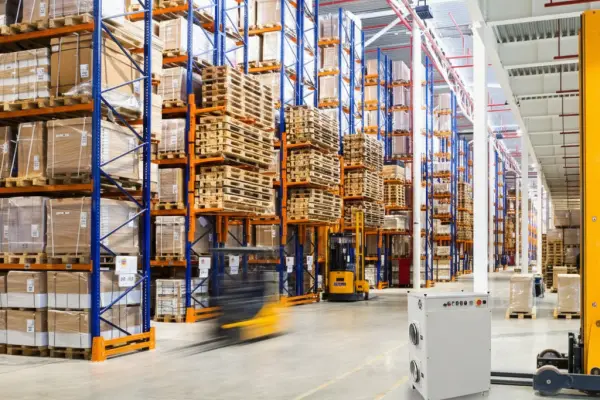
| Warehouse & anti-corrosion storage | 40-55% RH | 1,500-3,000 m³/h | Standard / Custom |
| Crawl space | <60% RH | 300-1,500 m³/h | Standard |
| Greenhouse | per crop/dew point | 1,000-3,000 m³/h | Standard / Custom |
| Electronics / small cleanroom | 30-50% RH | 1,000-3,000 m³/h | Standard / Custom |
| Construction / structural drying | drying, anti flash-rust | 300-1,500 m³/h + larger | Standard / Custom |
| Pharmaceutical (weighing / coating) | 20-45% process · 45-65% area | 1,000-3,000 m³/h | Standard / Custom |
| Water damage restoration | rapid drying | 300-1,500 m³/h | Standard |
| Archive/museum (quiet) | 45-55% RH | 800-3,000 m³/h | Standard |
| Food & powder packaging | 40-60% RH | 1,500-3,000 m³/h | Standard / Custom |
| Indoor pool | 50-60% RH | 3,000+ m³/h | Custom |
| Cold-store loading dock | anti-condensation | 3,000+ m³/h | Custom |
This content is hosted by YouTube. By clicking "Accept Cookies", you consent to YouTube's cookie policy and the video will load.
Or watch directly on YouTube →click images above to enlarge
We build to your project in two forms:
Across both, we customize process airflow, voltage, control system, filtration grade, corrosion protection and housing dimensions. Certification support (such as CE or UL/ETL) can be discussed per project and order volume.
Capacity rated at T=20°C, RH=60%. Actual output depends on your operating conditions—contact us for sizing.
| Model | RW-300M | RW-600M | RW-750M | RW-1000M | RW-1500M | RW-3000M |
|---|---|---|---|---|---|---|
| Power | 220V/50Hz | 220V/50Hz | 380V/50Hz | 380V/50Hz | 380V/50Hz | 380V/50Hz |
| Capacity (T=20°C, RH=60%) | 2.5 kg/h | 3.0 kg/h | 4.5 kg/h | 7.5 kg/h | 10 kg/h | 19 kg/h |
| Rated power | 2.0 kW | 4.5 kW | 7 kW | 11 kW | 15 kW | 30 kW |
| Current | 9 A | 20 A | 14 A | 18 A | 26 A | 50 A |
| Process airflow (m³/h) | 320 | 800 | 950 | 1,100 | 1,550 | 3,000 |
| Process airflow (CFM) | 188 | 471 | 560 | 648 | 913 | 1,767 |
| Regeneration airflow (m³/h) | 110 | 200 | 250 | 450 | 550 | 1,100 |
| Regeneration airflow (CFM) | 65 | 118 | 147 | 265 | 324 | 648 |
| Process ESP (Pa) | 80 | 100 | 120 | 150 | 200 | 400 |
| Regeneration ESP (Pa) | 50 | 70 | 80 | 100 | 150 | 200 |
| Process duct | Φ125mm×2 | Φ125mm×2 | Φ200mm×2 | Φ200mm×2 | Φ250mm×2 | 522×286 / Φ400mm |
| Regeneration duct | Φ80mm×2 | Φ100mm×2 | Φ125mm×2 | Φ150mm×2 | Φ160mm×2 | Φ200mm×2 |
| Operating temp | -10°C ~ +50°C | -10°C ~ +50°C | -10°C ~ +50°C | -10°C ~ +50°C | -10°C ~ +50°C | -10°C ~ +50°C |
| Size (L×W×H, mm) | 680×425×400 | 585×420×866 | 1090×600×671 | 875×640×1232 | 880×678×1238 | 1312×856×1300 |
| Weight | 45 kg | 70 kg | 110 kg | 160 kg | 180 kg | 300 kg |
It depends on your moisture load, target humidity/dew point, room size and required air changes. Send us your conditions and we’ll recommend a model—or engineer a custom system above 3,000 m³/h.
Process air is the dry air delivered to your space; regeneration air (about one-third of the process airflow) reactivates the wheel and is exhausted. Our wheels use electric regeneration.
Yes—desiccant supply air leaves warmer than the intake. Where temperature matters, we add a post-cooling coil so the supply air is dry and tempered.
300–3,000 m³/h as standard single units; custom single units and built-up systems above 3,000 m³/h.
By electric heating as standard.
Your information will be kept strictly confidential.
Our team would be happy to meet you and learn all about your business, requirements and expectations.