If an industrial dehumidifier is freezing up, the evaporator is usually running too cold for the actual operating condition around it. That can happen when the room is colder than expected, airflow across the coil is too weak, the refrigeration side is pulling temperature down too far, or the unit is not clearing frost fast enough.
In industrial spaces, the effect shows up quickly. Floors stay damp longer. Packaging feels soft or unstable. Door zones become harder to control. The unit keeps running, but the humidity result does not stay consistent. As the U.S. EPA notes, moisture control is the key when damp surfaces, condensation, or recurring humidity problems start showing up in a working environment. Instead of treating the ice as a one-off fault, it makes more sense to ask what operating condition is pushing the machine out of balance and what should be checked first.
What Freeze-Up Means Inside the Unit
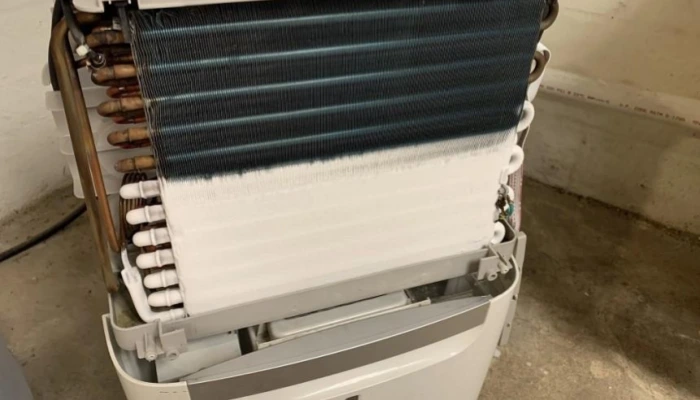
A refrigerant dehumidifier removes moisture by cooling air below its dew point so water condenses on the coil. That is normal. Freeze-up starts when the coil surface drops low enough that the moisture on it turns into frost or ice instead of draining away as liquid water.
Once that starts, the problem tends to build on itself. Ice blocks part of the airflow path. Heat transfer gets worse. The coil stays colder for longer. More moisture freezes on the surface instead of draining away. What begins as a light frost layer can turn into a heavier ice problem surprisingly fast.
Early Signs of Freeze-Up
In day-to-day operation, the first signs are usually easy to spot. You may see frost on the coil, weaker airflow, reduced drainage, or repeat problems in the same colder zone.
Quick Read: What the Symptom Usually Points To
| What you see | What it usually means | What to do next |
|---|---|---|
| Light frost on the coil | Early low-temperature or airflow problem | Check room temperature and airflow first |
| Thick ice across much of the coil | Ongoing airflow or defrost issue | Shut the unit down and inspect the basics |
| Ice on only part of the coil | Possible refrigerant or metering issue | Move to qualified technical diagnosis |
| Water output drops during colder periods | Condensate may be freezing before it drains | Check temperature, coil condition, and unit suitability |
| The same zone keeps icing | The operating condition may not match the unit | Reassess the application and temperature range |
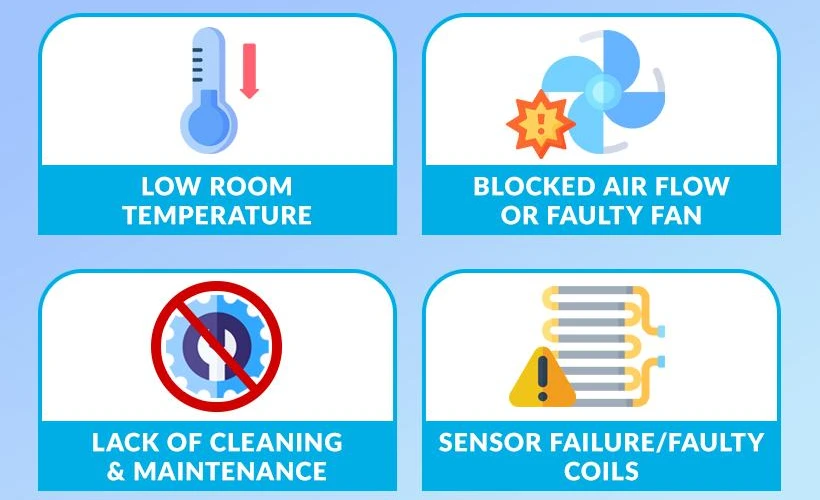
4 Common Reasons an Industrial Dehumidifier Freezes Up
The Operating Zone Is Too Cold
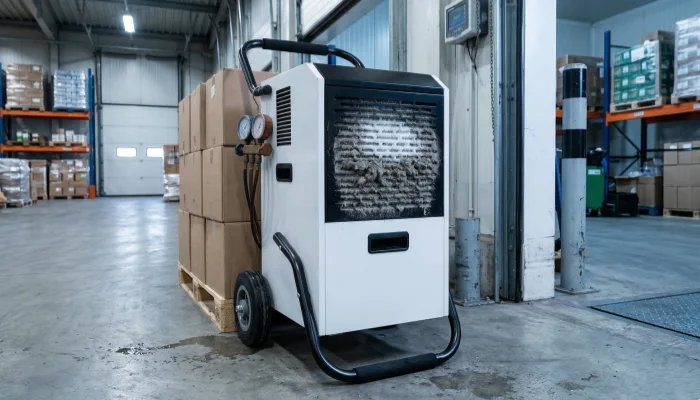
A refrigerant dehumidifier can freeze when the surrounding air does not provide enough heat load to keep the coil above freezing. This often happens in cold warehouses, chilled transfer areas, or near cold-room entrances, where the problem can overlap with cold storage humidity control rather than a one-time service fault. If icing appears mainly in the same low-temperature zone, the operating environment should be checked before assuming a major mechanical problem.
Airflow Across the Coil Is Too Low
Low airflow is one of the most common reasons a coil freezes. If not enough warm air moves across the coil, surface temperature drops, frost forms, and airflow gets worse as ice builds. In industrial spaces, the usual causes are dirty filters, blocked airflow paths, weak fans, or a dirty coil. In HVAC troubleshooting, restricted airflow and low refrigerant are widely recognized as common reasons an evaporator coil freezes, which is why filter condition, coil cleanliness, and airflow path should be checked before jumping to deeper service conclusions.
The Refrigeration Side Is Driving the Coil Too Cold
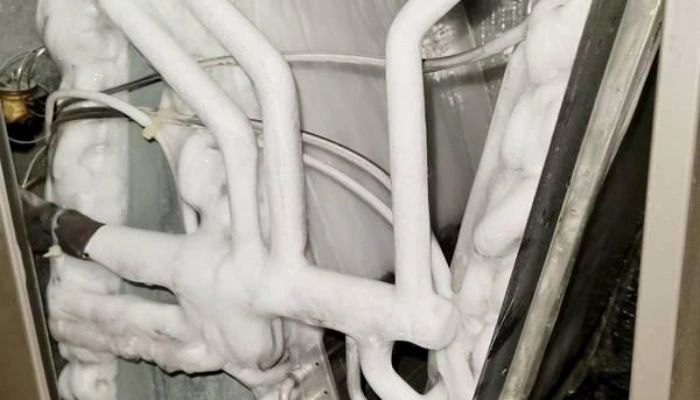
If room temperature and airflow look normal, the problem may be on the refrigeration side. Low refrigerant, a leak, or a metering issue can drive the evaporating temperature down far enough to create icing. Uneven frost, icing that returns quickly after thawing, or repeated freeze-up after airflow has been corrected usually points to a deeper technical fault.
Frost Is Not Being Cleared Effectively
Some units can handle light frost before it becomes a problem. Others begin icing when controls or defrost response cannot keep up with colder or lower-load conditions. If the same unit freezes again and again in the same operating window, the issue may be linked to defrost timing, control response, or overall application fit. In refrigeration control design, hot-gas bypass protection is used to help prevent evaporator icing by protecting against excessively low evaporating temperature under reduced load.
What to Check First
A frozen unit does not automatically mean there is a serious refrigeration failure. The order of checks matters.
Step 1: Shut the Unit Down and Let It Thaw
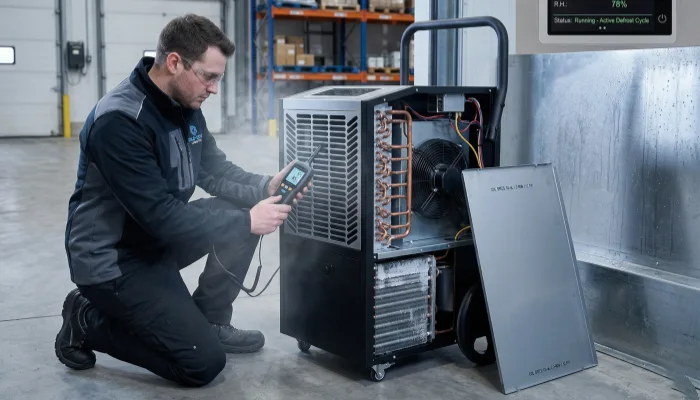
Do not keep running a frozen unit. Do not chip away at the ice. Let the coil thaw fully before judging what the problem looks like. If the ice is still present, later checks can be misleading.
Step 2: Look at the Actual Operating Zone
Do not rely only on the average building temperature. Look at the real zone where the unit is working.
- Is the unit near a cold doorway?
- Does the problem return during colder shifts or overnight?
- Is this a chilled transfer area or an unheated part of the site?
- Does the problem show up only during certain loading periods?
In washdown-heavy or chilled production areas, freeze-up is rarely an isolated coil issue. It usually sits inside a wider food processing humidity-control problem with condensation, packaging instability, or moisture returning around colder surfaces.
Step 3: Check Airflow and Coil Condition
This is often the highest-probability step.
- Inspect the filter
- Check intake and discharge clearance
- Look at the fan
- Inspect the coil for dust, residues, and visible fouling
If airflow is poor, correct that first. Many repeated icing complaints start here, not in the refrigeration circuit.
Step 4: Check Whether the Unit Is Clearing Frost Properly
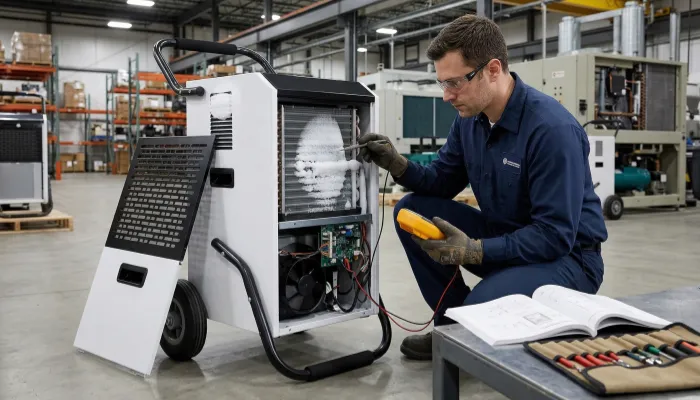
If the unit is designed to defrost, is it doing so in the right way and at the right time? Repeated icing in a cold or variable zone often points to a defrost or control issue before it points to a major mechanical failure.
Step 5: Move to Qualified Technical Service
Only after temperature, airflow, and visible coil condition have been checked does it make sense to move deeper into:
- refrigerant charge
- leak checks
- metering performance
- sensor accuracy
- control behavior
Practical Diagnosis Table
| Check first | Why it matters | What it suggests |
|---|---|---|
| Room temperature | Cold air reduces heat load on the coil | Possible application mismatch |
| Filter and airflow | Low airflow is a common icing trigger | Maintenance or airflow fault |
| Coil cleanliness | Dirty surfaces reduce heat transfer | Service needed before deeper diagnosis |
| Defrost behavior | Frost may be building faster than it is cleared | Control or defrost issue |
| Repeat icing after basic checks | The problem is deeper than routine maintenance | Move to qualified service and review fit |
When Repeated Freeze-Up Becomes an Application-Fit Problem
A one-time freeze-up may come from airflow or maintenance issues. Repeated freeze-up in the same operating window usually points to a broader fit problem.
If the same unit keeps freezing during the same shift, season, or temperature range, it makes sense to review operating temperature, moisture load, and installation conditions more carefully. That is where how to choose an industrial dehumidifier becomes relevant, especially when the question is no longer what failed, but whether the current unit matches the real environment.
If the site regularly operates near freezing, a purpose-built low temperature dehumidifier may be more suitable than a standard unit intended for warmer ambient conditions.
Quick comparison: repair issue or application issue?
| Situation | More likely a repair issue | More likely an application issue |
|---|---|---|
| Dirty filter caused one freeze event | Yes | No |
| One-off airflow blockage | Yes | No |
| Same unit freezes every winter | Sometimes | Often |
| Same cold door zone triggers icing repeatedly | Sometimes | Often |
| Unit runs in near-freezing conditions all season | Not usually enough by itself | Very likely |
Freeze-Up vs. Low Water Output
These two complaints often appear together, but they should not be treated as identical.
If the coil is frozen, water output may drop because the moisture is freezing on the coil instead of draining away. But low water output can also come from load changes, drainage problems, or other performance issues. If the unit is running but water output is low, compare the symptoms with the low-water-output troubleshooting guide so icing-related drainage loss is not confused with other causes.
How to Prevent Repeat Freeze-Up
The most effective prevention plan is usually simple.
- Keep filters and coils clean
- Maintain clear airflow around the unit
- Watch colder parts of the site, not just the average room reading
- Pay attention to door zones, transfer areas, and colder operating windows
- Review whether the equipment type matches the actual temperature range
In colder storage and transfer areas, repeated freeze-up often appears alongside floor dampness, heavier frost, or unstable zone conditions. In cold storage environments, excess humidity is closely associated with condensation, ice buildup, slippery floors, and frozen evaporator coils, which is why repeated freeze-up in these areas should be treated as a broader humidity-control issue rather than a one-off service event. Once the same pattern starts repeating, routine cleaning alone is usually not enough to stop it.
Preventive Action Table
| Preventive action | What it helps reduce |
|---|---|
| Clean filters on schedule | Airflow-related icing |
| Keep coil surfaces clean | Heat-transfer loss |
| Review colder operating hours | Hidden low-temperature risk |
| Watch door zones and transitions | Repeated localized freeze-up |
| Match unit type to temperature range | Chronic application mismatch |
What to Do Next
Freeze-up usually means the unit and the operating condition are no longer working well together. Start with the basics in order: check the room condition, airflow path, coil condition, and frost-clearing behavior first. If the same pattern keeps returning in the same zone or season, the site conditions and the current solution should be reviewed together. That is usually where the real answer begins.
FAQ
Why does the unit freeze only during certain shifts or seasons?
This usually points to changing conditions around the unit rather than a constant mechanical fault. Night shifts, colder weather, reduced room load, or frequent door openings can all change how much heat reaches the coil.
Can a repeed freeze-up shorten equipment life?
It can. A unit that freezes repeatedly may spend more time running inefficiently, may clear frost less effectively over time, and may face more strain if the underlying issue is never corrected.
Does repeated icing always mean the unit is too small?
No. In many cases, icing is more closely linked to temperature range, airflow, or equipment type than raw capacity. A larger unit is not always the answer if the environment is too cold for the current design.
Can door traffic alone trigger repeated icing in one area?
It can, especially if warm, moist air enters a colder zone again and again. That pattern is common near loading doors, cold-room entrances, and transfer spaces.
When is it worth considering a different dehumidification approach?
If icing keeps returning in the same cold or unstable environment after basic maintenance and service checks, it usually makes sense to review whether a different equipment type would fit the condition better.