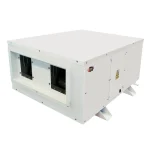
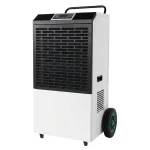
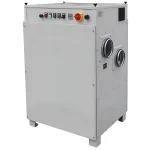
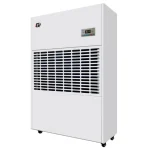
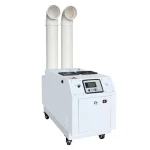
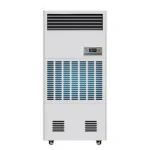
This guide explains how large-capacity dehumidification equipment works — the refrigerant and desiccant principles behind it — and how to diagnose the faults that appear once a unit is installed and running in warehouses, production halls, and cold stores.
For models, capacities and specifications, see our industrial dehumidifiers. This article is also the starting point for three more specific guides: how to choose an industrial dehumidifier for the decision points, how to size an industrial dehumidifier for capacity, and industrial dehumidification by application for environment-specific requirements.
What Sets Large-Capacity Units Apart
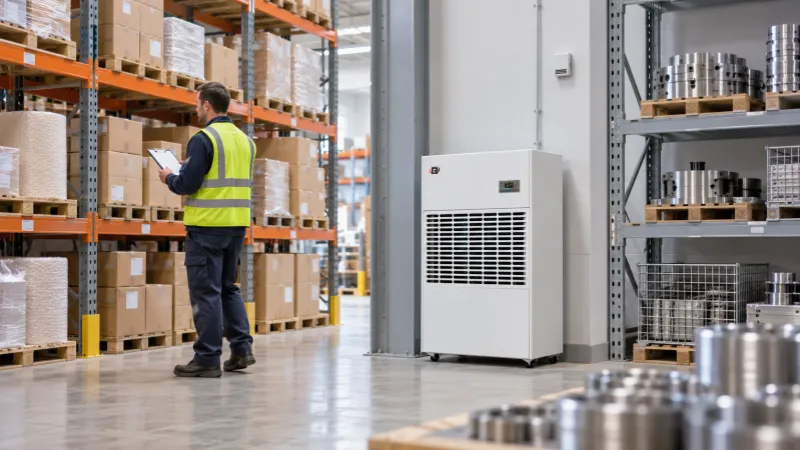
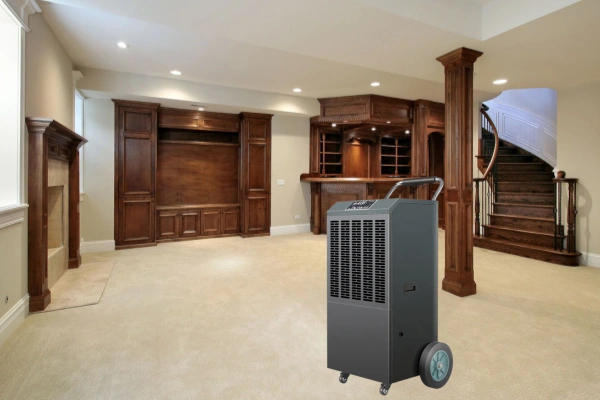
These machines are built for large-scale moisture removal. They are built with high-capacity components – powerful fans, large cooling coils or desiccant beds, and robust compressors or heaters – to process huge volumes of air continuously. For example, an industrial unit can pull hundreds of pints of water out of the air per day, equivalent to dozens of gallons or hundreds of liters. This far exceeds what a small home dehumidifier can manage. By cycling large amounts of air through the system, industrial models steadily reduce the overall humidity of a facility and keep it within a safe range.
Types of Industrial Dehumidifiers
There are two main types of industrial dehumidifiers: refrigerant and desiccant. Each uses a different method to remove moisture and is suited to different conditions. For effective humidity control, it’s important to understand the distinction between them.
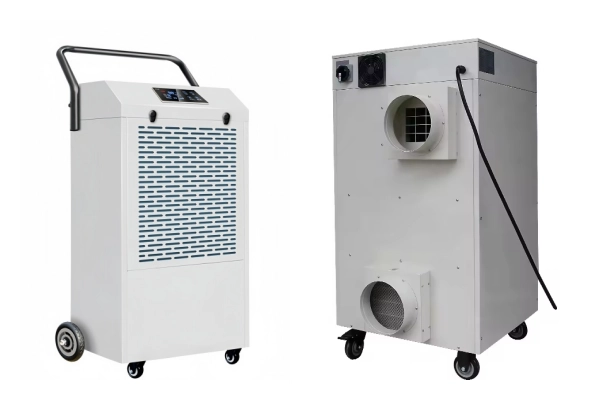
- Refrigerant (compressor) units
Refrigerant units condense water on a cold coil, so everything about their performance follows from one fact: the coil has to be colder than the dew point of the incoming air. In warm, humid conditions this is easy and efficient, which is why these units suit standard warehouses, production halls, and workshops. As the air gets colder or drier, the coil has to run closer to freezing, capacity falls, and eventually frost forms and blocks airflow. That is the real limit — not a temperature written on a datasheet, but the lowest dew point the coil can hold without icing. It is also why a rated capacity figure only means something alongside the temperature and RH it was measured at. - Desiccant (rotor) units
A desiccant unit does not cool the air. Moist air passes through a rotor coated in an adsorbent material that holds the water vapour; a separate airstream is heated and passed through another section of the same rotor to drive that moisture off and vent it away. Because no dew point has to be reached, the process keeps working at low temperature and can dry air well below what a coil can achieve. The costs are structural rather than incidental: heat is required continuously for regeneration, and because that heat enters the process, the air returning to the space is warmer than it went in. In a cold store this is sometimes a benefit and sometimes an added cooling load — it needs to be counted either way.
Working principle of industrial dehumidifiers
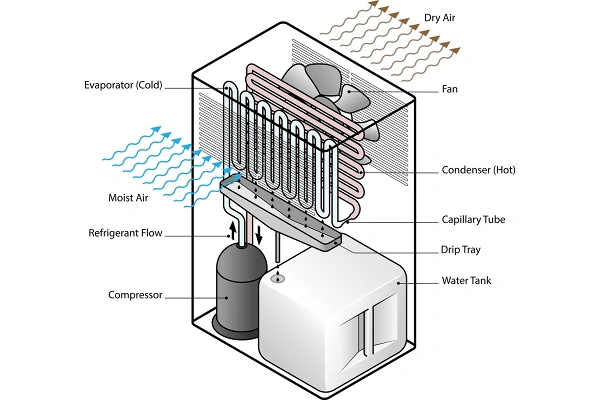
Refrigerant units use a refrigeration cycle similar to an air conditioner. When humid air passes over the dehumidifier’s cold evaporator coils, water condenses out of the air into liquid droplets. The collected water then drains away, and the air is reheated by the condenser coil and vented back into the room, now much drier. Want to know exactly how a dehumidifier works? Click the image for our in-depth article.
Desiccant dehumidifiers use a different approach – they pull moisture from the air using a drying substance. Typically, these units contain a rotor or cartridge filled with a desiccant material. As moist air flows through, the desiccant attracts and holds the water vapor. A second internal process then regenerates the desiccant: usually, a heater warms a portion of the desiccant material to release the absorbed moisture. The extracted moisture is vented out of the unit as a warm, damp airflow or condensed and drained away. The result is a flow of very dry air returning to the space.
Benefits of Industrial Dehumidifiers
Industrial dehumidification can help maintain the moisture conditions needed by goods, equipment, and processes when it is selected and operated for the site. The result depends on the moisture entering the space, the required condition, airflow, installation, and maintenance. Equipment alone does not replace storage procedures, building repairs, or the site’s quality controls.
- Mold and mildew risk: Excess moisture can make surfaces and stored goods more vulnerable to mold. Humidity control can help reduce that risk, but existing growth and water sources need separate treatment.
- Corrosion risk: Moisture can contribute to corrosion on machinery, panels, and structural steel. Control requirements also depend on surface temperature and contaminants.
- Safety and comfort: Condensation can contribute to wet surfaces and uncomfortable working conditions. Humidity control supports, but does not replace, site safety measures.
- Product quality: Moisture-sensitive goods and processes may require defined storage or production conditions. Meeting those requirements also depends on monitoring, handling procedures, and quality controls.
Where They Are Used

Warehousing, manufacturing, food and pharmaceutical storage, natatoriums, greenhouses, and construction drying all rely on industrial dehumidification, but each has a different moisture source, target RH band, and design constraint — and those differences change the equipment, not just the capacity. Humidity targets and requirements for each are compared in our guide to industrial dehumidification by application.
Working on a warehouse project? Use our warehouse dehumidification solution to review storage conditions, equipment routes, and the site information needed for selection. Keep the general sizing process separate from the warehouse’s specific operating inputs.
Choosing and Sizing: Where to Go Next
Selection separates into two questions. Use the industrial dehumidifier selection guide to compare technology and format against operating temperature, target humidity, and installation constraints. Then size the industrial dehumidifier from the moisture load rather than floor area alone.
Capacity bands, temperature ranges, and specifications for each format are listed on our full product range.
Installation Basics
Condensate drainage applies to refrigerant units. For desiccant systems, follow the required process and regeneration-air routing and electrical configuration. Installation details should always be checked against the selected model’s instructions.
Three installation details account for most performance complaints that are not sizing problems.
Level mounting. These units are heavy and the condensate pan drains by gravity to a single outlet. A unit sitting off-level holds water in the pan and can overflow while every reading on the panel looks normal.
Clearance at inlet and outlet. Both need space. A unit pushed into a corner recirculates its own dry discharge, reads a low RH at the sensor, and leaves the far end of the space damp. This is one of the most frequently misdiagnosed faults on site — it presents as insufficient capacity and is actually air distribution.
Drainage established before first run. Route the hose to a floor drain or sump before commissioning and confirm it is neither kinked nor lifted above the outlet. In cold rooms the line needs freeze protection, or it will back up while the unit runs normally.
Filter and coil service intervals, along with the maintenance-access points worth checking before ordering, are covered in the selection guide above.
Common Industrial Dehumidifier Problems and Solutions
Dehumidifier runs but humidity does not decrease
This is often caused by undersized equipment, excessive air infiltration, or clogged filters. Check whether doors and windows are frequently opened, clean the air filters, and verify that the unit capacity matches the moisture load.
Water leakage or drainage issues
Loose hoses, blocked drains, or a faulty condensate pump can cause water leaks. Inspect the drainage system, ensure hoses are properly connected, and clean any blockages.
Unit shuts down unexpectedly
This may result from electrical issues, overheating, or safety protection mechanisms being triggered. Check the power supply, ensure proper airflow around the unit, and inspect for error indicators.
Frost buildup on coils (refrigerant units)
Icing usually occurs in low-temperature environments or when airflow is restricted. Ensure the unit is operating within its temperature range and that defrost functions are working correctly.
Setpoint is reached but part of the space is still damp
The controller reads the air arriving at its own sensor, not the condition of the room. Where airflow does not reach a corner, a mezzanine, or the far side of a racking run, that zone stays wet while the panel reports target humidity. Check discharge direction and obstruction before adding capacity — a second unit placed for distribution often resolves this where a larger single unit will not.
Discharge air makes the space feel warmer
Refrigerant units return slightly warmed air by design, because the heat removed from the airstream plus the compressor’s own heat re-enters the room. Desiccant units add more, since regeneration heat is part of the process. Whether this is noticeable depends on room volume, ventilation, and run time. In small enclosed rooms it can be significant enough to affect the cooling load and should be accounted for at design stage rather than treated as a fault.
For detailed troubleshooting procedures, technical specifications, and maintenance schedules, always refer to the product user manual.
FAQ
Why is the unit running continuously without the humidity dropping?
The three usual causes are moisture entering as fast as it is removed, air not reaching the whole space, and restricted airflow through the machine. Check door and dock activity and any process moisture source, then the filter, then the discharge path. Capacity is the last thing to suspect, not the first.
What does a rated capacity figure actually tell me?
Only what the unit removed at the temperature and humidity used for the test. The same machine measured at a hotter, wetter condition shows a substantially larger number. A capacity figure quoted without its rating condition cannot be compared with another supplier’s.
Why does frost form on the coil, and is it a fault?
Frost forms when the coil surface drops to around freezing, which happens as entering air gets colder or drier. Occasional frost cleared by a working defrost cycle is normal operation. Persistent frost means either the ambient conditions are outside the unit’s range or the defrost function is not operating — and at that point the application may need a desiccant system rather than a larger refrigerant one.