Choosing the right electrical configuration is essential for an industrial dehumidifier. Matching voltage alone is not enough; phase, frequency, current, and connection requirements also need to match the actual site supply.
This guide explains the common voltage and frequency combinations by market, when single-phase or three-phase power is used, how to check the nameplate and site supply, and what to do when the electrical requirements do not match.
Specify the Full Electrical Combination, Not Voltage Alone
Voltage, phase, and frequency are separate variables. The supply available to an industrial facility also varies by country, utility, and building distribution system, so a familiar voltage alone does not prove that a dehumidifier is compatible.
Common Industrial Supply Examples by Market
The table below is only a regional reference. Always confirm the actual site supply before approving the equipment.
| Market | Common low-voltage supply examples | Frequency | What to confirm |
|---|---|---|---|
| United States | 208/120 V, 480/277 V three-phase systems; other systems also exist | 60 Hz | Actual line voltage, phase, and neutral requirement |
| Canada | 208/120 V, 347/600 V; other voltages may also be used | 60 Hz | Exact site voltage and phase |
| Europe / UK | 230 V single-phase, 400/230 V three-phase | 50 Hz | Actual terminal voltage and approved unit range |
| China | 220 V single-phase, 380/220 V three-phase | 50 Hz | Whether the unit is configured for the destination market |
| Australia / New Zealand | Around 230–240 V single-phase and 400–415 V three-phase | 50 Hz | Actual site voltage rather than nominal terminology alone |
| Japan | 100 V and 200 V systems | 50 Hz or 60 Hz depending on region | Both voltage and local frequency |
| South Korea | 220 V single-phase, 380/220 V three-phase | 60 Hz | Do not assume a 380 V / 50 Hz unit is compatible |
| Middle East | Commonly 230/400 V or 240/415 V, depending on country | Usually 50 Hz | Country- and project-specific supply |
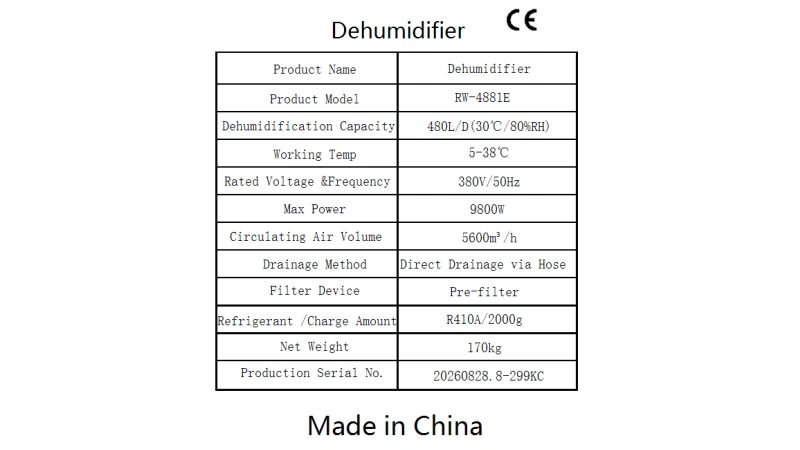
These regional values are useful for early project discussions, but they are not the final equipment specification. A request such as “380 V industrial dehumidifier” is still incomplete. The supplier should confirm the full combination:
Voltage / Phase / Frequency
For example:
400 V / 3 Ph / 50 Hz
Do not assume that similar nominal voltages such as 380 V, 400 V, and 415 V are automatically interchangeable. The approved electrical data sheet for the selected model should always be the final reference.
When Does an Industrial Dehumidifier Use Single-Phase or Three-Phase Power?
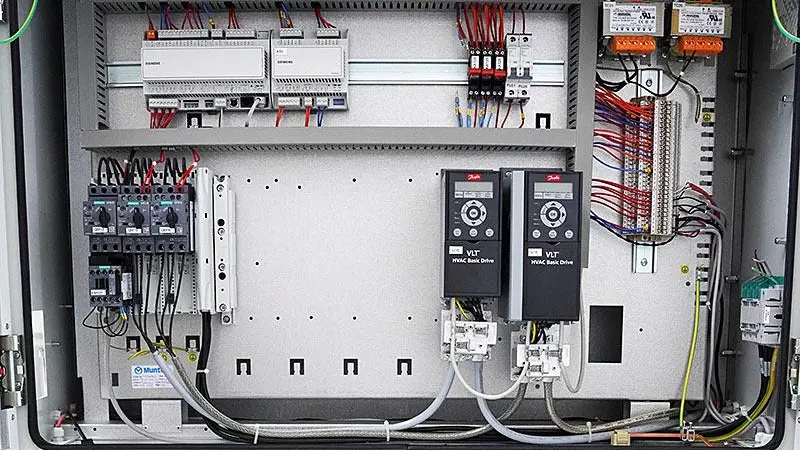
Single-phase equipment can be practical where the unit load is modest and the required electrical service is already available. Three-phase power becomes more common as compressors, fans, and regeneration heaters become larger because power is distributed across three phases and line current can be lower for the same real input power. There is no universal capacity or kilowatt threshold at which every industrial dehumidifier changes from single-phase to three-phase. The boundary depends on:
- equipment design;
- compressor, fan, and heater loads;
- available electrical versions;
- starting method;
- and the site’s existing distribution system.
For a balanced load, approximate current can be illustrated as:
- Single-phase:
I = P / (V × PF) - Three-phase:
I = P / (√3 × V × PF)
The following comparison assumes a real input power of 10 kW and a power factor of 0.90 only to show the relationship. It is not a circuit design schedule and does not include starting current or other design factors.
| Theoretical supply | Approximate line current for the same 10 kW input | What the comparison means |
|---|---|---|
| 230 V / 1 Ph | 48.3 A | A lower-voltage single-phase load requires more line current |
| 400 V / 3 Ph | 16.0 A | Three-phase distribution can substantially reduce line current |
| 480 V / 3 Ph | 13.4 A | Higher voltage further reduces current for the same assumed real power and power factor |
Buyers do not need to calculate these values themselves. The comparison simply explains why three-phase power becomes more common as equipment load increases.
Lower current can reduce voltage drop and reduce the load carried by the site’s electrical distribution system. It does not, however, prove lower energy consumption or better dehumidification efficiency. Compare electricity use from input power and runtime. Compare moisture removed per kWh only when the dehumidifiers are rated under the same test conditions. Those questions are covered separately in the guide to industrial dehumidifier electricity use.
When several single-phase units are supplied from a three-phase building system, the electrical designer should distribute the loads to avoid excessive phase imbalance. Do not assume that additional single-phase units can simply be connected wherever spare breaker positions are available.
Do Not Assume 50 Hz and 60 Hz Are Interchangeable
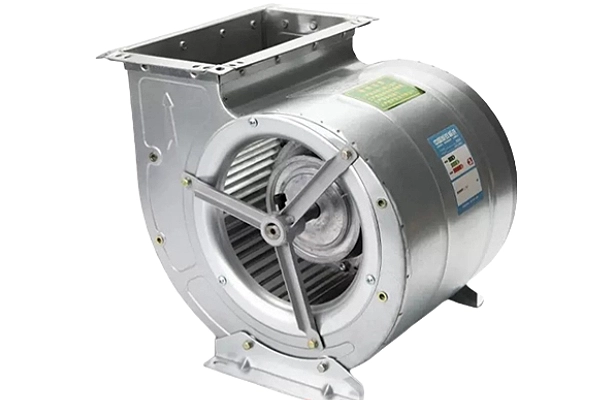
Matching voltage does not prove matching frequency.
An ordinary transformer can change a voltage ratio, but it does not change the supply frequency. This matters particularly for fixed-speed refrigerant dehumidifiers because compressors and fans contain rotating equipment whose speed, current, cooling, and protection behavior can depend on frequency. For a directly connected induction motor, synchronous speed is proportional to frequency. A frequency mismatch can therefore affect fan airflow and pressure, compressor operation, cooling, and current.
Buyers do not need to calculate the effect of a frequency mismatch. The practical rule is simple: use the frequency approved for the complete unit.
For example, a unit marked only:
230 V / 1 Ph / 50 Hz
should not automatically be approved for a site providing:
230 V / 1 Ph / 60 Hz
simply because the voltage matches.
Use a different frequency only when the complete-unit nameplate or approved data sheet explicitly includes it. A compressor or motor that is available in both 50 Hz and 60 Hz versions does not automatically make the complete dehumidifier dual-frequency compatible. Desiccant equipment requires the same check. A regeneration heater may be mainly voltage-sensitive, while process fans, regeneration fans, rotor drives, and controls can have different electrical requirements.
Review the complete installed load and the approved desiccant dehumidifier specifications rather than assuming that the regeneration-heater rating describes the whole machine.
Use the Nameplate and Electrical Data Sheet as the Final Reference
The nameplate and approved electrical data sheet should be the starting point for confirming whether a dehumidifier matches the site supply. A simple power / voltage calculation can omit power factor, three-phase relationships, individual internal loads, and compressor starting behavior. Buyers do not need to memorize every electrical abbreviation or calculate the supply circuit from these values. The important point is not to mistake a compressor, fan, or motor rating for the electrical requirement of the complete dehumidifier.
| Nameplate or schedule item | How to use it |
|---|---|
| Voltage and allowable range | Compare with the actual supply voltage at the equipment location |
| Phase and wire configuration | Confirm single- or three-phase supply, neutral requirement, grounding, and available panel configuration |
| Frequency | Match the site frequency unless the complete unit is explicitly rated for both |
| Complete-unit rated or input current | Use the manufacturer’s defined whole-unit operating value where provided |
| Compressor RLA / motor FLA | Check whether the value applies only to an individual compressor, fan, or motor; do not treat it automatically as complete-unit circuit current |
| LRA / manufacturer-specified starting current | Review starting demand; LRA and the actual complete-unit starting current are not automatically the same |
| MCA | Where provided, MCA gives the manufacturer’s minimum current basis for sizing the supply circuit. Local electrical codes still apply |
| MOCP or MOP | Where provided, do not use overcurrent protection above the manufacturer’s marked maximum value |
| Recommended breaker or fuse | Follow the listed device type together with local electrical requirements |
| Power connection | Confirm hardwire or plug/receptacle connection, disconnect arrangement, and cable-entry requirements |
MCA is not normal running current, and MOCP is not continuous current draw. Likewise, compressor RLA or fan FLA should not be substituted for a complete-unit circuit requirement unless the manufacturer’s documentation specifically instructs that use. If the required electrical values are not published, request the model’s electrical schedule instead of reconstructing one from a marketing power figure.
Once the unit requirements are clear, the next step is to confirm that the site can actually provide them.
Verify the Actual Supply Where the Dehumidifier Will Operate
A panel label tells you the nominal electrical system, but it does not always tell you what reaches the dehumidifier while the facility is operating under load. Long cable runs, temporary feeders, weak connections, generator regulation, and several motors starting at the same time can all affect the voltage available at the equipment.
Before final model approval, have the site electrical team confirm at least:
- actual line-to-line voltage and, where relevant, line-to-neutral voltage;
- single- or three-phase supply;
- 50 Hz or 60 Hz frequency;
- available circuit or breaker capacity;
- whether the source is normal utility power, transformer-fed, temporary distribution, or a generator;
- and the required grounding, neutral, disconnect, and connection arrangement.
Where supply quality is uncertain, measurements should represent realistic operating conditions rather than only an unloaded building.
| Site condition | What may appear during operation | Project response |
|---|---|---|
| Excessive voltage drop | Hard starting, protection trips, contactor instability, or overheating | Have the electrical designer check the supply circuit and verify terminal voltage under load |
| Generator sized only from running kW | Voltage or frequency sag during compressor starting | Check starting demand and generator regulator response |
| Several units start together | Bus-voltage dip or upstream protection operation | Review source capacity and starting sequence |
| Panel voltage is correct but equipment-terminal voltage is not | Intermittent apparent equipment faults | Inspect the connection path and measure at the unit |
| Supply is outside the approved unit range | Reduced performance, shutdown, or equipment damage | Correct the supply or select the appropriate electrical version before operation |
The dehumidifier manufacturer defines the electrical conditions the unit requires. The local electrical designer determines how the building should safely provide those conditions. If the site supply and the selected unit do not match, first identify what type of mismatch you actually have.
Can a Transformer Solve the Electrical Mismatch?
Sometimes—but only when the mismatch is actually a voltage problem. A transformer is not a universal compatibility device. Siemens’ transformer selection guidance notes that supply frequency must be compatible with the connected equipment and that an ordinary transformer does not convert single-phase power into three-phase power.
| Problem | Can an ordinary transformer solve it? | What to do |
|---|---|---|
| Phase and frequency match, but the site voltage is outside the unit’s approved range | Sometimes | Have the electrical designer select the transformer and confirm the resulting voltage with the dehumidifier manufacturer |
| 50 Hz supply and 60 Hz-only equipment, or the reverse | No | Select a complete unit approved for the actual site frequency |
| Single-phase supply and three-phase equipment | No, not by an ordinary transformer alone | Select the correct equipment version or use an engineered site-supply solution |
| Voltage drops excessively under load | Not necessarily | Investigate the supply circuit, connections, source capacity, or regulation problem first |
| Generator frequency falls during compressor starting | No | Correct generator sizing or control performance |
Do not select a transformer from running current alone. Transformer sizing and installation can also depend on starting demand, protection, grounding, enclosure, temperature rise, conductors, and local electrical codes. Those details belong to the electrical designer. The dehumidifier manufacturer should confirm that the resulting secondary supply remains inside the complete unit’s approved electrical range.
Confirm the Electrical Requirements Before Production
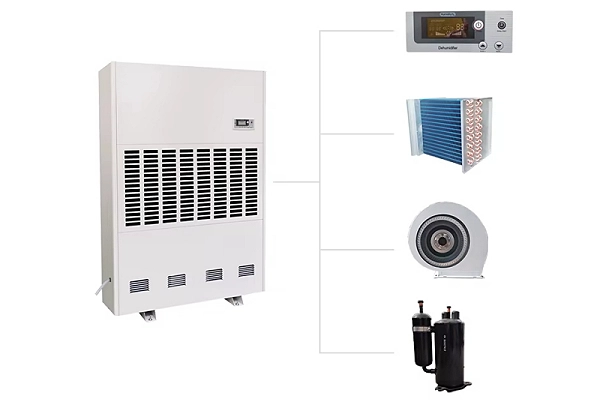
Electrical compatibility should be resolved before production, not after the dehumidifier arrives on site. For most industrial dehumidifier RFQs, the buyer should provide:
- Country and project location
- Actual or nominal site voltage
- Single-phase or three-phase supply
- 50 Hz or 60 Hz frequency
- Available circuit or breaker capacity
- Utility, transformer-fed, or generator-fed source
- Required plug type or hardwired connection
- Destination-market certification or inspection requirements
The supplier should then return the approved electrical schedule for the selected model, including:
- voltage and allowable range;
- phase;
- frequency;
- rated or input current;
- applicable starting-current information;
- MCA and MOCP/MOP where relevant;
- connection requirements;
- and the applicable wiring diagram.
More detailed matters such as conductor sizing, cable routing, voltage-drop calculations, breaker coordination, transformer selection, and local disconnect design should be completed by the qualified electrical designer responsible for the installation. Electrical data also does not replace the process information required to select the dehumidifier itself. The project should still define:
- application;
- operating temperature;
- current and target RH;
- moisture load;
- airflow requirements;
- and drainage arrangement.
For hazardous areas, electrical compatibility is only one part of the specification. The exact equipment build must also match the required hazardous-area classification and certification. See Rinwang’s hazardous-area dehumidifier solutions for project-specific review.
If you are preparing an industrial dehumidifier project, send Rinwang the site electrical information together with the temperature, humidity, and moisture-load data. Resolving the electrical interface before production is far less expensive than changing the building supply or replacing equipment after delivery.
Everything above should be resolved before production. One additional check becomes important after a three-phase unit reaches the site: phase sequence.
Verify Phase Sequence When Commissioning a Three-Phase Unit
Once a three-phase dehumidifier reaches the site, correct voltage alone does not prove that the compressor phase sequence is correct. Three-phase scroll compressors are designed to rotate in a specified direction. Wrong phase sequence, phase loss, voltage imbalance, or loose connections can cause abnormal operation or protection faults.
The Danfoss commissioning guidance for three-phase scroll compressors instructs technicians to establish phase order with a phase meter and describes model-specific phase-reversal and phase-loss protection.
During first start, symptoms such as:
- abnormal compressor sound;
- failure to develop the expected pressure difference;
- unexpectedly low power;
- or an immediate protection alarm
should be investigated before continued operation. Follow the equipment wiring diagram and compressor commissioning procedure rather than repeatedly restarting the unit to see whether the problem clears. Electrical panels and terminals should be inspected or serviced only by qualified personnel under the applicable local electrical-safety rules. In the United States, relevant work is subject to OSHA electrical work-practice requirements.
Frequently Asked Questions
Is a 208 V supply the same as 230 V or 240 V for an industrial dehumidifier?
No. Use a 208 V supply only when the complete dehumidifier is explicitly rated for a voltage range that includes the actual site voltage.
Can a 380 V industrial dehumidifier run on 400 V or 415 V?
Only when the complete unit’s approved voltage range includes the actual terminal voltage and the phase and frequency also match.
Can a 50 Hz industrial dehumidifier run on 60 Hz if the voltage is the same?
Only when the complete unit is explicitly rated for both frequencies. Matching voltage alone does not confirm compatibility because compressors, fans, drives, and controls may have frequency-specific requirements.
Does three-phase power make an industrial dehumidifier use less electricity?
Not automatically. Three-phase or higher-voltage distribution can reduce line current for the same real input power, but electricity consumption depends on input power and runtime.
Does an industrial dehumidifier need a dedicated circuit?
Follow the approved electrical data, installation manual, and local electrical design. Fixed industrial equipment is commonly supplied from a dedicated branch circuit so conductors, protection, disconnects, and starting behavior can be coordinated without unrelated loads.
Can a generator run an industrial dehumidifier?
Yes, provided the generator can maintain the required voltage and frequency while supplying both the running load and the equipment’s starting demand. Confirm phase, grounding, regulator response, starting performance, and the effect of other loads connected to the same generator.