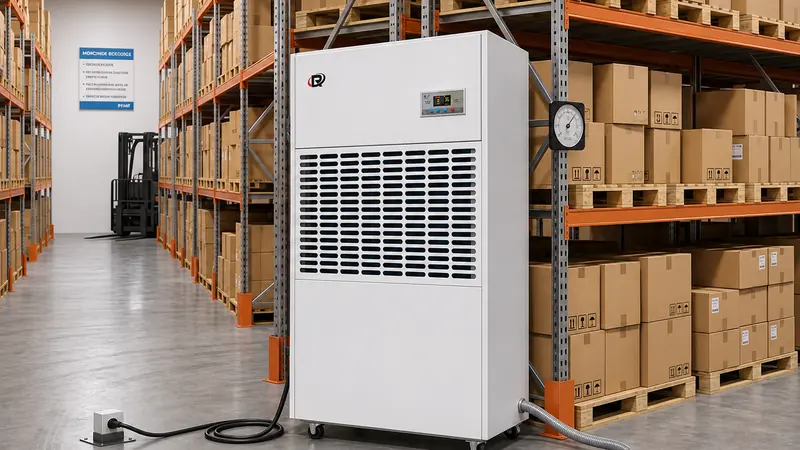
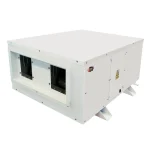
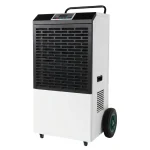
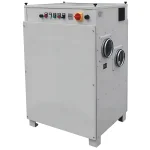
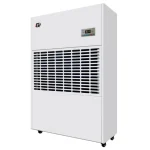
An industrial dehumidifier’s specification sheet tells you how much moisture it can remove, how much air it moves and what power supply it needs. But what do those figures mean for your facility? Does a rating of 150 L/day mean the machine will collect 150 liters every day? Will its stated airflow still be available after ductwork is connected?
This guide explains the main specifications in plain language, shows how operating conditions affect the numbers and highlights what to check before buying. You can use it while browsing product pages, reading a datasheet or comparing quotations.
What Does the Moisture-Removal Capacity Mean?
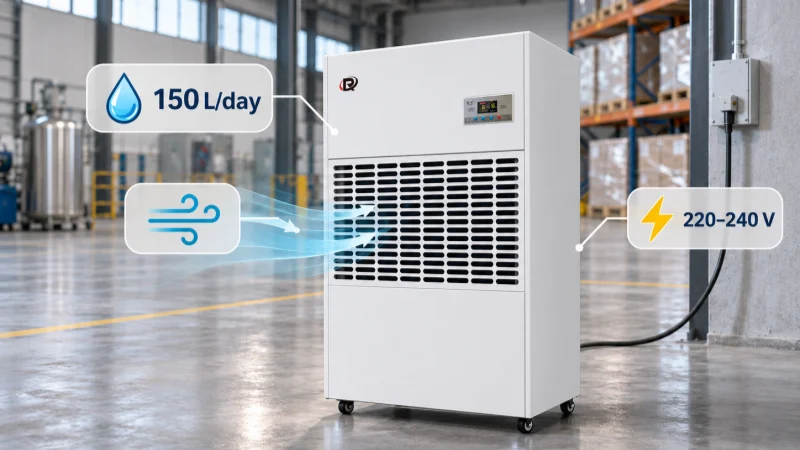
For industrial dehumidifiers, moisture-removal capacity is the amount of water a unit can remove from the air under stated test conditions. For example, 150 L/day at 30°C and 80% RH means the unit is rated to remove 150 liters over 24 hours under those conditions. RH stands for relative humidity.
It does not mean the machine will collect 150 liters every day in your facility. The amount removed depends on the temperature and moisture in the air entering the unit. A refrigerant dehumidifier will generally remove less water when the air is cooler or drier.
This is why the temperature and humidity printed beside the capacity matter. Consider this simplified example; these figures are illustrative, not specifications for actual products:
| Specification | Unit A | Unit B |
|---|---|---|
| Rated moisture removal | 150 L/day | 180 L/day |
| Temperature during testing | 26.7°C | 30°C |
| Relative humidity during testing | 60% RH | 80% RH |
Unit B has the larger published number, but it was also tested in warmer, more humid air. These figures alone do not show which unit would remove more water in the same room. To compare them fairly, ask for both units’ capacities at the same temperature and humidity, preferably conditions close to those expected in your facility.
Understanding L/day, PPD, kg/h and lb/hr
L/day means liters removed per 24 hours. PPD means pints per day, so check whether the supplier uses US pints or another pint definition. For US pints, multiply PPD by approximately 0.4732 to obtain L/day: 100 US PPD is about 47.3 L/day at the same test conditions. Ratings in kg/h or lb/hr express the mass of water removed per hour; 1 lb/hr is approximately 0.4536 kg/h.
Converting units makes the figures easier to read together, but it does not account for different test temperatures or humidity levels. The machine’s published rating is also different from your facility’s required moisture-removal capacity, which depends on how much moisture enters or is released in the space.
What Do “AHAM,” “DOE” and “Saturation” Mean?
AHAM stands for the Association of Home Appliance Manufacturers, and DOE for the U.S. Department of Energy. These names may appear beside a capacity figure to identify the testing basis. A “saturation” rating usually refers to very humid test conditions. In each case, look for the actual temperature and RH; if they are absent, ask which test method and conditions were used.
ENERGY STAR’s explanation of dehumidifier testing gives a useful example: changing the portable residential test temperature from 80°F to 65°F led to lower reported capacities. This illustrates why test conditions matter, but the residential method is not a universal industrial rating rule. Do not use it to calculate an industrial unit’s capacity at another temperature.
What Does the Operating Range Tell You?
The operating temperature range tells you the temperatures at which the machine is designed to run. It does not tell you how much water it removes at every temperature within that range. Similarly, the humidity range on a controller tells you which settings are available, not whether the machine can maintain every setting in your space.
For example, drying a warm, damp room initially is different from keeping it dry after it has cooled down. A capacity figure for the first situation does not describe performance in the second. If the datasheet only shows one test condition, the supplier can provide a table or chart showing capacity at other temperatures and humidity levels. Look for conditions close to the air that will enter the machine during normal use.
For a refrigerant dehumidifier used in a cool room, defrosting also matters. Frost on the cooling coil needs to be cleared, which can reduce the time available for removing moisture. Ask whether the stated capacity includes defrost periods. The words “automatic defrost” describe a feature; they do not tell you the average amount of water the unit will remove over a day.
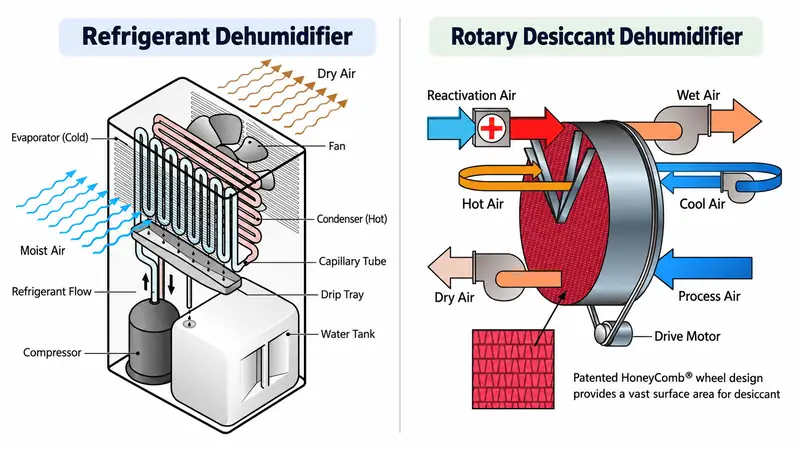
On a rotary desiccant model, you may see two sets of air figures. As described in ASHRAE’s handbook chapter on desiccant dehumidification, process air is the air being dried, while heated reactivation air dries the moisture-absorbing material so it can be used again. Keep the two sets of figures separate, and check what supplies the reactivation heat. The supplier’s data should describe the particular model you are considering.
How Should You Read Airflow and Static Pressure?
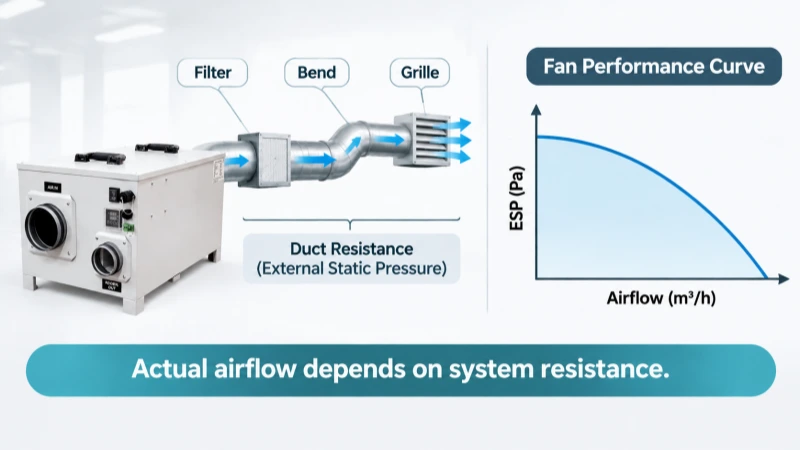
Airflow tells you the volume of air the machine moves, usually in m³/h or cubic feet per minute (CFM). It is different from moisture-removal capacity: moving more air does not, by itself, tell you how much water a unit removes. For a ducted installation, you also need to know whether the fan can deliver that airflow through the connected ductwork.
Ducts, bends and grilles resist airflow. External static pressure (ESP) describes the pressure the fan must work against outside the unit, usually in pascals (Pa) or inches of water column. A “free-air” airflow figure is measured without this external resistance, so it may be higher than the airflow available once ducts are connected.
An airflow chart shows how much air the fan can move at different pressures. The useful figure is the airflow at the pressure your duct system requires. Maximum airflow and maximum pressure listed separately are not necessarily available at the same time. The chart should also match the fitted filter and fan setting; a different filter or speed can change the result.
You do not need to calculate duct resistance from the product sheet yourself. The duct designer works out the installation’s resistance, and the supplier provides the matching fan data. They should also check which filter and accessory pressure losses are already included. For a unit with separate process and reactivation fans, each air path needs its own check.
What Do the Electrical and Efficiency Figures Mean?
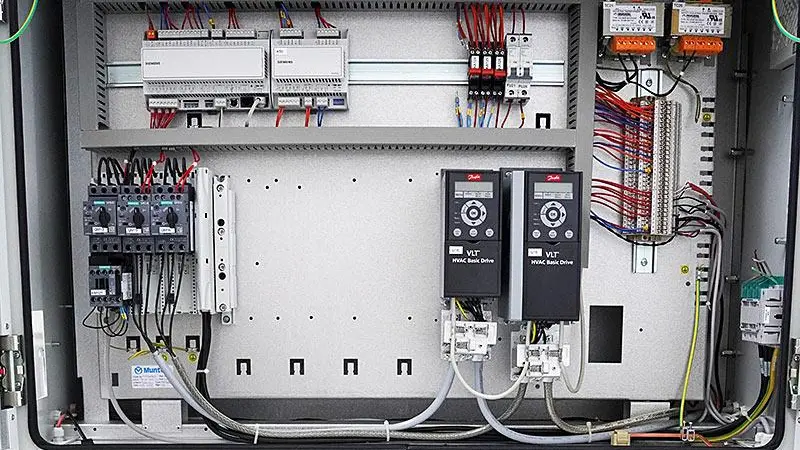
Electrical specifications answer two different questions: will the machine work with your power supply, and how much energy does it use to remove water? Start with voltage, phase and frequency. Voltage alone is not enough: a single-phase supply and a three-phase supply are different, and the equipment must also suit the site’s frequency, such as 50 Hz or 60 Hz.
Power in kilowatts (kW) describes the rate of electricity use under the stated conditions. Current in amperes (A) describes the electrical current drawn. Check whether a value is labeled rated or maximum; a brochure’s typical operating figure should not be used on its own to decide the wiring or circuit protection.
Some sheets also list MCA, or minimum circuit ampacity, and MOCP, or maximum overcurrent protection. MCA gives the minimum current-carrying capacity required for the supply wiring. MOCP gives the maximum permitted rating for the specified fuse or circuit breaker. These are installation details for your electrician to use with the unit’s nameplate, instructions and local requirements—not values to calculate from brochure power alone.
One measure of industrial dehumidifier efficiency is L/kWh: liters of water removed per kilowatt-hour of electricity. A higher value means more water removed per unit of electricity only when the test conditions and included components are comparable. Check whether the figure includes the fans, pumps and auxiliary heaters. For a desiccant system heated by gas or steam, electrical consumption alone leaves out the heat supply.
You may also see COP, meaning coefficient of performance. COP is a ratio without units, so a figure labeled “COP” but expressed in L/kWh needs clarification. Annual running cost also depends on how long and under what conditions the machine operates.
Which Installation Details and Options Matter?
A machine’s capacity is only part of its specification. Other details tell you how it will drain water, respond to humidity and fit into the available space. The table below explains common entries and why they matter. Some of this information may be in the installation manual or drawing rather than the short product sheet.
| Specification | What it means for you |
|---|---|
| Drain connection and pump | Connection size and position show where the drain attaches. If a pump is used, its flow at the required lifting height matters; maximum lift alone does not show how much water it can move at that height. |
| Humidity sensor and controls | Sensor location and accuracy affect the reading used to control the machine. “Deadband” is the gap between the humidity levels at which it switches on and off. |
| Building management system (BMS) connection | A BMS lets a building’s central controls exchange information with equipment. Check which readings, alarms and commands are supported, as well as the communication protocol. |
| Dimensions and service clearance | Cabinet dimensions show the unit’s size. Service clearance is the extra space needed to open panels, change filters and reach components. Operating weight and connection positions also matter for installation. |
| Discharge-air temperature | Air leaving the unit can add heat to the room. The temperature or heat-output data helps your project team assess the effect on room cooling. |
| Filters and materials | Filter type and airflow resistance affect operation. Cabinet materials and coil treatments describe the construction supplied for the intended environment. |
| Noise | A dB figure needs a measurement method and operating condition. Sound pressure depends on factors such as distance; it should not be directly compared with a sound-power figure. |
| Refrigerant and approvals | Refrigerant type, charge and safety classification help the installer check requirements. Approval documents need to cover the actual model and destination market. |
| Operating schedule and support | Permitted running hours, maintenance requirements, warranty terms and parts availability describe how the equipment can be used and supported. |
Features shown on a product page may be optional. For an industrial dehumidifier with a drainage pump, check whether the price includes the pump and whether it can handle your drain route. The same applies to remote sensors, BMS connections and special filters. If a feature is not mentioned, ask whether it is included, optional or unavailable rather than assuming it is missing from the equipment.
For approvals, a company certificate or a logo on a brochure is not enough to establish that a particular unit meets your installation requirements. Ask for the documents covering the model and intended market so the responsible project professional can review them.
What If the Specification Sheet Leaves Something Out?
A short datasheet does not always contain every detail you need, and you do not need to become an equipment engineer to ask a useful question. Point to the entry you want explained and describe the relevant site condition. For example: “This sheet shows capacity at 30°C and 80% RH. What capacity can we expect at our room’s normal temperature and target humidity?”
The supplier may answer with a performance table, an installation drawing or a clearer description of the options included. When comparing suppliers, use the same room conditions and installation details for each. If one answer is still missing, leave that comparison open rather than treating the missing number as zero or assuming both units perform alike.
Before ordering, have the agreed specifications and included options written into the quotation or order documents. Keep the model and document date clear, especially if accessories have changed. If a supplier promises a particular result at your site, agree on the conditions and how that result will be checked; a standard laboratory rating alone is not a site-performance guarantee.
Frequently Asked Questions
Does the number in a dehumidifier model name show its daily capacity?
Not necessarily. Manufacturers use model numbers in different ways, so look for the stated removal rate, its units and test conditions instead of reading capacity from the model name.
What if a quotation and a datasheet list different specifications?
Ask the supplier which figures apply to the version you are buying. Have the difference corrected or explained in writing before ordering, including any options that affect the figures.
Can I use calculated performance data to compare quotations?
Yes, provided the supplier makes clear that the figures are calculated rather than measured and explains the conditions and model they apply to. If your purchase depends on achieving a particular result, ask how the prediction has been checked and how the promised performance will be verified.
Is a performance test report the same as a product certificate?
No. A test report records performance under particular test conditions, while a certificate confirms only the requirements covered by its stated scope. Check that either document applies to the model you are considering.
If a figure on a Rinwang product sheet is unclear, include it in your enquiry along with the temperature and humidity expected in your facility. This gives the supplier a clear starting point for explaining how the specification relates to your application.