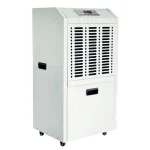
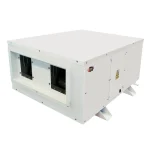
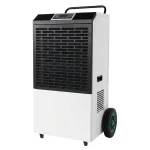
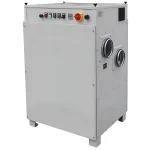
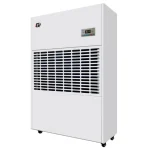
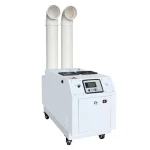
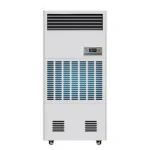
Struggling with persistent humidity? Worried that running an industrial dehumidifier while you sleep could cause problems? This is a common question in industrial moisture control. The answer is yes. A properly installed, high-quality industrial dehumidifier can operate safely overnight. Read on to learn why industrial dehumidifiers are designed for continuous operation, how to run them overnight with confidence, energy-saving tips, real-world industry use cases, and situations where overnight operation is not recommended.
Design and Safety of Continuous Operation
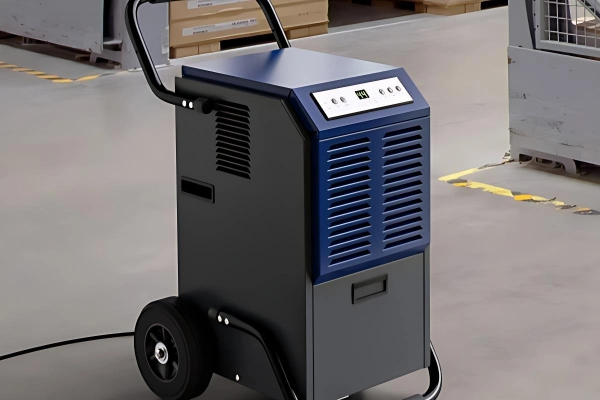
Most industrial dehumidifiers are designed to support continuous operation, including overnight use. Unlike residential units, they are built for extended runtimes in commercial and industrial environments where humidity control is required around the clock. The following sections explain the key design and safety features that allow industrial dehumidifiers to operate reliably during nighttime hours.
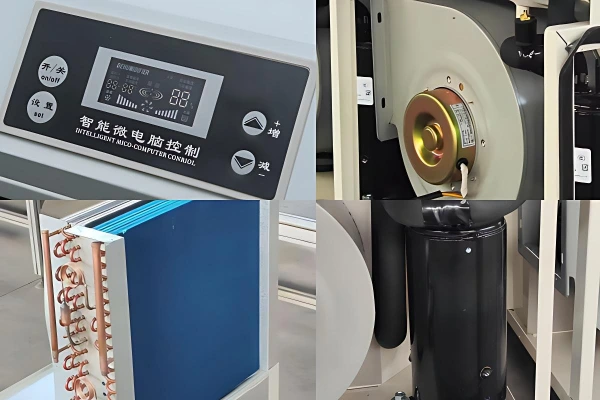
Continuous-Duty Construction and Durable Components
- Housing materials (metal/sheet metal / stainless steel)
Metal and sheet-metal cabinets keep the unit rigid during long runtimes. A rigid enclosure helps maintain stable airflow through the fan and coil section and reduces issues caused by vibration or handling (e.g., loosened panels or misalignment). In high-humidity or corrosive environments, stainless-steel housings help reduce rust on the exterior structure and around key compartments, supporting unattended overnight operation. - Core components (Hitachi / Panasonic compressor)
Ruiwang units use international brand compressors (e.g., Hitachi / Panasonic) and include three-minute automatic delay protection, which prevents immediate restarts after stopping or power interruptions. For overnight running, the control system supports fault code display for status checks, and automatic defrost helps maintain operation when coil icing risk increases at lower temperatures.
Electrical Safety Protections
Running any electrical equipment overnight raises safety questions. Industrial dehumidifiers address this with built-in electrical safety features. For example, quality models include thermal overload protection that will automatically shut off the unit if it begins to overheat. This prevents any potential fire hazard from an overheating motor or compressor. Additionally, dehumidifiers are subjected to rigorous safety testing and certifications (such as CE in Europe) to ensure compliance with electrical safety standards. Ruiwang industrial dehumidifiers meet CE certification requirements; you can download the CE certificate.
Auto Defrost for Low Temperatures
Many industrial dehumidifiers come with automatic defrost systems. If the evaporator coils get too cold and frost forms, the unit will temporarily stop the compressor and often run a defrost cycle to melt the ice. For example, some industrial models are specified to work in environments as low as 41 °F (5 °C) thanks to an auto-defrost feature. This ensures they keep running in unheated warehouses or chilly overnight conditions without freezing.
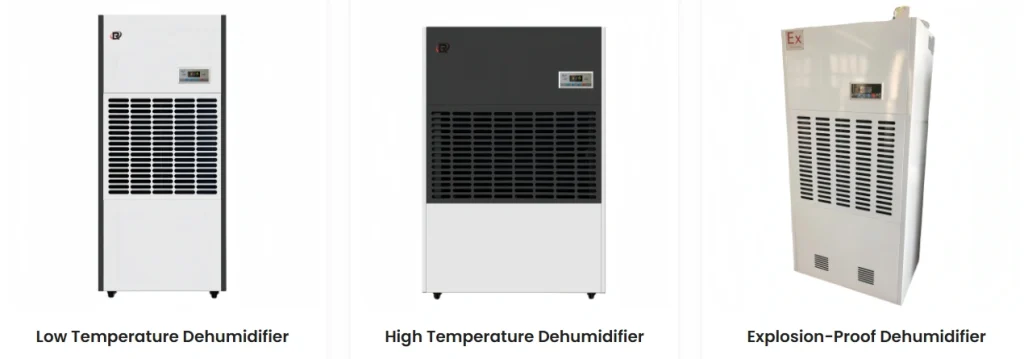
Based on these design principles, Ruiwang has developed industrial dehumidifiers capable of continuous overnight operation, including models suitable for various temperature conditions and explosion-proof applications. (Image links to industrial dehumidifier products)
Key Factors Affecting Nighttime Operation
Model and Specification Matching
Most industrial dehumidifiers are made for long and continuous operation. Still, some smaller or older units may not handle nonstop use very well. When choosing a dehumidifier, always check its capacity and duty rating. A proper industrial model should clearly support 24/7 operation in its manual or specs. You should also match the daily moisture removal capacity to the size of your space. If the unit is too small for a large, damp warehouse, it may never reach the target humidity, even if it runs all night. Over time, this puts extra stress on the machine. If you are not sure which capacity and configuration fit the space, use this industrial dehumidifier selection guide.
Ambient Humidity Level
High humidity often means longer run time. In very damp spaces, a dehumidifier may need to run overnight to bring moisture down to a safe level. For example, in a basement or warehouse during rainy weather, humidity can reach 80% in the evening. If the unit is turned off, condensation may appear by morning. Many dehumidifiers include a built-in humidistat. It turns the unit off once the target humidity, often around 50%, is reached and turns it back on if humidity rises again. Because of this, the overnight operation depends mainly on how high the humidity is.
Energy Consumption Considerations
Energy use is another factor to consider. Industrial dehumidifiers can consume a lot of power, especially larger models that draw 1,000 to 1,500 watts or more. Running the unit overnight will increase electricity costs. Example calculation: The table below assumes a 1.2 kW unit running for 8 hours overnight (9.6 kWh). Actual power draw and cost vary by model size, humidity load, and local tariffs. (Cost = kWh × electricity rate.)
| Region (industrial reference) | Typical electricity price | Overnight energy (8h) | Estimated overnight cost |
| United States (industrial avg, Oct 2025) | $0.0865/kWh | 9.6 kWh | $0.83 |
| Europe (EU non-household range, 1H 2025) | €0.0804–€0.2726/kWh | 9.6 kWh | €0.77–€2.62 |
| Middle East (UAE/Abu Dhabi industrial example, 2025) | 0.231–0.366 AED/kWh (e.g., transmission-connected fixed 23.1 fils/kWh, industrial TOU can be higher) | 9.6 kWh | 2.22–3.51 AED |
Energy Use and Efficiency Tips
- Use Reasonable Humidity Settings: Don’t set the dehumidifier to an unnecessarily low humidity level. Aim for a humidity of around 45–50% for general purposes. This level is sufficient to prevent mold and condensation in most cases.
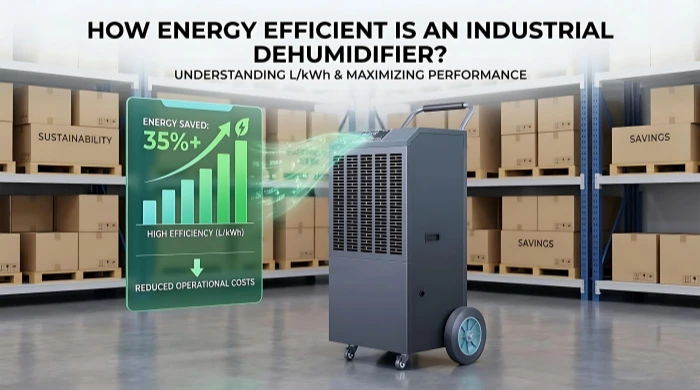
- Choose Energy-Efficient Models: If you’re selecting an industrial dehumidifier, look for an energy-efficient design. High-efficiency units remove more moisture per kWh of electricity. Features like variable-speed fans or smart sensors can optimize energy use by adjusting operation to the humidity conditions.
- Use Off-Peak Electricity: In many areas, electricity is cheaper at night during off-peak hours. If your facility or home has time-of-use pricing, take advantage of it. Running the dehumidifier overnight can actually be cost-effective if those hours have lower rates.
- Reduce the Dehumidifier’s Load: Make the environment easier to dehumidify so the unit doesn’t work as hard or as long. Simple steps can help a lot – close doors and windows to prevent humid outside air from leaking in.
Maintenance Requirements for Overnight Operation
Proper maintenance is also a prerequisite for safe and continuous overnight operation.
| Maintenance Item | Purpose | Recommended Frequency | Key Notes |
| Air filter cleaning | Maintain airflow | Monthly or as needed | Fully dry filters before reuse |
| Coil inspection | Support heat exchange | Annually | Power off the unit before cleaning |
| Drain system check | Prevent overflow | Monthly or quarterly | Inspect hoses and pumps |
| Water collection check | Avoid shutdown or leakage | As needed | Continuous drainage preferred |
| System inspection | Ensure stable operation | Per manufacturer guidance | Covers electrical and sensors |
| Professional service | Identify hidden issues | Yearly or bi-yearly | Suitable for continuous use |
Overnight Use in Different Industries
The need for overnight operation varies by industry, depending on moisture sensitivity and process requirements.
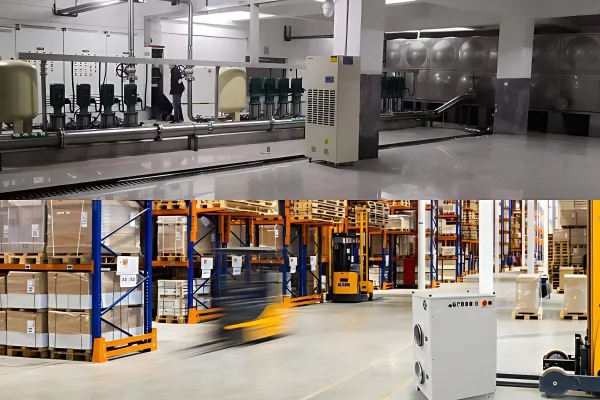
- Warehousing and Logistics
Warehouses typically store many moisture-sensitive items, such as paper products, metal components, and packaged goods. When humidity increases during unattended hours, condensation or corrosion may develop before operations resume. Maintaining controlled humidity through the night helps limit moisture buildup on stored inventory and reduces corrosion risks to handling equipment and building structures. - Food Processing
In food processing and storage environments, elevated humidity can increase the risk of microbial growth and cause dry ingredients like powders or sugars to clump. Dehumidifiers are often kept running during off-shift periods to maintain dry conditions when production lines are inactive. This reduces condensation on surfaces and equipment and helps prevent moisture from contacting food products outside active processing hours. - Pharmaceutical Manufacturing
Pharmaceutical facilities require stable environmental conditions to meet quality and compliance requirements. Many raw materials and finished products are sensitive to moisture exposure, so humidity is commonly controlled continuously to remain within specified limits. In production areas and cleanrooms, uninterrupted dehumidification helps prevent fluctuations that could affect material stability or process consistency. - Electronics Manufacturing
In electronics manufacturing, even short-term humidity changes can lead to defects. Excess moisture may cause corrosion, interfere with soldering processes, or create condensation on sensitive components. Humidity control is therefore maintained throughout the day and night to protect components in storage and partially assembled products during off-shift periods. - Laboratories and R&D
Laboratories depend on stable environmental conditions for accurate testing and equipment protection. Variations in humidity can influence experimental results, calibration stability, and sample integrity. Dehumidifiers are commonly used to maintain consistent conditions overnight when experiments, stored samples, or sensitive instruments remain unattended. - Underground Construction
Underground construction sites are continuously exposed to moisture from surrounding soil and groundwater. Without humidity control, excess moisture can affect material curing, surface conditions, and electrical systems. Dehumidifiers are often operated after working hours to limit humidity increases, support material drying, and reduce condensation on tools and equipment.
Despite these use cases, overnight operation is not suitable in every situation.
Situations Where Overnight Operation Is Not Recommended
- Outdated or inefficient units
Older dehumidifiers may lack modern safety controls, such as automatic shut-off or humidity-based cycling. These units can run continuously even when moisture removal is no longer required, increasing electrical load and wear. - Improper electrical installation
Overnight operation should be avoided if the unit is not connected to a dedicated and properly rated power source. Extension cords, undersized wiring, or overloaded circuits increase the risk of overheating or electrical failure. The unit should operate only within its specified voltage and current limits. - Limited drainage capability
Units without continuous drainage or reliable condensate pumps may stop operation or overflow when collection tanks fill during unattended hours. - Capacity mismatch with the space
Using a high-capacity dehumidifier in a small or sealed area can lead to excessive moisture removal and frequent cycling. This may reduce efficiency and increase mechanical wear. In these cases, shorter run periods or a lower-capacity unit are more appropriate.
Ruiwang Product Advantages and After-Sales Support
Product advantages
Ruiwang industrial dehumidifiers are designed for extended operation under stable load conditions. Core components and control systems support continuous moisture removal during overnight and multi-day use. Integrated protection functions and humidity-based controls allow unattended operation within defined limits. Adjustable operating parameters enable use across different environments, including storage, processing, and construction spaces.
After-sales support
Ruiwang provides user manuals, maintenance guidelines, and technical support to assist with installation and long-term operation. These resources help ensure correct setup, safe use, and proper maintenance. For detailed operating limits, maintenance procedures, and safety instructions, download the product user manual.
FAQ
Is it safe to leave a dehumidifier on overnight?
Yes. Modern dehumidifiers are designed for 24/7 use. Ensure your unit is in good condition, with no errors, and has features such as auto-shutoff when the tank is full. This way, it can run overnight safely without you worrying.
How long can a dehumidifier run continuously?
A quality dehumidifier can run continuously for days if needed. Industrial models are built for nonstop operation. Most have humidistats, so they will cycle off once the set humidity is reached and cycle back on as humidity rises, effectively allowing indefinite 24/7 operation.
How much does it cost to run a dehumidifier overnight?
It depends on the unit’s wattage and your electricity rate. As an example, a 500 W dehumidifier costs around $0.50 to $0.60 to run for 8 hours (an overnight stretch) at typical electricity rates. Larger industrial units (1000+ W) might cost around $1.00+ per night. Using energy-efficient models or off-peak power can reduce these costs.
Can a dehumidifier make the air too dry?
Yes – if left running in a small or already dry space, a dehumidifier can over-dry the air. This might bring humidity down below 30%, which can cause static electricity and discomfort (dry skin, etc.). To prevent this, use a model with a humidistat and set a reasonable humidity level (e.g. 50%). The unit will then shut off when it reaches that level, avoiding excessive dryness.
When should you not use a dehumidifier?
Do not use a dehumidifier in temperatures below about 41 °F – the moisture it collects can freeze on the coils and potentially damage the unit. Also, if the humidity is already very low (below ~30%), you don’t need a dehumidifier and it could over-dry the air. Avoid leaving a dehumidifier running if it’s an old or malfunctioning unit, or if you can’t ensure it’s draining properly (to prevent overflows). In short, use it when there’s a moisture problem to solve, and pause it in cold or already-dry conditions.