Warehouse humidity should follow the storage requirements of the goods and packaging at the actual operating temperature. The important distinction is between the permitted storage range, the equipment setpoint, and the warning level.
This guide explains how to check an RH requirement, allow an operating margin, and identify situations where temperature or surface condensation matters more than the room’s average humidity reading.
What Humidity Level Should a Warehouse Maintain? The Short Answer
There is no single RH setting suitable for every warehouse. Use the goods’ documented storage range, then set the operating target within that range with enough margin for normal fluctuations.
For example, if a supplier specifies a maximum of 60% RH, setting the controller to 60% leaves no margin below that limit. A lower operating target may be needed, but the appropriate margin depends on sensor accuracy, differences between storage locations, and how quickly the system responds.
For mixed inventory, compare the requirements of all goods stored in the same zone. If the permitted ranges do not overlap, separate controlled zones may be necessary. Where cold surfaces are present, check dew point as well as RH.
| Control item | What it should be based on |
|---|---|
| Operating target | Stored goods, packaging, temperature, and validated site requirements |
| High-humidity warning | A documented margin before conditions exceed the storage requirement |
| Alarm and response | The affected goods, duration of exposure, and corrective action procedure |
| Low-humidity warning | The goods’ sensitivity to over-drying and other site requirements |
| Condensation check | Air dew point compared with the coldest relevant surface temperature |
Humidity Requirements by Stored Goods Type: What to Check
Confirm the required humidity condition for each product group before selecting a setpoint. The questions below help identify what must be checked; they do not assign a universal range to the whole warehouse.
| Stored goods | Main concern | Requirement to confirm | Source to check |
|---|---|---|---|
| General industrial / mixed packaged goods | Different goods may tolerate different conditions | Product requirements and whether separate zones are needed | Supplier storage instructions and site procedures |
| Corrugated boxes, paper packaging, labels | Moisture exposure and changes in packaging strength | Storage conditions and relevant packaging performance criteria | Packaging supplier instructions; check the scope of any material test standard |
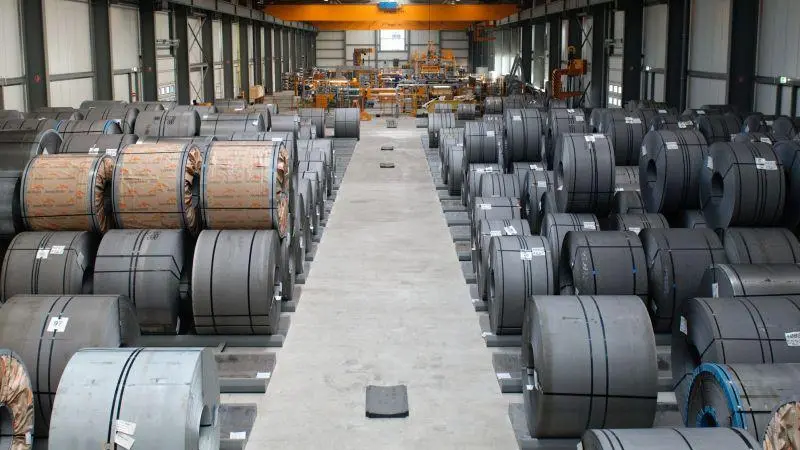
| Steel, tools, and non-ferrous metals | Surface moisture and corrosion exposure | Material, coating, storage duration, and condensation conditions | Material or component supplier requirements |
| Sealed and unsealed electronic components | Different packaging and moisture-sensitivity requirements | Package integrity, handling exposure, and any separate dry-storage needs | Component and packaging instructions; applicable moisture-sensitive-device procedures |
| Dry food ingredients and powders | Moisture uptake, clumping, and packaging conditions | Product-specific storage condition | Product specification and site food-safety procedures |
| Pharmaceuticals and medical supplies | Maintaining documented product conditions | Product label and validated storage requirement | Product instructions and site quality procedures |
| Textiles, leather, and wood | Moisture uptake and over-drying | Material-specific condition and permitted variation | Material supplier recommendations |
| Archive documents and records | Long-term preservation and stability | Collection-specific preservation conditions | Applicable conservation guidance |
| Cold storage / refrigerated goods | Condensation or frost at cold surfaces | Product conditions and air dew point relative to surfaces | Product requirements and the facility design |
Warehouse Temperature and Humidity Standards: Which Numbers Apply?
A number in a technical document may describe a storage condition, a laboratory test atmosphere, or an example used for engineering calculations. These serve different purposes. Before applying a value to your warehouse, identify the products it covers and the conditions under which it applies.
| Reference and context | Published condition | How to use it |
|---|---|---|
| WHO guidance for medical products: the storage descriptions “Store in a dry place” and “Protect from moisture” | No more than 60% RH | Interpret the description within the medical-product guidance. Follow the product label and applicable manufacturer instructions; do not apply it to all warehouse inventory. |
| TAPPI paper-testing context, as described in its paper test-room guidance | 23 ± 1°C and 50 ± 2% RH | These are conditioning/testing-room conditions. They are not a general storage specification for every warehouse holding paper or cardboard. |
Sources: WHO TRS 1025, Annex 7, Appendix 1, Table A7.1 (printed page 188); TAPPI TIP 0808-04: Paper Test Rooms—Design Considerations (2018).
For each product group, record the document name, applicable temperature and humidity conditions, packaging assumptions, and any handling restrictions. Where no usable storage requirement is available, obtain clarification from the product supplier before presenting a numerical target as a requirement.
A temperature–humidity condition used for product testing should not be copied into the warehouse control system unless it is also the applicable storage instruction.
Why RH Alone Is Not Enough in Some Warehouses
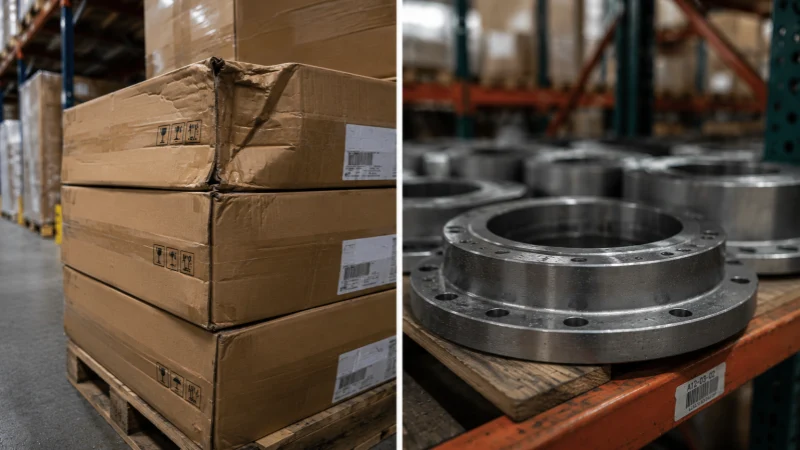
Relative humidity should be interpreted together with temperature. In warehouses with cold surfaces, loading docks, or transitions between warm and refrigerated areas, an acceptable room-RH reading does not by itself rule out local condensation.
Why RH Rises When Temperature Falls
When air cools at approximately constant pressure without gaining or losing water vapour, its relative humidity rises. This means an overnight increase in RH does not necessarily indicate that additional moisture entered the building. Compare the temperature and RH records before deciding whether the cause is moisture entry, cooling, or both.
What dew point tells you instead
Dew point is the temperature at which air reaches saturation for its current water-vapour content and pressure. If a nearby surface cools to or below the air’s dew point, condensation can occur even when a room sensor reports an apparently acceptable RH.
Compare the measured air dew point with the coldest relevant surfaces, such as incoming goods, exterior walls, metal racks, or cold-room entrances. Any design margin should account for measurement uncertainty and changing conditions; a single fixed temperature gap should not be treated as a universal warehouse rule.
For the measurement principles, see Vaisala’s explanation of dew point and surface condensation.
Where to Check for Local Condensation
| Situation | Why RH Alone Does Not Catch It |
|---|---|
| Metal parts warehouse | Steel surface temperature drops below dew point even when ambient RH appears acceptable |
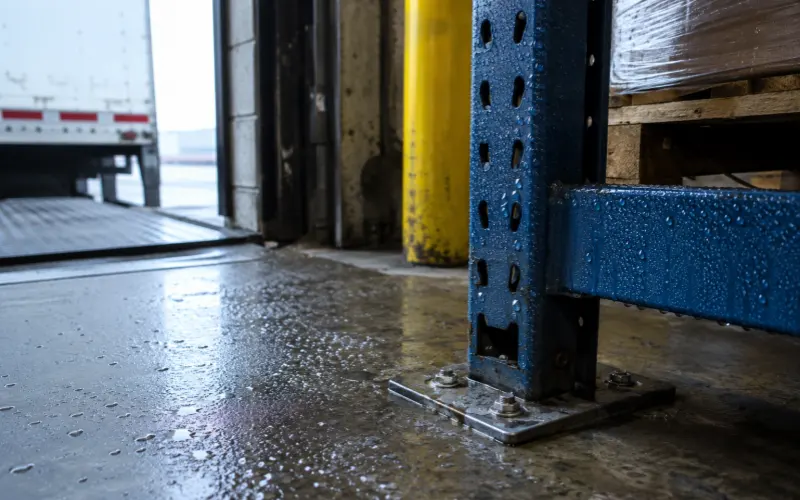
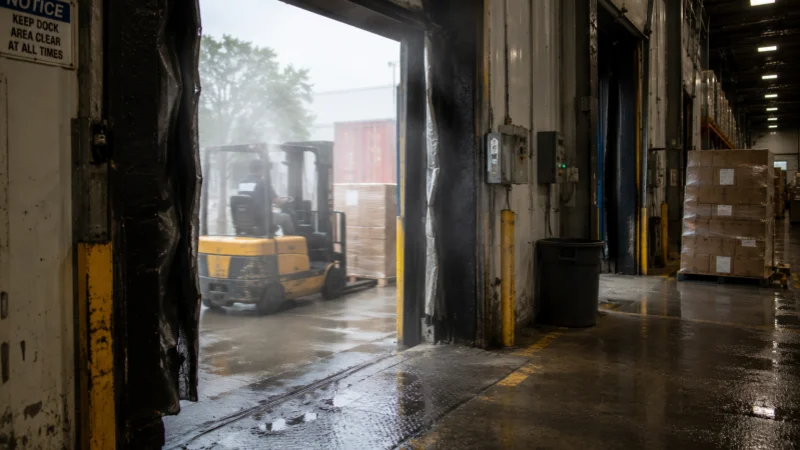
| Loading dock entry zone | Warm humid outdoor air hits cold internal surfaces and condenses before any zone sensor registers a change |
| Cold room entrance and buffer area | Temperature gradient creates local condensation zones that a centrally positioned sensor misses entirely |
| Overnight temperature drop | Surfaces cool faster than air; moisture forms on racks, floors, and outer packaging before morning |
| Coastal or tropical location | High ambient absolute humidity keeps dew point close to surface temperatures year-round |
At loading docks, inspect door seals, exposed surfaces, and incoming goods when condensation is reported. Compare those observations with nearby temperature and humidity records. The loading dock condensation guide explains the checks in more detail.
In refrigerated storage, maintain the product’s required temperature and humidity conditions while also assessing condensation or frost at cold surfaces and transition areas. Dew-point assessment complements the storage specification; it does not replace it.
How to Set Your Warehouse Humidity Target
Once you have the right RH range for your stored goods, build a control structure around it. A setpoint without alarm thresholds has no defined response when conditions drift — and conditions always drift.
Start with the product requirement, then set your margin
Set the operating target from the applicable storage requirement and allow a documented margin for normal variation. Warning and alarm points should prompt action before the goods are exposed to unacceptable conditions. Review the duration of an excursion as well as the peak reading.
Define Control Levels and Responses
| Control level | How to define it | Response |
|---|---|---|
| Operating target | The required condition for the controlled goods and zone | Monitor performance under normal operating conditions |
| Warning | A site-defined margin before an unacceptable excursion | Check doors, ventilation, weather, moisture sources, and equipment |
| Alarm | A threshold and duration defined by the storage requirement | Investigate the affected goods and follow the site procedure |
| Low-humidity warning | A lower limit where relevant to the goods | Check over-drying and any applicable handling requirements |
Worked Example: A Storage Limit Is Not a Setpoint
Suppose a supplier specifies a maximum of 60% RH for a particular packaged product at its stated storage temperature. If a facility selects 55% RH as an initial operating target, the nominal margin is 5 percentage points.
This is an arithmetic example, not a recommended warehouse setting. It does not establish that the margin is sufficient. The facility still needs to consider sensor uncertainty, differences between storage locations, door-opening events, and how quickly the control system responds.
Set the warning point and response procedure so that staff can act before the confirmed storage limit is exceeded. Do not automatically use the maximum permitted humidity as the equipment setpoint.
Set Temperature and RH as a Pair
Record temperature and RH together, and use the goods’ applicable storage condition to define the operating limits. A condition used for stability testing should not automatically be treated as the storage instruction for every product or warehouse.
If the stored goods have validated requirements, ask the supplier or site quality team which condition applies before setting targets or selecting equipment.
Zone your warehouse — conditions are not uniform
Receiving areas exchange air with the outdoors every time a door opens. Exterior wall sections run colder in winter and are the first place condensation appears. Dense pallet rack centers develop micro-climates that differ from the main aisle. A single sensor and setpoint leaves most of the building unmonitored.
At minimum, track these zones separately: the loading dock and receiving area; the central storage zone; any exterior wall sections; and if you have one, the cold room transition buffer. Each may need its own alarm threshold based on the goods stored there and the temperature profile of that zone.
Audit the Building Envelope Before Adding Capacity
Before increasing dehumidification capacity, inspect the paths through which moisture enters the warehouse. Check loading-door seals, dock gaps, roof or wall leaks, ventilation openings, and any process that releases moisture indoors. For help assessing whether mechanical dehumidification is needed, see the warehouse humidity-control guide.
Compare humidity events with door activity, weather, and equipment operation. If outdoor-air entry is the main driver, sealing or controlling that entry may reduce the load. If the building and ventilation arrangements are appropriate, reassess equipment performance at the actual operating temperature and humidity rather than relying only on a catalogue capacity rating. Use the industrial dehumidifier sizing guide to prepare capacity inputs.
Where to Place Humidity Sensors
Place monitoring points where they can represent the conditions experienced by the goods. A convenient reading from an open aisle may not describe the conditions inside a dense rack or near a cold wall.
Use the warehouse layout and observed risks to select locations. Check whether different heights or storage zones behave differently before deciding how many permanent monitoring points are needed.
| Monitoring location | What to investigate |
|---|---|
| Representative goods-storage locations | Whether routine readings reflect the conditions around the stored products |
| Dense racks and high-bay storage | Whether aisle readings represent conditions at different storage positions and heights |
| Loading and receiving areas | Changes associated with door opening, incoming goods, and outdoor-air entry |
| Cold walls and transition areas | Local surface temperatures and condensation risk |
| Equipment control-sensor location | Whether the control reading agrees with independent measurements in the storage area |
Distinguish the equipment’s control sensor from independent monitoring and alarm points. Avoid relying only on a sensor directly influenced by supply air, a nearby heat source, or another local condition that does not represent the goods.
Record temperature alongside RH. Select logging intervals that capture relevant operating events, and establish calibration and verification procedures appropriate to the instruments and site requirements. For equipment positioning and airflow considerations, see the warehouse dehumidifier placement guide.
When Your Warehouse Cannot Hold the Target
If the warehouse repeatedly exceeds its confirmed storage requirement, investigate the pattern before assuming that a larger dehumidifier is the answer.
| Observed pattern | What to check |
|---|---|
| RH rises while air temperature falls | Compare temperature, RH, and dew point to distinguish cooling from additional moisture entry |
| Excursions follow loading or receiving activity | Check door seals, opening duration, outdoor-air entry, and incoming goods |
| The control sensor is within range but goods-storage locations are not | Check sensor placement, airflow distribution, rack obstructions, and separate zones |
| Equipment runs continuously but the target is not maintained | Check moisture load, filters, airflow, controls, and capacity at the actual operating conditions |
| Water appears around refrigerant equipment | Inspect the condensate drain, trap, pump where fitted, and maintenance condition |
| A desiccant system underperforms | Check process and regeneration airflow, heating, exhaust arrangements, and the selected configuration |
Record the affected locations, the duration of each event, and the corresponding temperature and RH readings. These observations help distinguish a control or distribution problem from a capacity problem.
If the warehouse still cannot maintain its confirmed storage conditions, share the goods’ requirements, temperature and RH records, affected zones, and loading-door activity through our warehouse dehumidification solution. These details help us review equipment capacity, technology, and airflow distribution around the actual problem.
FAQ
Is 60% RH acceptable for a warehouse?
It depends on the stored goods, temperature, packaging, and exposure conditions. Check the applicable storage requirement before treating 60% RH as acceptable. If 60% RH is the confirmed maximum for a product, it should not automatically become the equipment setpoint. Allow an operating margin that reflects the site’s control performance and measurement uncertainty.
How should workplace guidance and product-storage requirements be distinguished?
A general worker-comfort range is not the storage specification for every product. Check applicable workplace requirements separately from the goods’ labels, supplier instructions, and site quality procedures.
At what humidity level does mold start to grow on stored goods?
There is no single room-RH threshold or fixed growth time for all stored goods. Material condition, surface moisture, temperature, exposure duration, and packaging affect the risk. Investigate repeated dampness and use product-specific requirements to define corrective action.
What temperature should a warehouse be kept at?
Use the goods’ storage requirements and the site’s operating needs to define the temperature range. General storage, pharmaceutical products, chilled goods, and frozen goods may require different conditions.
How often should warehouse humidity be checked?
Set the logging interval from the goods, operational changes, and the site’s monitoring procedure. Continuous logging may be useful where door activity or temperature changes cause excursions that spot checks miss.
Can high humidity damage products inside sealed packaging?
The risk depends on the packaging barrier, seal integrity, material, and exposure. Confirm the packaging specification rather than assuming every sealed package either blocks moisture completely or allows the same rate of moisture entry.