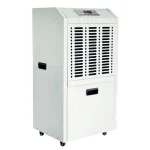
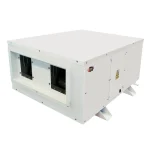
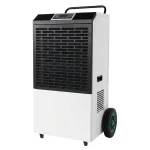
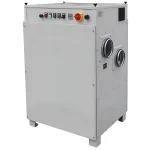
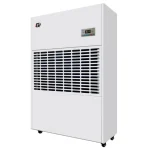
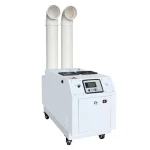
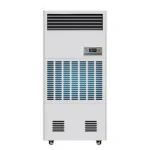
First shift. The dock door rolls up, the truck backs in, and within a few minutes the concrete near the opening is wet. Not from rain. Not from a spill. The floor is sweating. It happens at cold storage entrances too — a faint fog near the chilled room door, cartons softening at the base of the nearest pallet, and a forklift leaving wet tyre marks deeper into the facility. These are not cleaning problems. They are dew point problems. And unlike a spill, they recur with every delivery.
Loading docks and transition areas are where outdoor conditions meet your controlled indoor environment: dock doors, dock levellers, staging areas, and the buffer zones leading to cold rooms, production floors, and shipping zones. They appear in cold storage warehouses, food processing plants, pharmaceutical facilities, e-commerce distribution centres, and manufacturing sites. What they share is the same core problem — every door cycle brings a pulse of outdoor air that deposits moisture on whatever surfaces are cooler than its dew point.
This guide covers how to select, size, and install the right industrial dehumidifier to stop that moisture at the source.
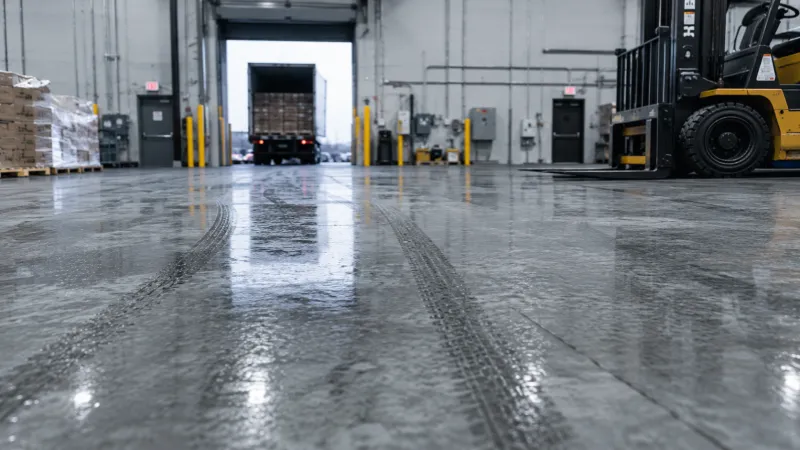
Causes of Loading Dock Condensation
The Impact of Door Cycling on Humidity
When a dock door opens and a trailer connects, outdoor air enters in a pulse. The moisture carried in depends on door size, outdoor humidity, and how long the door stays open.
Facilities with continuous, high-traffic loading bays face a drastically different moisture challenge than those with infrequent deliveries — even if their floor areas are exactly the same. Air conditioning and general ventilation are both sized for steady-state room conditions, not for repeated moisture pulses at an opening. They address background humidity between deliveries but cannot keep pace with the infiltration load a busy dock creates.
That distinction matters most for sizing: at a loading dock, the moisture load is determined by door frequency and outdoor conditions, not by room volume.
Dew Point vs. Relative Humidity
Condensation does not form because RH is high. It forms when a surface temperature drops below the dew point of the surrounding air.
On a summer morning with an outdoor dew point of 18 °C, any indoor surface below that temperature will collect moisture — the concrete floor, the steel door frame, the cold room panel at the back of the staging area, the metal rack legs near the chiller entrance. Even if the indoor RH reads 58%, condensation is still forming on those cold surfaces. Therefore, dew point—measured directly at risk zones like dock doors and cold room entrances—is the only reliable reference.”
Moisture Migration Across Warehouse Zones
Most dock areas run under slight negative pressure. When a dock door opens, humid outdoor air is pulled in — not just through the opening, but through door seal gaps and leveler edges. It does not sit near the doorway. It moves toward the staging area, the cold room entrance, and the packing zones beyond. By the time it contributes to broader warehouse humidity problems, it has already spread well past where it entered.
Additional Moisture Sources (Pallets, Rain, Washdowns)
Door infiltration is the main source, but not the only one:
- Wet pallets arriving from outdoor storage or rain-exposed truck beds
- Rainwater tracked inside by forklift tyres during and after a delivery
- Floor washdown in food or pharmaceutical receiving areas
- Ice and snow melt during winter receiving operations
- Wet packaging surfaces on chilled or frozen goods deliveries
Each adds to the total moisture load the dehumidifier must handle.
The Operational Impact of Poor Moisture Control
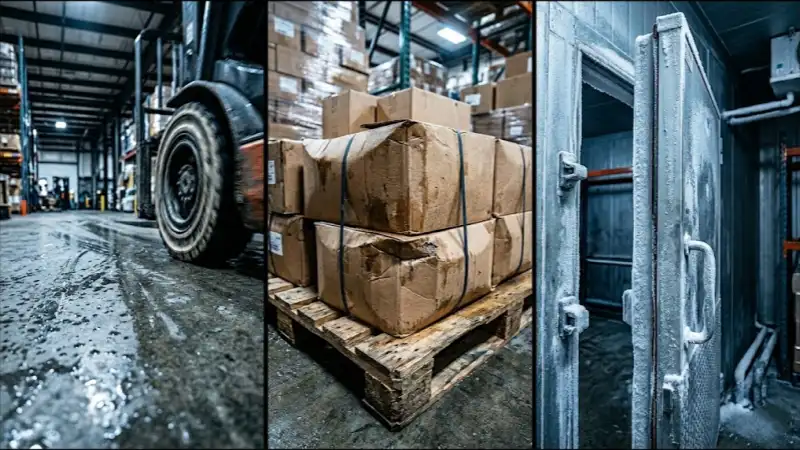
Slippery Floors Are a Safety Issue, Not a Housekeeping Problem
OSHA walking-working surface standards require warehouse floors be kept dry. In dock environments, condensation-driven wet floors make that requirement actively difficult to maintain during and after truck deliveries.
The risk compounds in cold storage facilities: fog at the cold room doorway reduces forklift visibility, and frost forming overnight on the threshold creates a hidden slip zone at shift start.
Once the dew point is controlled below the floor surface temperature, the floor stops sweating. Mopping becomes occasional rather than a daily opening task.
Product and Packaging Damage
Corrugated cardboard absorbs moisture quickly. In a staging area with high ambient humidity, bottom cartons can lose structural strength within hours.
The damage progression:
- Bottom cartons absorb moisture and soften under load
- Stacking strength decreases, increasing crush risk in transit
- Labels curl and lift at the edges
- Barcodes fail to scan reliably
- Pallets become unstable under forklift forks
For distribution operations this means return claims, repack labour, and carrier credits. For brands and retailers it affects how goods arrive at the customer.
Cold Storage Instability and Frost Accumulation
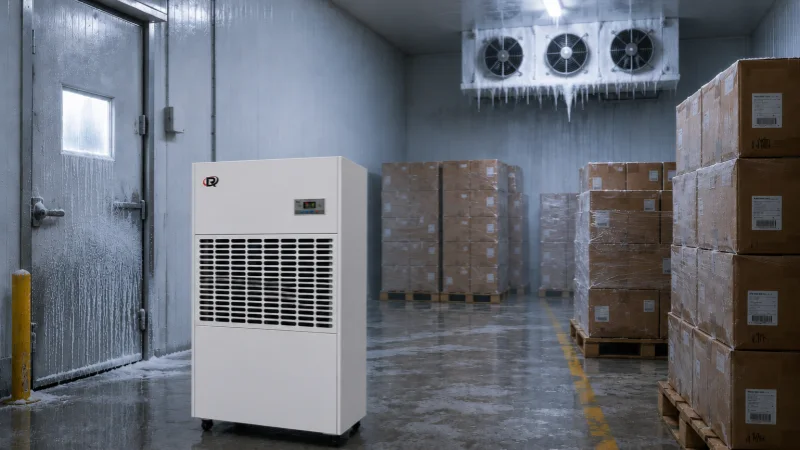
When moist dock air reaches the cold room boundary, the symptoms appear on the refrigeration side: frost at the doorway, evaporator coils frosting faster, cold room temperature fluctuating during peak receiving periods, and the refrigeration system running harder to compensate. Facilities with moist dock air at the threshold make cold storage humidity control harder to maintain inside the chilled room — the dock dehumidifier is what keeps that threshold dry.
Refrigeration teams often notice this as “the room runs warmer on busy receiving days.” The cause is moisture at the dock, not the refrigeration system itself.
Moisture Risk by Industry and Product Type
For food and pharmaceutical operations, the stakes go beyond physical product condition. Dehumidification in food processing environments involves hygiene documentation and facility-level moisture management. In pharmaceutical storage operations, unstable humidity at the receiving dock can affect GMP records and batch compliance. For other product types, the primary dock-level risk is:
| Product Type | Primary Moisture Risk at the Dock |
|---|---|
| Food products (ambient or chilled) | Surface condensation; hygiene records harder to maintain under unstable conditions |
| Pharmaceuticals | Unstable receiving conditions affecting GMP compliance documentation |
| Electronics and components | Condensation on PCBs, connectors, and internal packaging; ESD risk |
| Metal parts (machined, coated) | Surface rust on exposed or lightly coated areas; rework and customer rejections |
| Paper, textiles, soft goods | Absorption, softening, odour, mould risk under prolonged exposure |
Refrigerant vs. Desiccant Dehumidifiers for Docks
Ambient Temperature Docks (>15 °C)
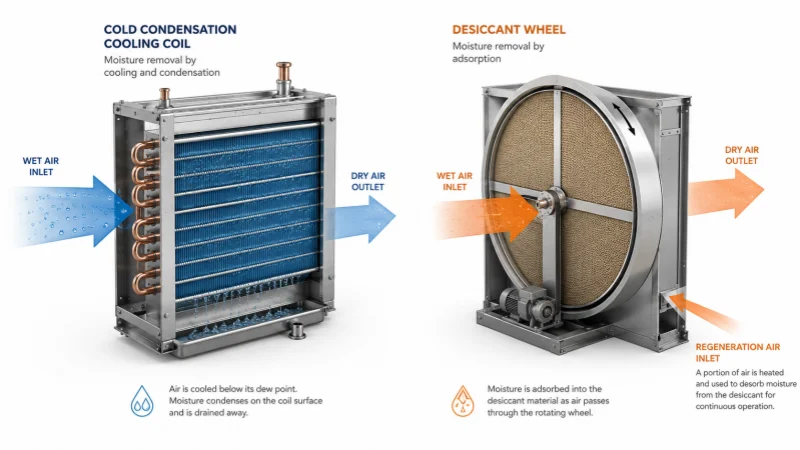
If the dock operates at ambient warehouse temperatures year-round — typically above 15 °C — a refrigerant dehumidifier is the natural starting point. It handles the moisture load efficiently, drains continuously, and does not require the additional infrastructure of a desiccant system.
This covers most standard distribution and manufacturing docks: shipping and receiving areas, staging zones on the warehouse floor and inbound docks without cold room adjacency.
At normal temperatures, rated capacity is reasonably close to actual performance. The main selection checks are capacity at real dock conditions (not lab test conditions) and airflow coverage across the door zone — both covered in the specifications section below.
Cold Storage and Low-Temperature Docks (<10 °C)
When the dock zone is consistently cold — adjacent to a chiller or freezer, or running as an anteroom — a refrigerant dehumidifier begins to lose effectiveness. Its capacity falls as temperature drops, and the coil can start to frost over, reducing moisture removal exactly when it is most needed.
A desiccant dehumidifier does not rely on a cold coil. Its capacity holds at low temperatures and it can reach lower dew points — which matters when the goal is preventing frost at a 2 °C cold room entrance or managing humidity in a staging zone adjacent to a freezer.
The Risks of Incorrect Technology Selection
A refrigerant unit running below its rated temperature floor will begin to ice up. Understanding why industrial dehumidifiers ice up helps evaluate whether a given model’s minimum temperature rating is genuinely sufficient for your winter dock conditions — and what the signs of a capacity problem look like before it becomes a failure.
Selecting on nominal rated capacity at standard test conditions, without checking the performance curve at your actual operating temperature, is the most common sizing mistake in dock dehumidification.
| Dock Condition | Recommended Technology | Primary Reason |
|---|---|---|
| Warm warehouse dock (ambient >15 °C year-round) | Refrigerant dehumidifier | Cost-effective, efficient at normal temperatures |
| Dock with seasonal variation (5–20 °C) | Refrigerant with verified low-temp rating, or desiccant | Check performance curve at winter minimum |
| Cold storage entrance (consistently <10 °C) | Desiccant dehumidifier | Stable capacity at low temperature; low dew point control |
| Freezer corridor or low-temperature staging | Desiccant dehumidifier | Prevents frost; handles sub-zero transition conditions |
| Large dock hall with high outdoor air volume | Dedicated outdoor air system (DOAS) | Designed for outdoor air moisture load at scale |
| Multi-door dock with significant zone variation | Distributed or zoned system | Prevents local humidity spikes and dead zones |
| Food or pharma receiving zone | Any type + monitoring, alarms, and data logging | Supports hygiene records and compliance documentation |
Temperature range is the main selection criterion at the dock. Refrigerant and desiccant systems also differ in energy profile, achievable dew point, and maintenance requirements — relevant if your application extends beyond the dock transition zone or requires tighter dew point control than a standard dock demands.
Sizing Industrial Dehumidifiers for Loading Areas
Calculating Moisture Load via Infiltration
Two loading docks with identical floor plans can require completely different dehumidification systems. For instance, a dock operating four active doors with 60 cycles a day generates a moisture load exponentially higher than a single-door facility used twice daily. Sizing strictly by floor area ignores this reality.
Sizing by floor area ignores the main driver of moisture in a dock environment: air infiltration through door openings.
Moisture Load ≈ Air Infiltration Rate × Humidity Difference (Indoor vs Outdoor)
The infiltration rate is driven by door size, opening frequency, and pressure conditions — not floor area.
A facility with high-frequency doors on a summer design day in a coastal location may need 30–40% more capacity than a sealed facility of identical size. The load calculation uses the same variables for sizing industrial dehumidifiers across other applications, but the infiltration assumptions are different — at a loading dock, door frequency and outdoor conditions dominate; in an enclosed warehouse interior, they contribute much less.
Real-World Capacity vs. Nominal Lab Ratings
The right humidity target depends on your control objective. There is no universal warehouse RH number that applies across all facilities.
| Control Objective | Recommended Target Approach |
|---|---|
| Protect corrugated packaging in staging area | Keep dock zone RH below 60–65% during operation |
| Prevent condensation on floor and metal surfaces | Control dew point below the coldest surface temperature in the zone |
| Prevent frost at cold room entrance | Control dew point well below cold room door surface temperature |
| Protect electronics or precision metal parts | Tighter RH control, typically 40–55%, with stability monitoring |
| Food receiving with hygiene compliance requirements | Defined RH range with alarm logging and temperature compensation |
To accurately maintain these target conditions, remote sensors must be utilized to monitor the air directly at the coldest surfaces.
Key Specifications for Dock Dehumidifiers
Capacity That Reflects Your Actual Dock Conditions, Not Lab Test Conditions Rated capacity is stated at 27 °C / 60% RH. If your dock runs at 15 °C in winter, that number significantly overstates what you will get. Always ask for capacity at your actual operating temperature and RH, and a performance curve across the full temperature range you will use.
Airflow matters alongside capacity. A unit with high rated moisture removal but limited airflow distribution will leave the far end of a long dock untreated while the sensor near the machine reads on target.
Low-Temperature Performance and Defrost Design For docks that drop below 15 °C seasonally, verify the following:
- Minimum rated operating temperature
- Defrost method (hot gas, off-cycle, or electric)
- Actual capacity at the low end of your temperature range
A refrigerant unit that performs well in summer but frosts up in winter provides seasonal coverage at best — not a year-round solution.
Drainage and Industrial Build Quality
At a loading dock, overflow during an unattended shift creates a new floor hazard. Continuous drainage is not optional — gravity to a floor drain or a condensate pump. Also check:
- IP or NEMA enclosure rating appropriate for dust, splash, and hose-cleaning exposure
- Coated evaporator coils and corrosion-resistant housing for coastal or food facility environments
Note: IP rating describes protection against external ingress. Ask specifically about internal coil and fastener corrosion protection — they are separate matters.
Controls That Work When You Are Not There
Dock operations run outside office hours. At a minimum, the dehumidifier should hold a setpoint unattended, send an alarm when conditions go out of range, log operating hours for maintenance scheduling, and accept a door signal input to coordinate with dock door operation.
Modbus RTU or BACnet integration if BMS connection is required. In pharmaceutical warehouse environments, timestamped humidity records may also form part of GMP compliance documentation requirements.
Installation Best Practices for Maximum Efficiency
Strategic Return Air Positioning
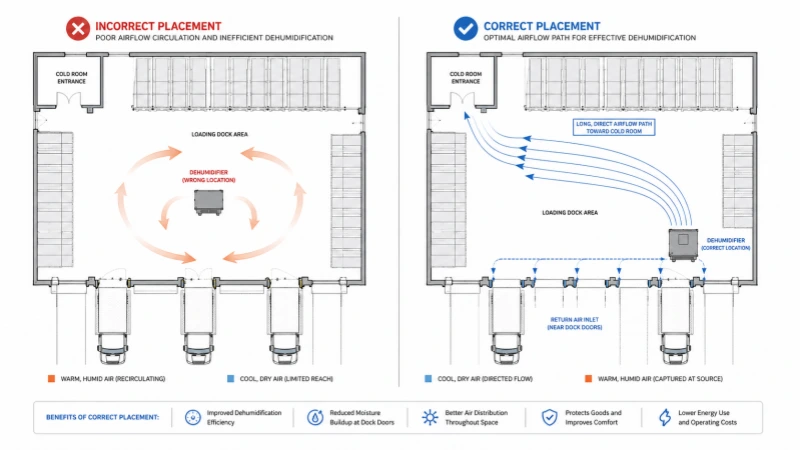
Moist air enters through the dock door. The return air intake needs to capture that air before it spreads — which means positioning it near the door zone, not at the centre or side wall of the dock.
Ensure remote sensors are strategically mounted in the aforementioned risk zones, rather than relying on the dehumidifier’s built-in sensors.
Deliver Dry Air to the Condensation Risk Zone
Treated dry air should reach:
- The floor zone in front of the dock leveler, where wet tyre marks begin
- The doorway zone where fog forms after each delivery
- The entrance to any cold room or freezer in the transition area
- The lowest rack level where moisture-sensitive packaging is stored
Directing dry supply air toward a central aisle or toward the ceiling does not reach the surfaces where condensation actually forms.
Avoid Short-Circuit Airflow
If the supply outlet and return inlet are positioned close together, the dehumidifier conditions the air around itself and leaves the dock door zone untreated. The sensor reads within target. The floor is still wet.
For long or multi-door dock areas, a single central unit without ductwork rarely provides even coverage. Options: ducted outlets at each door bay, multiple smaller units at individual door zones, or a single larger unit with extended ductwork routed to the active moisture entry areas.
Integration with Dock Seals and High-Speed Doors
Dock seals, high-speed doors, strip curtains, and air curtains reduce how much outdoor air enters during truck docking. The dehumidifier removes the moisture that enters anyway. The lower the infiltration load, the smaller and more efficiently the dehumidifier can run.
If dock sealing is poor — slow doors, worn seals, damaged shelters — the dehumidifier handles a larger load and runs longer. Improving infiltration control as part of the installation reduces ongoing operating cost and makes the target condition easier to maintain consistently.
Plan for Maintenance Access From the Start
A unit positioned for installation convenience rather than maintenance access becomes a unit that does not get serviced. Before finalising the location, confirm:
- Filter access without moving equipment or climbing on racks
- Coil access for annual cleaning from the open side
- Drain connection reachable for periodic inspection
- Electrical panel clear of forklift traffic
- Enough surrounding clearance for a service technician to work safely
Operating Costs and ROI Analysis
Energy Cost Follows Moisture Load, Not the Nameplate
The nameplate power tells you the maximum draw. What determines the electricity bill is how long the unit runs. How moisture load at different dock conditions translates into industrial dehumidifier electricity consumption follows operating hours more directly than power draw — the calculation matters most when comparing running costs between system options or justifying the investment in better door sealing.
A well-sealed dock with low infiltration means fewer running hours and lower cost. A dock with worn seals and high-frequency doors means the unit runs most of the shift. The installation decisions — door sealing quality, sensor placement, setpoint — determine operating cost as much as the equipment choice does.
Maintenance in a Dock Environment
Dock environments load dehumidifier components faster than cleaner warehouse interiors. Treating every interval from a standard industrial dehumidifier maintenance schedule as the upper limit — not the target — is the right approach at an active dock. Monthly filter inspection is the practical minimum; quarterly coil cleaning and drain checks are common at high-cycle facilities.
- Dirty filters reduce airflow and therefore moisture removal
- Dirty coils reduce heat transfer efficiency
- Partial drain blockages cause overflow without triggering alarms
- Sensor drift causes the unit to operate at the wrong setpoint
The Return on Controlling Dock Moisture
The return on a loading dock dehumidifier does not come from a single source. Fewer wet-floor incidents, less packaging rework, fewer product return claims, and more stable cold room entrance conditions all contribute. In most active dock environments, the sum of those avoided costs — particularly packaging damage and manual labour — is larger than the electricity cost of running the dehumidifier properly.
FAQ
Why is my concrete floor sweating?
Concrete floors sweat when warm, humid air meets a surface below the air’s dew point. An industrial dehumidifier stops this by lowering the ambient dew point.
Where is the best place to put a dehumidifier in a warehouse?
Place the return air intake near moisture sources like loading dock doors. Direct the dry supply air toward cold risk zones, such as freezer entrances.
How do you stop condensation in a warehouse?
Stop condensation by keeping the air’s dew point below the coldest indoor surface temperature. Use an industrial dehumidifier and seal dock doors to manage moisture loads.
Do dehumidifiers work in cold temperatures?
Yes, but standard refrigerant models freeze below 15 °C. For cold docks, use a desiccant dehumidifier or a low-temperature refrigerant unit with active defrost.
What humidity level should a warehouse be?
General warehouses typically target 40% to 60% relative humidity to protect packaging. However, in loading docks, controlling the dew point below surface temperatures is the actual goal.
Conclusion
Loading docks create the most intense and most frequent moisture events in a warehouse or distribution facility — not because they are large, but because they are open.
Condensation at the dock does not stay at the dock. It moves with the airflow and the forklift traffic. By the time it becomes visible — frost at the cold room door, soft cartons in staging, wet tyre marks in the picking zone — it has already spread past where it entered.
The right response is a dehumidifier sized to actual infiltration load rather than floor area, matched to your operating temperature with the correct technology, installed with airflow directed at the risk zone, and paired with the best dock sealing the facility can run.
When all of those are in place, the condensation problem is solved at the source. The floor stays dry. The cartons hold their shape. The cold room boundary stays consistent.