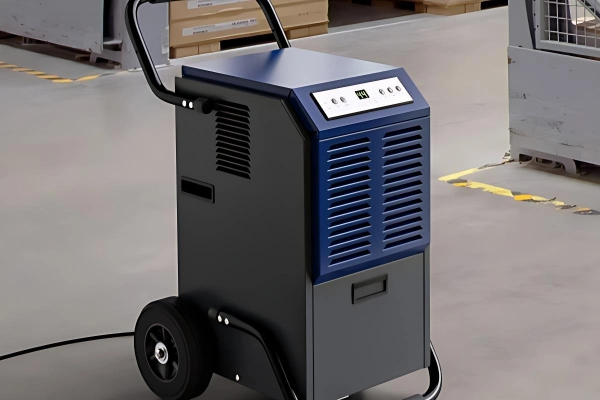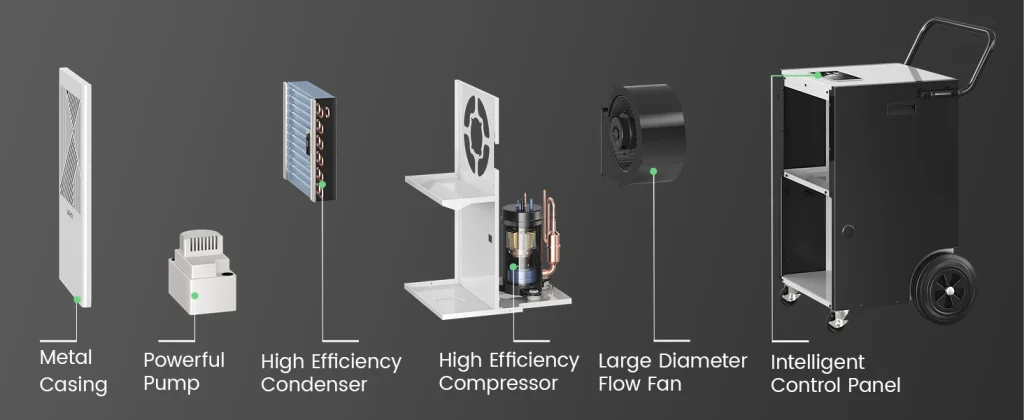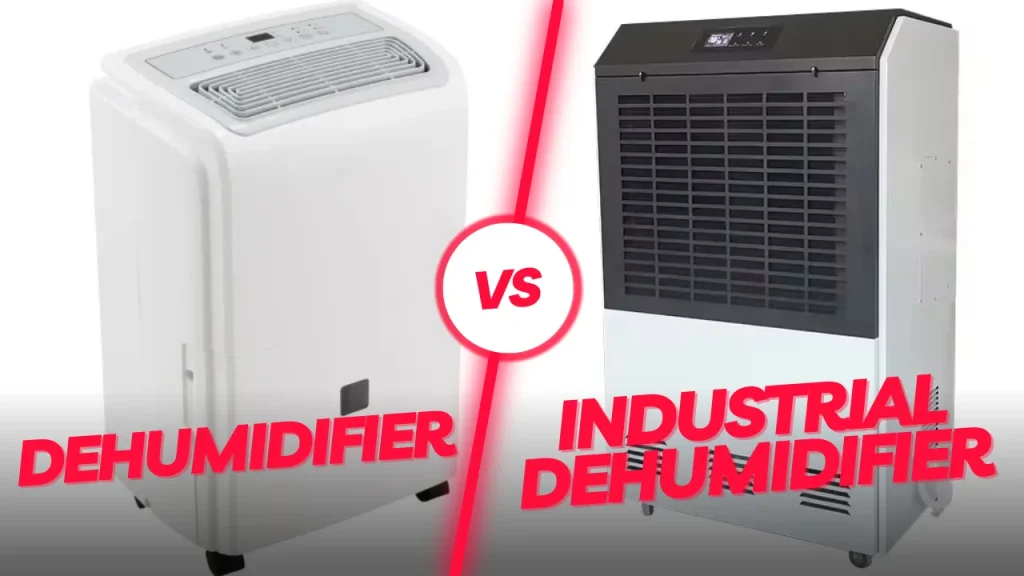
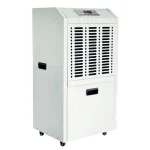
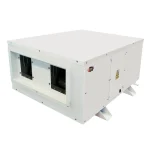
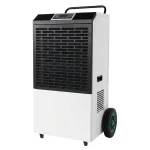
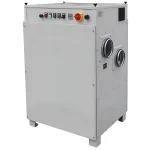
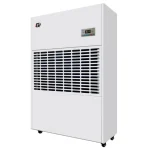
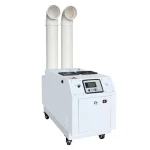
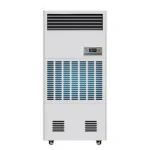
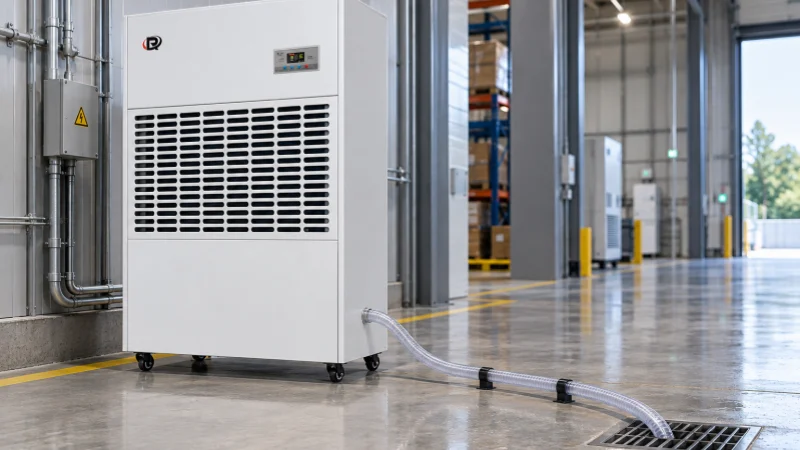
An industrial dehumidifier can remove tens or even hundreds of litres of water per day. That water has to leave the unit continuously. If the nearest drain is below the unit and the pipe can maintain a downward slope, gravity drainage may be enough. If the discharge point is higher, the route cannot maintain continuous fall, or the unit is installed overhead, a condensate pump or additional overflow protection may be required.
These decisions should be made before the unit is ordered. This guide explains how to estimate condensate flow, choose the drainage method, route the drain line, prevent air locks and overflow, and confirm the installation before handover.
Start With the Expected Condensate Volume
The first question is how much water the drainage system may need to handle.A dehumidifier’s L/day capacity is measured under a stated temperature and relative humidity. It does not mean the unit will collect exactly that amount under every site condition, but it provides a useful starting point. Convert the rated capacity into an hourly equivalent:
Rated L/day ÷ 24 = approximate hourly condensate rate at the rated test condition
| Rated capacity | Approximate hourly rate |
|---|---|
| 60 L/day | ~2.5 L/h |
| 150 L/day | ~6.3 L/h |
| 240 L/day | ~10 L/h |
| 480 L/day | ~20 L/h |
| 960 L/day | ~40 L/h |
| 1,500 L/day | ~62.5 L/h |
| 2,400 L/day | ~100 L/h |
Actual water output changes with temperature and humidity. In cooler or drier conditions, the unit will usually collect less water than at its published rating condition. The hourly figure is also an average rather than an instantaneous peak. Water can leave the pan unevenly, especially during initial pull-down or after a defrost cycle. A pump or receiver should therefore have enough margin for short periods of higher flow.
If several dehumidifiers share one drain route, consider their combined output. For example, two units each rated at 960 L/day represent an approximate combined rated flow of:
960 × 2 ÷ 24 = 80 L/h
If the dehumidifier capacity itself is still being selected, determine that first using the industrial dehumidifier sizing method.
Check the Site Before Choosing the Drainage Method
Before deciding between gravity drainage and a pump, check the physical route from the unit to the intended discharge point. The main site conditions are:
| Site condition | Why it matters |
|---|---|
| Drain-port height | Determines how much gravity fall is available |
| Discharge-point elevation | Shows whether condensate must be lifted |
| Horizontal distance | Determines how much vertical fall the route consumes |
| Doorways, aisles, walls, or beams | May prevent continuous downward slope |
| Floor-standing or overhead installation | Changes access and overflow-protection requirements |
| Temperature along the drain route | Identifies sections that may freeze |
| Number of units sharing the route | Affects combined flow and header size |
| Available drain receptor | Determines where condensate can actually terminate |
The most important question is simple: Can the drain line fall continuously from the unit to the discharge point?
If yes, gravity drainage is usually the first option to consider. If not, either the route has to change or condensate has to be pumped.
Gravity, Pump, or Tank: Choose the Right Drainage Method
There are three basic ways to remove condensate from a refrigerant dehumidifier.
Gravity Drainage
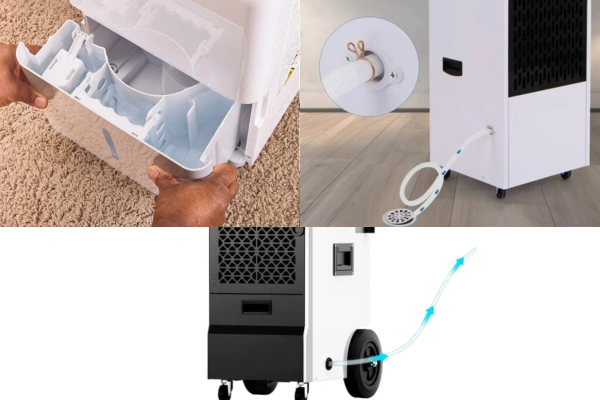
Gravity drainage allows water to flow continuously downward to an approved discharge point. It is normally the simplest option because it has no pump motor, reservoir switch, or additional powered failure point. Gravity works where:
- the discharge point is lower than the unit’s drain connection;
- the full route can maintain the required slope;
- and no obstacle forces the line upward.
A long horizontal run does not automatically require a pump. If enough vertical height remains available to maintain continuous fall, gravity drainage can still work.
Pumped Drainage
A condensate pump is needed where water must be lifted or where the route cannot maintain gravity fall. This may occur when:
- the nearest drain is above the unit;
- the pipe has to cross a doorway or other obstacle;
- the equipment is installed below grade;
- or the selected route leaves insufficient vertical space for the required slope.
Where lift is already known to be necessary, specifying an industrial dehumidifier with an integrated pump can avoid adding an external pump after installation. Do not select a pump by maximum lift alone. A pump advertised with a maximum lift of 6 m does not deliver its full flow at 6 m. Maximum lift is close to the point where usable flow approaches zero. The pump should instead be checked against the actual installation:
- vertical lift;
- discharge-tube diameter;
- total route length;
- elbows and fittings;
- check valves;
- required flow;
- and permitted operating duty.
The supplier should provide the pump performance data for the configuration being ordered.
Tank Drainage
An internal tank collects water until someone empties it manually. For continuous industrial humidity control, this is usually an attended or temporary arrangement rather than the preferred long-term solution. On high water, a Rinwang unit stops dehumidifying. That protects the machine, but it also means humidity control stops until the tank is emptied or the drainage problem is corrected. The practical fill interval can be estimated as:
Tank fill time = usable tank volume ÷ condensate production rate
For example, a 10 L tank collecting 2.5 L/h would fill in about four hours. For higher-capacity units or unattended spaces, continuous drainage is normally more practical.
Size and Route the Drain Line
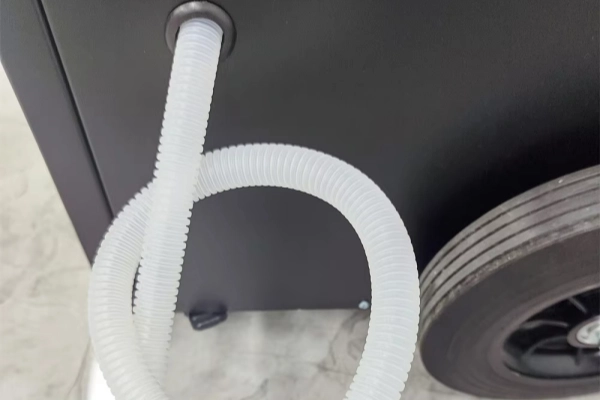
The drain line needs enough size, slope, and support to move condensate reliably. Under 2021 IMC Section 307.2.2, condensate drain piping should be not less than 3/4-inch pipe size and should not decrease in size between the drain pan connection and the point of disposal. The route also needs continuous downward fall. IMC Section 307.2.1 specifies a minimum slope of:
1/8 inch per foot, or approximately 1 percent
If the equipment manufacturer requires a greater slope, follow the manufacturer’s instruction. Even a small slope consumes noticeable vertical space on a long run:
- 3 m horizontal run → about 30 mm of fall
- 6 m → about 60 mm
- 10 m → about 100 mm
- 20 m → about 200 mm
This should be checked before the machine position is fixed. For shared condensate headers, 2021 IMC Table 307.2.2 uses refrigeration capacity:
| Equipment capacity | Minimum condensate pipe size |
|---|---|
| Up to 20 tons of refrigeration | 3/4 inch |
| Over 20 to 40 tons | 1 inch |
| Over 40 to 90 tons | 1-1/4 inches |
| Over 90 to 125 tons | 1-1/2 inches |
| Over 125 to 250 tons | 2 inches |
A dehumidifier’s L/day moisture-removal rating is not refrigeration tonnage. Do not convert one directly into the other for pipe sizing. Three practical details also matter.
Support the line.
A flexible or poorly supported pipe can sag and create a low point that holds water.
Leave maintenance access.
Provide a cleanout, union, or other accessible point so a blocked line can be cleared without cutting the pipe.
Plan shared drains carefully.
Where several units connect to one header, arrange the route so flow or pressure from one machine does not interfere with another.
Cold or Exposed Drain Runs
A drain line can freeze if part of the route crosses an outdoor wall, loading area, unheated corridor, or cold-room boundary. Where freezing is possible:
- keep the exposed section short;
- maintain enough slope to prevent standing water;
- insulate where appropriate;
- use approved heat tracing where required;
- and avoid outdoor termination if a suitable indoor drain is available.
A frozen drain line does not automatically mean the dehumidifier itself is unsuitable. Ice forming on the evaporator is a separate problem related to operating temperature, airflow, defrost, or equipment selection. See the guide to why an industrial dehumidifier freezes up.
Traps and Air Locks
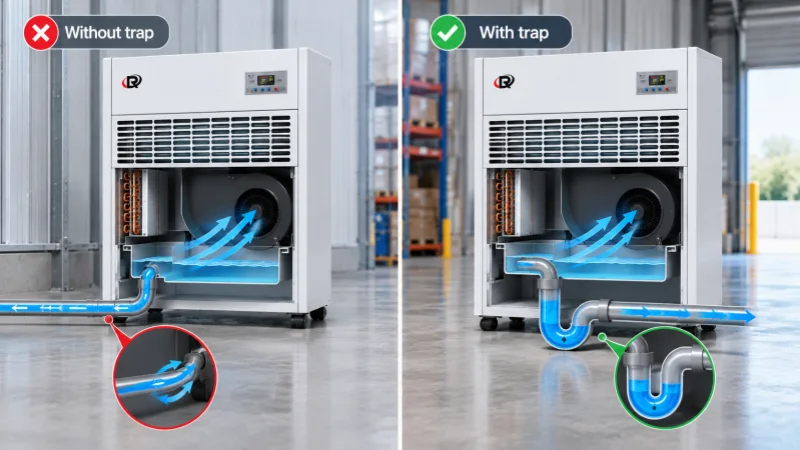
A dehumidifier can operate normally and still fail to drain. In some draw-through arrangements, the fan places the drain pan under negative pressure. If the drain connection does not have the required water seal, the fan may pull air inward through the drain line instead of allowing water to leave freely. Condensate then backs up in the pan even though the refrigeration system itself is working. A trap prevents this by maintaining a water seal. A commonly used field rule is to make the effective seal depth approximately twice the maximum negative pressure at the drain pan:
| Negative pressure at the pan | Approximate seal depth |
|---|---|
| 0.5 in. w.c. (≈125 Pa) | ≈1 in. / 25 mm |
| 1.0 in. w.c. (≈250 Pa) | ≈2 in. / 50 mm |
| 1.5 in. w.c. (≈375 Pa) | ≈3 in. / 75 mm |
| 2.0 in. w.c. (≈500 Pa) | ≈4 in. / 100 mm |
This is only a field rule. The final arrangement should follow the equipment manufacturer’s instructions. IMC Section 307.2.4 requires condensate drains to be trapped where required by the manufacturer. That means:
- do not assume every unit needs the same trap;
- do not add a second trap if a suitable factory arrangement already exists;
- and do not assume several units can share one common trap unless that arrangement is permitted.
Where a field-installed trap is required, prime it before startup and keep it accessible for inspection and cleaning. If drainage problems appear immediately after installation, check the slope, trap, and drain route before assuming that the dehumidifier itself has failed. If a unit that previously drained normally suddenly stops collecting water, see the industrial dehumidifier water output troubleshooting guide.
Plan for Overflow and Drain Failure
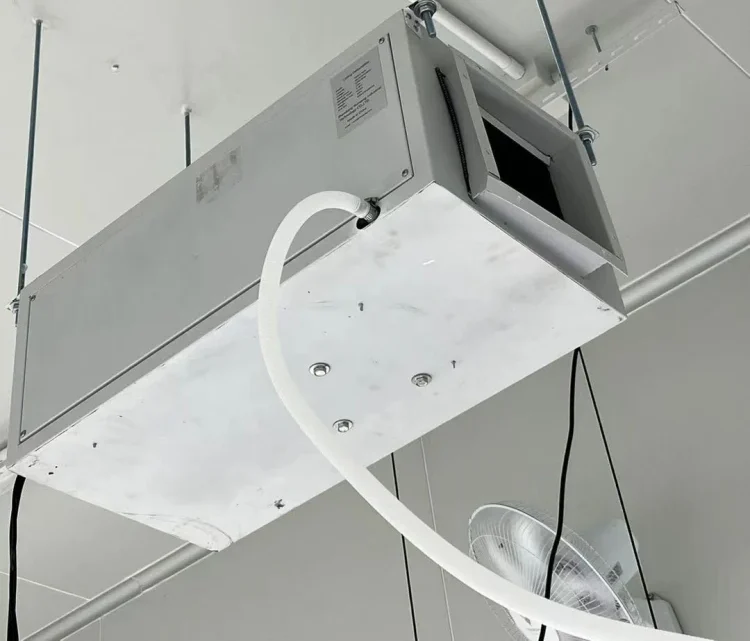
High-water shutdown protects the dehumidifier, but it does not automatically protect the building below it.
Unit High-Water Protection
On high water, a Rinwang unit stops dehumidifying. This prevents the machine from continuing to generate condensate after the high-water condition is detected. The exact behaviour should still be checked on the selected model during commissioning.
Site Overflow Protection
Water may already be sitting in the drain pan, pump reservoir, or downstream pipe when a blockage occurs. Where overflow could damage building components, additional protection may therefore be required. Under 2021 IMC Section 307.2.3, possible approaches include:
- an auxiliary drain pan with a separate drain;
- a separate overflow drain;
- an auxiliary pan with a water-level device;
- or an approved water-level device that shuts the equipment down when the primary drain becomes blocked.
This is particularly important for ceiling-mounted dehumidifiers installed above finished ceilings, stored goods, electrical equipment, or production machinery. Where an overflow drain is used, its termination should be visible enough for a drainage failure to be noticed. Where a water-level device is used instead, test the shutdown function during commissioning.
Confirm the Discharge Point
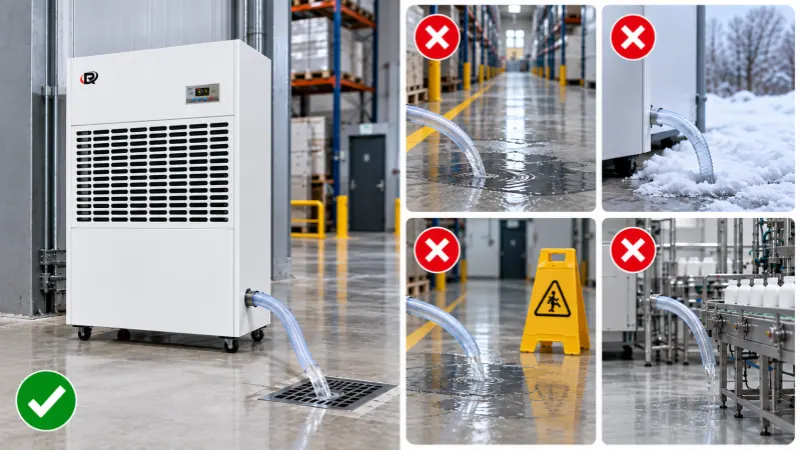
Do not decide where the condensate will go after the drain line has already been installed. Under IMC Section 307.2.1.1, condensate drains should not connect directly to plumbing drain, waste, or vent piping. The exact receptor, indirect-waste arrangement, air gap, or air break depends on the mechanical and plumbing codes adopted at the project location. In practical terms, avoid discharging condensate:
- across walkways or traffic areas;
- where standing water creates a slip hazard;
- into a location where the discharge can freeze;
- or into a hygienic product zone.
Food, beverage, pharmaceutical, and similar facilities may also require additional controls for piping material, cleanability, inspection access, and separation from production areas. Dehumidifier condensate should not be treated as potable water. It can collect dust, microorganisms, metal residues, cleaning chemicals, and biofilm from the coil, drain pan, and piping. If condensate is to be reused for irrigation, cooling-tower makeup, or another process, treat that as a separate engineered water-recovery system.
What About Desiccant Dehumidifiers?
A desiccant dehumidifier normally does not collect liquid water in a drain pan. Moisture is adsorbed by the rotor and released into the reactivation airstream, so the main installation requirement becomes the reactivation exhaust duct rather than a condensate drain. The exhaust should be routed so humid air cannot return to the unit intake, and cold duct sections may require insulation because condensation can still form inside the exhaust duct. For desiccant projects, the important site question is usually:
Where can the reactivation exhaust duct terminate?
rather than:
Where is the floor drain?
See the desiccant dehumidifier range for this type of application.
Commission the Drainage Before Handover
Do not accept the drainage system simply because the drawing looks correct.
Before handover:
- Confirm the unit is level.
An incorrectly pitched cabinet can retain water in the pan. - Check the trap arrangement.
If a trap is required, prime it before startup. - Verify the final drain slope.
Check the completed route, including flexible sections. - Run the unit until it produces condensate.
Confirm that water leaves the unit and reaches the intended discharge point. - Check all drain connections for leaks.
- For pumped systems, observe a complete pump cycle.
Confirm that the pump starts, discharges, and stops correctly. - Test the high-water protection.
Verify what the selected unit actually does when drainage is blocked. - Test any site-installed overflow protection.
- Confirm that traps, pumps, cleanouts, and unions remain accessible.
- Record the final drain route in the handover documents.
That final record makes future maintenance much easier. If the drain blocks later, the facility team should know where the line runs, where it is trapped, and where it terminates.
What to Confirm Before the Unit Ships
Once the drain route has been planned, confirm the equipment-side details with the supplier. Ask for:
| Item to confirm | Why it matters |
|---|---|
| Drain-port size and connection standard | Determines the required fitting or adapter |
| Whether a drain hose is supplied | Defines what the installer must provide |
| Availability of a factory condensate pump | Determines whether lift can be handled inside the unit |
| Pump flow and lift data | Confirms that the pump works at the site’s actual route |
| High-water behaviour | Shows what happens when drainage fails |
| Trap requirement | Prevents incorrect or duplicate trapping |
| Availability of alarm or interlock output | Allows connection to BMS or site monitoring |
| Drain-pan and condensate-path material | Important in corrosive or hygienic environments |
| Whether an auxiliary drain pan is supplied | For Rinwang units, this is site-provided where required |
Frequently Asked Questions
What size drain line does an industrial dehumidifier need?
Under 2021 IMC Section 307.2.2, condensate drain piping should be not less than 3/4-inch pipe size and should not decrease in size between the drain pan connection and the point of disposal.
Does an industrial dehumidifier drain need a P-trap?
It depends on the unit design. A draw-through unit with a negative-pressure drain pan may require a trap so the fan does not pull air through the drain and interfere with condensate flow. Follow the manufacturer’s trap instructions for the selected model.
When does an industrial dehumidifier need a condensate pump?
A pump is normally required when the discharge point is above the unit or when the route cannot maintain continuous gravity fall. A long horizontal run does not automatically require a pump if enough elevation remains available for the required slope.
What happens when an industrial dehumidifier’s tank is full?
A Rinwang unit stops dehumidifying when the high-water condition is reached. This protects the machine, but humidity control also stops until the water is removed or the drainage problem is corrected.
Can dehumidifier condensate discharge directly into a sanitary drain?
Do not assume that a direct connection is permitted. The required receptor, air gap, air break, or indirect-waste arrangement depends on the mechanical and plumbing codes adopted for the project.
Do desiccant dehumidifiers need a condensate drain?
Normally, no. A desiccant unit removes moisture through adsorption and releases it through the reactivation exhaust rather than collecting liquid water in a drain pan.
The installation therefore focuses mainly on the exhaust-duct route rather than condensate piping.