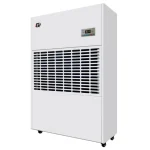
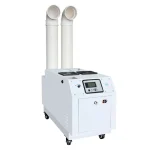
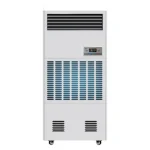
When choosing an industrial dehumidifier, you may notice that some models use R410A while others use R32 or R454B. Does the refrigerant make a difference, and which one should you choose?
R410A is an established refrigerant, while R32 and R454B have a lower environmental impact if released into the atmosphere. However, the refrigerant also affects equipment safety, maintenance and compliance with regulations in different markets. A lower environmental impact does not automatically mean better dehumidification performance.
For industrial buyers, the goal is to choose a machine that meets the required humidity conditions, complies with local regulations and remains practical to maintain. This guide explains the main refrigerant differences and what they mean when purchasing industrial dehumidifiers.
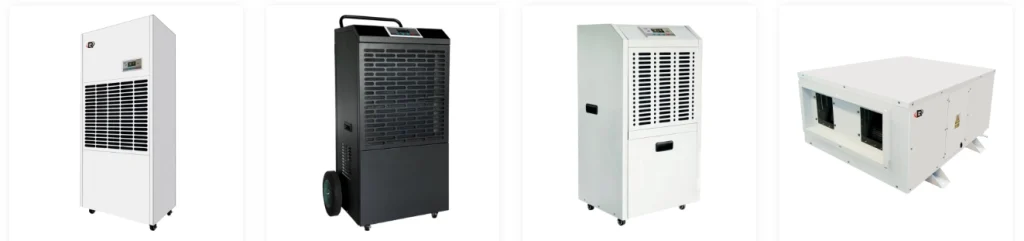
Which Refrigerants Are Used in Industrial Dehumidifiers?
A refrigerant dehumidifier removes moisture by cooling humid air until water condenses and drains away. The refrigerant circulates inside a sealed cooling system, allowing the machine to repeat this process continuously. This is the same basic principle behind how industrial dehumidifiers remove moisture from the air.
Not all industrial dehumidifiers use refrigerants. Desiccant dehumidifiers absorb moisture using a specialized drying material and do not require refrigerant for their main drying process. The two technologies serve different needs, particularly when operating temperatures and required humidity levels make one approach more suitable than the other.
Among refrigerant-based equipment, the following refrigerants are commonly encountered in existing or newer dehumidifier designs.
| Refrigerant | GWP | Safety Class | What Buyers Should Know |
|---|---|---|---|
| R410A | 2,088 | A1 | Established technology, but faces increasing environmental restrictions |
| R32 | 675 | A2L | Lower environmental impact; requires equipment designed for mild flammability |
| R454B | 466 | A2L | Lower-GWP alternative used in some newer dehumidifiers |
| R134a | 1,430 | A1 | Found in certain existing and specialized models |
| R290 (propane) | 3.3 | A3 | Very low GWP, but higher flammability requires additional design precautions |
| R407C | 1,774 | A1 | Used in some established refrigeration systems |
GWP values are based on the IPCC Fourth Assessment Report (AR4) for comparison. Legal GWP calculations may differ by market. Safety classes follow the ASHRAE refrigerant classification system.
GWP stands for Global Warming Potential. It measures how strongly a gas contributes to global warming compared with carbon dioxide over a specified period. A lower number means a lower climate impact for the same amount released.
The safety classes describe flammability and toxicity characteristics. A1 refrigerants do not spread flames under standard test conditions, A2L refrigerants are mildly flammable, and A3 refrigerants have higher flammability.
For buyers comparing industrial equipment, R410A, R32 and R454B are particularly useful reference points because they illustrate the trade-offs between established designs, lower GWP and changing safety requirements.
R410A vs R32 vs R454B: What Are the Main Differences?
The biggest differences between these three refrigerants involve environmental impact, equipment safety and how the cooling system must be designed.
Environmental Impact
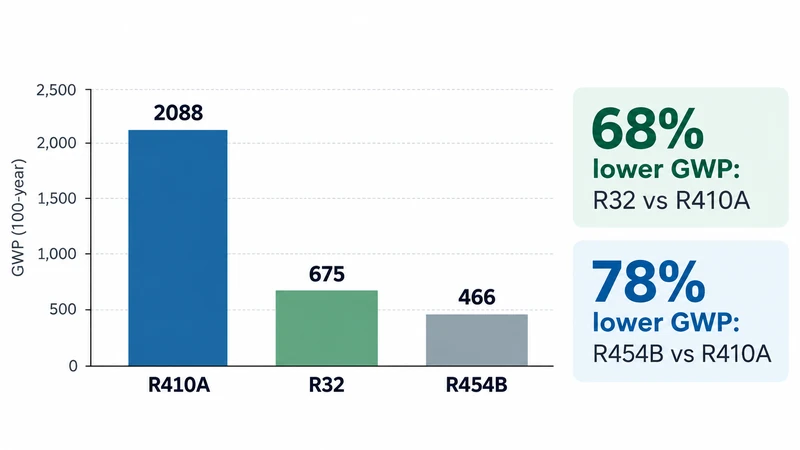
R410A has a GWP of 2,088, compared with 675 for R32 and 466 for R454B. Based on these values, R32 has approximately 68% lower GWP than R410A, while R454B has approximately 78% lower GWP.
This matters because many markets are gradually restricting high-GWP refrigerants in new equipment. Lower-GWP options can reduce the environmental impact of refrigerant leakage and may help manufacturers meet certain regulatory requirements.
However, GWP only describes the impact of the refrigerant itself. A dehumidifier also consumes electricity, so overall environmental performance depends on energy use, refrigerant leakage and the machine’s working life.
Safety and Equipment Design
R410A belongs to safety class A1, while R32 and R454B are classified as A2L. This means equipment using R32 or R454B must be designed to manage the risks associated with mildly flammable refrigerants.
The refrigerants also behave differently inside the cooling system. For example, R32 can produce higher compressor temperatures than R410A under certain conditions. Manufacturers must account for these differences when choosing components and designing protective controls.
R454B offers a lower GWP than R32 and is already used in some professional dehumidification equipment. However, it also requires a compatible system designed for that refrigerant.
None of these refrigerants can simply be exchanged without considering the equipment design. For buyers, the important point is to choose a complete machine designed for the refrigerant it uses, rather than assuming that one refrigerant is always superior.
Does R32 Make an Industrial Dehumidifier More Efficient Than R410A?
Not necessarily. Although R32 has properties that can support efficient cooling-system designs, the actual moisture-removal performance depends on the entire dehumidifier.
The compressor, cooling coils, airflow and controls all affect how much water the machine removes and how much electricity it consumes. A well-designed R410A model may outperform a poorly optimized R32 model under the same operating conditions, and the reverse may also be true.
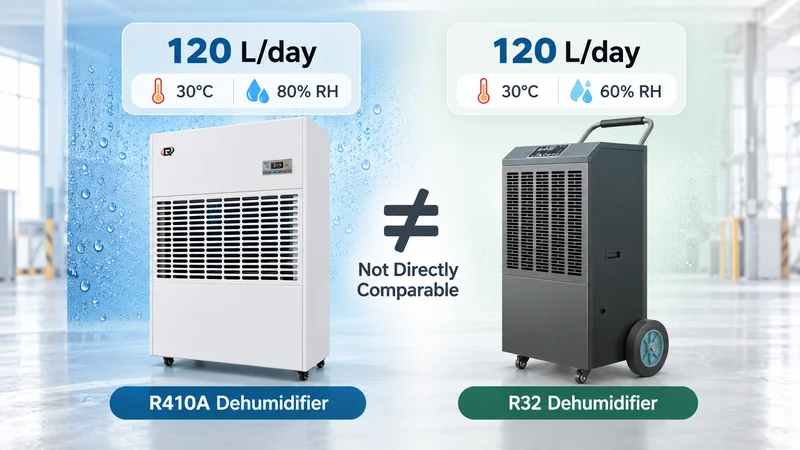
When comparing equipment, pay attention to the conditions used for the published capacity ratings. For example, a machine rated at 120 L/day at 30°C and 80% relative humidity cannot be directly compared with one rated at 120 L/day at 30°C and 60% relative humidity. Removing moisture is generally easier when the air contains more water vapor.
A more useful comparison is how many liters of water each machine removes under the same temperature and humidity conditions, together with its electricity consumption. Measuring liters removed per kilowatt-hour (L/kWh) helps buyers understand how much dehumidification they receive for the electricity consumed.
Operating temperature matters as well. High temperatures can place greater demands on the cooling system, while lower temperatures may reduce moisture-removal capacity and cause frost to form on cooling coils. The refrigerant must therefore be evaluated as part of the complete machine rather than as a separate performance guarantee.
Is R410A Being Phased Out or Banned?
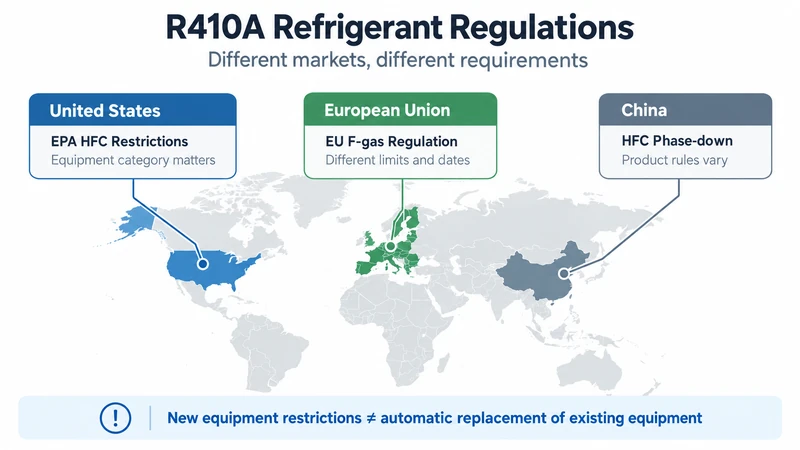
R410A is increasingly restricted because of its high GWP, but there is no single worldwide ban that applies to every industrial dehumidifier. Regulations depend on the country, the type of equipment and whether the rules concern new machines or existing installations.
For industrial buyers, understanding these differences is more useful than relying on a general statement that R410A is banned or that R32 is always permitted.
United States
The U.S. Environmental Protection Agency (EPA) is restricting high-GWP refrigerants under the American Innovation and Manufacturing (AIM) Act.
An important point is that non-residential dehumidifiers are addressed under the residential and light commercial air-conditioning and heat-pump category in EPA’s regulatory framework, rather than being automatically excluded from refrigerant restrictions.
For covered new equipment, the applicable rules prohibit refrigerants with a GWP of 700 or greater, subject to the relevant requirements and exceptions. January 1, 2025, is the principal manufacturing and import compliance date for the covered product categories.
This makes R410A, with a GWP of 2,088, unsuitable for covered new equipment subject to that limit. R32 and R454B are below the threshold, although the finished equipment must still meet relevant safety and product requirements.
The precise rules can depend on how a particular machine is classified, and transitional provisions may affect certain previously manufactured equipment. Before supplying new dehumidifiers to the U.S., buyers and importers should check EPA’s current refrigerant restrictions for the relevant equipment category.
European Union
The EU’s revised F-gas Regulation is gradually reducing the use of high-GWP refrigerants and introducing restrictions for specified equipment categories.
Under certain air-conditioning and heat-pump categories, new self-contained equipment with capacities up to 12 kW faces a GWP threshold of 150 from January 1, 2027, with specific safety-related exceptions. Other categories have different limits and dates.
However, these air-conditioning and heat-pump restrictions should not automatically be applied to every industrial dehumidifier. The first step is to determine how the particular machine is classified under the regulation.
Although R32 and R454B have lower GWPs than R410A, both remain above 150. Their suitability therefore depends on which equipment requirements apply. The distinctions between equipment categories and effective dates are set out in the EU F-gas Regulation and its product restrictions.
China and Other Markets
China is also reducing its reliance on high-GWP refrigerants through national HFC controls and related policies. However, general refrigerant phase-down targets should not be confused with specific restrictions on individual industrial dehumidifier models.
For equipment manufactured in China and exported internationally, the destination market is especially important. A refrigerant configuration suitable for one country may not meet the requirements of another.
What Happens to Existing R410A Equipment?
Restrictions on new equipment do not automatically mean existing R410A dehumidifiers must be replaced.
In many cases, installed machines can continue operating and receiving appropriate service under applicable regulations. However, the gradual reduction in HFC supply may create longer-term price and availability pressure for R410A.
For facility owners, the practical approach is to maintain existing equipment, prevent refrigerant leakage and consider future regulations when planning replacement purchases.
Regulatory information reviewed as of October 2026. Requirements and equipment classifications should be confirmed against current official rules before purchasing or importing equipment.
Are R32 and R454B Safe for Industrial Dehumidifiers?
R32 and R454B are classified as A2L refrigerants, meaning they are mildly flammable. This does not make them unsuitable for industrial dehumidifiers, but it does mean the equipment must be specifically designed to use them safely.
Depending on the amount of refrigerant inside the machine and where it is installed, safety measures may include leak protection, airflow controls and requirements for the surrounding space. These requirements vary by equipment design and applicable standards, so not every A2L dehumidifier needs the same installation arrangements.
Maintenance also requires appropriate procedures and tools. Buyers should confirm that technicians servicing the equipment can work with its refrigerant safely, particularly when machines are installed across multiple facilities or maintained by external contractors.
One important limitation is that R32 cannot be used as a direct replacement for R410A in an existing machine. Their safety classifications and operating characteristics differ, so changing refrigerants requires an engineered and properly approved equipment design. Unless the manufacturer provides an approved conversion, the original refrigerant should be retained.
How Should Buyers Choose the Right Refrigerant?
The best refrigerant depends on the project rather than a single technical specification. For most industrial buyers, four considerations are enough to guide the initial decision.
| What to Check | Why It Matters |
|---|---|
| Destination market | Determines which refrigerant restrictions apply to the equipment |
| Operating conditions | Helps identify machines that can maintain the required humidity |
| Installation and servicing | Confirms that the equipment can be used and maintained safely |
| Long-term costs | Includes electricity consumption, maintenance and refrigerant availability |
Start by confirming whether the proposed machine is suitable for the destination market. Then compare complete dehumidifiers at the temperatures and humidity levels expected on site. An equipment specification should be assessed against the moisture load the facility actually needs to remove, rather than relying only on a headline capacity rating.
For existing facilities, the choice may be between maintaining an R410A machine and replacing it with a newer model. For new projects, lower-GWP refrigerants may offer environmental and regulatory advantages, but the machine must still meet the required performance and safety conditions. Rinwang’s industrial dehumidifier manufacturing capabilities include R410A and R32 configurations, allowing buyers to discuss equipment options based on their operating conditions and destination market.
The final decision should balance these considerations rather than treating refrigerant GWP as the only measure of equipment suitability.
Industrial Dehumidifier Solutions from Rinwang
Rinwang offers industrial dehumidifiers with R410A and R32 refrigerant configurations. Our team can help buyers evaluate suitable equipment based on operating conditions, humidity requirements and destination market.
Buyers can explore industrial dehumidifier models and available configurations or contact our team to discuss their project requirements.
Frequently Asked Questions
What refrigerant do industrial dehumidifiers use?
Industrial dehumidifiers may use R410A, R32, R134a, R407C or other refrigerants, depending on the machine’s design. R454B and R290 are also used in certain professional dehumidification products. The actual refrigerant should be confirmed from the equipment specifications or nameplate.
Is R32 better than R410A for dehumidifiers?
R32 has a significantly lower GWP, but it is not automatically more efficient. Actual moisture-removal capacity and electricity consumption depend on the complete equipment design. Buyers should compare finished machines at the same temperature and humidity conditions.
Is R32 being phased out?
There is no single worldwide ban date for R32. Its suitability depends on the destination market and equipment category. Although R32 has a lower GWP than R410A, it may not meet stricter refrigerant limits applying to certain equipment types.
Can an R410A dehumidifier be converted to R32?
R32 is not a direct replacement for R410A. Their different safety and operating characteristics mean that an existing machine cannot simply be recharged with R32. An engineered and appropriately approved conversion would be required.
Can existing R410A dehumidifiers still be used?
In many markets, existing R410A dehumidifiers can continue operating and receiving appropriate maintenance, subject to local regulations. Restrictions on newly manufactured equipment do not automatically require owners to replace installed machines.