Packaging goes limp. Racking starts to rust. The air conditioner runs constantly, but the RH never drops. Or the opposite: static incidents spike, paper stock curls before it reaches the press, wood shipments arrive warped. Both are humidity problems — they just need opposite solutions.
A humidifier adds water vapour to the air to raise relative humidity (RH). A dehumidifier removes moisture from the air to lower it. Which one you need depends on what your RH actually is and what’s driving it — not on how the air feels.
For homes, the cost of getting this wrong is discomfort. For warehouses, food plants, and industrial facilities, it’s typically months of undetected product damage, equipment failure, or compliance exposure before anyone traces it back to humidity.
What a Humidifier Does
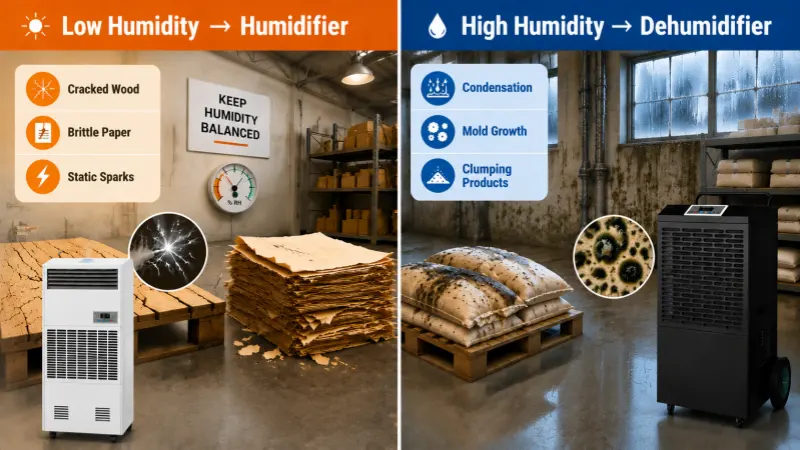
Thread breakage rates climb. Paper stock curls and jams feeders. ESD incidents damage components on the assembly line. These are the symptoms of air that’s too dry — and a humidifier is what fixes them.
A humidifier releases water vapor into the air to raise relative humidity. It’s used when RH drops below the threshold that materials, processes, or products can tolerate.
Three main types are used in commercial settings:
| Type | How It Works | Best For |
|---|---|---|
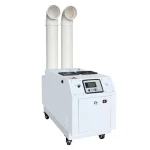
| Ultrasonic | High-frequency vibration breaks water into fine mist | Electronics, quiet environments, smaller zones |
| Evaporative | Fan draws air through a wet wick or pad | Large open spaces, cost-sensitive applications |
| Steam / Isothermal | Boils water and injects steam directly into airflow | Cleanrooms, pharmaceutical, precision manufacturing |
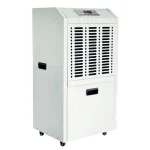
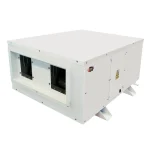
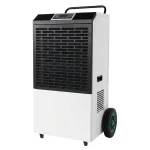
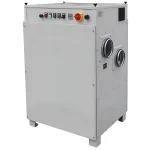
What a Dehumidifier Does
Damp packaging collapses under load. Racking corrodes. Floors stay wet and create slip hazards. Mold spreads through HVAC ductwork. Pharmaceutical products degrade. These are the problems of air that holds too much moisture — and a dehumidifier is what removes it.
A dehumidifier extracts water vapor from the air to lower relative humidity. In commercial and industrial settings, the damage from excess moisture shows up in product loss, equipment failure, and structural repair costs — often long before anyone identifies humidity as the cause.
Two technologies dominate at industrial scale:
| Type | How It Works | Best Operating Range |
|---|---|---|
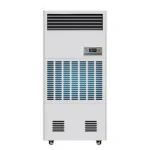
| Refrigerant (compressor) | Cools air below dew point; moisture condenses on coils and drains away; air is reheated and returned | Above 15°C; warm to moderate climates |
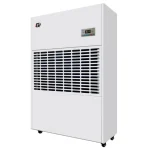
| Desiccant (rotary wheel) | A silica gel or molecular sieve wheel adsorbs moisture; a heated regeneration airflow removes and exhausts it | Low temperatures, sub-zero environments, extremely low RH targets |
A refrigerant unit in a cold storage environment below 5°C will frost over and stop working. A desiccant unit in a standard ambient warehouse is typically over-specified and unnecessarily expensive. The deciding factors are operating temperature and target RH — the full comparison of refrigerant vs desiccant dehumidifiers covers where each technology wins and where it doesn’t.
Side-by-Side: The Core Differences
| Category | Humidifier | Dehumidifier |
|---|---|---|
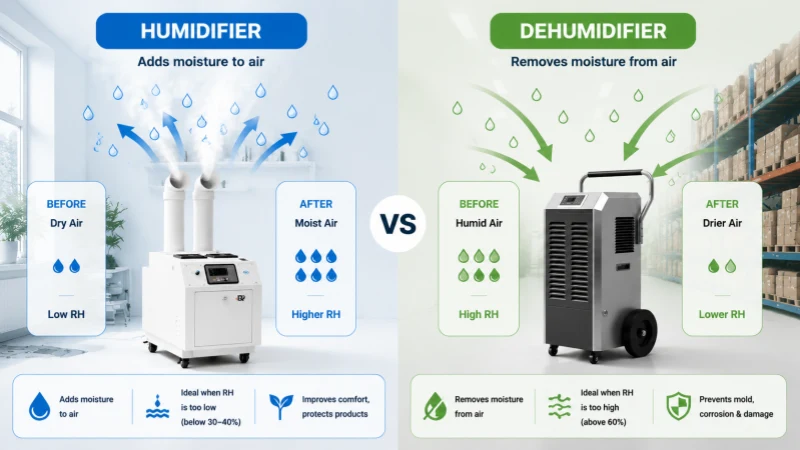
| What it does | Adds moisture to air | Removes moisture from air |
| Used when RH is | Too low (below 30–40%) | Too high (above 60%) |
| Main technology types | Ultrasonic / Evaporative / Steam | Refrigerant (compressor) / Desiccant (rotary wheel) |
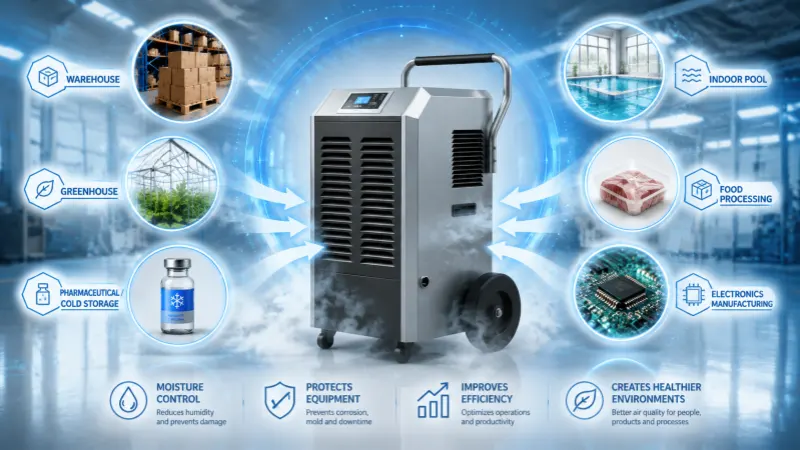
| Common commercial uses | Printing, electronics, textiles, wood storage | Warehousing, indoor pools, food processing, cold storage, pharma |
| Energy demand | Low–medium | Medium–high (varies by capacity and technology) |
| Water handling | Needs water supply | Needs drainage (hose, pump, or floor drain) |
| Industrial sizing unit | kg/h humidification output | L/day or pints/day moisture removal |
How to Know Which One Your Facility Needs
Most facilities end up with the wrong equipment for the same reason: the decision was based on how the air felt, not what the RH actually measured.
Step 1: Measure First — Before Buying Anything
Use a calibrated hygrometer and take readings in the actual spaces where you’re seeing problems. Measure at different times of day, across seasons where possible, and near the specific areas where damage is occurring — not just in the centre of the room.
The U.S. Environmental Protection Agency recommends keeping indoor relative humidity between 30% and 60% for general indoor environments. In commercial and industrial facilities, the targets vary significantly by application:
| Application | Target RH Range | Primary Risk if Out of Range |
|---|---|---|
| General warehousing | 40%–60% | Above 60%: carton collapse, pallet mold, rack corrosion |
| Food processing | 30%–50% (product dependent) | Above: microbial growth, packaging failure; below: product desiccation |
| Cold storage | Below 65% | Frost on coils, condensation on product during temperature pull-down |
| Indoor swimming pool | 50%–60% | Above 60%: structural corrosion, glazing condensation, unhealthy air |
| Pharmaceutical storage | 35%–65% (per product spec) | Product degradation, GMP/GDP compliance failure |
| Greenhouse / cannabis | 40%–50% (flowering stage) | Above 60%: botrytis, powdery mildew; below 40%: plant stress |
| Electronics manufacturing | 40%–55% | Below 40%: ESD damage; above 65%: moisture damage to components |
| Printing / paper handling | 45%–55% | Below 40%: static, curl, feed failures; above 60%: ink spread, paper cockling |
If your target RH isn’t defined yet, that’s where to start — the right number comes from your product specifications or industry standard, not from general comfort guidelines.
Step 2: Match Your Symptoms to the Right Device
Cross-check your RH readings against what you’re actually seeing in the space.
Your facility likely needs a humidifier if:
- RH is consistently below 30–40%
- Static electricity or ESD incidents are occurring
- Paper, textiles, or wood are cracking, curling, or becoming brittle
- Products are losing weight or drying out during storage
- Thread breakage rates increase on production lines
Your facility likely needs a dehumidifier if:
- RH is consistently above 60%
- Condensation appears on walls, ceilings, pipes, or ductwork
- Musty odours or visible mold are present
- Metal racking, equipment, or structures show signs of corrosion
- Packaging is losing strength, collapsing, or going limp
- Products are clumping, absorbing moisture, or sticking together
- Floors stay wet or slippery without an obvious water source
- Your HVAC or air conditioning cannot stabilise indoor humidity
Step 3: Find Where the Moisture Is Coming From
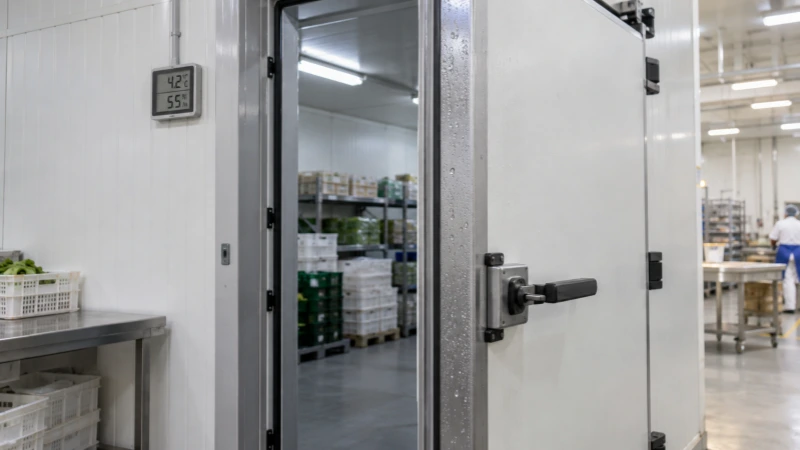
Buying the right device category won’t help if you haven’t identified the moisture source. High humidity in a cold storage facility often comes from warm air infiltrating through worn door seals during loading operations — not from the product itself. A larger dehumidifier doesn’t fix a broken seal; it just runs harder until it fails. Loading dock condensation is one of the most underestimated moisture sources in warehouse environments, and no dehumidifier capacity compensates for an unsealed building envelope.
The same logic applies to HVAC. Air conditioning removes some moisture as a byproduct of cooling, but it optimises for temperature, not humidity. In high-moisture environments, the system must over-cool the space to extract enough moisture from the air, wasting energy and potentially damaging temperature-sensitive products. When cooling and dehumidification run as separate systems, both tasks are handled more efficiently.
Can You Use a Humidifier and Dehumidifier in the Same Facility?
The short answer depends on whether they’re serving the same zone at the same time. In the same room simultaneously, no — each device works against the other, and you waste energy on both sides.
In practice, there are three scenarios where both devices legitimately coexist in one facility:
Different zones, different needs. A large distribution centre might have a climate-controlled pharmaceutical storage zone that needs dehumidification, while a dry-goods packaging station in a separate heated area needs humidification to suppress static. Each device serves its own defined zone, controlled independently by its own humidistat.
Seasonal switching. Many facilities in temperate climates run dehumidifiers through summer — when hot, humid outdoor air raises interior RH — and switch to humidification in winter, when cold outdoor air, once heated indoors, becomes extremely dry. A building management system (BMS) handles the setpoint switching automatically based on real-time RH readings.
Precision process environments. In pharmaceutical cleanrooms and certain electronics manufacturing facilities, HVAC systems sometimes over-cool to reach a specific dew point target, then bring RH back up to the process setpoint using a steam humidifier. This is controlled engineering — it’s how ±2% RH tolerances are achieved in practice.
If your facility needs humidity control in both directions, the right setup is an integrated control system with automatic setpoint switching — not two independently operated devices.
How Different Industries Use These Devices
Warehousing and Logistics
Corrugated cartons lose significant compressive strength as RH climbs above 60%. Metal racking corrodes. Pallet boards grow mold. Floor condensation creates slip hazards that trigger safety incidents. Warehouse humidity control in practice means deciding which dehumidifier technology fits the temperature range, how much capacity the moisture load requires, and where in the air distribution scheme the units are placed — all of which vary considerably between a refrigerated facility and a standard ambient warehouse.
Indoor Swimming Pools
Water surface evaporation is continuous and large in volume. Without active dehumidification, moisture attacks structural steel, glazing seals, timber roof structures, and mechanical systems — the damage compounds quietly over years. Pool dehumidifiers are typically ducted into the ceiling supply rather than deployed as standalone units, because air distribution across the water surface is as important as raw moisture removal capacity.
Greenhouse and Controlled Horticulture
Botrytis and powdery mildew spread fastest above 70% RH, which is exactly where many greenhouse and grow room environments sit during the dark period without active dehumidification. Standard units that cycle on and off can’t hold the stable overnight RH that commercial cultivation requires — a documented failure pattern in commercial cannabis grow rooms where the moisture load and the RH sensitivity of the crop are both high.
Food Processing
Every washdown cycle floods the air with moisture. Cold processing surfaces attract condensation that drips directly onto product lines. At 70–80% RH, packaging loses structural integrity faster than most quality control schedules catch it. Food processing plant dehumidification adds requirements beyond basic moisture removal: corrosion-resistant construction that survives daily washdowns, hygienic drainage that doesn’t create pooling near product, and documentation that satisfies HACCP and food safety audit requirements.
Cold Storage and Pharmaceutical Environments
Cold storage below 5°C requires desiccant technology — refrigerant units frost over and stop working at low temperatures. Pharmaceutical storage adds regulatory requirements on top: ICH Q1A(R2) stability storage conditions specify controlled temperature and RH ranges that must be validated and continuously logged as part of GMP compliance. Pharma-grade dehumidifier selection starts with the product’s stability specifications, not the room dimensions.
Electronics Manufacturing and Printing
This is the one commercial sector where either device may be the answer, depending on measured RH. Below 40% RH, static discharge (ESD) damages components and causes paper jams and feed failures. Above 65%, PCBs absorb moisture and inks spread on printing stock. Measure first — the answer is in the data, not the air quality feel. PCB assembly and semiconductor fabrication often specify RH tolerances of ±2% around a 45–55% target, which requires precision control typically integrated with a BMS. ESD-safe dehumidification for electronics environments covers the specific requirements that standard commercial units don’t meet.
For a broader view of which configurations suit other industrial sectors, the industrial dehumidifiers by application guide covers the full range of commercial environments.
Why Home Units Don’t Work in Commercial Spaces
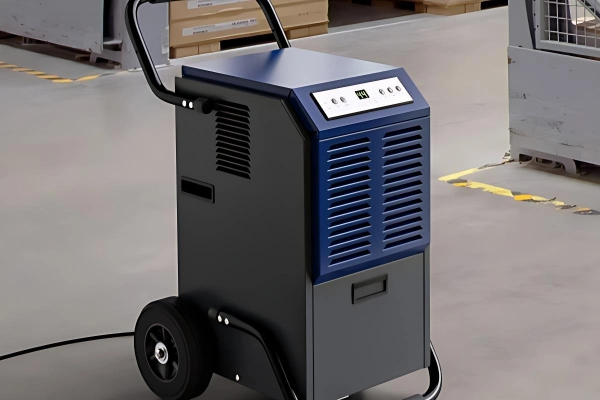
Home dehumidifiers process roughly 30–70 pints per day (14–33 litres/day), cycle on and off, and drain into a bucket you empty manually. Industrial units handle 100 litres/day to several thousand litres/day, run continuously, drain to a fixed plumbing line, and are built to sustain the mechanical stress of year-round operation.
The gap isn’t just capacity. An indoor pool generates far more moisture per square metre than a dry-goods warehouse — getting those two confused produces a unit that runs at full load around the clock and still can’t hit the RH target. And beyond capacity, construction standards, control accuracy, drainage design, and duty cycle rating all differ in ways that matter in commercial deployments. A home unit deployed under sustained commercial load typically fails within months. The difference between a home dehumidifier and an industrial one covers those gaps in full before you commit to a specification.
FAQ
What’s better for reducing humidity: an air conditioner or a dehumidifier?
A standalone dehumidifier is usually more effective at removing moisture than an air conditioner, which mainly cools air and only reduces humidity as a side effect.
Can a dehumidifier improve indoor air quality besides humidity control?
Yes — by lowering humidity it helps prevent mold, dust mites, and musty odors, which can improve overall indoor air quality.
What indoor humidity level should I aim for?
Experts recommend keeping indoor relative humidity roughly between 30 % and 50 % for comfort and to avoid mold or dryness issues.
Do humidifiers help with allergy symptoms?
Humidifiers can ease dry air–related irritation in nasal passages and skin, but too much humidity can encourage mold and dust mites that worsen allergies.
Are there devices that both humidify and dehumidify automatically?
Most units are designed for one function; combo systems are rare, and in practice separate devices or integrated HVAC controls are used for precise humidity management.
Key Takeaways
- Measure relative humidity with a calibrated hygrometer before choosing any equipment — and identify the moisture source before sizing anything.
- In most industrial applications — warehousing, food processing, indoor pools, cold storage, pharmaceutical — dehumidification is the primary need.
- Refrigerant dehumidifiers work above 15°C; desiccant units handle low temperatures and sub-zero environments. Getting the technology wrong is as costly as getting the device category wrong.
- Home-grade units are not rated for commercial moisture loads, continuous operation, or fixed drainage. They fail quickly under sustained commercial conditions.
- When both humidity directions are needed in one facility, the answer is an integrated control system — not two devices running without a setpoint strategy.