Carton blanks arrive in good condition but feel softer after several weeks on the rack. Label rolls behave differently after storage near a receiving door. A batch of bagged ingredients develops lumps before it reaches production. In each case, the useful question is where the material gained moisture and how long it remained exposed.
This guide explains how to choose and use an industrial dehumidifier for packaging materials and dry goods storage. It helps buyers turn material storage requirements and everyday warehouse conditions into a practical equipment brief, so they can compare suitable options and verify whether moisture control is working around the stored goods.
Identify When Stored Materials Become Exposed to Moisture
Compare batch condition at receipt, after storage and at issue to production, alongside local humidity records. This helps distinguish incoming damage from exposure during holding or transfer.
| Storage stage | Evidence to collect | Decision it supports |
|---|---|---|
| Receipt | Packaging damage, wet pallet surfaces, lot identification and arrival condition | Whether a batch needs quality review before joining normal stock |
| Time on the rack | Storage position, temperature and relative humidity (RH) history, dwell time and condition of protective wrapping | Whether exposure develops in a particular location or during long holding periods |
| Opening and issue | When wrapping or liners are opened, quantities removed and how remnants are resealed | Whether handling creates exposure that room control alone cannot prevent |
| Transfer to production | Material condition at handover and time spent outside controlled storage | Whether the storage specification remains useful through the transfer |
Moisture changes the physical properties of paper and board; visual appearance alone may not reveal a loss of carton stacking performance. Paper label stock can swell as it absorbs moisture, affecting dimensional stability. Controlling the air around stored stock helps limit further exposure, but it cannot certify that an already affected batch remains suitable for use.
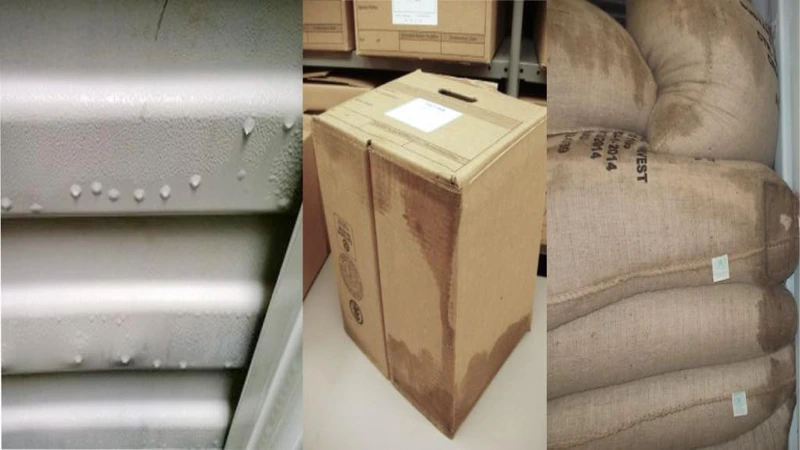
Powders need a different assessment. Water uptake can alter particle surfaces and promote bridges between particles, reducing flowability. Composition, particle-size distribution, temperature and prior moisture exposure affect that response, so a storage condition suitable for one grade of an ingredient may not suit another.
Research by Popil on the effects of moisture on corrugated board compression strength demonstrates why humidity exposure matters to carton performance. Research by Mathlouthi and Rogé (2004) on white sugar caking also shows that particle size and temperature influence moisture-related instability. These findings should be interpreted within their tested material and environmental conditions, not treated as universal failure thresholds for every carton or powder.
| Material | Humidity-related behavior | Practical implication |
|---|---|---|
| Corrugated board | Moisture can reduce compression performance and affect stacking strength | Evaluate carton condition and supplier testing criteria after significant exposure |
| Pressure-sensitive labels | Paper facestock can expand with moisture uptake, affecting dimensional stability | Follow supplier storage and conditioning guidance |
| Fine sugar powder | Particle size and temperature influence moisture uptake and caking behavior | Establish storage limits for the actual ingredient grade |
| Other hygroscopic powders | Water uptake can promote particle adhesion and reduce flowability | Check product-specific storage specifications and packaging barriers |
A defect first noticed on a production line may originate in storage. Check material condition at handover and its earlier exposure before investigating whether the food packaging area adds moisture or other process-related causes. The point of discovery does not establish the source.
Turn Material Instructions into a Storage-Zone Specification
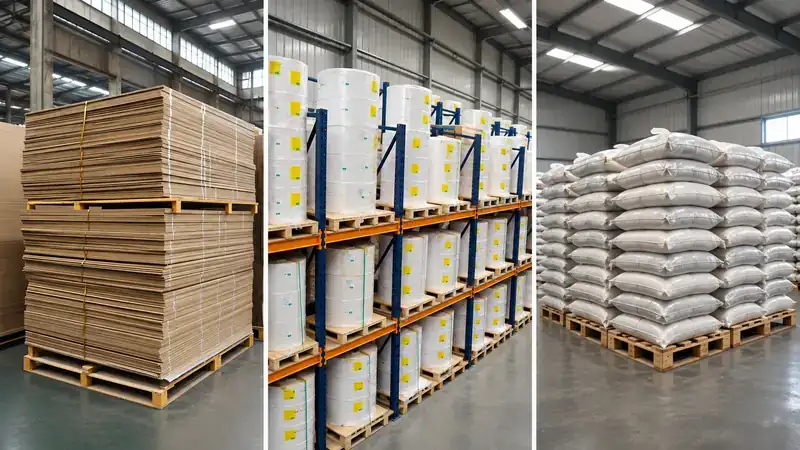
Build the storage requirement from the materials that will actually share the space. Obtain their temperature and RH instructions, protective-packaging requirements and permitted holding conditions. Where requirements are incompatible, separate the inventory rather than lowering the entire room to satisfy just one item.
A useful reference is Avery Dennison’s storage bulletin for pressure-sensitive materials and finished labels. It recommends approximately 22°C and 50% RH for the materials discussed, together with protective wrapping and pallet storage rather than direct contact with concrete. These recommendations apply to the materials covered by that guidance; they are not a universal specification for cartons, ingredients or every label construction.
For paper and board, ASTM D685 provides standard conditioning conditions for testing paper and paper products, including a reference environment of approximately 23°C and 50% RH. This is a laboratory conditioning reference, not a mandatory warehouse storage target. Actual storage requirements should follow the material supplier’s instructions and the performance requirements of the goods.
For bagged dry ingredients, confirm the supplier’s storage instructions and liner or moisture-barrier requirements. Keep three measurements separate:
| Measurement | What it describes | How it informs the storage decision |
|---|---|---|
| Relative humidity (RH) | Water-vapor pressure in air relative to saturation at the same temperature | Defines an environmental control condition together with temperature |
| Moisture content | The amount of water in the product, on a stated wet- or dry-mass basis | Assesses the material itself; it is not a room humidity setting |
| Water activity (aw) | The product’s equilibrium water-vapor pressure relative to pure water at the same temperature | Helps assess product stability; it cannot be inferred from a routine room-RH reading |
At equilibrium and the same temperature, water activity corresponds to equilibrium relative humidity divided by 100. Sealed or recently moved goods may not be in equilibrium with the room, so room monitoring cannot replace product assessment. For food ingredients, product water activity and moisture content should be evaluated against the relevant product specification and quality requirements.
Specify the stock covered, its allowed temperature/RH range, any condensation requirement and the response to an excursion. Set operating targets and alarms within those limits, accounting for sensor uncertainty and measured control variation.
If cold deliveries enter a warmer store, compare the local air dew point with the temperature of the exposed packaging or goods. A suitable room RH target does not by itself establish that cold incoming surfaces will remain dry. Agree on a receiving and conditioning procedure with the material supplier instead of applying one unpacking delay to every shipment.
Decide Whether a Separate Storage Room Is Worth Controlling
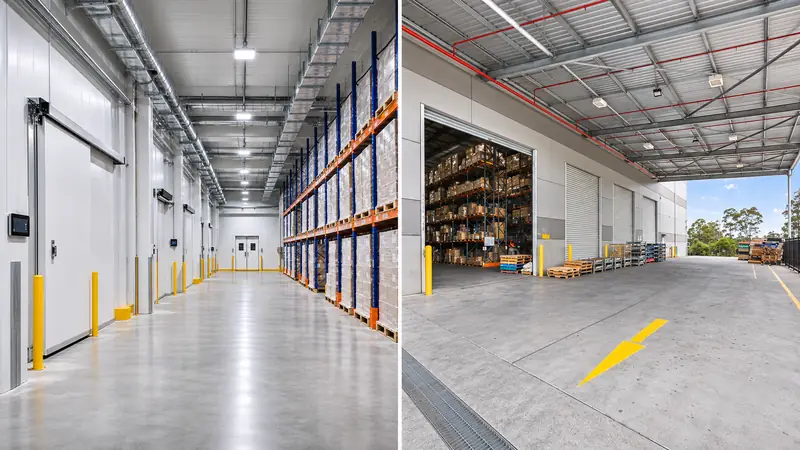
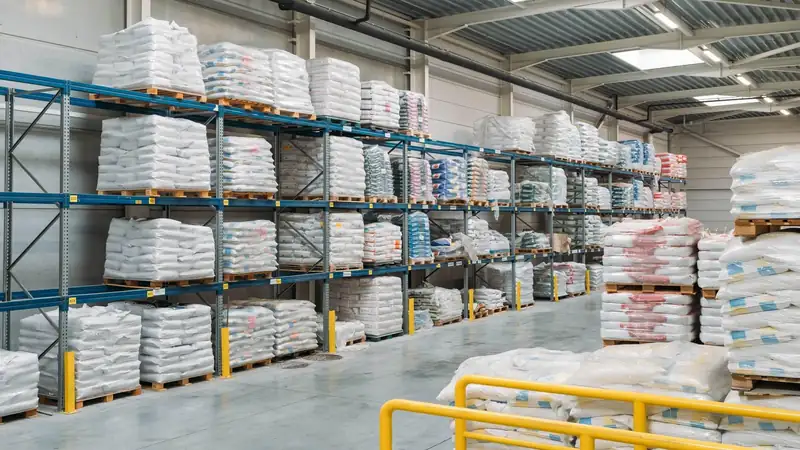
A separate controlled store is useful when a limited stock group has requirements that the surrounding warehouse cannot reliably maintain. Its value depends on whether daily handling preserves the boundary. A partition with an opening left exposed throughout the shift can behave more like part of the warehouse than a separate room.
Keep stock movement practical: deliveries enter an inspection or receiving position, accepted material goes into controlled storage, and only the quantity needed for use leaves it. Minimize avoidable exposure while keeping access, required ventilation and the site’s material-handling procedures intact. Repair water leaks and keep wet cleaning activity from becoming a routine load inside the dry store.
For example, a mixed warehouse holding a small stock of sensitive label rolls and ingredient bags may benefit from an enclosed store sized for peak inventory and normal replenishment. An open-sided staging area connected to dispatch presents a different problem: its exposure to incoming air must be reduced or explicitly included in the design before equipment capacity can be established.
These are illustrative arrangements, not customer cases or guaranteed savings. The decision should account for stock volume, daily movement, access requirements and the ability to maintain the intended environmental boundary.
Estimate the Moisture Load Inside the Storage Boundary
Separate the load that occurs once from the load that returns during normal operation. Initial drying may involve damp building materials or recovery after a water incident. Continuous moisture load includes outdoor air and any recurring internal releases.
New pallets do not automatically create a significant material load. Their moisture condition, the goods they carry, packaging protection and the air admitted during handling determine the contribution.
| Moisture source | What to establish for this store |
|---|---|
| Door openings and leakage | Opening size, duration and frequency; the humidity of the air entering from outdoors or adjacent areas |
| Required ventilation | Supply and exhaust quantities and whether incoming air is already treated; avoid counting the same air twice |
| Goods, pallets and packaging | Actual wetness or moisture release, delivery quantity and packaging protection—not delivery count alone |
| People and cleaning | Occupancy periods, cleaning method and time needed for wet surfaces to dry |
A Small Example: Reducing Air Entry Before Adding Capacity
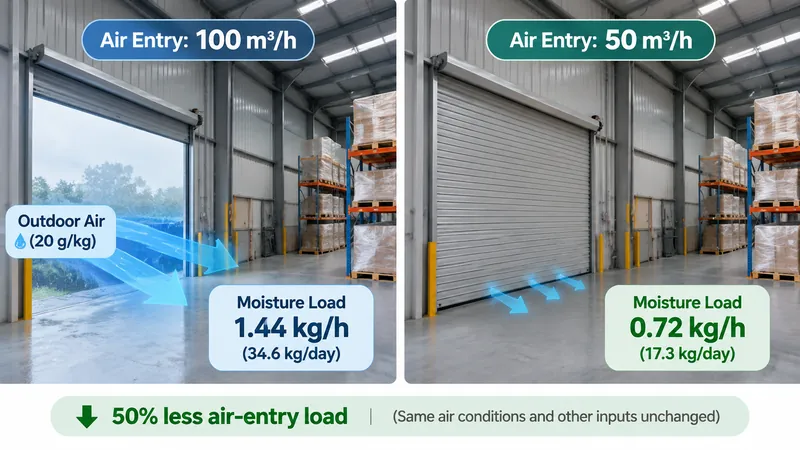
Assume a storage enclosure admits 100 m³/h of humid air from outside the controlled zone. This is incoming air, not the dehumidifier’s recirculating airflow.
Use an assumed density of 1.2 kg of dry air per m³, an incoming humidity ratio of 20 g/kg and an indoor target of 8 g/kg. Humidity ratio means grams of water per kilogram of dry air. These illustrative inputs must be replaced with values derived from the project’s temperature, RH and pressure.
The air-entry load is approximately:
100 × 1.2 × (20 − 8) ÷ 1,000 = 1.44 kg of water per hour.
If air entry persists for 24 hours, it contributes 34.6 kg/day. Reducing it to 50 m³/h halves this component to 0.72 kg/h, with other assumptions unchanged.
Better door closure and leakage control can therefore reduce the required moisture-removal capacity. However, required ventilation must remain accounted for, and any reduction in air entry must be compatible with the site’s ventilation and safety requirements.
This is only the air-entry component. Add applicable internal loads, assess peak door events and the allowed recovery period, and compare equipment at the actual storage condition. A unit labeled 35 L/day at a warm, humid test point is not thereby adequate for this example.
The industrial dehumidifier capacity assessment must bring together the moisture load, operating conditions and available removal capacity.
Match the Dehumidifier to Replenishment and Holding Conditions
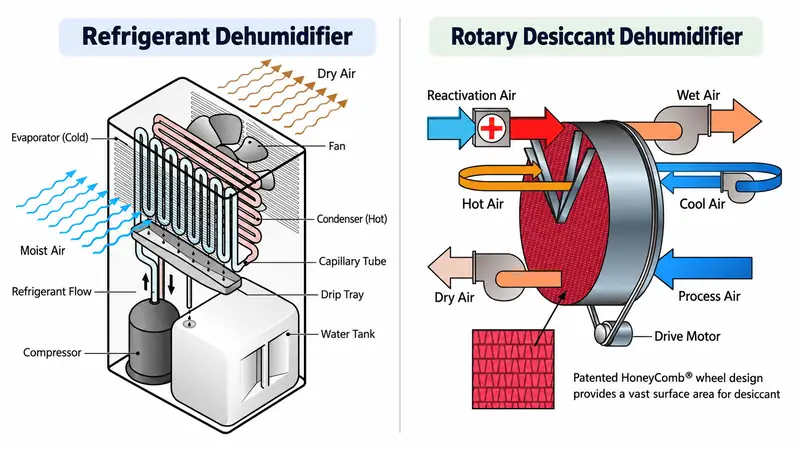
Choose the technology from the storage temperature and required humidity or dew point, then compare capacity at those conditions. Refrigerant equipment condenses water on a cold coil; a regenerated solid-desiccant system adsorbs moisture and removes it through a regeneration process.
ASHRAE’s mechanical dehumidifier guidance explains why cooling-based moisture removal has limits as the required dew point falls.
| Storage condition | Route to assess | What must be checked |
|---|---|---|
| Enclosed, moderate-temperature packaging store with a material-approved mid-range RH target | Refrigerant dehumidification | Capacity near the target, heat released into the room and continuous drainage |
| Unheated stockroom that becomes cold during holding periods | Compare low-temperature refrigerant and desiccant proposals | Require removal capacity at the minimum storage temperature and target RH, including any defrost-related loss of operating time |
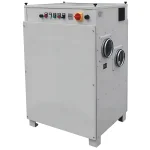
| Ingredient grade with a specified low storage dew point | Obtain desiccant and refrigerant performance data at the required conditions | If the refrigerant proposal cannot hold the target while meeting the load, assess a desiccant configuration and its regeneration, exhaust and heat requirements |
| Frequent replenishment through a poorly controlled opening | Improve the boundary and quantify air entry before selecting either route | The remaining peak load and recovery requirement after practical corrections |
Compare energy use at the same required duty, including fans, compressor or regeneration energy, and any additional room cooling. A universal temperature cut-off cannot establish the better route.
For desiccant systems, regeneration energy is an important part of operating cost. The design must also account for regeneration-air heating, moisture-laden exhaust routing and the effect of released heat on the surrounding space. A low-dew-point requirement may justify this approach, but the complete system energy demand should be evaluated rather than comparing dehumidification capacity alone.
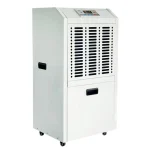
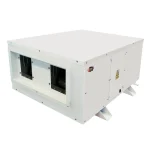
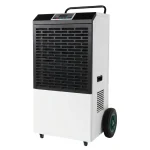
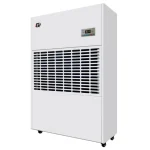
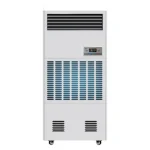
Rinwang’s industrial dehumidifier range lists capacities at 30°C/80% RH and, for selected models, 26.7°C/60% RH. Neither rating is a promise of the same output in a cooler, drier stockroom. Obtain performance data for the proposed storage conditions, including the lowest relevant operating temperature. If the available removal rate is below the assessed load, revise the capacity or technology proposal.
Arrange Airflow and Moisture Disposal Around the Racks
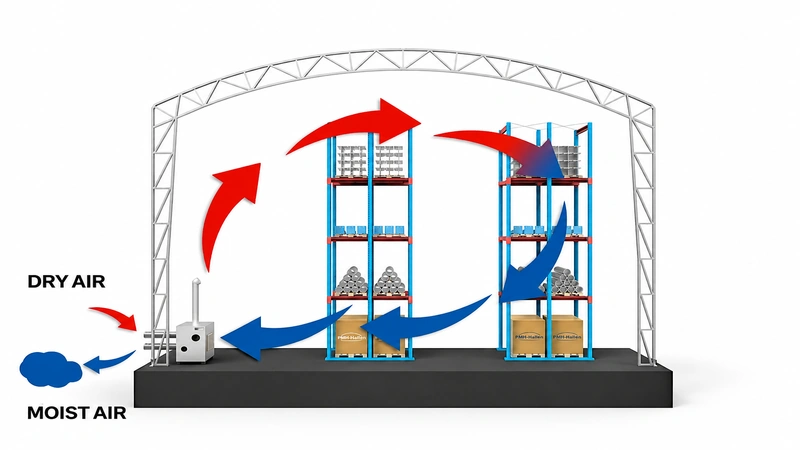
Dry air must reach the stored materials and return to the dehumidifier without immediately recirculating from its discharge into its intake. Directing the outlet into a blocked pallet face can leave the rear of the rack untreated.
Review the arrangement at peak stock, preserve the intended air paths, and check whether ducts or multiple outlets are needed to reach separated storage positions.
If ductwork is required, check that the fan can deliver the necessary airflow after accounting for resistance from ducts, bends and filters. This resistance is known as external static pressure. The available fan pressure must be sufficient to maintain the intended airflow under the proposed installation conditions.
For refrigerant equipment where gravity drainage is impractical, an industrial dehumidifier with pump-assisted drainage is an option to evaluate. Confirm the actual lift, route and failure response. A typical regenerated desiccant system instead needs a designed path for moisture-laden regeneration exhaust, with any additional condensate arrangements checked for the specific system.
Have the responsible installer or engineer finalize electrical protection, drainage and ductwork using the selected equipment’s connection requirements. Preserve access for filter, coil or regeneration-system service.
Verify Performance with Stock in Place
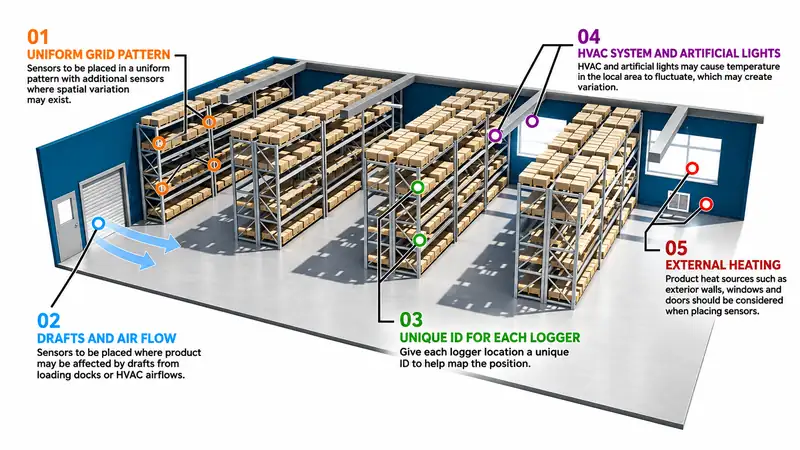
Check conditions at stored-material locations with independent verification sensors, including rack positions that may differ from the aisle. Survey high racks, cold external walls and receiving openings for additional monitoring needs.
Keep an external control sensor out of direct discharge air. Where the unit uses a built-in sensor, verify that its reading represents the stock rather than relocating it without manufacturer guidance.
Record temperature with RH. Where incoming goods or nearby surfaces are cold, compare local dew point with surface temperature as well. If the controller reaches its target while a rear rack remains humid, investigate distribution and sensor location before concluding that a larger unit is required.
Agree on the commissioning conditions, permitted excursions and recovery criteria before testing. Use representative inventory and normal replenishment and overnight schedules; an empty-room test with closed doors does not demonstrate stocked-room performance.
| Acceptance check | What to demonstrate | What a failure suggests checking |
|---|---|---|
| Normal replenishment | Conditions remain within the agreed storage requirement during the agreed door and delivery schedule | Door exposure, incoming load and available capacity |
| Loaded racks | Verification readings represent the stored material locations, not just the controller position | Blocked air paths, sensor bias or an unsuitable distribution arrangement |
| Overnight holding | Temperature and RH remain suitable when staffing and other HVAC schedules change | Controls, temperature changes and operating schedules |
| Drain or exhaust operation | Removed moisture leaves the controlled space as intended | Drain restrictions, pump operation or regeneration-air routing |
| Alarm response | A responsible person receives the warning and follows the stock-protection procedure | Signal availability, escalation and access to alternative storage |
Retain environmental trends with batch receipt, location and issue records so the quality team can assess the exposure history of suspect stock. Restoring room conditions does not establish that previous damage has been reversed.
Frequently Asked Questions
What Is the Ideal Relative Humidity for Packaging Material Storage?
There is no single ideal RH for all packaging materials. The appropriate condition depends on the material construction, supplier recommendations, storage duration and surrounding temperature. For example, Avery Dennison recommends approximately 22°C and 50% RH for the pressure-sensitive materials covered in its storage guidance. Other cartons, films and packaging materials may require different conditions.
Can Desiccant Sachets Replace a Dehumidifier in a Packaging-Material Store?
Desiccant sachets protect a defined package or enclosure when their type, quantity and moisture load are matched. They do not provide controlled room conditions for repeatedly opened storage areas, although package protection and room dehumidification may be used together.
Can a Dehumidifier Restore the Strength of Damp Cartons?
Do not assume that lowering room humidity restores damp cartons to their required stacking strength. Use the packaging supplier’s inspection or testing criteria before returning affected cartons to service.
Can Monthly Average RH Demonstrate Acceptable Storage?
Monthly average RH alone cannot demonstrate that a storage area stayed within its requirements. Review the time-based record against the permitted range and excursion procedure, because an average can hide shorter periods outside the limit.
Does Dehumidification Extend a Supplier’s Shelf-Life Date?
Dehumidification does not authorize an extension of a material’s stated shelf life. Continue to follow the supplier’s date limits and stock-rotation instructions unless a documented assessment supports a different limit.
Can an Industrial Dehumidifier Control Humidity in an Open Warehouse?
An industrial dehumidifier can contribute to humidity control in a warehouse, but open doors, air leakage and large uncontrolled spaces may create substantial moisture loads. Where sensitive materials occupy only part of the building, a defined storage zone with suitable separation may be more practical than attempting to control the entire warehouse.
Prepare a Storage-Zone Equipment Enquiry
Begin with the stock group, its required conditions and a sketch showing where material enters, remains and leaves. Use the following checklist for an initial enquiry; mark unknowns so they can be measured or clarified rather than replaced with guesses.
| Information | What to provide |
|---|---|
| Storage space | Length × width × height, rack layout and peak inventory |
| Temperature and humidity | Minimum, normal and maximum temperature; current RH trends and required conditions with their material-specific basis |
| Goods and packaging | Product or material grade, protective packaging, storage duration and observed damage |
| Replenishment and doors | Delivery quantities, wet-material observations, opening dimensions, frequency and duration |
| Ventilation and cleaning | Available fresh-air/exhaust data, existing air treatment and wet-cleaning schedule |
| Installation and moisture disposal | Floor-standing, suspended or ducted preference; service access; gravity drain, pump route or regeneration-exhaust options |
| Power and controls | Voltage, phase and frequency; required alarms, monitoring and communication interfaces |
Use this information to establish the load and installation constraints. Before ordering, agree on model performance, connections and controls; before acceptance, demonstrate the stocked-room conditions and alarm response.
For a warehouse dehumidification enquiry, send Rinwang the packaging and dry-goods storage brief, your material requirements and the available site information. Use those conditions to discuss an equipment configuration that fits the storage boundary and daily stock movement.