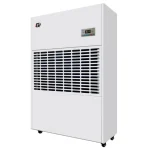
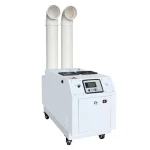
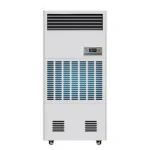
Food packaging areas are where humidity problems quickly become production problems. In most packaging rooms, the sensitive points are around filling, sealing, labeling, coding, carton forming, case packing, packaging material staging, and short buffer areas near the line. If the moisture source comes from raw material storage, washing rooms, cold rooms, or the wider production area, the root cause may need to be reviewed at the food processing plant level.
The goal is not simply to lower RH. The goal is stable packaging performance: dry cartons, readable codes, reliable labels, consistent seals, smooth powder flow, fewer condensation events, and fewer unplanned stops.
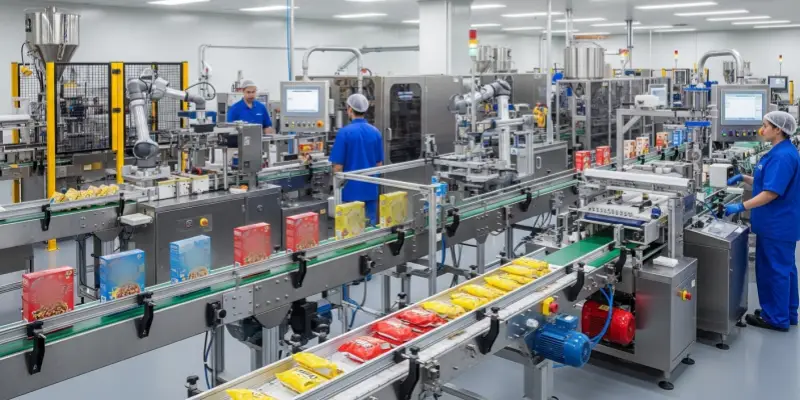
Quick Answer: What Humidity Should a Food Packaging Area Maintain?
There is no single RH value for every food packaging room. The right target depends on the product, packaging material, room temperature, cold surfaces, air infiltration, and condensation risk.
| Packaging condition | Suggested starting range | Main reason |
|---|---|---|
| General ambient food packaging area | 40%–55% RH | Balance packaging stability and operating cost |
| Hygroscopic powders, snacks, biscuits, dry products | 35%–45% RH | Reduce moisture pickup and clumping |
| Paper cartons, labels, paper-based packaging | 40%–50% RH | Maintain paper strength and label stability |
| Static-sensitive film or labeling stations | Avoid long-term below 30%–35% RH | Very low RH may increase static |
| Condensation-risk surfaces | Dew point 3–5°C below coldest surface | Reduce condensation risk |
These ranges are engineering starting points, not legal limits. Final settings should be verified by product behavior, packaging material, surface temperature, room layout, and local climate.
What to Check First: RH, Dew Point, and Surface Temperature
RH Is the Starting Point
Relative humidity tells you how much moisture the air contains compared with the maximum amount it can hold at that temperature.
It is useful, but it changes with temperature. The same RH value can mean different actual moisture levels at different temperatures.
That is why packaging rooms should not be judged by RH alone.
Dew Point Shows Condensation Risk
Condensation happens when humid air meets a surface cold enough for water vapor to become liquid water.
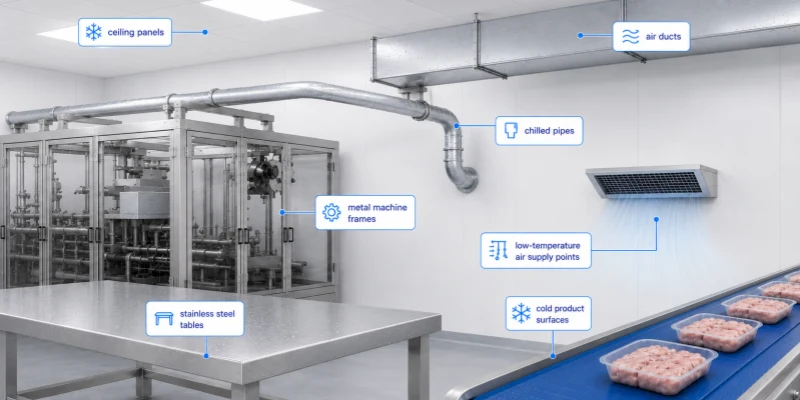
In packaging rooms, condensation often appears on:
- ceiling panels
- air ducts
- chilled pipes
- metal machine frames
- stainless steel tables
- cold product surfaces
- low-temperature air supply points
If air dew point is too close to the coldest surface temperature, condensation can form even when the room RH looks normal.
For condensation-sensitive packaging areas, keeping dew point at least 3–5°C below the coldest surface temperature is a useful engineering check.
Moisture-Sensitive Products Need Tighter Control
Dry powders, milk powder, protein powder, seasoning mixes, sugar, salt, biscuits, crackers, puffed snacks, and pet food additives can absorb moisture during short exposure before sealing.
This can cause clumping, caking, poor flow, texture loss, or powder contamination around the sealing area.
The practical question is simple:
Can the product tolerate the room air during the time it is exposed before packaging is sealed?
If not, RH and dew point become process-control variables, not comfort settings.
Common Packaging-Line Problems Caused by Poor Humidity Control
Humidity problems often appear as packaging defects, machine instability, or seasonal downtime.
Condensation on Ducts, Ceilings, Machines, and Cold Surfaces
Condensation is one of the clearest warning signs.
It may appear as droplets on ducts, damp patches under overhead structures, wet floors near cold surfaces, or repeated moisture marks around the same equipment.
In food packaging areas, condensate is not only a housekeeping issue. If it drips onto packaging materials, food-contact surfaces, open product, or work tables, it becomes a hygiene and audit concern.
FDA’s 21 CFR 117.20 plant construction and design requirements address the need to prevent drip or condensate from fixtures, ducts, and pipes from contaminating food, food-contact surfaces, or food-packaging materials.
| Condensation location | What it may indicate |
|---|---|
| Ceiling or overhead duct | Dew point too high or surface too cold |
| Metal machine frame | Local cold surface or poor airflow |
| Door or opening area | Humid outdoor air infiltration |
| Air supply area | Supply air too cold or uneven mixing |
| Cold product surface | Product temperature below room dew point |
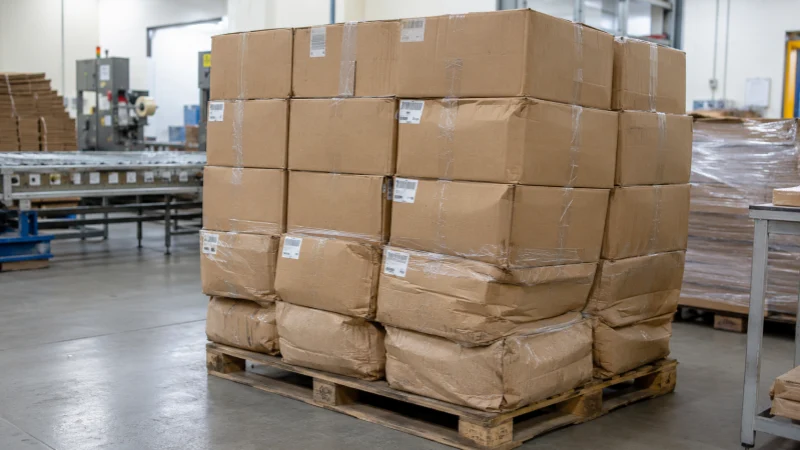
Carton Softening and Paper Packaging Deformation
Paper-based packaging absorbs moisture.
Corrugated cartons, paperboard boxes, paper labels, dividers, trays, and outer cases can lose stiffness and dimensional stability when RH stays high.
Common signs include:
- cartons feel soft before filling
- case erectors jam more often
- boxes bulge after packing
- pallet loads become less stable
- printed cartons show waves or deformation
- outer cases fail during storage or transport
Packaging material staging areas should be included in the humidity control plan. Damp cartons can fail before they even reach the line.
Labeling, Coding, and Print Legibility Problems
Labeling and coding issues are often blamed on the printer or labeler. Sometimes the hidden cause is humidity.
High humidity can affect paper labels, adhesives, carton surfaces, film surfaces, and ink drying. Very low humidity can increase static.
Typical symptoms include:
- labels curl before application
- labels lift after application
- labels shift on the package
- inkjet codes smear or bleed
- date codes become hard to read
- QR codes or batch codes fail scanning
For food packaging, this is not just an appearance issue. Labels and codes support traceability, shelf-life information, and shipment approval.
Sealing and Package Integrity Failures
Sealing problems can be expensive because they may not be visible immediately.
Flexible films, pouches, bags, trays, and laminated materials need stable surface conditions. Moisture, powder residue, condensation, or material distortion can make seal strength inconsistent.
Humidity-related sealing problems include:
- weak seals
- micro-leaks
- film surface moisture
- powder contamination in the seal area
- more frequent seal test failures
- package failures during transport
A seal failure is not always a sealing-machine problem. If humidity changes the condition of the film, powder, or sealing surface, the same machine settings can produce different results.
Powder Clumping and Filling Instability
Powder filling areas are highly sensitive to humidity.
Milk powder, protein powder, coffee powder, flour mixes, seasoning powder, sugar, salt, cocoa powder, and instant drink powders can absorb moisture quickly.
Once moisture pickup begins, powder flow changes.
Common problems include:
- clumping inside hoppers
- bridging above the filler
- blocked filling nozzles
- unstable dosing
- powder sticking to machine surfaces
- more frequent cleaning stops
- powder contamination near the sealing area
If operators keep adjusting vibration, auger speed, or filling time, but the problem returns during humid periods, check room humidity near the filler.
Static and Corrosion Problems
Humidity control is not only about high humidity.
Very low RH can increase static, causing film attraction, dust pickup, powder sticking, label misplacement, and sensor interference.
High humidity and repeated condensation can accelerate corrosion on machine frames, fasteners, bearings, electrical cabinets, sensors, and conveyors.
The right target is not “as dry as possible.” The target is stable enough for film feeding, labeling, powder flow, seal strength, and equipment reliability.
How to Diagnose the Root Cause Before Selecting Equipment
Before buying or resizing a dehumidifier, match packaging defects with environmental data.
| Symptom | Possible humidity-related cause | What to check |
|---|---|---|
| Cartons soften | Paperboard moisture absorption | RH trend in carton staging area |
| Labels curl or lift | Moisture imbalance or adhesive instability | RH near labeling station |
| Codes smear | Damp surface or slow ink drying | RH and surface condition near coding station |
| Condensation appears | Dew point close to surface temperature | Dew point and coldest surface temperature |
| Powder clumps | Moisture pickup from air | RH near hopper and filler |
| Seal failures increase | Film moisture or powder contamination | RH, dew point, seal area condition |
| Film feeding has static issues | RH too low | RH near film unwinding |
| Seasonal downtime increases | Outdoor air infiltration | Door cycles, outdoor dew point, indoor trend |
Do not rely on one humidity reading.
Compare RH, dew point, defect logs, door opening times, outdoor weather, cleaning schedules, machine stoppage records, seal test results, and label rejection records.
If defects increase during the same humidity patterns, humidity is likely part of the root cause.
How to Control Humidity in a Food Packaging Area
Once humidity is confirmed as a factor, the next question is not just “which dehumidifier should we buy?”
The better question is:
Which part of the packaging process needs protection, and what condition must be maintained there?
Air Conditioning Alone Is Often Not Enough
Air conditioning can remove some moisture during cooling, but it is mainly designed to control temperature.
| Situation | Why AC may not solve it |
|---|---|
| Room temperature is acceptable but cartons are damp | AC may stop when temperature is satisfied |
| Condensation appears on cold ducts | Cooling can create colder surfaces without lowering dew point enough |
| Humidity spikes during rainy days | AC may lack latent capacity |
| Powder clumps near the filler | Whole-room cooling may not protect the local point |
| Year-round stability is required | AC operation changes with cooling demand |
For packaging areas with condensation, damp cartons, unstable sealing, or powder clumping, humidity control should be evaluated separately from temperature control.
Refrigerant or Desiccant Dehumidification
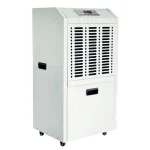
Refrigerant dehumidifiers are often suitable for general ambient packaging rooms where temperature is moderate and the target RH is around 40%–55%.
They are commonly used for carton packing, case packing, labeling, coding, dry goods packaging, and packaging material staging areas.
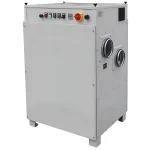
Desiccant dehumidifiers are more suitable when the process requires lower dew point control or when products are highly moisture-sensitive.
Typical applications include milk powder, protein powder, seasoning powder, instant drink powder, sugar, salt, high-humidity climates, and local dry-air supply to critical filling or sealing points.
When the packaging room requires lower dew point control, handles hygroscopic powders, or operates in a low-temperature environment, the choice between refrigerant and desiccant dehumidification becomes part of the engineering decision.
Whole-Zone Control vs Spot Control
Not every packaging room needs the same control strategy.
| Control method | Suitable for | Example |
|---|---|---|
| Whole-zone control | Room-wide RH stability | Carton packing, labeling, secondary packaging |
| Spot control | Specific problem points | Powder filler, film unwinding, sealing station |
| Hybrid control | High-value or high-speed lines | Base room control + dry air to critical points |
Whole-zone control helps when the entire room is affected or packaging materials are stored in the same area.
Spot control may be better when the problem is concentrated around one machine or exposure point.
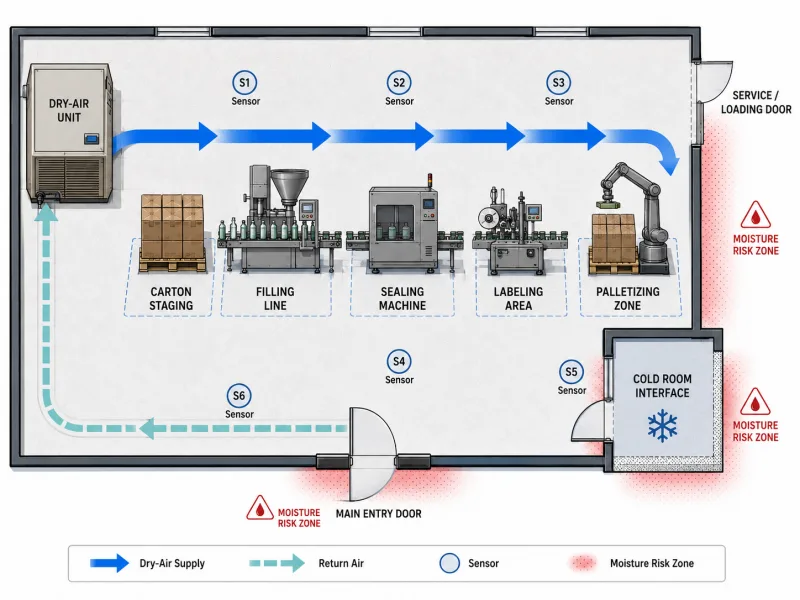
Airflow Design Matters
A correctly sized dehumidifier can still fail if airflow is poor.
Dry air must reach the problem area. Humid air must return to the unit. If dry discharge air short-cycles back into the intake, the machine may run normally while cartons, labels, or cold surfaces still have problems.
Check:
- where humid air enters
- whether doors or conveyors introduce outdoor air
- whether dry air reaches the filler, labeler, and sealer
- whether the carton staging area is covered
- where the humidity sensor is located
- whether drainage and maintenance access are practical
Capacity matters, but distribution decides whether that capacity is useful.
Monitoring and Acceptance: How to Verify the System Works
One wall sensor is often not enough.
Packaging-room humidity problems may occur near the filler, door, cold surface, or carton staging area while the main room sensor looks normal.
| Sensor location | Purpose |
|---|---|
| Return-air area | Control general room condition |
| Packaging material staging area | Check carton and label exposure |
| Labeling/coding station | Track label and print quality risk |
| Film unwinding/sealing station | Track film and seal consistency |
| Powder filling area | Track moisture exposure near product flow |
| Door or logistics opening | Detect humid air infiltration |
| Cold surface or duct area | Track condensation risk |
A practical monitoring plan should include RH, air temperature, dew point, surface temperature at condensation-risk points, alarm duration, and trend logs.
Project acceptance should match the real problem.
| Project goal | Acceptance indicator |
|---|---|
| Prevent condensation | No visible condensation at known cold points |
| Stabilize packaging room | RH and dew point stay within target range |
| Protect cartons | Carton staging area stays within agreed RH range |
| Improve labeling/coding | Fewer label lift, code smear, or scan failures |
| Improve sealing | Lower seal failure or leak rate |
| Reduce powder clumping | Fewer filling blockages and cleaning stops |
| Reduce downtime | Less humidity-related stoppage time |
What to Confirm Before Choosing a Dehumidifier for Your Packaging Line
A packaging-room dehumidifier should not be selected by floor area alone.
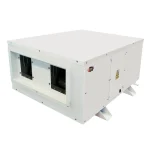
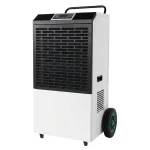
After the packaging-area risks are clear, the next step is to choose an industrial dehumidifier based on capacity, installation conditions, controls, drainage, airflow design, and maintenance access.
| Question | Why it matters |
|---|---|
| What product is being packaged? | Product moisture sensitivity affects the target |
| Which packaging material fails first? | Cartons, labels, films, and seals need different controls |
| Is the issue high humidity, low humidity, or condensation? | Each requires a different control strategy |
| What RH or dew point target is required? | Defines system performance |
| Are there cold surfaces or cold products? | Determines condensation risk |
| How often do doors or conveyors open? | Affects moisture load |
| Whole-room or spot control? | Determines air distribution |
| Is ducted dry air needed? | Critical stations may need local supply |
| How will condensate drain? | Affects operation and maintenance |
| How will success be verified? | Prevents unclear acceptance |
If the room has multiple doors, conveyor openings, outdoor air infiltration, or moisture-sensitive products, the dehumidifier size should be calculated from the actual moisture load rather than estimated by floor area.
Poor humidity control also becomes an operating cost:
- rejected cartons
- wasted labels
- repacking labor
- seal failures
- line stops
- powder cleanup
- customer complaints
- rejected shipments
- corrosion maintenance
- audit observations
A simple ROI estimate:
Annual value = reduced packaging waste + reduced rework + reduced downtime + reduced complaints + reduced maintenance cost − additional energy cost
Once the packaging risk is defined, energy use can be compared against the cost of defects, downtime, complaints, and maintenance.
FAQ: Food Packaging Area Humidity Control
What humidity should a dehumidifier be set at in a food packaging area?
Many ambient packaging rooms start around 40%–55% RH. Hygroscopic powders, dry snacks, or biscuits may need 35%–45% RH. Condensation-sensitive areas should also check dew point against the coldest surface temperature.
Can a dehumidifier help prevent condensation in food packaging areas?
Yes, if it is correctly sized and applied. An industrial dehumidifier lowers air dew point, reducing condensation risk on cold ducts, metal surfaces, cold product surfaces, and ceiling structures.
Is air conditioning enough to control humidity in a packaging room?
Usually not when humidity problems repeat. Air conditioning mainly controls temperature. When cooling stops, moisture may remain. Dedicated humidity control should be evaluated if the room has damp cartons, condensation, seal failures, or powder clumping.
What size dehumidifier do I need for a food packaging area?
Do not select by square footage only. Consider room volume, target RH or dew point, door openings, outdoor air infiltration, conveyor openings, product exposure time, cleaning water, and airflow design.
Should a food packaging area use a refrigerant or desiccant dehumidifier?
Refrigerant dehumidifiers usually fit general ambient packaging rooms around 40%–55% RH. Desiccant dehumidifiers are better for lower dew point, hygroscopic powders, high-humidity climates, or tighter year-round stability.
Conclusion: Start With the Failure Pattern
If the same packaging defects appear during rainy days, night shifts, door-opening periods, or after cleaning, start by checking RH, dew point, surface temperature, airflow, and defect timing together.
The cause may be high humidity, low humidity, dew point, cold surfaces, outdoor air infiltration, poor airflow, or local product exposure.
Once the cause is clear, the solution may be whole-zone dehumidification, spot dry-air supply, improved airflow design, better sensor placement, or a combined approach.
If your packaging area has repeated condensation, damp packaging, label failure, powder clumping, sealing defects, or seasonal downtime, contact Rinwang to assess the room layout, target RH/dew point, airflow route, sensor locations, and dehumidifier capacity.