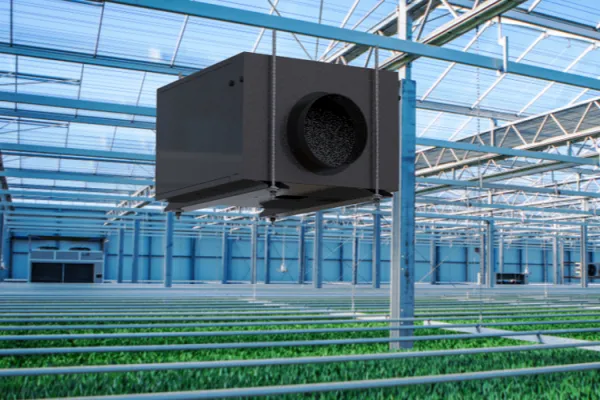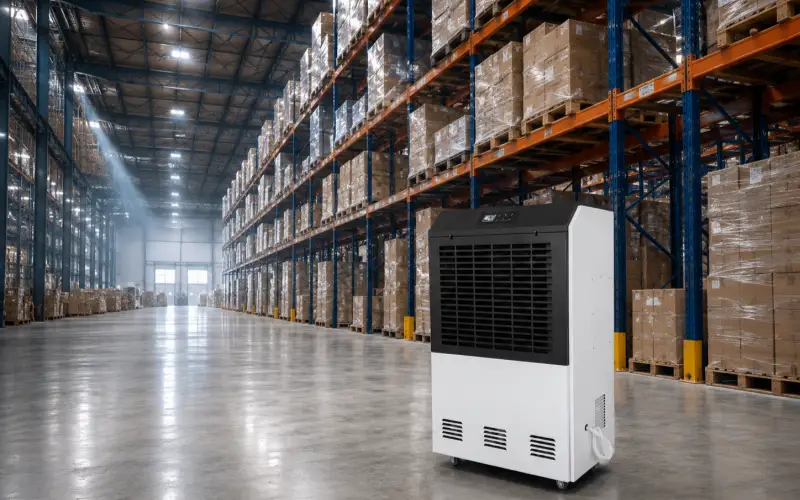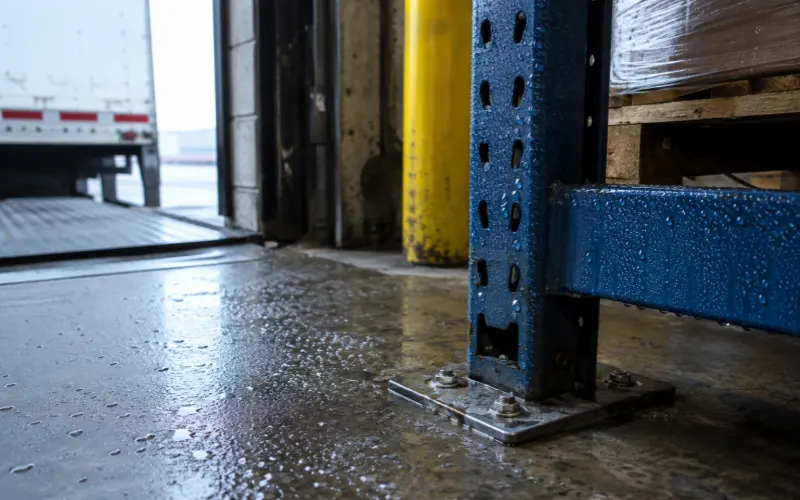
Water is forming on the mold even though the material-drying system is operating normally.
Droplets appear on the mold frame, chilled-water valves, quick connectors, or nearby pipes. The floor beside the machine becomes wet. Slides and inserts begin to corrode. Operators may raise the chilled-water temperature simply to keep the mold dry.
These are environmental humidity problems.
A material dryer controls moisture inside plastic resin. An ambient dehumidifier controls water vapor in the air around molds, cooling lines, storage rooms, and other production areas.
Use this quick check to identify which part of the process needs attention:
| What you see | Likely moisture source | What usually needs attention |
|---|---|---|
| Water on the mold or machine guard | Humid air around a cold surface | Local dew-point control |
| Dripping valves, pipes, or connectors | Humid air around the chilled-water system | Insulation and ambient dehumidification |
| Rust on stored molds and inserts | Storage-room air | Room RH control |
| Damp cartons or unstable QC readings | Packaging or measurement-room air | Stable temperature and RH |
| Splay or bubbles caused by wet material | Moisture inside the resin | Material-drying process |
For water forming on molds, cooling lines, or stored tooling, the next decision is whether to control the entire room or create a low-dew-point zone around the affected equipment.
Why Injection Molds Sweat
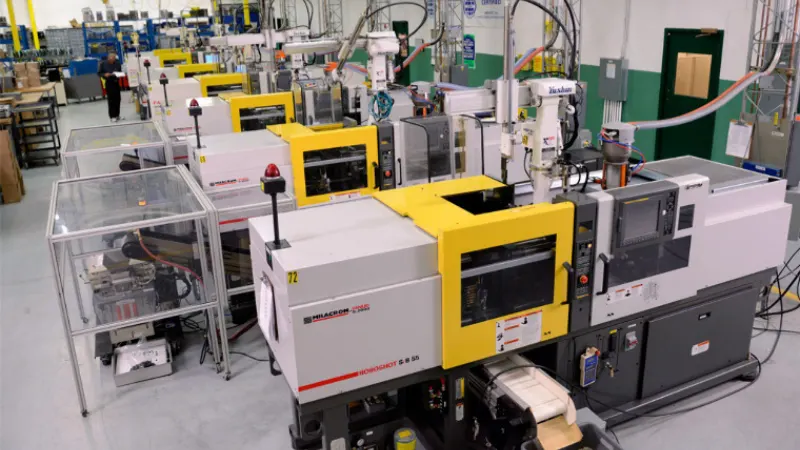
Mold sweating occurs when humid air contacts a surface that is colder than the air’s dew point.
When chilled water passes through a mold, the mold surface can become much colder than the surrounding production air. Once the surface reaches or falls below the dew point, water vapor changes into liquid water.
The same condition can affect:
- mold frames and platens;
- chilled-water manifolds;
- quick connectors and valves;
- flexible cooling hoses;
- exposed pipe sections;
- metal guards close to the cooling circuit.
This can happen even when the resin has been dried correctly. The material-drying circuit does not normally lower the humidity around the mold, pipework, or production room.
Compare the Room Dew Point With the Coldest Surface
Relative humidity alone cannot tell you whether a mold will sweat.
You need to know:
- the room temperature;
- the room relative humidity;
- the coldest mold, pipe, or connector surface temperature.
The controlling rule is straightforward:
Condensation begins when the surface temperature is at or below the surrounding air’s dew point.
Vaisala’s explanation of dew point describes the same cold-surface effect: once a surface reaches the dew point of the surrounding air, condensation begins.
Why Raising the Chilled-Water Temperature Only Treats the Symptom
When a mold begins to sweat, operators may raise the chilled-water temperature until the mold surface stays above the room dew point.
This may stop the visible water, but it does not remove moisture from the air. It also changes the cooling conditions and may increase cycle time for some molded parts.
Ambient dehumidification takes the opposite approach:
- the cooling-water temperature remains at the required process setting;
- the surrounding air dew point is lowered;
- the mold surface stays above the local dew point;
- condensation is prevented without relying only on warmer cooling water.
The dehumidifier does not replace the chiller or mold-temperature controller. It changes the moisture condition of the air.
Find the Room Dew Point From Temperature and RH
The following values use the Magnus dew-point approximation and are rounded to one decimal place.
| Room temperature | 50% RH | 60% RH | 70% RH | 80% RH |
|---|---|---|---|---|
| 25°C | 13.9°C | 16.7°C | 19.1°C | 21.3°C |
| 28°C | 16.6°C | 19.5°C | 22.0°C | 24.2°C |
| 30°C | 18.4°C | 21.4°C | 23.9°C | 26.2°C |
| 32°C | 20.3°C | 23.3°C | 25.8°C | 28.1°C |
| 35°C | 23.0°C | 26.1°C | 28.7°C | 31.0°C |
At 30°C and 70% RH, the room dew point is approximately 23.9°C.
Any mold, pipe, valve, or connector below 23.9°C can develop condensation.
Three Injection Molding Condensation Examples
| Production condition | Coldest surface | Condensation judgment |
|---|---|---|
| 30°C / 70% RH, dew point 23.9°C | 12°C mold | Severe condensation risk |
| 28°C / 60% RH, dew point 19.5°C | 18°C connector | Condensation risk |
| 25°C / 50% RH, dew point 13.9°C | 15°C pipe | No theoretical condensation, but limited margin |
The control target should not sit exactly at the condensation threshold.
Actual installations may also have:
- colder local sections on the mold;
- surface-temperature gradients;
- sensor error;
- doors opening;
- humid-air leakage;
- uneven dry-air distribution.
For preliminary planning, the target air dew point may be set approximately 2–3°C below the coldest measured surface. The final margin should be confirmed from site conditions and commissioning measurements.
Choose Between Insulation, Whole-Room Dehumidification, and Local Dry Air
Not every condensation problem requires the same response.
The right method depends on where the water appears, how many machines are affected, and how low the local dew point must be.
| Control method | Best used when | Main limitation |
|---|---|---|
| Raise chilled-water temperature | A temporary operating adjustment is needed | May affect cooling conditions and cycle time |
| Repair or improve pipe insulation | Condensation is limited to exposed pipework | Does not protect molds, valves, or open fittings |
| Dehumidify the whole room | Many machines and support areas share the same humidity problem | Large treated air volume and higher infiltration load |
| Enclose the mold and supply dry air | Selected molds require a low local dew point | Requires enclosure and duct design |
| Combine room and local control | Different production zones have different humidity targets | More complex system design |
When Pipe Insulation Is the First Fix
Damaged or missing insulation should be repaired first when condensation is limited to straight chilled-water pipes.
However, insulation may be difficult to maintain around:
- quick connectors;
- valves;
- flexible hoses;
- service points;
- moving components;
- mold surfaces.
When these exposed surfaces must operate below the room dew point, lowering the surrounding air dew point may still be necessary.
Use Local Dry Air When Only Selected Molds Sweat
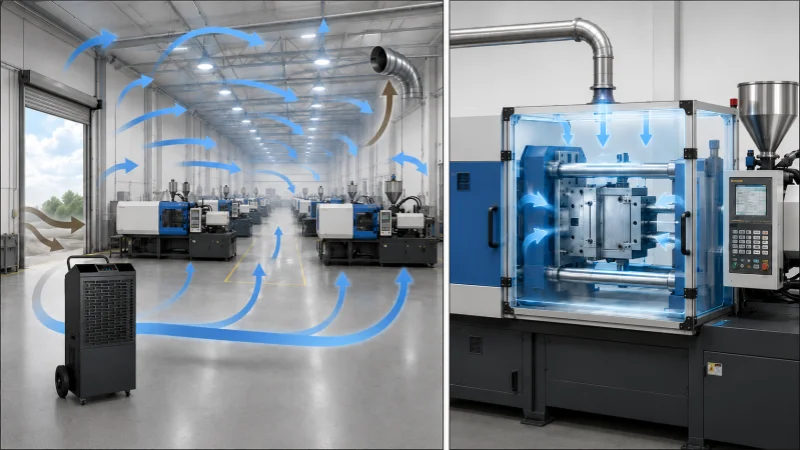
At 30°C, protecting a 10°C surface would theoretically require the surrounding air to remain below roughly 29% RH before adding an engineering margin.
Maintaining this condition across an open molding hall can be difficult when the space has:
- frequent door openings;
- outdoor-air infiltration;
- process exhaust;
- heat from molding machines;
- a large untreated air volume.
If only a few molds are affected, whole-room deep drying treats far more air than necessary.
A smaller enclosure around the mold or machine cell allows low-dew-point air to be delivered directly to the critical area.
The enclosure does not need to be completely airtight. However, larger openings increase the required dry-air volume and make the local dew point harder to stabilize.
Use Whole-Room Control When the Problem Is Widespread
Room-level dehumidification may be reasonable when:
- several machines experience condensation;
- mold storage areas also have corrosion problems;
- packaging or QC areas require more stable RH;
- the room is reasonably enclosed;
- door and fresh-air loads are manageable;
- dry air can be distributed evenly.
Capacity should be based on treated air volume, moisture load, infiltration, ventilation, and the required humidity reduction—not floor area alone.
Where Injection Molding Plants Need Ambient Dehumidification
Different areas of an injection molding plant usually require different humidity targets.
| Plant zone | What the customer sees | Main control target | Likely solution |
|---|---|---|---|
| Enclosed mold cell | Mold sweating, water marks, corrosion | Dew point below the coldest surface | Ducted low-dew-point air |
| Chilled-water service area | Dripping fittings, valves, and hoses | Dew point below exposed surfaces | Local or room-level control |
| Mold and insert store | Rust on tools and metal components | Stable corrosion-control RH | Refrigerant dehumidification |
| Material staging room | Open material exposed to humid air | Stable room RH | Room-level dehumidification |
| Regrind storage | Material remains exposed to ambient moisture | Stable room RH | Room-level dehumidification |
| Finished-goods and packaging room | Soft cartons, lifting labels, corroding inserts | Stable RH | Refrigerant dehumidification |
| QC or measurement room | Results vary by location or shift | Stable temperature and RH | Project-specific control |
Humidity-control equipment should be selected by the moisture source and required condition rather than by one factory-wide setpoint. This same principle applies across other industrial dehumidifier applications.
Preventing Rust in Mold and Insert Storage
A mold store normally does not need the same low dew point as a chilled mold enclosure.
Its main objectives are:
- reducing corrosion risk;
- protecting cooling channels;
- preventing rust on ejector pins and slides;
- keeping inserts and spare parts dry;
- maintaining stable storage conditions.
A room-level refrigerant dehumidifier is often suitable when the storage area operates at moderate temperatures and requires general RH control.
Humidity Control for Packaging, QC, and Support Areas
Packaging, finished-goods, and QC rooms usually need stable conditions rather than extremely dry air.
Possible problems include:
- corrugated cartons losing stiffness;
- labels lifting;
- metal inserts corroding;
- measurement results changing between shifts or locations.
Some molded components also require controlled moisture conditioning. Polyamide parts, for example, can absorb moisture and change dimensionally after molding. BASF’s MUSE moisture-uptake tool illustrates this behavior for polyamide components.
The objective should be a defined and repeatable condition—not the lowest RH the equipment can produce.
When temperature stability is also critical, temperature-resistant dehumidifiers may be more appropriate than independent RH control.
Controlled molding rooms should be evaluated together with the facility’s makeup air, filtration, pressure, temperature, and monitoring system. A standalone dehumidifier may support one area, but it cannot establish full facility compliance by itself.
Personnel areas should also not automatically receive the mold enclosure’s low-dew-point condition. Excessively dry air can increase electrostatic charge accumulation on plastics, packaging, clothing, and moving equipment. The EOS/ESD Association’s humidity guidance notes that humidity can influence charge accumulation, although humidity alone is not a complete ESD-control method.
Which Dehumidifier Type Fits Each Injection Molding Zone?
The technology should be selected from the target RH or dew point—not from room temperature alone.
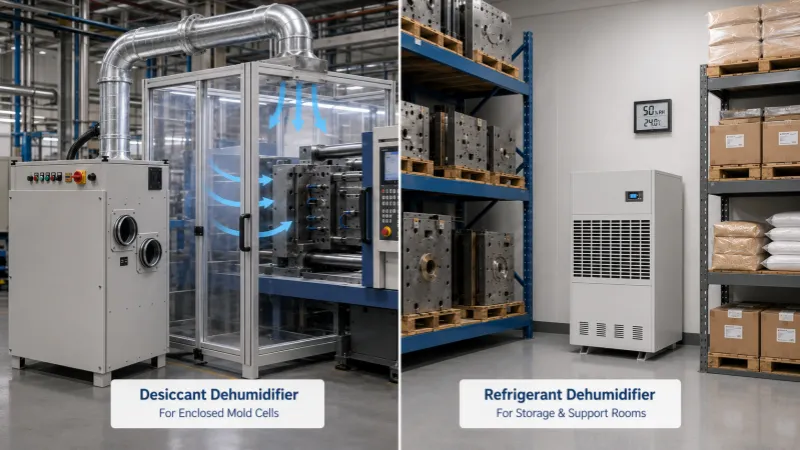
Desiccant Dehumidifiers for Enclosed Mold Cells
A desiccant dehumidifier is normally the stronger option when the project requires:
- low-dew-point supply air;
- ducted delivery into a mold enclosure;
- stable control around chilled tooling;
- a target dew point below what room-level refrigerant equipment can reliably maintain;
- centralized dry-air supply to one or more nearby machines.
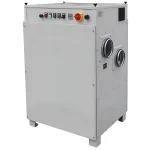
Rinwang’s ducted desiccant dehumidifier systems can be configured around:
- required airflow;
- fan static pressure;
- duct length and resistance;
- filter arrangement;
- outlet positions;
- enclosure leakage;
- sensor and control requirements.
One system may serve multiple nearby machines, but the combined airflow demand and duct distribution must be calculated together.
Pointing dry air toward a completely open mold does not create a stable low-dew-point zone.
Refrigerant Dehumidifiers for Storage and Support Rooms
Refrigerant dehumidifiers are often suitable for:
- mold stores;
- material staging rooms;
- regrind areas;
- packaging rooms;
- finished-goods rooms;
- moderate-condition QC rooms.
These areas usually need stable RH rather than very low-dew-point process air.
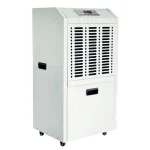
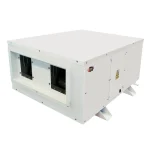
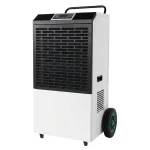
Rinwang’s industrial dehumidifier range includes floor-standing, ceiling-mounted, duct-compatible, continuous-drainage, and communication-enabled configurations for different facility layouts.
Two rooms with the same floor area may still need different capacities when one has more door activity, outdoor-air infiltration, or process exhaust.
Choose by Target Dew Point, Not Room Temperature Alone
A high-temperature molding hall may still need desiccant dehumidification when the mold enclosure requires a low dew point.
A cooler storage room may use a suitably designed refrigerant unit when its target is moderate RH.
The choice between refrigerant and desiccant dehumidifiers should consider:
- target RH or dew point;
- coldest surface temperature;
- moisture load;
- room or enclosure leakage;
- supply airflow;
- available fan pressure;
- condensate handling;
- operating hours;
- control and communication requirements.
What Site Data Is Needed Before Equipment Selection?
Start with site measurements, not a model number.
| Information required | Why it matters |
|---|---|
| Room or enclosure dimensions | Defines treated air volume |
| Highest room temperature and RH | Establishes the worst moisture condition |
| Coldest mold, pipe, or connector surface | Establishes the condensation threshold |
| Target RH or dew point | Defines the control objective |
| Number and layout of machines | Determines zoning and airflow distribution |
| Door, fresh-air, and exhaust conditions | Determines infiltration load |
| Existing enclosure and duct route | Determines leakage and fan pressure |
| Operating hours and control requirements | Determines duty and integration needs |
Room volume, ventilation, infiltration, and moisture reduction should be included in industrial dehumidifier sizing.
Mold-sweat projects then require additional checks for:
- cold-surface temperature;
- enclosure leakage;
- dry-air distribution;
- duct resistance;
- local dew-point measurement.
Where to Place the Dew Point Sensors
The unit outlet only shows the condition of the supplied air. It does not confirm the condition around the entire mold.
Useful sensor locations include:
- the dehumidifier supply outlet;
- the most difficult point inside the mold enclosure;
- the surrounding production room.
The critical enclosure sensor should be placed at a representative worst-case location, such as:
- far from the supply outlet;
- near a frequently opened guard;
- close to the coldest mold section;
- in an area with weak air circulation.
The sensor closest to the supply outlet may not represent the far side of a large or leaking enclosure.
Why Capacity Alone Is Not Enough
A liters-per-day rating does not show:
- whether dry air reaches the affected surface;
- whether the fan can overcome duct resistance;
- how much humid air leaks into the enclosure;
- whether the target is normal RH or low dew point;
- whether several machines run simultaneously.
Final industrial dehumidifier selection should combine rated performance with airflow, installation, drainage, controls, operating schedule, and service conditions.
How Long Does It Take to Stop Mold Sweating?
The time depends on enclosure size, starting humidity, airflow, and leakage. Mold sweating stops once the local dew point stays below the coldest surface.
Should the Dehumidifier Start Before the Molding Machine?
Usually, yes. Pre-running the dehumidifier lowers the enclosure dew point before the mold cools, reducing condensation risk at startup and during early production.
Can Opening the Mold Guard Cause Condensation?
Yes. Opening the guard lets humid room air enter the enclosure, so frequent access can raise dew point and cause condensation to return.
Should Dry Air Be Recirculated or Discharged?
Recirculation is often more efficient because return air is already drier. Once-through supply may be better when heat, oil mist, or dust must be removed.
How Do You Check Whether the System Is Working?
Check the mold-zone dew point, coldest surface temperature, and recovery after guard openings. The system works when dew point remains safely below the surface temperature.