Condensation in cold storage rooms happens when humid air contacts surfaces that are colder than the air’s dew point. In chillers, it shows up as water droplets on doors, ceilings, walls, or packaging. In freezer rooms, the same moisture turns into frost or ice. The problem is typically worst in summer and at coastal or tropical sites, where outdoor air carries far more moisture per door cycle than in cooler conditions.
The same visible symptom — a wet floor near the door, a dripping ceiling, frost on the coils — can come from very different mechanisms, and the right fix depends on which mechanism is dominant in your facility. Five mechanisms account for almost every cold storage condensation problem, and where the condensation appears tells you which one to look at first.
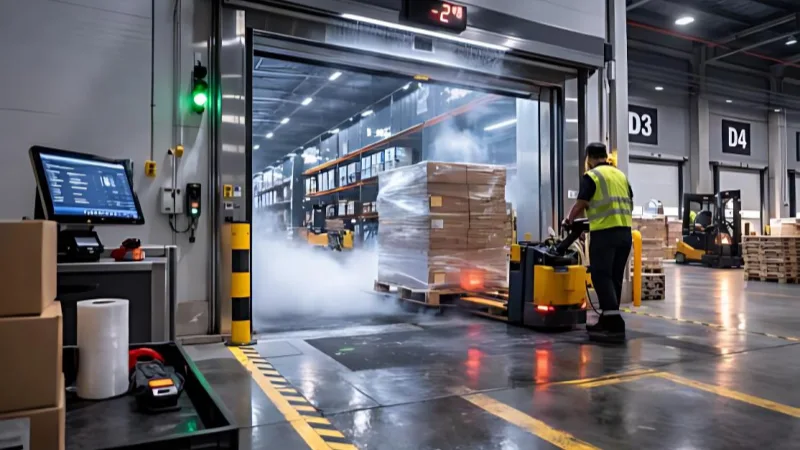
Cold Storage Condensation: An Operating Issue
If your facility is fighting condensation every week, you are not dealing with cosmetics. You are dealing with a daily operating cost.
For cold storage operators in food processing, pharmaceutical storage, logistics, and cold chain handling, persistent condensation produces a predictable set of shift-level failures:
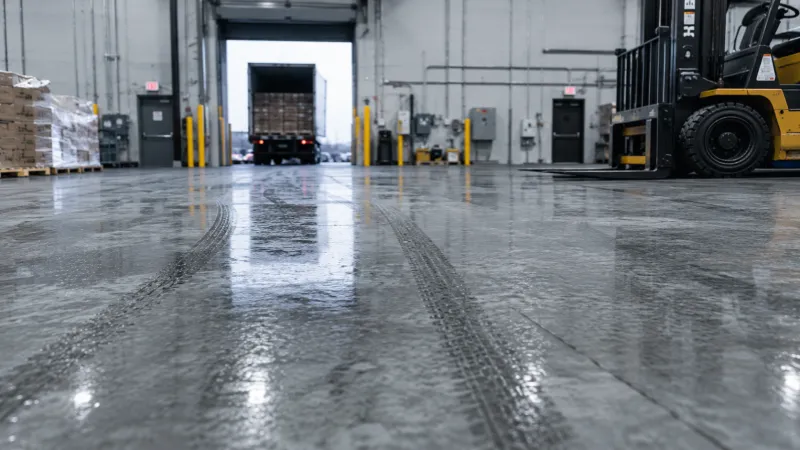
- Wet, slippery floors in door zones and transfer aisles, with real worker-injury exposure
- Damp cartons and softened packaging, especially in the first pallet row inside the door
- Peeling labels and unreadable barcodes, slowing pick-and-pack operations
- Ice buildup around door frames, preventing doors from sealing properly and making the problem worse over time
A wet floor at the door and a ceiling drip ten meters from the door are usually telling you two different stories — which is why diagnosis matters before any equipment decision.
The Fundamental Rule of Condensation
Condensation forms whenever a surface is colder than the dew point of the air around it.
Warm air can hold more water vapor than cold air. When warm humid air meets a cold surface, it cools at that surface. If it cools below its dew point, the vapor it can no longer hold has to go somewhere — and it deposits onto the surface as liquid water or, below 0 °C, as frost or ice.
Why Surface Temperature Matters More Than Room Temperature
The temperature on your wall display tells you about the bulk air in the room. It does not tell you about the temperature of a specific door frame, panel seam, or ceiling corner — and those local surface temperatures are what actually drive condensation.
A practical example. Outdoor air at 30 °C and 80% RH has a dew point around 26 °C. The moment that air enters your cold room — through a door cycle, a leaking gasket, or a panel seam — any surface colder than 26 °C becomes a condensation site. That is almost every surface in the room. The question is no longer if condensation forms, but where it forms first.
Why Relying Only on Relative Humidity is Misleading
The same RH reading means very different things at different temperatures. 60% RH at 25 °C carries far more water per cubic meter than 60% RH at 2 °C.
This is the trap many facility managers fall into. The room sensor reads 55% RH and the operator concludes that humidity is “under control.” But if the panel seam in the back corner is sitting at –1 °C and the local air has a dew point of 0 °C, that seam is still going to condense.
Cold storage humidity should be judged by dew point and surface temperature together. Relative humidity on its own is a misleading metric.
The Five Real Causes of Cold Storage Condensation
Almost every cold storage condensation problem in the field traces back to one or more of the following five mechanisms. The one that matches your dominant symptom is usually the one to fix first.
1. Door Openings and Dock-Area Air Exchange
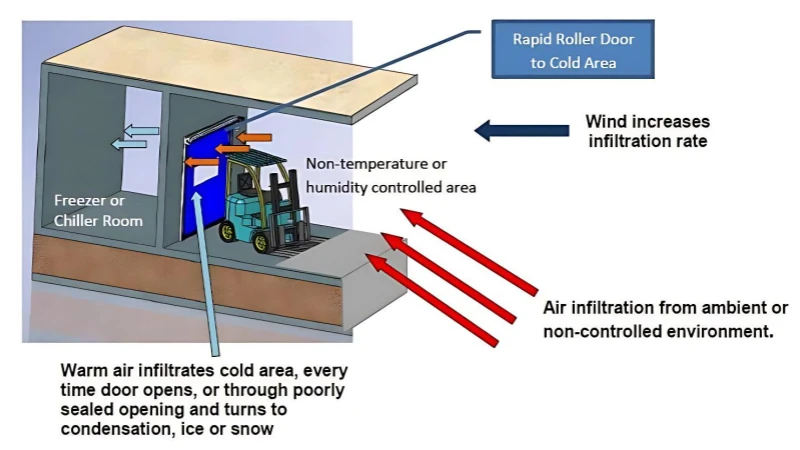
This is the single largest moisture source in most cold storage operations. Every time the door opens, you do not get a clean swap — you get a high-energy two-way flow.
Cold air inside the room is denser than the warm air outside. The moment the door opens, the dense cold air falls out at the bottom of the opening while the warm humid air rushes in at the top. The two flows happen at the same time, through the same opening, and they continue as long as the door is open.
Forklift traffic and staged loading make this dramatically worse. A door that is propped open for 90 seconds of manual transfer brings in roughly six times the moisture of a door that opens for 15 seconds. Door open time is usually the dominant variable — far more than how often the door cycles.
There is also a less obvious geometry effect. The volume of air exchanged through a doorway grows with door height to the power of 1.5 — a relationship documented in the ASHRAE Refrigeration Handbook. A tall, narrow doorway lets in significantly more moisture than a short, wide doorway of the same total area. Many facilities never connect this to their condensation problems.
The protective device on the door matters as much as the door itself. Effectiveness varies more than buyers usually expect:
| Door protection | Real-world effectiveness | Best fit |
| PVC strip curtains | Low under forklift traffic — strips get pushed aside and stay open | Light pedestrian use only |
| Standard air curtains | Medium — sensitive to room pressure differential and door geometry | Moderate-temperature chillers with predictable traffic |
| High-speed insulated doors | High — by sharply reducing door open time | High-traffic loading docks |
| Dry-air pillow systems | Very high — actively absorbs incoming vapor at the opening | Spiral freezers, low-temperature transfer zones |
Typical symptoms: wet floor inside the first three meters of the door, condensation running down the door frame, ice on the door hinge side, water dripping from the ceiling directly above the door, fog visible when the door opens.
When the moisture concentrates at the dock interface rather than deep inside the room, you are dealing with loading dock condensation — a related but distinct problem with its own diagnostic path around dock seals, vestibule conditions, and transfer-area dew point.
2. Air Leaks Through Seals, Joints, and Penetrations
Doors are visible. Leaks are not. And unlike door openings, leaks pull moisture into your room continuously, 24 hours a day, including at night when no one is there to notice.
The most common leak paths in cold storage facilities are:
- Compressed and aging door gaskets, which lose their elasticity within 3 to 5 years of daily use
- Insulated metal panel (IMP) seams where the sealant has cracked, the cam-locks have loosened, or thermal cycling has pulled the joints apart
- Pipe and conduit penetrations through walls and ceilings, where the original sealing has degraded or was never done properly
- Floor drains, washdown sumps, and chase ways that bypass the envelope
- Roof-to-wall transitions, especially in older retrofit facilities
There is a counterintuitive factor that makes leaks worse than they should be. Your evaporator fans pull air through the coil, which creates a slight negative pressure inside the room. That negative pressure does not just sit passively — it actively pulls outside air in through every small gap in the envelope. You are not just receiving leaked air. The room is sucking it in.
IMP seam failures have a particularly nasty signature. Once a small amount of warm moist air starts migrating through a seam, the vapor reaches its dew point somewhere inside the joint and condenses. In a freezer, that condensate freezes into ice crystals. Ice expands. The expansion widens the seam. The wider seam admits more moist air. Within one or two seasons, what started as a barely visible hairline gap becomes a structural failure of the panel joint.
3. Vapor Diffusion Through Walls and Insulation
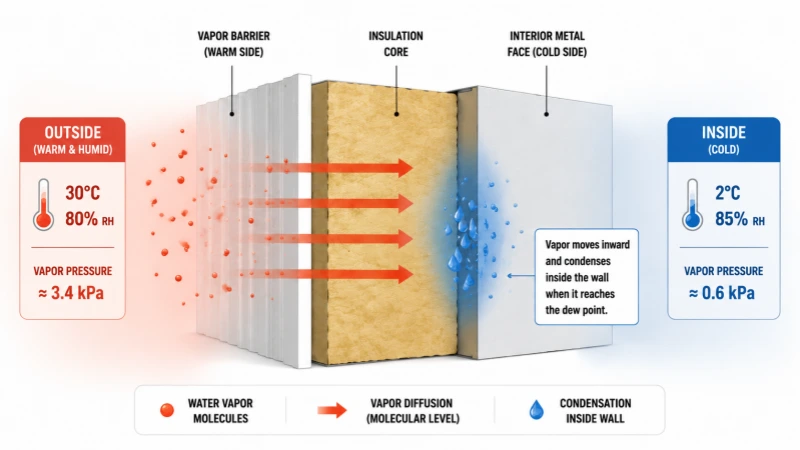
Vapor diffusion is different from air leakage. Air leakage moves through gaps. Vapor diffusion moves through the material itself, at the molecular level. You cannot stop it by sealing cracks because there are no cracks involved.
The driver is vapor pressure differential. Outside air at 30 °C and 80% RH has a water vapor pressure of roughly 3.4 kPa. Inside a 2 °C room at 85% RH, the vapor pressure is about 0.6 kPa. That 2.8 kPa pressure differential pushes water molecules through your walls, roof, and floor 24 hours a day, in every season, regardless of how well you sealed the envelope — a steady-state moisture source that the IIAR’s discussion of vapor drive in cold storage identifies as the load hiding behind most other diagnoses.
The damage happens inside the wall, not on the surface. As vapor migrates through the insulation toward the cold side, it eventually reaches a layer cold enough to drop below its dew point. There, hidden inside the panel, it condenses. Over months and years, the insulation becomes wet. Wet insulation loses thermal performance. With less insulation value, the inside surface gets colder. With a colder inside surface, the visible condensation in the room gets worse. The whole envelope enters a self-reinforcing decline.
This is why cold storage envelopes need a vapor barrier on the warm outside, which is the opposite of a heated building in a cold climate. It is also why insulated metal panels with continuous foil facers and properly sealed joints outperform field-built walls of stick framing and batt insulation by a wide margin for cold storage use.
4. Thermal Bridges and Localized Cold Spots
The basic rule of condensation is that a surface needs to be below the air’s dew point. Thermal bridges are the parts of your envelope that fail this rule first, even when the rest of the wall is fine.
A thermal bridge is anywhere that a more conductive material breaks through your insulation — and as cold storage roof design research documents, vapor drive then concentrates moisture exactly at those bridges. The most common locations in cold storage:
- Steel fasteners that penetrate insulated metal panels
- Structural steel columns and beams that run from outside to inside
- Metal door frames, which conduct cold from inside to the exposed exterior face
- The slab-to-wall interface, where the concrete floor often acts as a continuous thermal bridge
- Roof penetrations for pipes, conduits, and refrigeration lines
- High-low temperature transition T-joints — where a chilled room (+2 °C) shares a wall with a freezer (–25 °C). The single point where three temperature zones meet sees three to five times the thermal stress of a normal seam. These joints fail more than any other detail in poorly built facilities.
There is also a subtle effect worth understanding, called the boundary layer effect. Even if the bulk air in your room shows 50% RH on the sensor, the thin layer of air sitting against a cold wall is cooler than the bulk air. That boundary layer can be at 80–100% RH while the room display reads “safe.” This is why corners and panel seams can grow mold even when your central monitoring shows nothing wrong.
Local airflow makes this worse. Where pallets stack against a wall, the airflow over that wall stops. Stagnant air against a cold surface holds moisture against the surface long enough for condensation to develop. The combination of cold spot + airflow dead zone is where you will see condensation appear first in any cold storage room.
Typical symptoms: a single panel seam that is wet while the rest of the wall is dry, drips from a specific ceiling location every morning, sweat appearing on door frames or column bases, frost rings around individual fasteners on the cold-side surface.
5. Internal Moisture from Products, Packaging, and Washdown
Not all the moisture in your cold room comes from outside. A significant portion is generated inside the room by what you are storing and how you handle it.
Common internal moisture sources:
- Fresh produce continues to respire after harvest, releasing both water vapor and heat
- Unwrapped meat and seafood carry significant surface moisture that evaporates into the room air
- Wet packaging — damp cardboard cartons, washed plastic crates, recently cleaned bins — release water into the room over hours
- Wood pallets absorb and slowly release moisture, especially when they have been outside before entering the cold room
- Washdown and sanitation cycles in food processing plants, dairy, seafood, and pharmaceutical facilities create high-humidity pulses that can take hours to clear
- Defrost meltwater released back into the room air if the evaporator drainage does not move it out fast enough
One nuance matters for food and pharma operators. Dropping room humidity as low as possible is not always the right answer. Over-dry conditions cause weight loss in fresh produce, dehydration on meat surfaces, and quality issues in fresh-stored pharmaceutical materials. The right target is controlling dew point and surface condensation risk, not pushing RH to its minimum.
Diagnosing Condensation by Location
Where condensation appears first is the single fastest diagnostic signal you have. The pattern in your facility almost always points directly at the dominant cause — often before any measurements are taken.
What the Location of Condensation Is Telling You
Match the location of your most consistent condensation problem to the most likely cause, and that tells you what to check first.
| Where condensation appears | Most likely cause | What to check first |
| Around doors and door frames | Door air exchange, damaged gaskets, failed frame heaters | Open time per cycle, gasket compression, strip curtains, air curtain alignment |
| Ceiling near the entrance | Warm humid plume entering and rising in the door zone | Door traffic pattern, ceiling airflow, vestibule conditions |
| Panel seams or corners | Thermal bridge, vapor diffusion through joint, sealant failure | Joint condition, surface temperature, signs of internal panel moisture |
| Around fasteners, frames, columns | Structural thermal bridges | Surface temperature vs room dew point, condition of thermal breaks |
| Near evaporator units | High latent load, defrost problem, poor drainage | Coil frost pattern, drain pan, defrost cycle timing |
| Floor pooling near doors | Door infiltration, forklift-tracked moisture, slope problems | Dock dew point, floor slope, water tracking from outside |
| On stored products or packaging | Product surface temperature below room dew point | Product staging temperature, packaging moisture, transit conditions |
| On the outside surface of cold room panels | Cold bridging from inside, insulation failure, high ambient RH | External surface temperature, panel condition, ambient dew point |
Pre-Diagnostic Checks Before Contacting Suppliers
Before contacting any humidity-control supplier, gather these four pieces of information. They will tell you more about your real situation than any product catalog comparison.
Field diagnosis checklist:
- Record dew point, not just RH, in three locations: inside the room, outside the room, and at the loading dock. The dew point differential tells you how much moisture is being driven toward your room.
- Run thermal imaging on door frames, panel seams, ceiling corners, and any visible fasteners. Mark the surfaces that fall below the room dew point — those are your condensation hotspots.
- Log when condensation appears — after door cycles, after washdown, after defrost, overnight, or in rainy weather. The timing isolates which cause is dominant.
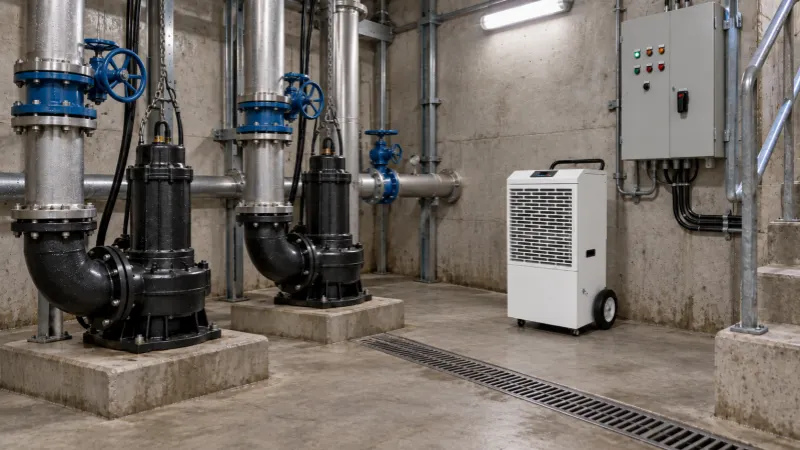
- Note that a dehumidifier alone won’t dry a wet floor that keeps receiving new water. If the moisture entry path is not fixed, even a properly sized dehumidifier will struggle to keep up.
Two Mistakes That Make Cold Storage Condensation Worse
Two patterns still show up in facilities that have already done some envelope and door work.
Mistake 1: Adding Ventilation Without Drying the Air
The instinct is intuitive — if there is too much moisture in the room, get more air movement to flush it out. In a normal warehouse, that works. In a cold room, it usually makes the problem worse.
The reason is straightforward. Whatever air you bring in from outside carries the outside dew point with it. In most cold storage climates, that means you are pulling in air with a higher absolute moisture content than the air already in the room. You are not flushing moisture out. You are pumping more in.
The only ventilation that helps a cold storage room is ventilation that has been actively dried first.
Mistake 2: Treating a Dehumidifier as a Substitute for Sealing the Envelope
A dehumidifier removes moisture from the air. It cannot stop moisture from entering the air in the first place. If your door gaskets are failing, your panel seams are open, and your drain is overflowing during defrost, no amount of dehumidification capacity will fully fix the problem — and the equipment that does get installed will be operating well above its design load just to keep up.
The right sequence is always: fix the envelope first, address the entry paths, then evaluate whether a dehumidifier is still needed to handle the residual load. In some facilities, just sealing the leaks and upgrading the door protection is enough to bring condensation under control without any added equipment.
When Persistent Condensation Becomes a Capital Risk
Occasional condensation after a door cycle or a washdown is normal. The question is whether it clears within a reasonable time, or whether it builds up faster than the facility can deal with it.
Persistent condensation — the kind that returns as fast as you clean it — signals that the moisture load has outgrown what the envelope, airflow, refrigeration, and humidity control can handle. At that point, the cost stops showing up as a cleaning expense and starts showing up in capital and compliance line items:
- Compressor runtime increases of 20–40% from heavier evaporator frost and more frequent defrost cycles, with corresponding wear on compressors, fans, and electrical contactors
- Insulation saturation that progressively drops envelope thermal performance and brings panel-system replacement five to ten years earlier than the original design life
- HACCP, GMP, or FSMA non-conformance findings tied to visible mold near food or pharmaceutical storage — usually the single most expensive consequence per audit cycle
- Cumulative product-stability losses for biotechnology materials and other temperature-sensitive inventory whose specification windows are tight
- Structural corrosion of refrigeration piping, support steel, racking, fasteners, and embedded concrete reinforcement
At this stage, condensation moves from a daily nuisance to a recurring line item in the maintenance budget and the compliance risk register — and it stays there until the underlying cause is addressed.
FAQ
What causes condensation to form on cold room ceilings or walls?
Condensation forms where warm, humid air contacts cold surfaces such as ceilings or walls and cools below its dew point, causing water droplets or frost to accumulate.
Can condensation in cold storage lead to mold growth and food safety issues?
Yes — persistent moisture from condensation creates ideal conditions for mold growth, bacterial contamination, and product spoilage if not controlled properly.
Does poor ventilation contribute to condensation problems in cold rooms?
Absolutely. Poor or stagnant air circulation traps moisture-laden air inside, increasing relative humidity and the likelihood of condensation on cold surfaces.
Why does frost or condensation sometimes appear on the outside of cold storage panels?
When outside air is humid and cold surfaces on panels fall below the ambient dew point, moisture condenses or freezes on the exterior panel surface.
How does dew point affect condensation risk in a cold storage environment?
Condensation begins when the surface temperature falls below the dew point of the surrounding air, meaning moisture capacity drops and water vapor must condense into liquid or frost.
Targeted Solutions After Diagnosis
Identifying the dominant cause is the prerequisite for matching the right control strategy. The same equipment can perform well in one facility and underperform in another when the dominant cause is different.
With the dominant cause identified, the next decision branches by what the diagnosis pointed to. Moisture load that envelope and door work alone cannot bring under control becomes a question of equipment type and capacity matched to your operating temperature range — covered in our companion guide on choosing the right industrial dehumidifier for cold storage. For broader background on how humidity control fits across different industrial environments, our complete guide to industrial dehumidifiers covers the wider picture. And if the diagnosis points at the dehumidifier itself icing up rather than the cold room envelope, that has separate causes — see why an industrial dehumidifier freezes up.
Information to gather before requesting a quote:
If condensation in your facility keeps returning after door, seal, drainage, and airflow checks, the next step is a dew point and moisture load evaluation. To make that conversation productive, have the following ready:
- Cold room dimensions and target operating temperature
- Current RH and, if possible, dew point readings inside and at the loading dock
- Door dimensions, door type, and average open frequency per hour
- Product types and typical inbound product temperature
- Photos of where condensation appears most consistently
- Washdown frequency and defrost schedule
If the diagnosis points to a moisture load that envelope and door work alone cannot bring under control, Rinwang’s application engineering team can help size the right low-temperature dehumidifiers or dry-air control approach for the operating conditions you are working with. We work with cold storage facilities across food processing, pharmaceutical, cold chain, and logistics applications.