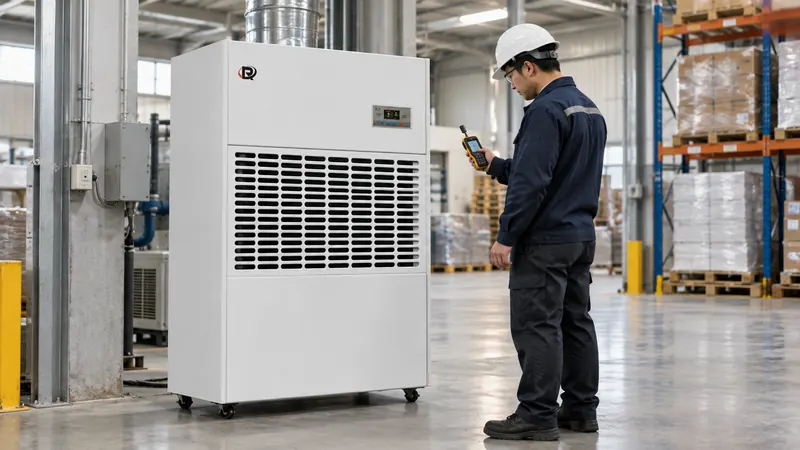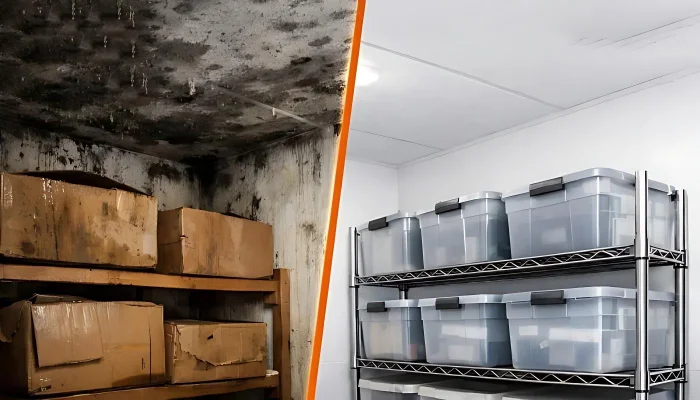
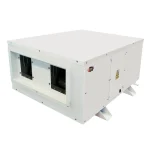
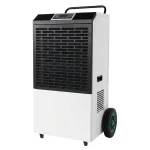
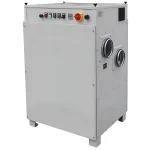
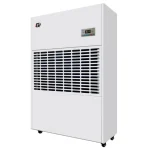
An industrial dehumidifier can keep running while room humidity stays above the target even when the machine has not completely failed. The reading may be misleading, the unit may be removing less moisture than expected at the actual operating condition, or it may be drying its process air correctly while moisture enters the space just as quickly.
This guide focuses on separating those situations. The goal is to determine whether the problem is measurement, actual moisture removal, site conditions, air distribution, controls, or finally equipment selection.
First, Confirm That the Humidity Reading Is Real
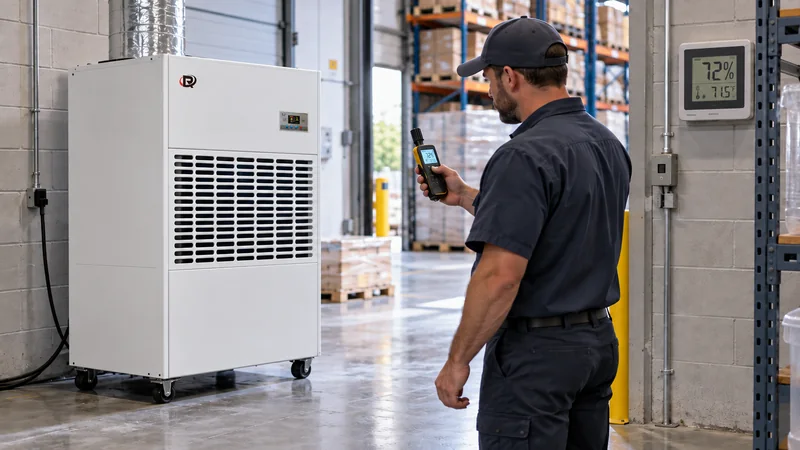
Start by checking the room rather than the machine. Compare the controller with a calibrated or recently verified temperature-and-humidity instrument and take readings in representative parts of the protected space, not directly in the dry-air discharge, next to a loading door, against a cold wall, or above a wet floor.
Relative humidity also changes with temperature. A room can show a higher RH after cooling even when little additional moisture has entered the air, which is why the National Weather Service explanation of dew point is useful when troubleshooting. Record temperature and RH together and compare dew point over time instead of judging the problem from RH alone.
If one sensor shows high humidity while other representative locations do not, investigate sensor location or calibration first. If several independent readings confirm that the controlled area is genuinely too humid, move to the equipment.
Is the Dehumidifier Actually Removing Moisture?
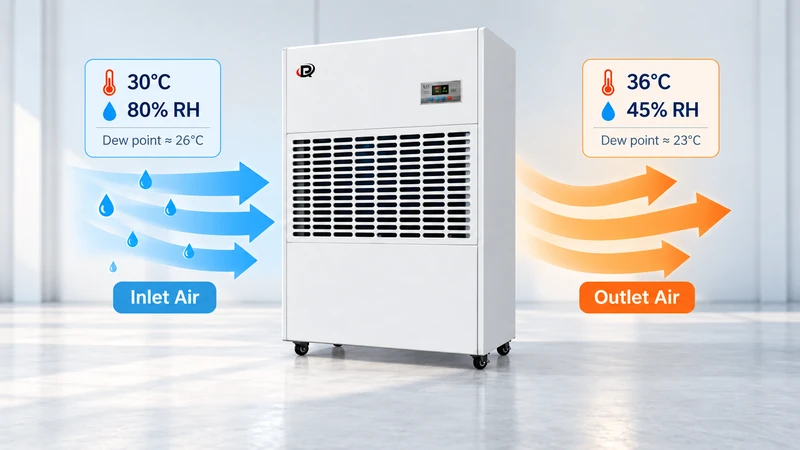
The quickest practical check is to compare the air entering and leaving the unit during a stable operating period. Record inlet and outlet temperature and RH, then compare their dew points. On a refrigerant unit, also confirm that condensate is being produced and discharged when the inlet condition should support condensation.
Do not use outlet RH alone as proof that the unit is working. Refrigerant dehumidifiers normally reheat the air after moisture removal, so warmer discharge air can show a lower RH partly because its temperature has increased.
A simple split test helps separate the main cases:
| What you find | What it suggests | Where to go next |
|---|---|---|
| Little inlet-to-outlet dew-point reduction and little condensate | The unit is removing little moisture | Check the water-removal fault path |
| Clear dew-point reduction and condensate, but room humidity stays high | The machine works locally; the problem is probably outside the basic refrigeration process | Check moisture load, distribution, and controls |
| Fan operates but the active drying section does not | The machine may be powered without actually dehumidifying | Check status, alarms, and service requirements |
| One area improves while another stays humid | The whole room is not being represented by the machine or sensor | Check room airflow and zoning |
If a refrigerant unit is producing little or no water, the next checks are drainage, filters, coils, compressor operation, low temperature, and related equipment-side faults. If the coil repeatedly freezes, treat that as a separate fault condition rather than assuming the unit is simply too small.
For a desiccant unit, visible condensate is not the correct test because removed moisture normally leaves in the reactivation exhaust. Compare process-air inlet and outlet dew point and confirm that the rotor and reactivation system are operating. If the application itself may be outside the efficient range of refrigeration-based drying, the choice between refrigerant and desiccant dehumidification can be reviewed separately.
Check the Actual Operating Condition Before Blaming Capacity
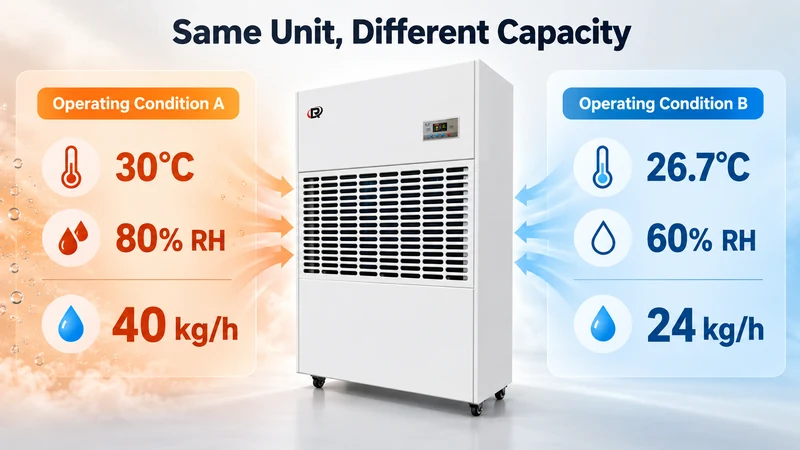
A dehumidifier does not remove the same amount of water under every temperature and humidity condition. Rated capacity applies to a stated test condition, and refrigerant moisture-removal capacity normally falls as the entering air becomes cooler or drier.
The ENERGY STAR explanation of dehumidifier testing and capacity illustrates how reported capacity changes with test conditions. Those ratings apply to portable equipment rather than industrial project sizing, but the same comparison principle matters: a headline capacity number should not be treated as the unit’s guaranteed output under different inlet conditions.
Rinwang’s published data show the same effect in an industrial model. The RW-9681E is listed at 40 kg/h at 30°C and 80% RH, compared with 24 kg/h at 26.7°C and 60% RH. This is why troubleshooting should compare the actual inlet condition with the manufacturer’s performance data rather than assuming that continuous runtime automatically means a fault.
If the measured moisture load is consistently higher than the unit can remove, the next step is to review the actual capacity requirement using the site’s temperature, humidity, infiltration, door activity, and process load.
If the Unit Is Drying Air but the Room Is Still Humid
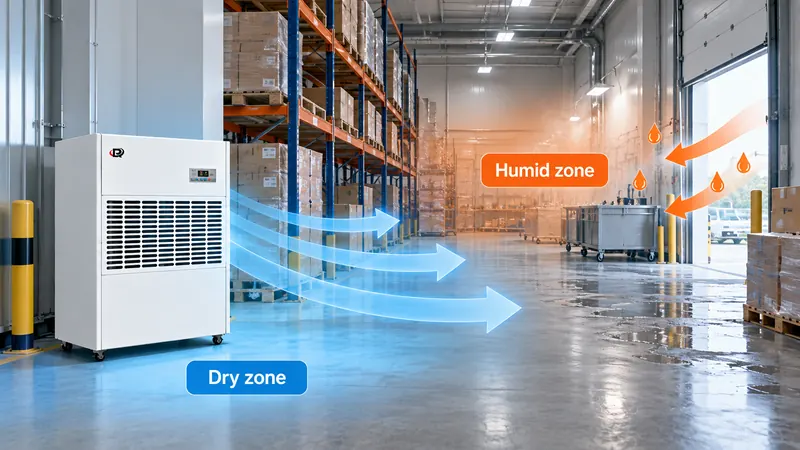
When the outlet air has a meaningfully lower dew point but the room does not improve, shift the investigation away from the machine itself. Moisture may be entering or being generated about as quickly as the unit removes it.
The U.S. EPA’s moisture-control guidance emphasizes controlling moisture sources and transport paths. In an industrial facility, those sources commonly include humid outdoor air entering through doors or makeup-air systems, negative building pressure, washdown, wet products, open processes, or moisture still drying from building materials.
Look for timing rather than trying to calculate the complete load immediately. If room dew point rises after dock activity begins, after an exhaust system starts, or during a wet production process, that trend helps identify where the additional load is coming from.
Air distribution can create the same symptom. If the area near the unit reaches the target while rack aisles or remote zones remain humid, check whether air distribution through the space is limiting the result. Supply and return paths, racks, partitions, and sensor location can all affect whether the dry air actually reaches the controlled zone.
Check the Control Sequence
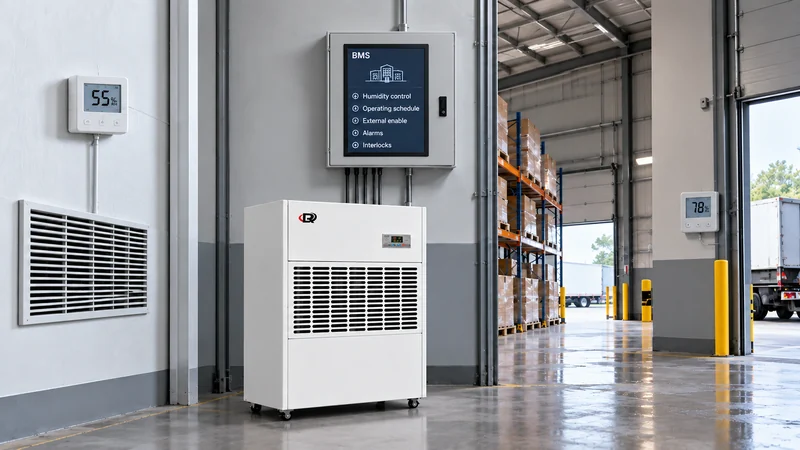
A dehumidifier can also appear to run normally while the control system prevents stable room drying. Review the humidity setpoint, deadband, operating schedule, external enable signal, alarms, sensor location, defrost status, and any BMS interlocks that affect the drying call.
Sensor location is especially important. A sensor close to dry discharge air may reach setpoint before the rest of the room does, while one beside a loading door or wet process may keep the equipment running even though that point does not represent the main controlled zone.
For refrigerant equipment, the relationship between compressor and fan operation can also matter. NREL laboratory testing found that some tested standalone dehumidifiers returned part of the collected moisture to the air when the fan continued operating after compressor shutdown. Those products were not industrial project units, so this should be treated as a possible mechanism to investigate rather than a universal diagnosis.
When Is It Actually a Sizing or Technology Problem?
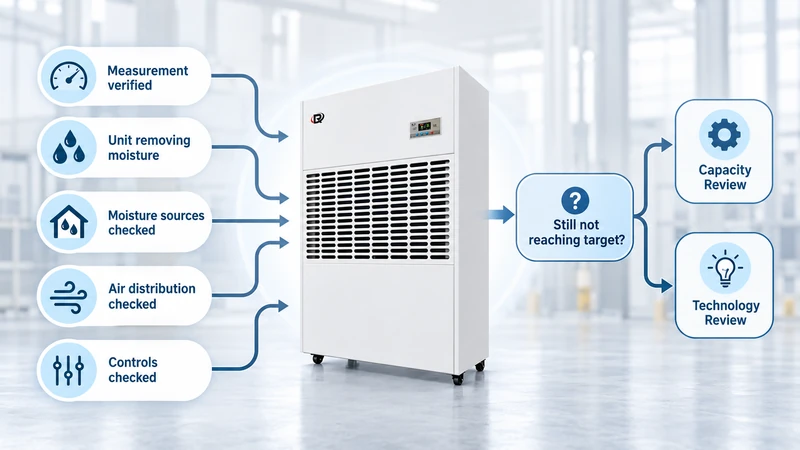
Do not conclude that the unit is undersized simply because it runs continuously. First confirm that the humidity measurement is representative, the unit is actually removing moisture, the entering condition is within its useful operating range, major moisture sources have been identified, dry air reaches the required zones, and the controls are behaving as intended.
If those checks are satisfactory but the system still cannot reach the required dew point or recover after normal site disturbances, capacity or technology selection becomes a reasonable next question. Persistent continuous running or short cycling can then be assessed together with recovery time, site load, and effective capacity rather than being used as a sizing conclusion by itself.
For a useful technical review, record the room and outdoor conditions, unit inlet and outlet readings, operating status, known moisture sources, airflow arrangement, and control settings. These measurements are usually more useful than simply reporting that the machine has been running for a certain number of hours.
Final Check Before Changing Equipment
If an industrial dehumidifier is running but humidity is not falling, do not jump straight to a larger unit. First verify the reading, confirm that the machine is actually removing moisture, and check the site load, air distribution, and controls.
Once those factors are confirmed, you can judge whether the real issue is capacity, operating condition, or technology selection. For project-specific troubleshooting, the most useful starting point is always measured site data rather than runtime alone.
Frequently Asked Questions
Why does humidity increase when the temperature drops?
Relative humidity rises as air cools because cooler air reaches saturation with less water vapor. The actual moisture content may change very little, so compare dew point as well as RH.
How do I know if my dehumidifier humidity sensor is bad?
Compare the controller with a verified independent instrument at the same representative location. A consistent difference under stable conditions can indicate calibration drift, contamination, or poor sensor placement.
Does a dehumidifier work better with doors and windows closed?
Usually yes, because uncontrolled outdoor air adds moisture that the unit must continuously remove. Industrial sites should also check loading doors, makeup air, exhaust systems, and building pressure rather than only visible openings.