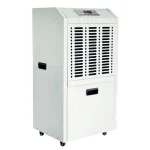
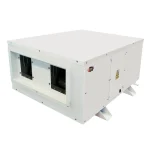
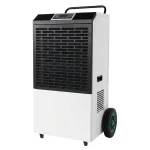
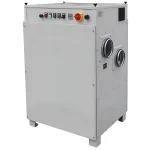
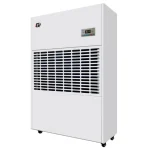
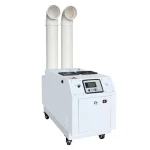
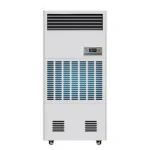
Museum dehumidifier selection starts with the collection, not the machine. A modern gallery, a historic museum, a temporary loan exhibition, and a sealed display case can require very different humidity-control strategies, even when the spaces are similar in size. The first question is therefore not how many litres per day a dehumidifier can remove, but what environment the collection requires and whether the building can safely maintain it.
A practical selection process starts by defining the collection and control requirement, then checking the building envelope, HVAC system, room-versus-display-case strategy, and peak moisture load. Only after those conditions are clear should capacity, airflow, refrigerant or desiccant technology, drainage, controls, and installation format be specified. This guide explains that sequence and the information needed to select a museum dehumidifier at the actual design condition.

Why 50% RH Is the Wrong Starting Point for a Museum Dehumidifier
A single RH number hides four different decisions: the safe outer limits for the collection, the annual baseline, permitted seasonal adjustment, and acceptable short-term fluctuation plus spatial gradients. It also hides whether the building envelope can hold those conditions without condensation inside walls or roofs.
The Canadian Conservation Institute’s current explanation of the ASHRAE types of control makes two points that change procurement. First, AA, A1, A2, B, C, and D are types of control, not a quality ranking. Second, local climate, the collection, and the building should drive the target instead of a universal fixed specification.
| Control path | Typical building situation | What the dehumidifier means to the project | Procurement consequence |
|---|---|---|---|
| AA, A1, or A2 | Modern purpose-built museum or purpose-built collection room | One component in a precision HVAC and envelope system | Verify whole-room performance, seasonal strategy, gradients, and recovery – not controller display accuracy alone |
| B | A museum that needs limited control and must reduce stress on the building | Part of a seasonal control strategy | Coordinate dehumidification with temperature, ventilation, and the historic envelope |
| C | A historic building or smaller institution where preventing RH extremes is the realistic goal | May provide the main active summer moisture intervention | Specify the permitted band and time above the alarm limit; do not present C as failed A control |
| D | An open or lightly serviced historic structure where avoiding dampness is the priority | May operate only during the humid season | Treat the project as damp prevention, while accepting the collection risks that remain outside a tighter control type |
An ASHRAE control type describes the environment achieved over time. It is not a compliance mark that can be attached to a dehumidifier. A tender should therefore state the control objective and the evidence required to verify it across the occupied zone, storage zone, and sensitive collection locations.
Loan Exhibitions Add Contractual Environmental Requirements
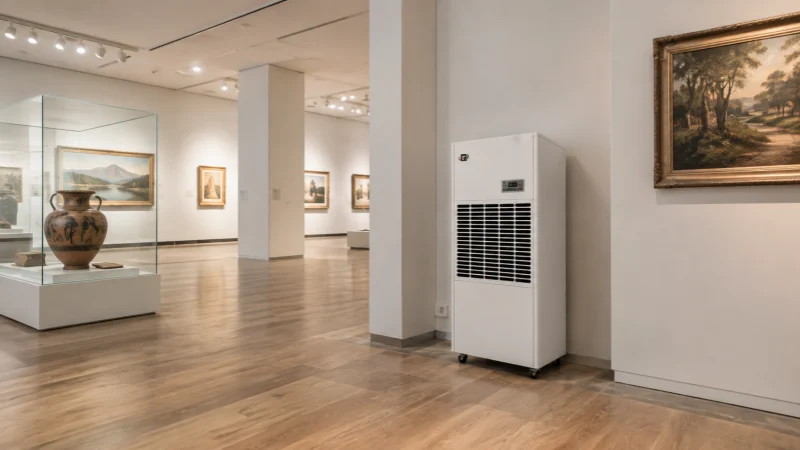
Permanent collections can be managed around their condition, history, local climate, and the museum’s building. A loan exhibition adds another authority: the loan agreement.
The 2023 Bizot Green Protocol gives a 40-60% RH and 16-25°C range for many hygroscopic objects, with no more than +/-10% RH fluctuation over 24 hours within that range. It also states that more sensitive objects may require tighter control based on their materials, condition, and history, with a conservator establishing the appropriate conditions.
That distinction changes the equipment schedule. A gallery may normally operate to a locally appropriate annual strategy but need tighter control during a three-month loan. Temporary exhibition rooms, unpacking areas, loading routes, and object-acclimatisation spaces may also see different door traffic and moisture loads from the permanent galleries.
Before requesting equipment, convert the loan obligation into measurable requirements:
- the spaces and dates covered by the agreement;
- the approved temperature and RH band;
- the permitted duration and magnitude of excursions;
- where verification loggers will be placed;
- the recovery time allowed after door opening, installation work, or a visitor peak;
- the response required after a power, drainage, or HVAC fault.
The museum dehumidifier is then selected against the contract condition, not against an average annual reading.
Put the Tightest RH Requirement Around the Object, Not the Entire Gallery
Painted wood, canvas, textiles, leather, paper, metals, unstable glass, natural history specimens, and modern composites do not share one universal safe RH band. Driving an entire gallery to the most demanding object’s condition can waste energy, create risk for other materials, and impose a climate the building cannot safely sustain.
For organic hygroscopic materials kept in long-term indoor storage or exhibition, BS EN 15757:2010 is the relevant European framework for limiting climate-induced mechanical damage. Sensitive metals or unstable glass may instead need a special microclimate defined by their critical RH. The conservation team must set those requirements before an equipment supplier translates them into air treatment.
| Zone or collection | Primary risk to examine | Best control boundary to evaluate first | System implication |
|---|---|---|---|
| General gallery with mixed, robust collections | Visitor-driven RH peaks and repeated daily cycling | Gallery or HVAC zone | Coordinate latent removal, supply-air distribution, and temperature control |
| Hygroscopic organic objects with a known climate history | Mechanical response to unsuitable fluctuation | Room zone plus object-level monitoring | Use the approved conservation specification rather than a generic set point |
| Corroded metal, unstable glass, or another critical-RH object | Deterioration above or below a material-specific threshold | Sealed or well-buffered display case | Do not force the whole gallery to the case requirement |
| Temporary loan exhibition | Contractual band and excursion limits | Exhibition, unpacking, and transition spaces | Check peak loads and recovery performance for the loan period |
| Historic gallery | Wall, roof, and window condensation caused by aggressive conditioning | Building envelope plus occupied zone | Complete an envelope and hygrothermal review before tightening the interior target |
Display cases, sealed frames, and buffered enclosures reduce the volume that needs the tightest control and add resilience during plant faults. They do not remove the need for room-level control; they divide the work between a stable background environment and a more protective microclimate.
Where institutional libraries and special collections fit
A library reading room is an occupied commercial space, while a rare-book room or special-collections gallery is a preservation environment. Use the museum decision path only when materials, exhibition, loans, or conservation requirements justify it. Dedicated repositories for archive and library materials fall under ISO 11799:2024, which covers repository buildings and equipment but explicitly excludes exhibition and display guidance; Rinwang’s archive humidity control guide handles that separate storage intent.
Calculate the Museum Moisture Load Before Matching Capacity
Floor area indicates neither how much water enters a museum nor how quickly RH changes. Two galleries with the same dimensions can have very different latent loads if one has an airlock and controlled outdoor air while the other has leaky historic windows, direct street doors, and daily visitor peaks.
| Moisture-load input | What to measure or define | Why it changes the museum dehumidifier selection |
|---|---|---|
| Outdoor air and infiltration | Outdoor design humidity ratio, ventilation rate, leakage, vestibules, and door-opening schedule | Outdoor air can dominate the peak load in humid weather |
| Visitors and staff | Maximum planned occupancy, dwell pattern, event schedule, and ventilation response | A crowded opening night can create a different peak from normal weekday operation |
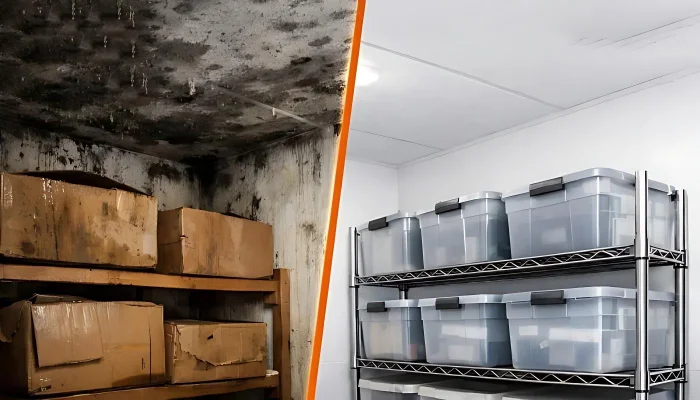
| Building fabric | Basement or ground contact, damp walls, wet construction, roof or plumbing leaks, and cold surfaces | Bulk-water defects and envelope moisture must be corrected rather than assigned to equipment |
| Exhibition activity | Cleaning, wet installation materials, open water, plants, temporary walls, and object acclimatisation | Temporary internal loads can determine commissioning and recovery capacity |
| Existing HVAC | Cooling-coil latent capacity, reheat strategy, outdoor-air control, operating hours, and zone sequence | Avoids buying capacity already available or creating opposing control loops |
| Adjacent spaces | Loading dock, café, entrance lobby, store, workshop, or outdoor-connected corridor | Pressure and air transfer can move moisture across the gallery boundary |
| Collection and enclosures | Hygroscopic mass, display cases, cabinets, storage furniture, and permitted recovery time | Buffering slows both RH excursions and recovery, changing how performance should be judged |
The peak maintenance load should be calculated as a moisture balance using project-specific inputs. Initial drying after construction, a leak, or exhibition installation is a separate temporary load. The method for comparing removal capacity, rating conditions, airflow, and real moisture sources is covered in Rinwang’s industrial dehumidifier sizing guide.
Ask suppliers for moisture-removal performance at the museum’s entering-air condition. A capacity stated only at a hot, humid catalogue rating point cannot show what the same machine will remove in a cooler gallery operating near its approved RH band.
Match Technology to Each Museum Zone and Its Design Condition
The word “museum” does not determine the technology. The design temperature and RH determine the dew point; the dew point, together with the entering-air condition, determines whether a refrigerant coil can remove water without excessive frosting or defrost time.
| Project condition | Refrigerant dehumidification | Desiccant dehumidification | What to verify |
|---|---|---|---|
| Conditioned gallery with a moderate RH target | Usually the first technology to evaluate | Often unnecessary for the main room | Capacity and efficiency at the actual gallery condition; heat added to the room; defrost behaviour |
| Cool store or unheated space | Capacity may fall and defrost time may rise | Remains a candidate when the required dew point is low | Full performance curve, minimum entering condition, regeneration-air route, and process heat |
| Low-RH room for a material-specific risk | A larger refrigerant unit may still be unable to reach the required dew point | Often the practical route | Target dew point, energy source, wet-air exhaust, sealing, and temperature control |
| Mixed museum with galleries, cold stores, and special rooms | One technology may fit some zones but not others | Can serve only the low-dew-point zones | Zone-by-zone loads and whether shared air paths will defeat separate targets |
The underlying technology trade-offs are set out in Rinwang’s refrigerant versus desiccant comparison.Do not convert a rule such as “below a particular RH use desiccant” into a universal threshold; the same RH produces a different dew point at a different temperature.
After the control type, design condition, load, and installation format are fixed, the industrial dehumidifier range becomes a commercial comparison of capacity, airflow, drainage, and configuration. Projects that genuinely require low-dew-point process air can then be narrowed to the desiccant dehumidifier range. Model selection still requires performance data at the project condition.
Design the Whole Humidity-Control System, Not a Standalone Machine
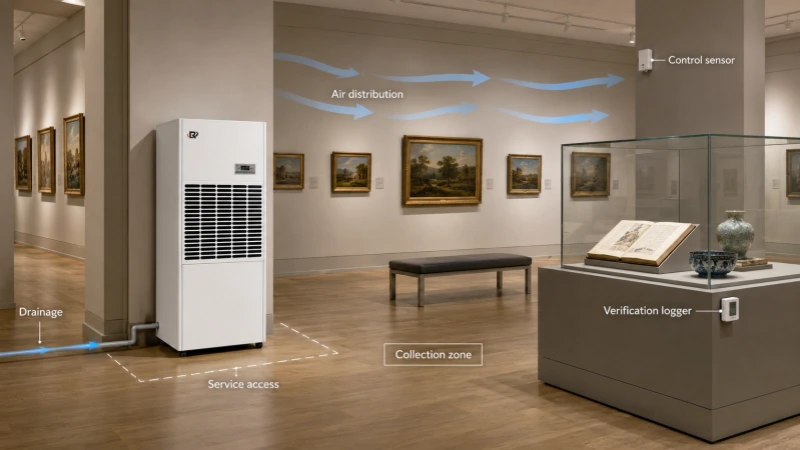
A correctly sized museum dehumidifier can still leave one display wall damp and another zone over-dry. The installed result depends on airflow, sensor location, control sequence, drainage, service access, and the interaction with temperature control.
Air distribution must reach the collection zone
Map supply and return paths around partitions, tall cases, temporary walls, stairs, doors, and dense stores. The goal is not maximum air speed at the machine; it is an acceptably small RH gradient through the occupied and collection zones without directing turbulent air at fragile objects.
Control and verification are different jobs
Place the control sensor in representative return air, away from a supply jet, exterior surface, door, or heat source. Add independent verification loggers at the farthest zone, near known cold surfaces, and inside critical enclosures. Specify sensor accuracy, calibration method, controller deadband, alarm delay, data retention, and the response after communication loss.
Drainage failure must not become a collection incident
Gravity drainage is the simplest route where a suitable drain is available. A pump may be necessary when lift is unavoidable, but the project should then define a high-level alarm, overflow interlock, secondary containment, and access for testing and cleaning. A tank that depends on staff emptying it is not a continuous-control strategy.
Occupied galleries add non-capacity constraints
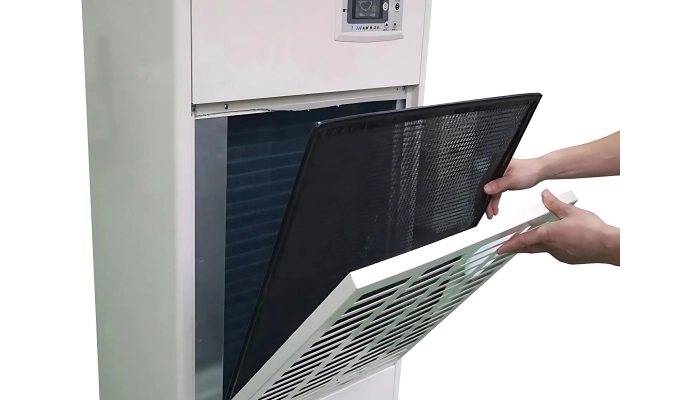
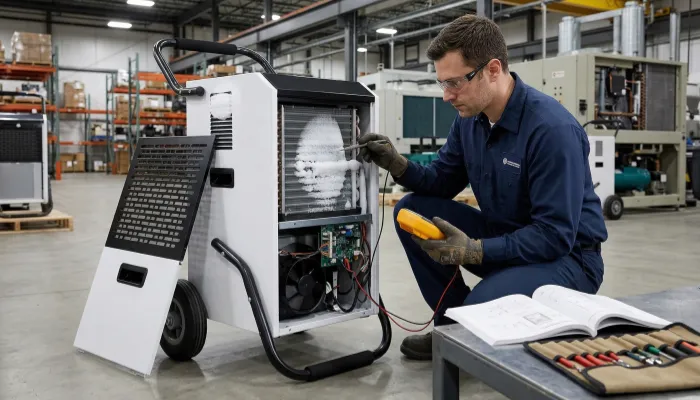
Noise, vibration, appearance, maintenance access, filter change paths, heat rejection, and operating hours can decide whether a floor-standing, ceiling-mounted, ducted, or mechanical-room installation is acceptable. Specify measurable project limits and ask for the test condition behind any supplier value. Rinwang’s industrial dehumidifier selection guide provides the broader procurement checks that should accompany the museum-specific conservation requirements.
Build a Museum Dehumidifier RFQ That Can Be Tested at Handover
A useful request for proposal lets the supplier test a proposed configuration against the real site instead of returning a coverage-area estimate.
| Project input | Minimum information to provide | Decision it supports |
|---|---|---|
| Collection basis | Materials, vulnerable objects, conservator requirements, and display-case strategy | Approved RH boundaries and zoning |
| Governing requirement | ASHRAE control type, loan clause, internal conservation policy, or other stated basis | Control precision, verification, and reporting |
| Plans and room data | Length, width, height, sections, doors, cases, partitions, service rooms, and protected fabric | Volume, equipment format, airflow, and access |
| Current climate data | At least one humid-season and one dry-season record from representative points | Baseline, gradients, excursions, and likely moisture sources |
| Design conditions | Indoor temperature/RH band, outdoor design humidity, seasonal strategy, and operating hours | Dew point, technology, and performance point |
| Occupancy and events | Normal and peak visitors, event schedule, and ventilation response | Peak latent load and recovery requirement |
| Existing HVAC | Airflow, outdoor air, cooling and reheat sequence, latent capacity, and available controls | Integration and avoidance of conflicting loops |
| Building constraints | Historic protection, airtightness, insulation, cold surfaces, and known water defects | Safe target and envelope work required before equipment |
| Utilities and interfaces | Electrical supply, drainage route/lift, communication protocol, and alarm destination | Installation and controls |
| Acceptance criteria | Sensor locations, allowed excursion, recovery time, noise/vibration limits, and commissioning period | Testable tender and handover |
Frequently Asked Questions
Does a museum dehumidifier control temperature as well as RH?
Not necessarily. A standard refrigerant dehumidifier removes latent moisture and normally adds sensible heat to the room, so temperature control must be coordinated with the HVAC system. A project that requires independent temperature and RH control needs a defined air-treatment and reheat/cooling sequence, not an assumption based on the word “dehumidifier.”
Should a museum use a floor-standing or ceiling-mounted dehumidifier?
Choose the format from airflow, noise, maintenance access, drainage, and heritage constraints. A ceiling-mounted or ducted unit can keep equipment out of the gallery, while a floor-standing unit may be easier to service; neither format compensates for poor air distribution.
Can one dehumidifier serve a gallery and a library special-collections room?
Only if both zones have compatible temperature, moisture-content, operating schedule, and conservation requirements. Separate zones or equipment are preferable when the library store, gallery, or display cases require different conditions or when shared return air would erase the separation.
When should a museum control RH inside the display case?
Use a case microclimate when a small group of objects needs conditions the room cannot safely or economically maintain, or when additional resilience is required during HVAC faults. The case should have its own monitoring and maintenance plan because a sealed-looking enclosure can still leak or contain moisture-emitting materials.
How should museum RH alarms be set?
Set alarms from the approved control band, the allowed duration of an excursion, and the response plan. A delayed alarm for a short door-opening event and an immediate alarm for drainage failure solve different problems, so one high/low number is not enough.
Next Step
Send Rinwang the approved conservation target, room drawings, climate records, peak occupancy, existing HVAC data, drainage route, and acceptance criteria. Request a museum dehumidifier selection review so the proposed refrigerant or desiccant configuration can be checked at the actual design condition rather than selected from floor area alone.