A concrete floor may look dry while still failing the flooring manufacturer’s moisture requirements. Plaster and joint compound may delay finishing, and a completed floor may need protection while wet work continues elsewhere. On a new build, these problems cannot be solved by reading a room humidity display alone.
Construction dehumidifiers remove water vapor released by damp building materials, helping maintain conditions in which drying can continue. This guide focuses on planned drying during new construction rather than emergency restoration after flooding or major leaks. For contractors selecting equipment, the practical questions are when controlled drying can begin, which dehumidifier technology suits the site, what removal capacity is needed, and how to verify that the next trade can proceed.
When Does a New Build Need a Dehumidifier?
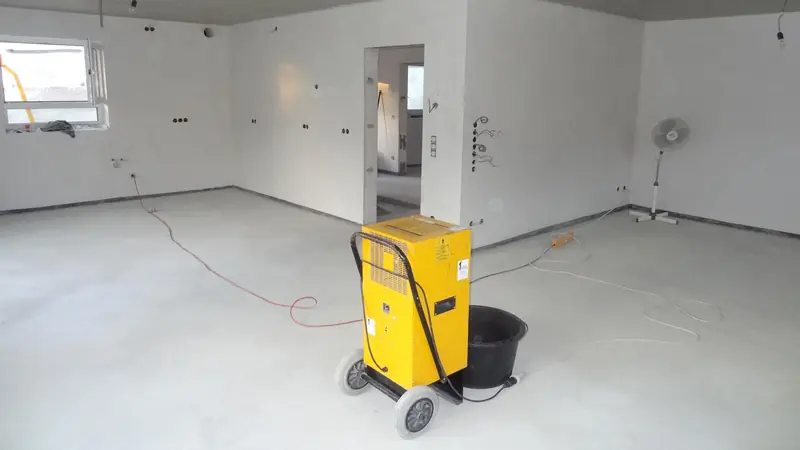
Mechanical dehumidification is most useful when the building can be divided into reasonably enclosed drying areas, active water entry has been addressed, and the materials have reached a stage when controlled drying is permitted. Common applications include screed awaiting floor finishes, plaster and joint compound between finishing stages, and multi-floor fit-outs where different zones have separate handover dates. Similar principles apply to refurbishment and renovation projects involving substantial wet work.
Dehumidifiers should not replace prescribed curing or compensate for uncontrolled rain, plumbing leaks or standing water. The American Concrete Institute’s explanation of concrete curing describes why suitable moisture and temperature conditions must be maintained while cementitious materials develop their properties. Contractors should follow the applicable material requirements and project specification when determining when controlled drying may begin.
Start With the Material Requirements of the Next Trade
Before selecting a machine or room RH setting, identify the conditions required by the following trade. Ambient relative humidity describes the surrounding air, but it cannot establish whether a concrete slab, screed, timber component or joint compound is ready for the next construction stage. Different materials require different testing methods and acceptance criteria, which should be confirmed through the relevant product instructions and project documents.
| Upcoming work | What to check | What determines acceptance |
|---|---|---|
| Flooring over concrete | Specified slab moisture test and installation conditions | Flooring, adhesive or coating requirements and project specification |
| Finishes over screed | Moisture condition using the method required for the screed system | Screed and finish manufacturers’ instructions |
| Painting over gypsum finishes | Compound dryness, temperature, RH and permitted recoat intervals | Compound, primer and paint instructions |
| Wood flooring or enclosed timber | Material moisture and expected service environment | Wood product requirements and project specification |
For concrete floors tested under the applicable US framework, ASTM F2170’s in-situ relative humidity method measures conditions inside the slab at specified locations and times. A wall-mounted hygrometer cannot replace this measurement. Dehumidification provides environmental control during drying, while material-specific testing establishes whether the next trade can proceed.
Choose the Dehumidifier Around Actual Site Conditions
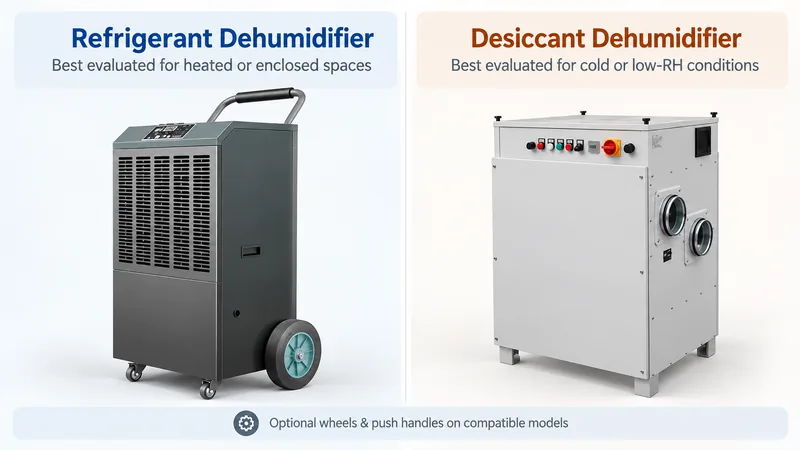
The starting point for equipment selection is the temperature and humidity range expected throughout the drying period, including overnight operation and the later stages when the space becomes drier. An enclosed, heated building may be suitable for a refrigerant dehumidifier, whereas a cold shell may require a low-temperature refrigerant unit or a desiccant system. Actual water-removal capacity at the expected operating conditions matters more than the maximum capacity stated in a product headline.
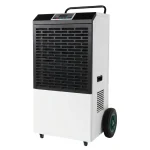
Portability should be evaluated separately from the drying technology. Rinwang offers both refrigerant and desiccant dehumidifiers with optional mobility features, including wheels and push handles on compatible models. These configurations can help contractors relocate equipment between rooms or construction stages, but the appropriate machine still depends on drying performance, site access and installation requirements.
| Site condition | Equipment approach to evaluate | Important selection factors |
|---|---|---|
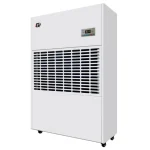
| Enclosed, heated rooms | Refrigerant dehumidifiers serving defined drying zones | Actual-condition output, airflow distribution, drainage and handling |
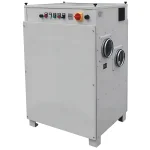
| Cold or intermittently heated shell | Low-temperature refrigerant versus desiccant systems | Cold-condition output, defrost, regeneration energy and exhaust route |
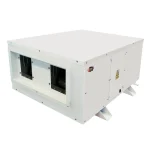
| Large enclosed commercial floor | Multiple distributed units or an engineered ducted arrangement | Air delivery, temporary power, equipment count and installation effort |
| Finished areas beside continuing wet work | Separate drying zones with suitable controls | Moisture transfer, material requirements and different handover dates |
Refrigerant and desiccant systems remove moisture through different processes, making their performance dependent on temperature, humidity and installation conditions. The main trade-offs are explained in Rinwang’s comparison of refrigerant and desiccant dehumidification technologies. Heating can support evaporation and maintain suitable working conditions, but it does not remove water vapor from a closed space by itself. Ventilation can remove moisture when incoming air is sufficiently dry, although required worker ventilation and extraction must be maintained regardless of the drying arrangement.
How Equipment Deployment Changes Across Construction Projects
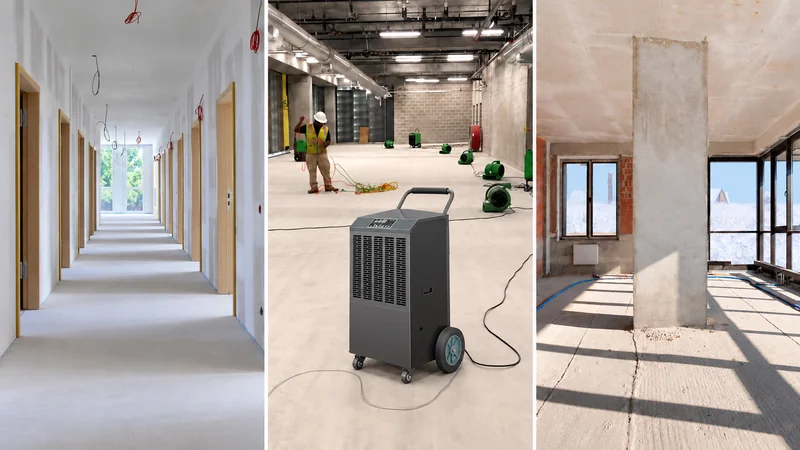
Multi-room apartments and hotel fit-outs: A dehumidifier operating in a corridor cannot be assumed to dry rooms behind closed doors. Contractors should define separate air zones and provide suitable circulation within each area. Where mobility is required, compatible refrigerant or desiccant units equipped with wheels and push handles may simplify relocation as rooms pass their material checks. Door dimensions, lift access, drainage and electrical connections should be considered before selecting equipment.
Large commercial floors: Several distributed machines may provide more flexible coverage, but each requires suitable power, drainage and maintenance access. A larger ducted system may reduce the number of machines if the equipment can deliver adequate airflow through the proposed duct network. Selection should account for practical installation and operating requirements rather than relying only on the combined nominal L/day capacity.
Cold-weather construction: Overnight temperature drops may significantly reduce the useful output of refrigerant equipment and increase the effect of defrost cycles. Contractors should compare documented performance under the expected conditions with a desiccant alternative, including regeneration energy and moist-air exhaust requirements. Minimum operating temperature alone does not indicate how much water a machine can remove.
Estimate Capacity From the Construction Drying Load
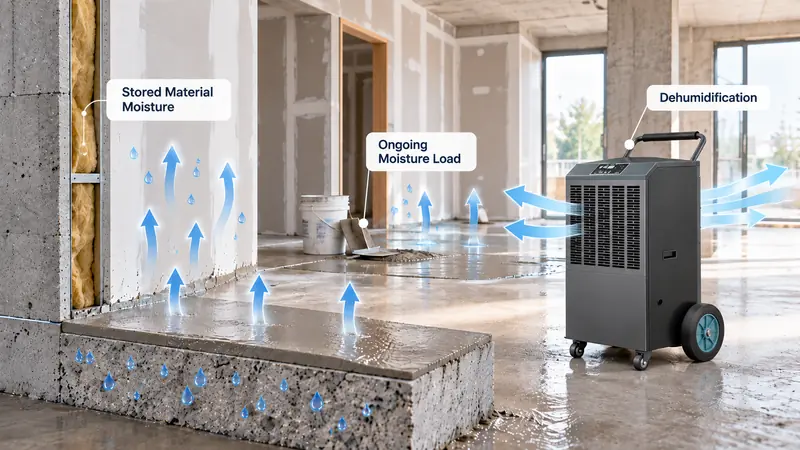
Construction drying capacity should reflect the moisture stored in building materials, any continuing moisture load and the time available before the next trade begins. Floor area helps describe the drying zone, but it does not indicate how much removable water is contained in concrete, screed, plaster or timber. Before estimating equipment quantity, gather information about the materials and their thicknesses, installation dates, existing moisture readings, enclosure status, room temperature and RH, available operating hours and required completion date.
If material water content cannot be estimated with reasonable confidence, establish baseline measurements and monitor the drying trend rather than applying an unsupported water-per-square-meter allowance. For an initial planning check, the average required air-side removal can be estimated as follows:
Average removal requirement (L/day) ≈ Removable material water (L) ÷ Available drying days + Continuing moisture load (L/day)
This calculation provides an initial water-balance estimate, not a guaranteed drying time. Moisture must still migrate from within the materials to their exposed surfaces, and the dehumidifier’s actual removal rate will change as the drying environment becomes less humid.
Example: Estimating Equipment Capacity for a Construction Zone
Assume a surveyed construction zone contains approximately 280 L of removable material water, has 10 days available for drying and experiences an additional moisture load of 7 L/day. The average required removal is therefore 280 ÷ 10 + 7 = 35 L/day. These values are hypothetical and illustrate the calculation method; they are not a Rinwang project result or a promised drying period.
Suppose a candidate dehumidifier has documented output of 20 L/day at 20°C and 60% RH. Two machines would nominally provide 40 L/day at that particular condition, making them a preliminary configuration worth evaluating. Before confirming that arrangement, the contractor should review performance at the lower RH expected later in drying, airflow between rooms, permitted operating hours and the measured material drying trend.
If the performance data or site measurements do not support the required completion date, the plan may need a different machine quantity, equipment arrangement, environmental conditions or drying period. Adding machines cannot automatically overcome moisture migration limits within the materials. The general capacity principles in Rinwang’s guide to estimating industrial dehumidifier capacity provide a broader sizing framework, while construction projects also require material-specific drying and acceptance checks.
Install Dehumidifiers for Reliable Construction Site Drying
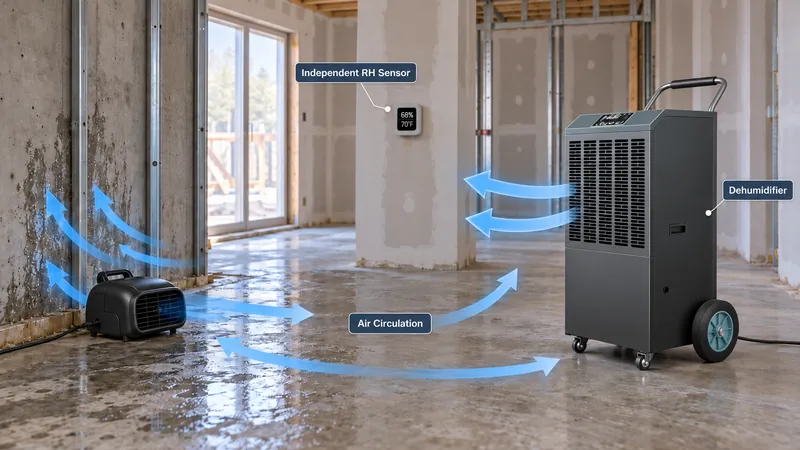
A practical drying plan begins with a survey of material conditions and water sources, followed by zone definition, equipment installation, monitoring and material acceptance. The equipment must be positioned so that conditioned air reaches damp surfaces and moisture-laden air can return to the dehumidifier. A single unit placed in a convenient corridor may not provide effective drying in adjacent rooms with closed doors or restricted air movement.
Position machines on suitable stable surfaces with the clearances required by the manufacturer. Independent temperature and RH sensors should be placed away from machine discharge, heaters, direct sunlight and other influences that could distort readings. Air movers may help reach stagnant areas, but excessive airflow or concentrated heating directed at newly finished surfaces should be avoided. USG’s guidance on gypsum finishing under cold and humid conditions explains how environmental conditions and temporary heating can affect finishing work. Where condensation is a concern, local air dew point should also be compared with representative cold surface temperatures.
Plan Condensate Drainage and Temporary Power
Condensate removal should be planned before deciding the final equipment location. Drain lines must reach an approved discharge point without interfering with access routes, and should be checked for kinks, freezing exposure and potential blockages. Rinwang’s guidance on planning continuous condensate drainage provides additional details for selecting a suitable arrangement.
Where gravity drainage is impractical, equipment with pump-assisted drainage may be appropriate. For example, a commercial dehumidifier equipped with a condensate pump can be evaluated for locations where water must be discharged to a higher point. The actual pump capacity, lift, hose arrangement and fault response must be confirmed for the selected model and configuration.
Temporary construction power requires attention because dehumidifiers may operate alongside air movers, heaters, lighting and other equipment. The supplier should provide the selected machine’s electrical requirements, while qualified site personnel determine suitable circuits and protection. Contractors should verify voltage, phase and frequency compatibility before ordering, especially when purchasing equipment for use across multiple locations.
Monitor Drying Progress Before Releasing the Next Trade
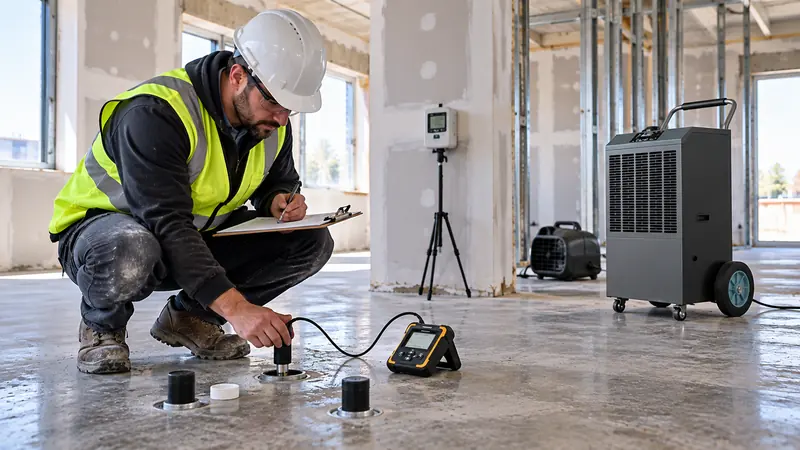
Monitoring should combine representative room temperature and RH readings with the material measurements required by the project. Record baseline values and repeat tests at consistent locations, noting operating interruptions, drainage problems and any new wet work. Condensate volume can help indicate equipment operation, but reduced water collection may reflect changing temperature or reduced available moisture rather than confirmation that the building materials are ready.
If drying progress slows unexpectedly, verify the measurements and check for continuing water entry before assuming insufficient equipment capacity. Review the operating temperature, filters, airflow paths, drainage and controls, then compare actual conditions with the manufacturer’s performance data. Rinwang’s troubleshooting approach for dehumidifiers that are running without reducing humidity can help distinguish equipment issues from excessive site moisture loads.
Final release should follow the test method, environmental conditioning requirements and acceptance criteria specified for the materials being installed. A favorable room RH reading does not replace the required material test. Once a zone has been accepted, maintain the conditions needed by the next trade until its work is complete.
What Contractors Should Confirm Before Purchasing Construction Dehumidifiers
Contractors purchasing equipment for repeated use should compare more than maximum water-removal ratings. Actual operating performance, drainage reliability, maintenance access and compatibility with site electrical supplies can affect whether equipment remains useful across different projects. Transport and handling also matter, particularly when machines must move between floors or through partially completed buildings.
At the quotation stage, confirm whether the shortlisted model supports optional wheels, push handles or other handling configurations. These mobility options are available for compatible Rinwang refrigerant and desiccant dehumidifiers, but should be confirmed for the specific equipment being ordered. Request dimensions and operating weight so the unit can be evaluated against actual doorway, lift and storage constraints.
| Procurement stage | Information to confirm |
|---|---|
| Initial shortlist | Operating temperature/RH, documented removal output, equipment type and intended site arrangement |
| Before order approval | Exact model and electrical version, drainage configuration, controls, dimensions, weight, mobility options and required documentation |
| Repeat-project planning | Filter and pump access where applicable, maintenance instructions, spare parts, warranty, transport and storage requirements |
For contractors building a reusable equipment fleet, total ownership cost should account for realistic utilization, energy, maintenance, transport, storage and handling labor. Optional monitoring functions, alarms and automatic restart should also be confirmed against the selected model rather than assumed to be standard. Where equipment is expected to reduce project delays, the claimed benefit should be supported by actual schedule requirements and measured drying progress.
What Information Should You Send for a Construction Dehumidifier Recommendation?
An initial equipment enquiry does not require a completed engineering calculation. Providing the project location, expected operating season, drying zone dimensions, number of rooms, wet materials, current temperature and RH, heating and enclosure status, available power supply and proposed drainage arrangement gives the manufacturer a practical starting point. The required next-trade condition and target completion date are particularly useful because they explain what the equipment must help achieve.
A marked floor plan can help identify separated zones, air-distribution constraints and equipment access requirements. Based on the available information, Rinwang can help shortlist suitable refrigerant or desiccant equipment, review optional mobility and drainage configurations, and identify any additional performance data needed before final selection. Contractors and procurement teams can send their construction drying requirements to Rinwang for further equipment discussions.
Frequently Asked Questions
How long does a construction dehumidifier take to dry a new build?
There is no fixed drying period because material moisture, thickness, temperature, exposed surfaces and continuing moisture loads vary between projects. Use measured drying trends to review progress, and confirm completion through the material tests required by the following trade.
Can a household dehumidifier be used during construction?
A household dehumidifier should only be considered when its approved operating environment, capacity, drainage arrangement and permitted duty match the project. Larger construction areas or extended drying programs may require commercial or industrial equipment with suitable documented performance.
Can construction dehumidifiers operate overnight?
Overnight operation may be possible when the manufacturer’s instructions and site operating plan permit it. Confirm electrical protection, dependable drainage, appropriate fault response and inspection arrangements before leaving equipment running outside working hours.
Can both refrigerant and desiccant construction dehumidifiers be portable?
Yes. Both technologies can be supplied in mobile configurations. Rinwang offers optional wheels and push handles on compatible refrigerant and desiccant models. The final configuration depends on the selected equipment’s dimensions, weight and site requirements, while the drying technology should be chosen according to operating temperature, humidity and required performance.
How many dehumidifiers does a construction project need?
The initial quantity depends on the estimated removable material water, continuing moisture loads, available drying period and documented machine output at actual operating conditions. Separate rooms, airflow limitations and material drying rates may require changes to the arrangement even when the combined nominal capacity appears sufficient.