Relative humidity is the percentage you see on a humidity meter, building controller or dehumidifier display. It looks like a simple number, but it is easy to misunderstand because the percentage changes with temperature. A room may show a lower RH after the heating is turned on even though no water has actually been removed, while a cold pipe or wall may still collect condensation even when the room RH appears normal.
This guide explains what relative humidity actually tells you and why temperature, dew point and moisture content need to be considered together. It also explains how to measure a room correctly, how to decide what humidity level is appropriate, where excess moisture may be coming from, and when ventilation, air conditioning or dedicated dehumidification should be considered. For commercial and industrial spaces, the goal is not simply to reach a particular RH percentage, but to maintain conditions that protect the building, stored materials or process.
What Does Relative Humidity Mean?
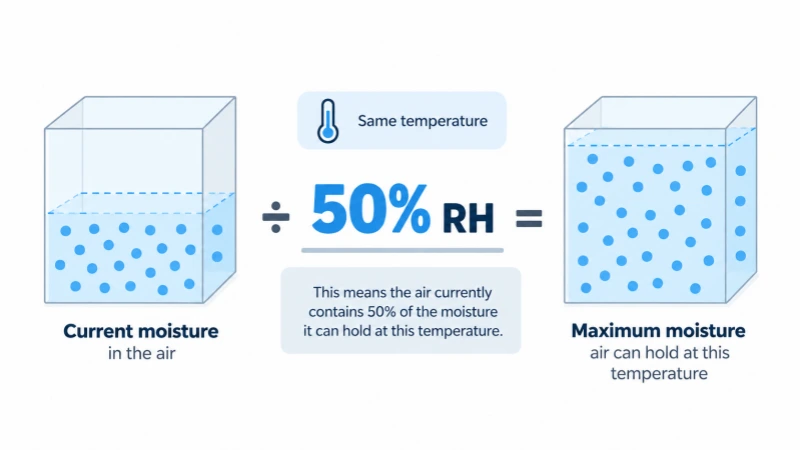
Relative humidity tells you how close the air is to saturation at its current temperature. Put simply, 50% RH means the air contains about half the water vapor needed to reach saturation at that temperature. It does not mean that 50% of the air is water, and it does not tell you the total amount of water in the room.
The relative humidity definition can be written as:
RH (%) = actual water vapor pressure ÷ saturation vapor pressure at the same temperature × 100
The phrase “at the same temperature” is important. When air becomes warmer, more water vapor is required for it to reach saturation, so the RH percentage falls even if no moisture has been removed. When the same air becomes cooler, less water vapor is needed to reach saturation, so the RH rises again.
This is why temperature and RH should always be read together. A humidity percentage by itself can tell you what the air condition is at that moment, but it cannot tell you whether moisture has actually entered or left the room.
A Lower RH Reading Does Not Always Mean the Air Is Drier
For example, imagine a room at 20°C (68°F) and 60% RH. If the air is heated to 25°C (77°F) without adding or removing moisture, the RH falls to approximately 44%. The dew point remains close to 12°C (54°F), which tells us that the amount of water vapor has essentially not changed.
In practical terms, the heater has changed the RH number but has not dried the room. If the same air later cools back to around 20°C, its RH will rise toward 60% again. This is why a warehouse or workshop may show lower RH during the day when heating or machinery raises the temperature, then show higher RH again overnight without any new moisture entering the building.
Relative Humidity, Humidity Ratio and Dew Point: What Is the Difference?
Humidity can be described in several ways, which is one reason the subject often feels more complicated than it needs to be. You do not need to use every humidity measurement for every project. The important point is knowing which number helps answer which question.
Relative humidity is useful when you want to know the condition of a room at its current temperature. Dew point is more useful when you are concerned about condensation on pipes, walls, products or equipment. Humidity ratio is useful when you want to compare how much moisture different air streams are carrying, such as indoor air and outdoor ventilation air.
| Measurement | What it means in simple terms | When it is useful |
|---|---|---|
| Relative humidity, %RH | How close the air is to saturation at its current temperature | Checking the condition of a room or storage area |
| Absolute humidity, g/m³ | Water vapor contained in a volume of air | Describing moisture per unit volume |
| Humidity ratio, g/kg dry air | Water vapor compared with the mass of dry air | Comparing moisture carried by different air streams |
| Dew point, °C or °F | The temperature at which the current air would start to reach saturation when cooled | Checking condensation risk |
The different humidity parameters are related, but they should not be treated as interchangeable. A simple rule for most commercial and industrial humidity problems is: use RH to describe the room, dew point to understand condensation, and humidity ratio when comparing moisture loads.
Absolute humidity is useful in some technical work, but it is expressed as water vapor per volume of air. Because the volume of air changes as temperature and pressure change, absolute humidity is often less convenient than humidity ratio when engineers compare ventilation or dehumidification conditions.
Why Dew Point Matters When Condensation Appears
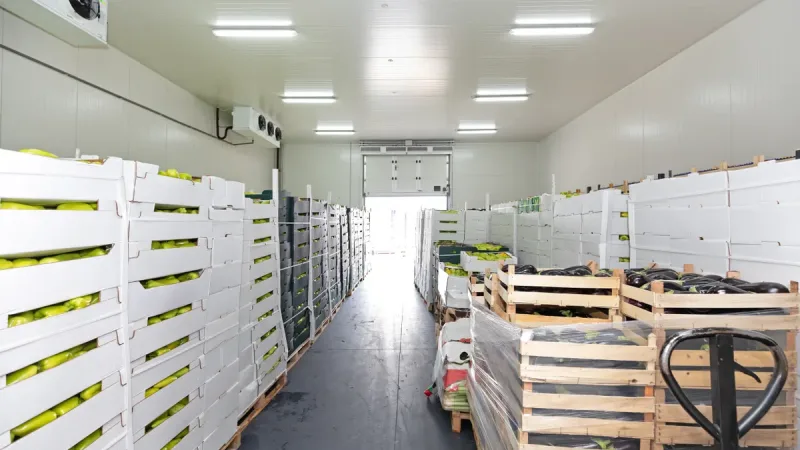
A room does not need to reach 100% RH before condensation can form. What matters is the temperature of the surface compared with the dew point of the surrounding air. If a pipe, wall or product surface becomes cold enough, the air immediately beside it can reach saturation even while the rest of the room is well below 100% RH.
For example, air at 25°C (77°F) and 60% RH has a dew point of approximately 16.7°C (62°F). If a pipe in that room has a surface temperature of 14°C (57°F), the pipe is colder than the dew point. Moisture can therefore condense on the pipe even though the room sensor still shows only 60% RH.
This example also shows why lowering the RH of an entire room is not always the only solution. Depending on the cause, the better response may be to lower the room dew point, improve insulation around the cold surface, reduce humid-air infiltration, raise the surface temperature, or combine several of these measures.
Cold rooms are a good example. Condensation around doors and frost formation can depend on door opening, warm-air infiltration and surface temperatures rather than on a single room-average RH value. These conditions are discussed separately in our guide to cold storage humidity control.
It is also better not to design a system so that the calculated dew point is exactly equal to the coldest allowable surface temperature. Sensors have measurement error, operating conditions change and some surfaces may be colder than the measurement location, so a practical operating margin is normally required.
Measure the Room Before Changing the Humidity Setpoint

Before changing a setpoint or buying a larger dehumidifier, first make sure you know what is actually happening in the room. The humidity sensor built into a machine only measures the air around that sensor. If it is close to the dehumidifier outlet, a heater or another warm area, its reading may be very different from the condition in a cold storage corner or beside a loading door.
Temperature and RH should therefore be recorded together. A single reading tells you what was happening at one moment, while a record taken over several hours or days can show when the problem begins and what may be causing it. If possible, record normal operating events such as production startup, wet cleaning, deliveries, door opening, ventilation changes, overnight cooling and equipment shutdown.
| What you see in the record | What may be happening | What to check first |
|---|---|---|
| RH rises while temperature falls, but dew point changes little | The RH change may mainly be caused by cooling | Compare surface temperature with dew point |
| Dew point rises after doors open or cleaning starts | New moisture is entering the room | Check the moisture source and timing |
| One area is consistently wetter than nearby areas | There may be a local source, cold spot or airflow problem | Compare nearby measurements and inspect the area |
| Two nearby sensors show different readings | Sensor placement, accuracy or response time may be involved | Check calibration and location |
These patterns help narrow down the cause, but they should not be treated as proof on their own. The sensor should be suitable for the expected temperature and humidity range, and it needs time to stabilize after being moved. If a reading looks unusual or will be used for equipment sizing, it is worth checking it with a maintained reference instrument.
Large warehouses and production areas often need more than one measurement location. The center of the room may look acceptable while loading doors, exterior walls, poorly ventilated corners or wet-process areas behave very differently. Measure both the general room condition and the locations where condensation, damp packaging, corrosion or other problems actually occur.
What Indoor Humidity Level Should You Aim For?
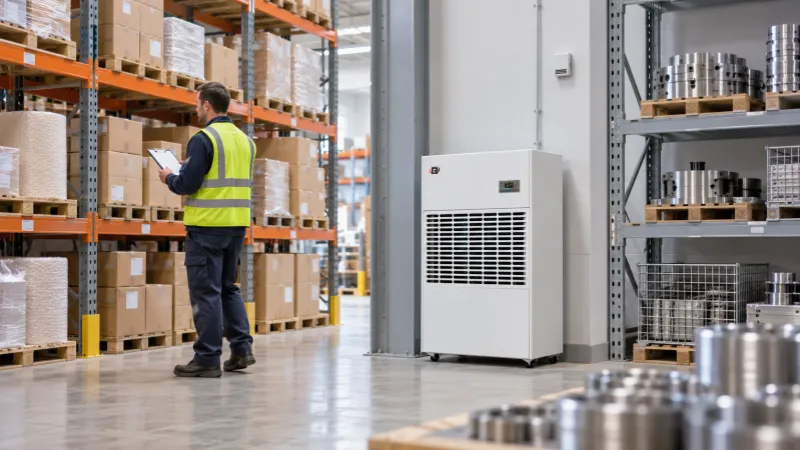
There is no single RH percentage that is correct for every indoor space. For general building moisture and mold prevention, the U.S. EPA recommends keeping indoor RH below 60%, ideally between 30% and 50% if possible. That is useful guidance for occupied buildings, but it should not automatically become the specification for every warehouse, production room or industrial process.
The better question is: What are you trying to protect? A general office may mainly need acceptable indoor comfort and moisture control. A warehouse may need to prevent packaging from softening or metal parts from corroding. A chilled process area may be more concerned with condensation on cold surfaces than with maintaining a conventional comfort RH range.
| What needs to be protected | What should determine the target |
|---|---|
| General occupied area | Building guidance, comfort and project requirements |
| Stored products and packaging | Material requirements and allowable exposure time |
| Cold pipes, walls or equipment | Dew point compared with the coldest surface temperature |
| Sensitive process or component | Approved product or process specification |
For storage applications, warehouse humidity targets should be based on the goods being stored and the room temperature rather than on a generic number found online. Paper, metal parts, food ingredients, pharmaceuticals and other products can respond very differently to the same environment.
It is also useful to separate the normal operating target from the alarm limit. A loading door opening for several minutes may cause a short RH increase without creating the same risk as an elevated RH that lasts all night. For moisture-sensitive products, both the humidity level and the length of exposure can matter.
How to Control Relative Humidity Indoors
Once measurements show that the humidity is genuinely too high, the next step is to understand where the water is coming from. Indoor moisture may enter through outdoor air, open doors, leaks or wet materials, or it may be produced inside the building by people, washing, steam, drying products or industrial processes.
Humidity control normally works best when these loads are dealt with in the right order. First reduce moisture that does not need to be there. Then check whether ventilation and the existing HVAC system are helping or making the problem worse. Dedicated dehumidification can then handle the moisture load that remains.
Correct Moisture Sources That Can Be Reduced
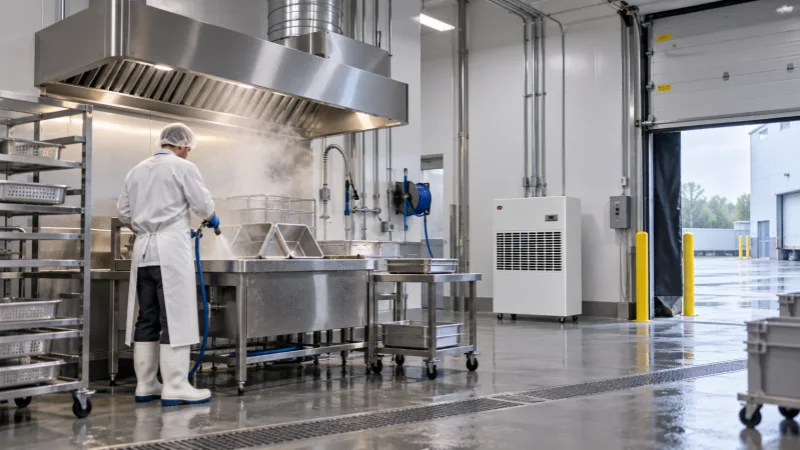
A dehumidifier should not be expected to solve a leaking roof, damaged door seal or continuous water spill. If liquid water is entering the room or wet materials are repeatedly being introduced, repairing or controlling that source usually makes more sense than continuously removing the same moisture after it evaporates into the air.
The same applies to process moisture. If steam or vapor can be captured close to the point where it is produced, the room receives a smaller moisture load. A kitchen hood, local exhaust system or enclosed wet process may therefore reduce the amount of dehumidification required for the rest of the space.
Ventilation and exhaust also need to be considered together. Closing required ventilation simply to lower RH can create other indoor-air or process problems, while excessive exhaust can make a room negatively pressurized and pull humid outdoor air through doors and building gaps. The aim is not to eliminate ventilation, but to control where the replacement air comes from and how much moisture it brings with it.
Will Outdoor Air Make the Room Drier or Wetter?
Outdoor air does not automatically dry a humid room. Whether ventilation helps depends on how much water vapor the incoming air actually contains compared with the room air.
This can seem confusing because outdoor RH alone does not answer the question. On a cold winter day, outdoor air may show 80% RH but still contain relatively little moisture. Once that air enters the building and is heated, its RH may fall significantly. In a hot and humid climate, outdoor air showing a lower RH percentage can still contain much more water vapor and make the indoor moisture problem worse.
For practical ventilation decisions, it is therefore better to compare dew point or humidity ratio rather than simply looking at indoor and outdoor RH percentages. If the incoming air contains less moisture, ventilation can help with drying; if it contains more, the ventilation system adds moisture that must be removed somewhere else.
Why Air Conditioning Does Not Always Control Humidity
Air conditioners can remove moisture because their cooling coils become cold enough for water vapor to condense. The water then drains away, so the system is doing some cooling and some dehumidification at the same time.
The problem is that many air-conditioning systems are mainly controlled by temperature. Once the room reaches its temperature setpoint, the compressor may stop even though the humidity is still too high. This can happen during mild weather, periods of low production or other situations where the room does not need much cooling but outdoor air, people or processes continue adding moisture.
If temperature looks normal but humidity remains high, lowering the thermostat is not always the best solution. Check whether the cooling system is running long enough to remove moisture, whether condensate is draining properly and whether its controls were designed to manage humidity as well as temperature.
When Dedicated Dehumidification Is Needed
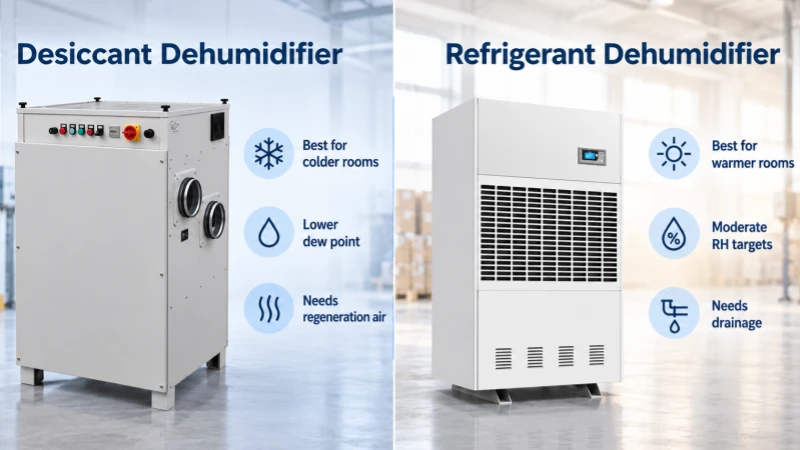
Dedicated dehumidification becomes useful when moisture-source control, ventilation management and the existing HVAC system still cannot maintain the required condition. The two main industrial approaches are refrigerant and desiccant dehumidification.
A refrigerant dehumidifier cools incoming air until water vapor condenses into liquid water. The water is drained away and the drier air is returned to the space. A desiccant dehumidifier uses a drying material to capture water vapor, and that material is then regenerated so it can continue absorbing moisture. ASHRAE’s overview of dehumidification methods explains these different approaches in more detail.
For warm rooms with moderate RH requirements, refrigerant equipment is usually one of the first technologies to evaluate. When the room is cold or the project requires a much lower dew point, desiccant equipment becomes more important. There is no single temperature or RH percentage at which every project should switch technologies, so refrigerant versus desiccant selection should be based on the real operating condition and target.
Another common mistake is to compare dehumidifiers only by their headline L/day rating. That number is measured at a specific temperature and RH, and moisture-removal performance changes as conditions change. A machine tested in warm, very humid air will normally collect more water than the same machine operating in a cooler, drier room.
For this reason, ask the supplier how much water the unit can remove at conditions close to your project. If your target is 20°C and 55% RH, a capacity measured at a much warmer and wetter condition should not be used as though it were the capacity available at your target.
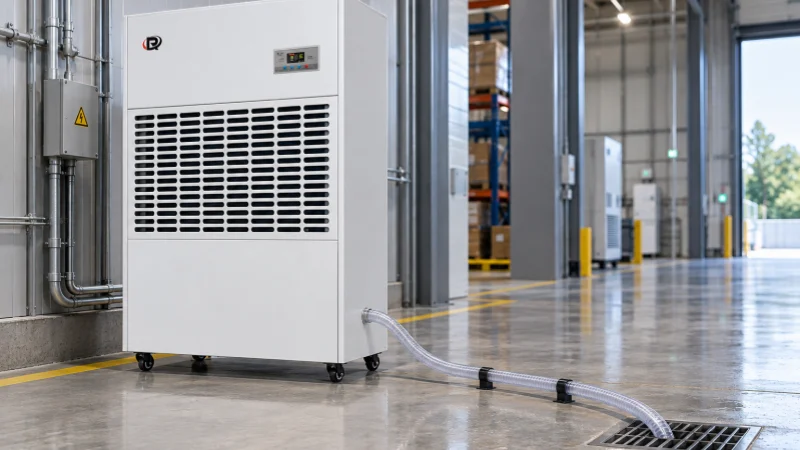
Airflow is also part of the solution. A dehumidifier may have enough nominal capacity but still fail to control the whole room if dry air cannot reach distant zones or humid air cannot return to the machine. The collected water must also leave the controlled area reliably through condensate drainage or, in the case of a desiccant system, the regeneration-air arrangement.
Turn Your Room Data Into a Useful Dehumidifier Enquiry
Once you understand the room condition and likely moisture sources, the next step is to give the supplier enough information to evaluate the project. Room size matters, but floor area alone is not enough to select a dehumidifier.
Imagine two warehouses with exactly the same dimensions. One has almost no outdoor-air ventilation and rarely opens its doors. The other has large loading doors opening every few minutes and an exhaust system pulling outdoor air inside. Their floor areas are identical, but their moisture loads can be very different.
For an initial commercial or industrial dehumidification assessment, try to provide the following information:
| Information to provide | Why the supplier needs it |
|---|---|
| What the room is used for | Helps define what needs to be protected |
| Room length, width and height | Gives the basic room volume |
| Normal operating temperature | Affects RH and dehumidifier performance |
| Current temperature and RH | Shows the existing condition |
| Required temperature and RH or dew point | Defines the target |
| Outdoor or makeup-air volume | Shows how much outside air enters continuously |
| Exhaust airflow or room pressure | Helps identify air being pulled into the room |
| Door size and opening frequency | Shows how often outdoor air enters |
| Wet cleaning or washdown | May create temporary high moisture loads |
| Moisture released by products or processes | May be a major part of the total load |
| Where condensation or dampness occurs | Helps separate local problems from room-wide problems |
| Operating hours | Helps determine how long the system can run |
| How quickly the room must recover | Affects the required moisture-removal rate |
| Available power supply | Determines electrical compatibility |
| Drainage conditions | Determines how condensate can be removed |
A simple room layout can make the discussion much easier. Mark the doors, ventilation and exhaust points, cold surfaces, major moisture sources, existing HVAC equipment and areas where condensation or high RH has been observed. This helps determine not only the required moisture-removal capacity, but also where equipment should be placed and whether one unit can effectively serve the whole space.
After a basic solution has been selected, the next checks include actual dehumidifier performance at the expected temperature and RH, airflow arrangement, installation space, power supply, drainage and control requirements. Final building-service design and local compliance should be completed by the responsible project professionals, while commissioning should verify humidity in the important areas of the room rather than only checking the display on the machine.
For more detail on comparing equipment, see our guide to industrial dehumidifier selection. If you are discussing a commercial or industrial humidity problem with Rinwang, send us the room dimensions, temperature and humidity readings, required condition, ventilation information, door-use pattern and known moisture sources. That gives us a much better starting point than selecting equipment from floor area alone.
Frequently Asked Questions
Can High Humidity Make You Sick?
High humidity can encourage mold and dust mites, which may worsen allergies or respiratory symptoms. The concern is usually the damp indoor environment it creates.
What Happens If Indoor Humidity Is Too Low?
Very low humidity can dry the eyes, skin and airways and increase static electricity. It may also affect moisture-sensitive products and materials.
Does a Fan Reduce Humidity or Just Move Air?
A normal circulating fan mainly moves air and does not remove moisture. Humidity only falls if moist air is replaced or water vapor is physically removed.
Can Humidity Damage Electronic Devices?
High humidity can contribute to corrosion, while condensation creates a greater risk when water forms directly on components. Follow the equipment manufacturer’s environmental limits.
Can Relative Humidity Be Over 100%?
Brief supersaturation above 100% is physically possible, but it is not a normal stable indoor condition. Excess water vapor usually begins to condense.