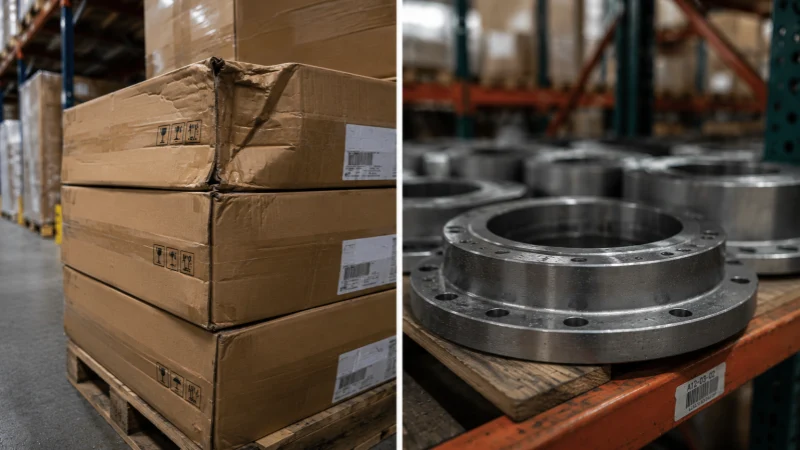
A warehouse humidity target is not a single number. It depends on what you store, how often the building spends time above 60% RH, and what the temperature is doing when the sensors are read. A facility reading 53% at 4 PM can hit 65–70% in the same space at 2 AM with no change in moisture content — and arrive at the morning shift with damp carton corners and a condensation film on lower-rack metal. Setting a useful target means controlling the setpoint, the alarm thresholds, and the sensor layout together.
The problem is not just the number — it is what the number means for your stored goods, how long it stays elevated, and whether your control system is set up to catch problems before damage accumulates.
The Short Answer: 45–55% RH for Most Warehouses
For most general warehouses storing packaged industrial or commercial goods, 45–55% RH is the recommended daily operating target.
| RH Level | What It Means for Your Warehouse |
|---|---|
| Below 30–35% | Too dry — static electricity risk rises; some materials become brittle |
| 40–60% | Acceptable range for most general warehouses |
| 45–55% | Recommended daily operating target for most industrial storage |
| Above 60% | Warning zone — not a safe long-term target for most stored goods |
| Above 65–70% | High-risk zone — investigate moisture sources immediately |
60% RH is a warning threshold, not a goal. Many materials begin showing damage at 60–65%, well before reaching 70%. Warehouses that routinely run at 58–60% are operating with no safety margin.
Damage is defined by duration, not the peak reading. A brief spike to 65% when the loading dock opens is very different from 12 hours at 65% overnight. The most useful daily metric is not the highest RH recorded — it is how many hours the warehouse spent above 60%. Consistently exceeding 4–6 hours per day above 60% RH warrants investigation of the moisture source, even if the daily average looks acceptable.
Recommended Humidity Levels by Stored Goods Type
The 45–55% general target holds for mixed packaged goods. It breaks down for metal parts, electronics, pharmaceuticals, and anything that goes in or out of a cold zone. The right number depends on what you are storing — and if you have a mix, the most moisture-sensitive material in the space sets the ceiling.
| Stored Goods Type | Recommended RH Range | Daily Setpoint | High-RH Alarm | Key Monitoring Point | Standard Reference |
|---|---|---|---|---|---|
| General industrial / mixed packaged goods | 40–60% | 50% | 60% | Hours per day above 60% | Engineering baseline |
| Corrugated boxes, paper packaging, labels | 45–55% | 45–50% | 55–60% | Box stack compression strength (BCT) | TAPPI T402 |
| Steel parts, molds, cast iron components | ≤40% at stable temperature | 40–45% | 50–55% | Surface temp vs. dew point gap; condensation film on arrival batches | Electrochemical corrosion threshold |
| Aluminum and non-ferrous metals | ≤50% | 45% | 55% | Surface condition on long-duration storage batches | Material passivation layer properties |
| Electronics in sealed moisture barrier bags | 30–60% | 45–55% | 60% | Also set low-RH alert at 30–35% for ESD risk | IPC/JEDEC J-STD-033 |
| Unsealed moisture-sensitive devices (MSL 3+) | <10% (critical: <5%) | Dry cabinet storage only | — | Popcorn effect risk during downstream reflow soldering | IPC/JEDEC J-STD-033 |
| Dry food ingredients, powders, bulk materials | Below 60% | Per product specification | 60% | Clumping and caking in hygroscopic materials | Product specification takes priority |
| Pharmaceuticals and medical supplies | Per product label / QA standard | Per product label / QA standard | Per quality system | Deviations must be documented — compliance is non-negotiable | WHO GDP (TRS 957 Annex 5); USP <1079> |
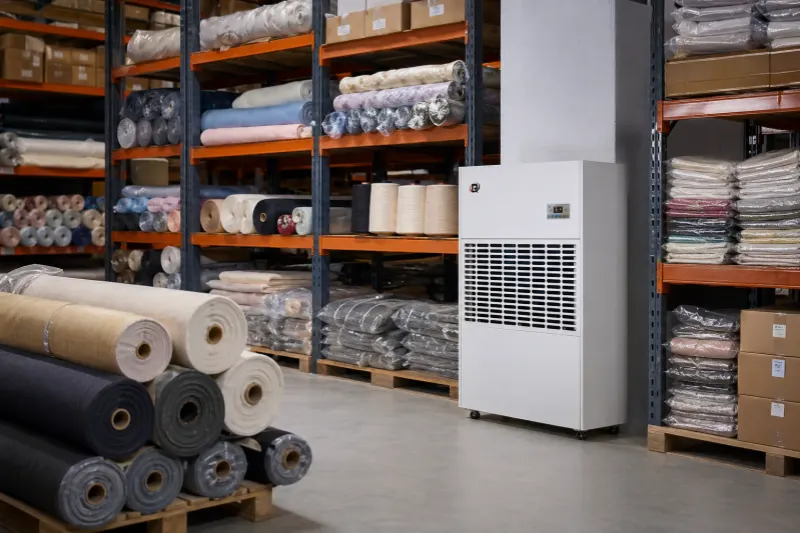
| Textiles, leather, wood products | 45–55% | ~50% | 60% | Moisture absorption and dimensional change; daily RH fluctuation ideally within ±5% | — |
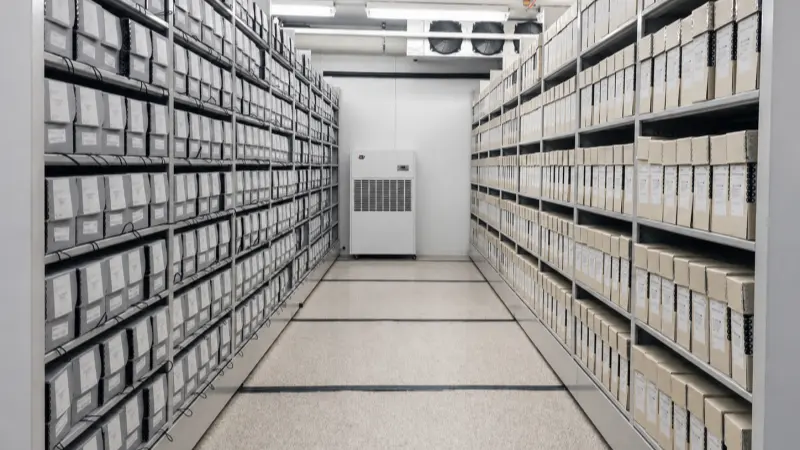
| Archive documents and paper records | 35–50% | 40–50% | 55% | RH stability matters more than the absolute level | — |
| Cold storage / refrigerated warehouse | Product-specific | Manage by dew point | — | Condensation on walls, floors, and product surfaces; frost on equipment | See RH vs. Dew Point section below |
These are engineering reference ranges. They do not replace product labels, safety data sheets, GMP requirements, HACCP plans, ISO certifications, or insurance and audit requirements. For pharmaceuticals, food, and precision materials, the product specification and quality system take priority.
Three product types in this table have requirements that go beyond the RH number:
Electronics storage — Most electronics warehouses hold both sealed inventory and open or partially consumed reels of MSL-sensitive components. These two populations need different humidity conditions, and a single zone setpoint serves one at the expense of the other. Humidity control for electronics storage environments covers how to structure separate zones, which equipment configurations suit each, and how to manage the transition risk when components move between them.
Pharmaceutical and medical supplies storage — The table does not assign a specific RH number to pharmaceutical storage because none applies universally. The actual requirement for any product is its label claim and validated storage condition — typically expressed as a temperature/RH pair such as 25°C / 60% RH for ICH Zone II, or 30°C / 65% RH for Zone IVa. A warehouse hitting 58% RH but running at 28°C may be outside the validated range even if the humidity number looks safe. Temperature and humidity must both be controlled and documented. Choosing a dehumidifier for pharmaceutical storage covers what WHO Good Distribution Practice requires for equipment selection and documentation.
Textiles, leather, and wood products — These materials are sensitive to humidity in both directions. Above 60% RH, natural fibers absorb moisture, adhesive seams soften, and mold establishes on undyed or loosely woven surfaces. Below 30%, leather cracks, wood joints open, and woven fabrics lose flexibility. The practical target is stability within 45–55% RH with daily fluctuation kept within ±5% — a swing from 45% to 55% within a single day stresses dimensional-sensitive materials nearly as much as a sustained exceedance. The early warning signs of humidity damage in textile storage differ by material type and appear gradually, making continuous logging more reliable than periodic spot-checks.
Why RH Alone Is Not Enough in Some Warehouses
For most general ambient-temperature warehouses, monitoring relative humidity is sufficient. In warehouses with loading docks, cold zones, or significant overnight temperature drops, RH gives an incomplete picture — and sometimes a misleading one.
Why RH Rises When Temperature Falls
Relative humidity measures how full the air is with moisture relative to what it could carry at that temperature. When temperature drops, RH rises automatically — even if no moisture was added to the space. A warehouse reading 52% RH at midday can push to 65–70% in the same area at 2 AM when temperatures fall by 4–5°C, with no change in actual moisture content. A control system targeting only the RH setpoint may run unnecessarily and miss the real condensation risk.
What dew point tells you instead
Dew point is the temperature at which condensation begins forming on surfaces. It does not change when air temperature changes — only when actual moisture is added or removed. The engineering rule is direct:
If any surface in your warehouse is colder than the air’s dew point, condensation will form on it — regardless of what the RH sensor reads.
Air dew point should be kept at least 2–3°C below the coldest surface temperature in the storage area. In metal parts warehouses and cold chain transition zones, this is the parameter to manage.
Five Situations Where RH Alone Fails
| Situation | Why RH Alone Does Not Catch It |
|---|---|
| Metal parts warehouse | Steel surface temperature drops below dew point even when ambient RH appears acceptable |
| Loading dock entry zone | Warm humid outdoor air hits cold internal surfaces and condenses before any zone sensor registers a change |
| Cold room entrance and buffer area | Temperature gradient creates local condensation zones that a centrally positioned sensor misses entirely |
| Overnight temperature drop | Surfaces cool faster than air; moisture forms on racks, floors, and outer packaging before morning |
| Coastal or tropical location | High ambient absolute humidity keeps dew point close to surface temperatures year-round |
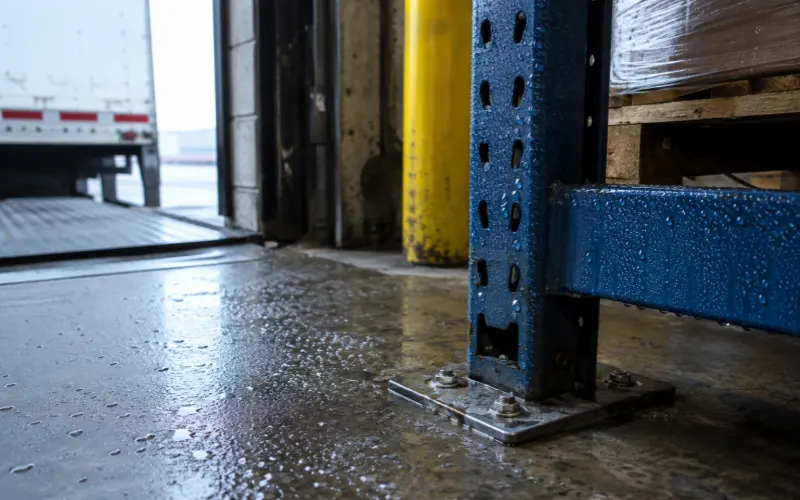
At loading dock entries, this shows up as wet concrete floors in the morning, frost on lower rack levels near the doors, and damp corners on cartons that arrived overnight. In coastal and high-humidity facilities we work with, the most persistent RH exceedances occur not during loading hours but in the early morning window — after overnight temperatures have fallen and before the first door opens. These are dew point events. Diagnosing and stopping loading dock condensation starts with surface temperature measurement, not adjusting the zone RH setpoint.
For cold storage and refrigerated warehouses, RH is not a sufficient primary control metric. The table marks these facilities as “manage by dew point” rather than assigning an RH target because no single RH figure is reliable when surface and air temperatures differ significantly. Cold storage humidity control starts with a dew point map of the facility, not an RH setpoint.
How to Set Your Warehouse Humidity Target
Once you have the right RH range for your stored goods, build a control structure around it. A setpoint without alarm thresholds has no defined response when conditions drift — and conditions always drift.
Start with the product requirement, then set your margin
If the most humidity-sensitive goods in your facility require storage below 60% RH, set the operating target at 50–55% and use 60% as the warning trigger. Running at 59% leaves no room for the overnight rise that happens every time temperatures fall.
Three control levels, not one number
| Control Level | Typical Setting — General Warehouse | Recommended Response |
|---|---|---|
| Operating target (setpoint) | 45–55% RH | Normal operation; continue monitoring |
| High-humidity warning | 60% RH | Check loading activity, door status, ventilation, outdoor conditions |
| High-humidity alarm | 65% RH | Investigate persistent moisture source; check exposed goods condition |
| Critical investigation threshold | 70% RH or visible condensation | Immediate inspection and corrective action |
| Low-humidity warning | 30–35% RH | Check for ESD risk and over-drying of paper, wood, or textiles |
Set Temperature and RH as a Pair
The targets in the storage type table assume typical industrial storage temperatures of 15–25°C. The same RH carries significantly more moisture at 30°C than at 15°C, which means a 55% target in a hot warehouse provides less protection than 55% in a cool one.
For goods with validated or regulated storage requirements, the condition is almost always defined as a temperature/RH pair. ICH Zone II — the stability testing standard applicable across most of Europe, North America, and East Asia — specifies 25°C / 60% RH. Zone IVa, covering tropical markets including South and Southeast Asia, specifies 30°C / 65% RH. A pharmaceutical warehouse hitting 58% RH while running at 28°C is outside the Zone II validated condition even if the humidity number appears compliant. Temperature and humidity setpoints must be controlled and documented together.
For general industrial storage without specific temperature requirements, a practical guide:
| Warehouse Operating Temperature | Practical RH Target Adjustment |
|---|---|
| Below 15°C (unheated warehouse in winter, not refrigerated storage) | 50–60% RH is acceptable; dew point on cold surfaces is the primary risk, not high RH in absolute terms |
| 15–25°C | 45–55% RH — standard operating range; table values apply directly |
| Above 25°C | Target the lower end of the range (40–50% RH); the same RH carries more moisture at higher temperatures, increasing the effective exposure for stored goods |
Zone your warehouse — conditions are not uniform
Receiving areas exchange air with the outdoors every time a door opens. Exterior wall sections run colder in winter and are the first place condensation appears. Dense pallet rack centers develop micro-climates that differ from the main aisle. A single sensor and setpoint leaves most of the building unmonitored.
At minimum, track these zones separately: the loading dock and receiving area; the central storage zone; any exterior wall sections; and if you have one, the cold room transition buffer. Each may need its own alarm threshold based on the goods stored there and the temperature profile of that zone.
Audit the Building Envelope Before Adding Capacity
A warehouse with three bay doors opening 40 times a day in a coastal summer climate will not maintain 45% RH without substantial mechanical support. Before adding equipment, audit the building envelope first: door seal condition, dock gap dimensions, panel joint integrity, and floor drainage. Mechanical dehumidification works most efficiently in a well-sealed space. Adding capacity to a building that continuously exchanges air with the outdoors is expensive and rarely sufficient on its own.
Where to Place Humidity Sensors
The most common placement mistake is a single wall-mounted sensor at eye level in the central aisle. This captures the most stable part of the building and misses every high-risk zone.
Sensors should be at the height where goods are stored, not at eye level. In high-bay racking, place sensors at low, mid, and upper rack levels — warm air stratifies upward, so RH near the ceiling consistently differs from RH near the floor. For the zones that matter most:
| Priority Zone | Why It Needs a Dedicated Sensor |
|---|---|
| Loading dock and entry area | Every door opening introduces outdoor air. RH spikes here first and persists longest. |
| Exterior wall sections | Cold walls in winter can drop below dew point even when the central zone reads within range. |
| Dense pallet rack centers | Thermal mass from stacked goods creates micro-climates that do not mix with aisle air. |
| Cold room buffer and transition zone | Temperature gradient generates condensation on packaging and goods moving between zones. |
For large facilities, ISPE environmental mapping protocols provide reference density guidance: one sensor per 100 m² for pharmaceutical, food compliance, and audit-regulated environments; one per 150–200 m² for general industrial storage. Sensors should be spaced 5–10 metres apart in standard arrays, extending to 20–30 metres in very large facilities with documented risk justification.
A common pattern we see in warehouse sensor layouts is over-relying on the HVAC system’s built-in humidity sensor as the primary reference point. That sensor is almost always positioned in the return air path — meaning it reads the average of the whole space after air has been conditioned, not the actual conditions at product level. Use the HVAC sensor as a secondary reference, not the primary alarm trigger.
Do not mount sensors directly in HVAC or dehumidifier airstreams (reads artificially low), facing a loading door (captures every door-opening spike), or near floor drains and standing water (reads artificially high). Always log temperature alongside RH: RH without temperature cannot be used to calculate dew point. Calibrate sensors against a traceable reference on a fixed schedule — every 6–12 months — not only when readings seem off. Sensor verification belongs on the same maintenance schedule as filter cleaning and coil inspection; the full maintenance schedule for industrial dehumidifiers covers each checkpoint with recommended service intervals.
When Your Warehouse Cannot Hold the Target
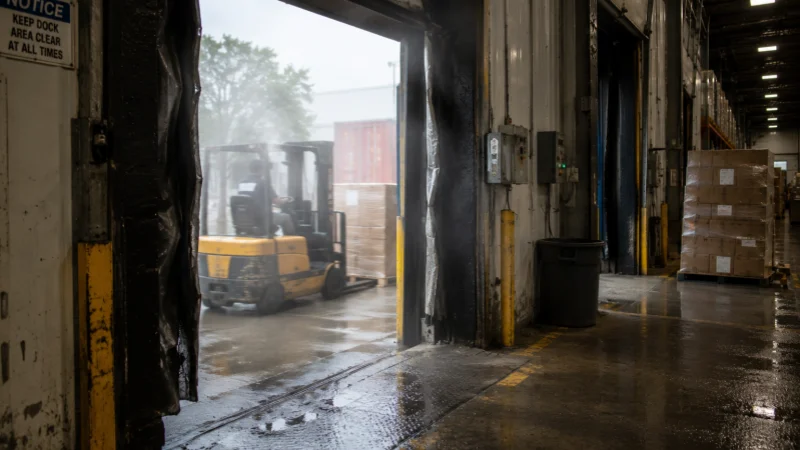
Peak humid season makes target maintenance harder. Outdoor air carries more moisture, every door opening introduces it, and overnight RH rises are larger than daytime readings suggest. In high-humidity climates, periodic manual spot-checks are not adequate during the humid season — continuous automated monitoring with alert thresholds is the only way to catch overnight events before damage accumulates.
Cold dry seasons run the other direction. Heated warehouses drawing in dry winter air can develop RH below 30–35%, increasing ESD risk for electronics and causing wood products and paper packaging to become brittle. A warehouse at 35% RH in a cold month is not automatically failing — check requirements for the most sensitive goods before taking action.
When the warehouse cannot hold its target despite normal seasonal variation, the question becomes: why can’t it hold it? The most common causes:
- High door-opening frequency with no air curtain, vestibule, or dock seal reducing outdoor air ingress
- Building envelope gaps — unsealed panel joints, deteriorated dock seals, poorly insulated roof sections
- Dehumidification equipment undersized for the actual moisture load under operating conditions
- Condensate drainage gaps that allow collected moisture to re-evaporate into the space
Seal the building before adding equipment capacity. A dehumidifier working against continuous outdoor air infiltration through unsealed dock gaps is fighting itself — and most systems that appear undersized are correctly sized for a building that is not properly sealed.
If the building is confirmed tight and the moisture load still exceeds current capacity, the next decision is equipment type and sizing. Refrigerant and desiccant dehumidifiers have different performance profiles at different operating temperatures, which matters in warehouses with wide seasonal ranges or unheated zones. Once the type is determined, calculating the right capacity accounts for actual door-open cycles and moisture load, not just floor area. If the question is whether mechanical dehumidification is the right intervention at all, when to use a warehouse dehumidifier covers the full assessment.
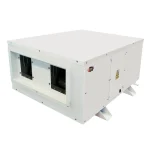
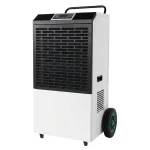
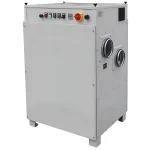
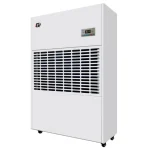
For an overview of units built specifically for warehouse applications, our industrial warehouse dehumidifier range covers configurations from mid-capacity units for controlled storage rooms to high-capacity systems for large distribution facilities.
FAQ
Does OSHA regulate humidity levels in warehouses?
OSHA has no specific humidity regulation for warehouses and relies on the General Duty Clause. ACGIH and NIOSH recommend 30–60% RH for worker comfort, while product-storage requirements come from industry standards rather than OSHA.
At what humidity level does mold start to grow on stored goods?
Most molds require surface water activity above 0.75, corresponding to sustained ambient RH above 70%. On porous materials like cardboard, fabric, or untreated wood, visible colonies can establish within 24–48 hours.
What temperature should a warehouse be kept at?
For general industrial storage, 15–25°C (59–77°F) is the standard operating range, which also aligns with OSHA’s recommended 68–76°F for worker comfort. Cold storage, pharmaceutical, and frozen storage follow product-specific requirements.
How often should warehouse humidity be checked?
Continuous automated logging is the standard — manual spot-checks miss overnight RH peaks that cause most damage. Sensors should log at least every 15 minutes with alarms set for high and low thresholds.
Can high humidity damage products inside sealed packaging?
Yes. Sealed packaging slows moisture penetration but does not block it; over weeks at sustained RH above 70%, moisture diffuses through plastic film, bag seals, and cardboard into the contents.