Tobacco does not remain at one moisture level from harvest to manufacturing. It is dried, reconditioned, processed, dried again, and then stored under controlled conditions. Some stages intentionally add moisture because tobacco that becomes too dry is brittle and difficult to handle, while other stages deliberately remove moisture to reach a required finished specification.
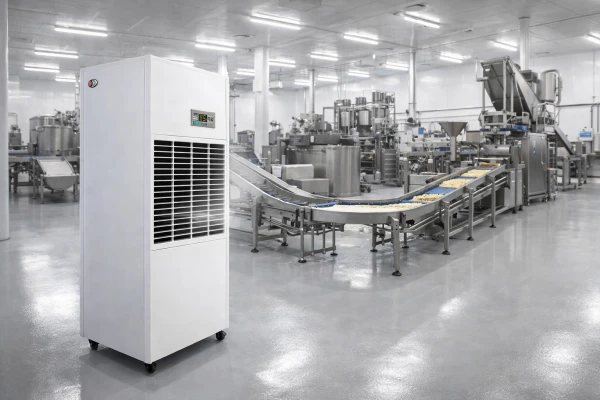
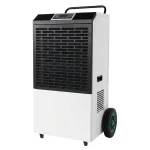
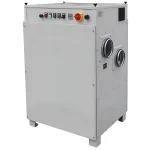
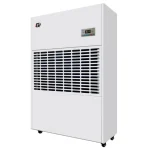
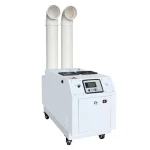
That is why the question “Does tobacco need a dehumidifier?” is too broad to be useful for equipment selection. A tobacco facility may require humidification in one part of the process and dehumidification in another, while a storage warehouse may require either depending on the tobacco moisture target, storage temperature, local climate and the moisture entering the room. Where excess environmental moisture is the actual problem, an industrial dehumidifier should be selected from the required room condition and moisture load rather than from the application name alone.

How Tobacco Moisture Changes During Processing
The moisture target changes several times before tobacco reaches long-term storage. In flue-cured tobacco, for example, curing can leave the leaf extremely dry and too brittle for normal handling. According to NC State Extension’s guidance on flue-cured tobacco ordering, cured leaf at the end of the curing process can be essentially at zero moisture, making moisture addition necessary before proper handling and market preparation. Before threshing, the tobacco may be conditioned again so that the stem can separate from the lamina without excessive breakage, while redrying later brings the material back to its specified finished moisture before storage.
| Stage | Typical moisture condition | Main purpose |
|---|---|---|
| Green leaf | Roughly 80–85% moisture | Starting condition before curing |
| After flue-curing | Extremely dry and brittle | Curing removes most of the original water |
| Order / case | Commonly around 14–18% moisture | Restore flexibility for handling |
| Conditioning before threshing | Commonly around 17–22% moisture | Support stem and lamina separation |
| Finished redried tobacco | Commonly around 11.5–13% moisture | Finished condition before storage |
| Storage / ageing | Maintain the specified product moisture | Prevent unwanted moisture gain or loss |
| Factory processing | Varies by operation | Maintain processability and product stability |
This sequence is important because different equipment performs different jobs. Curing barns and redrying lines actively change the moisture content of the tobacco as part of the production process, while an industrial room dehumidifier normally controls the surrounding air so that already processed tobacco does not move away from its intended condition. A room dehumidifier should therefore not be treated as a replacement for dedicated tobacco curing or redrying equipment.
Why Tobacco Storage RH Cannot Be One Fixed Number
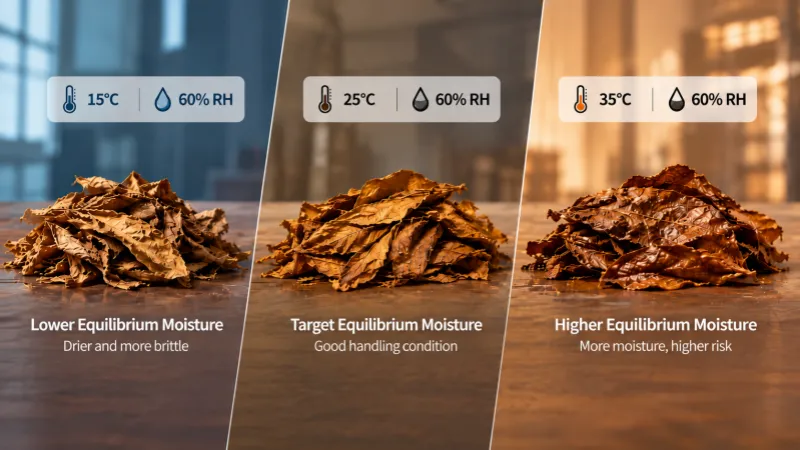
Tobacco is hygroscopic, which means it absorbs or releases water according to the condition of the surrounding air. Given enough time at a stable temperature and relative humidity, tobacco tends toward an equilibrium condition determined by the interaction between the product and its environment. A 2025 Scientific Reports study on redried tobacco storage found that ambient RH in controlled-atmosphere storage was significantly related to tobacco moisture content, temperature and nitrogen concentration, illustrating why RH cannot always be interpreted independently of the storage condition.
For this reason, a statement such as “11–13% tobacco moisture requires 60–70% RH” should not be treated as a universal design rule. Published guidance for some cigarette-production and exposed cut-tobacco storage areas does use approximately 60–70% RH, but those figures do not automatically apply to every redried-leaf warehouse, bale store or ageing facility. The correct sequence is to establish the tobacco moisture specification first and then determine the air condition required to maintain it at the intended storage temperature.
This distinction matters directly to equipment selection. If a warehouse specification simply states “maintain 60% RH” without connecting that number to the product moisture requirement, tobacco type and storage temperature, the dehumidifier may control the room accurately while still failing to maintain the desired condition of the product.
Where to Humidify and Where to Dehumidify
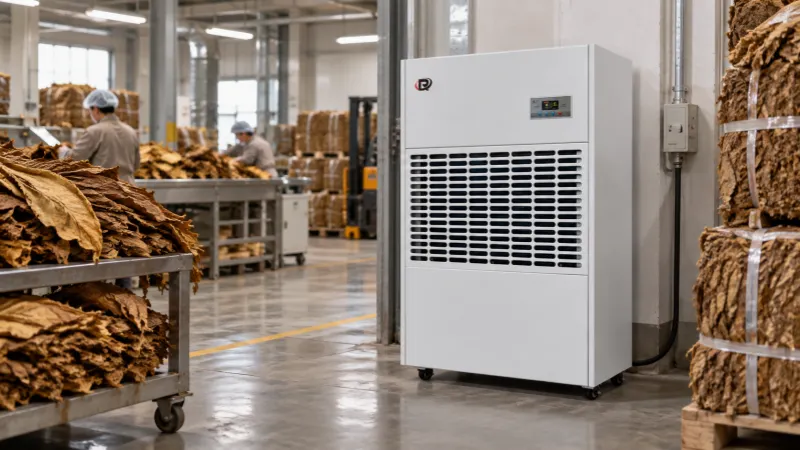
A tobacco facility is better divided according to what each process is trying to do with moisture rather than by assuming that some rooms are simply “wet” and others “dry.” Ordering after curing and conditioning before threshing are intentional moisture-addition steps, while redrying is a dedicated process-drying operation. Storage and ageing are different again because their purpose is not to keep removing water but to prevent the finished tobacco from drifting away from its required equilibrium condition.
| Stage or zone | Moisture-control objective | Typical solution |
|---|---|---|
| Curing barn | Remove large quantities of moisture from green leaf | Dedicated curing / drying equipment |
| Ordering after curing | Restore flexibility to dry tobacco | Humidification |
| Conditioning before threshing | Add moisture for mechanical processing | Steam / humidification |
| Redrying line | Bring tobacco to specified finished moisture | Dedicated process equipment |
| Redried tobacco warehouse | Prevent unwanted moisture gain or loss | Humidification or dehumidification depending on room condition |
| Ageing warehouse | Maintain stable long-term equilibrium | Environmental humidity control |
| Factory tobacco buffer | Prevent moisture drift before production | Humidity control according to process and climate |
| Casing / softening | Increase moisture and flexibility | Humidification |
| Static-sensitive paper areas | Avoid excessively dry air | Maintain a minimum RH |
The key point is that storage is not automatically a dehumidification application. A warehouse in a tropical or very humid climate may receive a continuous moisture load from ventilation, door openings and air leakage, so active dehumidification is necessary. The same tobacco stored during a cold, dry season may instead lose moisture to the air and require humidification. The product target remains the same; what changes is the direction in which the environment is trying to move it.
When Tobacco Storage Actually Needs Dehumidification

Dehumidification becomes the correct tool when moisture entering the storage space would otherwise keep the room above the condition required to protect the tobacco. In practice, this moisture can enter through humid outdoor air leaking through the building envelope, ventilation or make-up air, frequent loading-dock openings, movement of material between outdoor and indoor areas, wet-season weather or other internal sources. These are common warehouse humidity control problems, and identifying which source dominates is important before deciding how much dehumidification capacity the facility actually needs.
In these conditions, tobacco gradually absorbs water from the surrounding air because it is hygroscopic. The real problem is therefore not simply that the RH reading on the wall is high; it is that the product moisture begins to move away from specification. The dehumidifier must remove enough water from the room air to stop that movement and maintain the required equilibrium condition.
This is also why tobacco storage does not automatically mean desiccant dehumidification. Commercial raw-tobacco storage projects can use condensation or refrigerant dehumidifiers successfully when the warehouse operates at moderate temperatures and moderate RH targets. The technology has to match the actual temperature, dew point and moisture load rather than the fact that tobacco happens to be stored in the room.
Too Much and Too Little Moisture Both Cause Problems

Excessive moisture is the more obvious storage risk. As tobacco absorbs water, the likelihood of microbial deterioration, heating, mould and related quality losses increases. Post-harvest guidance for flue-cured tobacco shows that deterioration becomes much more serious as moisture rises into the low-20% range and beyond, so a humid warehouse can create significant risk if the surrounding air continually pushes the tobacco upward from its intended storage condition.
However, lowering RH as far as possible is not the correct solution. Tobacco that loses too much moisture becomes brittle, causing more breakage and fines during handling. In facilities with strong seasonal variation, this can create a control problem: a dehumidifier may be essential during a humid summer but unnecessary during a dry winter. If the same aggressive RH setpoint is used throughout the year, the system can solve the wet-season problem while creating an over-drying problem later.
A tobacco-storage control strategy should therefore maintain an acceptable operating band rather than follow the assumption that lower RH is always safer. The upper limit protects against excess moisture gain, while the lower limit protects against brittleness and handling loss.
Long-Term Ageing Requires Stable Control
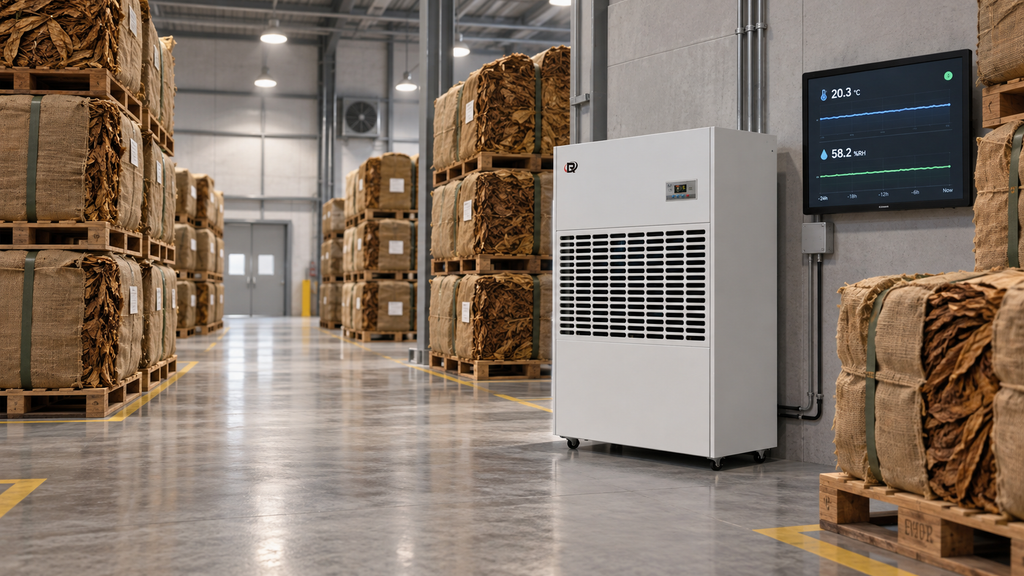
Long-term ageing makes control stability more important because tobacco may remain in storage for months or years. A short humidity excursion in a temporary buffer area and an unnoticed deviation in a long-term ageing warehouse do not carry the same operational consequences. Small environmental differences maintained over long periods can eventually create meaningful changes in the stored tobacco.
For that reason, ageing facilities should be designed around maintaining the required equilibrium condition rather than simply drying the room. In a humid climate this may require regular or continuous dehumidification, while a dry season may require much less moisture removal or even humidification. The equipment and control system should therefore be capable of stable automatic operation across the expected seasonal range.
Monitoring becomes especially important in this application. Temperature and RH trend recording, high-humidity alarms, equipment-status monitoring and drain-failure alarms can reveal a developing problem before it affects a large inventory. Where product moisture is critical, room RH should also be considered together with direct tobacco moisture measurements rather than treated as the only quality indicator.
Humidity Control Inside a Cigarette Factory
A cigarette factory contains multiple humidity zones, and the target can vary substantially from one operation to another. Casing, softening, stemming, tobacco storage, cigarette production and paper handling do not all require the same environmental condition. Published tobacco-production humidity guidance from Condair describes primary production, tobacco stores, filter production and cigarette manufacturing as separate humidity-control zones, reinforcing the need to define the process requirement before applying humidification or dehumidification to the surrounding space.
Paper and filter-handling areas create another constraint because excessively dry air increases electrostatic problems and can affect dimensional stability and web tension. This means a dehumidifier installed for one humid process area should not be allowed to pull nearby static-sensitive areas below their minimum acceptable RH.
For an industrial dehumidifier supplier, the most relevant factory applications are usually raw or redried tobacco storage, ageing rooms, temporary tobacco buffers, humid-climate warehouses and production zones where the actual ambient moisture load remains above the process target. Other parts of the same plant may be primarily humidification applications, which is why the facility should be divided into humidity zones before equipment is selected.
Tobacco Dust and the Equipment Environment
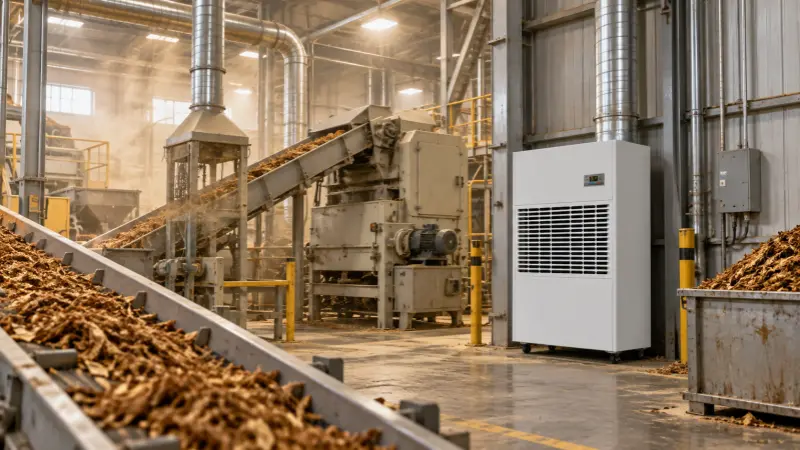
Tobacco processing can generate combustible organic dust, particularly around threshing, stemming, cutting and similar mechanical operations. This creates an equipment-selection issue that is separate from the RH requirement itself. A documented OSHA inspection of a tobacco-processing facility identified serious fire and explosion hazards associated with accumulated combustible tobacco dust.
That does not mean every dehumidifier used in the tobacco industry automatically needs an explosion-proof specification. The facility should first determine whether the intended installation location is part of a dust-hazard area through its own hazard analysis and applicable local requirements. The equipment supplier can then review the necessary motor, electrical components, enclosure protection, controls, filtration and installation arrangement. Dehumidification equipment should complement proper dust extraction and housekeeping rather than being treated as a substitute for them.
How to Select a Dehumidifier for Tobacco Storage
Once the project has confirmed that excess environmental moisture is the real problem, dehumidifier selection should begin with the product condition rather than with equipment capacity or warehouse floor area. The tobacco type, processing stage, target product moisture, storage temperature and allowable RH range should first be confirmed. Where the project specification is expressed mainly as tobacco moisture content, the corresponding equilibrium condition should be established before the room setpoint is finalised.
The second step is to establish the design conditions on both sides of the building envelope. The supplier needs the required indoor temperature and RH as well as the expected outdoor wet-season temperature and humidity, ventilation rate, loading schedule and door-opening frequency. Without the outside-air condition and operating pattern, the actual latent load cannot be calculated reliably.
Moisture Load Matters More Than Floor Area

A warehouse should not be sized only by square metres or cubic metres. Two buildings of the same size can have completely different dehumidification loads if one is tightly sealed and rarely opened while the other has constant ventilation and frequent loading traffic.
Outdoor-air infiltration through leaks and uncontrolled openings can create a continuous latent load, while large loading doors may introduce even more moisture during humid weather. Ventilation and make-up air add another predictable load because every cubic metre of humid outside air brought into the room has to be conditioned. Incoming tobacco, people, cleaning activities and nearby processes may contribute additional moisture depending on the site.
The required dehumidifier capacity should therefore be based on the combined design moisture load with a suitable operating margin rather than on floor area alone. Reducing uncontrolled moisture entry through better door management, airlocks or envelope improvements can sometimes reduce the required equipment capacity more economically than simply installing a larger machine. For the calculation sequence itself, see our industrial dehumidifier sizing method, which explains how room volume, infiltration, ventilation and internal moisture loads are translated into a required removal capacity.
Refrigerant or Desiccant?
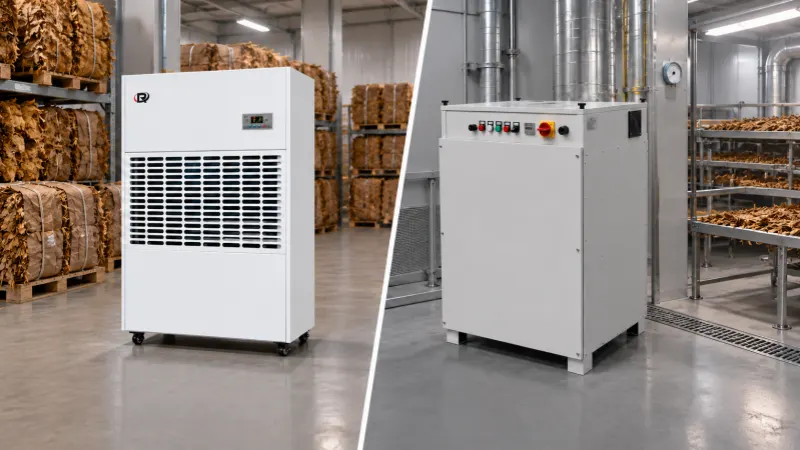
There is no engineering rule that says “tobacco storage means a desiccant dehumidifier.” For moderate-temperature warehouses with moderate RH targets, refrigerant dehumidification is often the more economical choice because condensation systems perform efficiently within that operating range.
Desiccant dehumidification becomes more attractive when the room operates at lower temperatures, when the required RH or dew point is significantly lower, or when the process specifically needs dry air beyond the efficient range of a conventional refrigeration system. The technology decision should therefore be based on temperature, target RH or dew point, moisture load, operating hours and energy strategy rather than simply on the fact that tobacco is being stored. For projects close to the technology boundary, our refrigerant vs desiccant dehumidifier guide compares how the two systems behave under different industrial conditions.
Drainage and Monitoring Should Be Planned Early
A refrigerant dehumidifier serving a large tobacco warehouse can generate substantial condensate during humid weather, so drainage should be planned before the equipment is ordered rather than dealt with during installation. The project should confirm whether gravity drainage is available, whether a condensate pump is required, what pipe slope and drain elevation are available, and how overflow or drain failure will be detected. Our industrial dehumidifier drainage guide covers these decisions in more detail, including condensate-flow estimation, gravity versus pumped drainage, drain routing and overflow protection.
Monitoring should be considered part of the humidity-control system rather than an optional accessory, especially for long-term storage. Multiple temperature and RH sensors can be useful in large warehouses where conditions near doors, exterior walls or densely stacked material may differ from the central control point. Historical trend data also makes it easier to determine whether a problem comes from equipment capacity, door management, seasonal outdoor conditions or another operational change.
Information Needed for Equipment Selection
| Project information | Why it matters |
|---|---|
| Tobacco type and processing stage | Defines the appropriate product condition |
| Target tobacco moisture | Determines what condition the room must protect |
| Required temperature and RH | Defines the equipment operating point |
| Outdoor design temperature and RH | Determines the incoming moisture load |
| Room dimensions and construction | Affects air volume and infiltration |
| Ventilation airflow | Adds a continuous outdoor-air load |
| Door size and opening schedule | Can be one of the largest warehouse moisture loads |
| Incoming material condition | Can change the room moisture balance |
| Operating season | Shows whether dehumidification is seasonal or year-round |
| Dust conditions | May affect electrical and enclosure requirements |
| Drainage availability | Determines gravity or pumped condensate removal |
| Power supply | Determines equipment configuration |
| Monitoring requirements | Important for long-term and unattended storage |
With these inputs, the dehumidifier can be selected from the actual moisture load and operating condition rather than from a generic floor-area estimate.
FAQ
What humidity should tobacco be stored at?
There is no single RH suitable for every tobacco-storage application. Some exposed tobacco-storage and cigarette-production areas operate around 60–70% RH, but redried tobacco warehouses and ageing facilities should be specified according to the tobacco type, target moisture, storage temperature and the relevant equilibrium relationship.
Does tobacco need a humidifier or a dehumidifier?
It can need either depending on the stage and climate. Ordering and several processing steps deliberately add moisture, while storage facilities require dehumidification when humid outdoor air, ventilation, infiltration or other moisture sources would otherwise push the tobacco above its required condition. The same storage operation may require less dehumidification or even humidification during a dry season.
Why is high warehouse humidity a problem for tobacco?
Because tobacco is hygroscopic, sustained high surrounding humidity causes it to absorb moisture. If the product moisture moves far enough above its intended storage condition, the risk of mould, microbial deterioration, heating and other quality losses increases.
Can tobacco be over-dried?
Yes. Excessively dry tobacco becomes brittle and breaks more easily during handling, producing fines and product loss. A properly controlled warehouse therefore needs both upper and lower humidity limits rather than a strategy based only on maximum RH.
Should tobacco warehouses use refrigerant or desiccant dehumidifiers?
Neither technology is automatically correct. Refrigerant dehumidifiers are suitable for many moderate-temperature warehouse conditions, while desiccant systems become more relevant as operating temperature, target RH or required dew point falls. The selection should be made from the actual psychrometric condition and moisture load.
Final Takeaway
Tobacco humidity control is not about keeping every room as dry as possible. The material moves through stages in which moisture is deliberately removed, deliberately added and then held within an acceptable range. Storage and ageing are therefore stability problems rather than simply drying problems, and dehumidification becomes necessary only when environmental moisture is pushing the stored tobacco wetter than its required condition.
For a tobacco warehouse, the correct selection sequence is target tobacco moisture → storage temperature → required RH or dew point → outdoor and internal moisture load → required removal capacity → refrigerant or desiccant technology. Following that sequence produces a more reliable specification than choosing equipment from warehouse floor area or from a generic “tobacco storage RH” alone.