Hospital humidity control is not just about making the air feel comfortable.
In operating rooms, sterile storage areas, CSSD rooms, pharmacies, laboratories, imaging rooms, equipment rooms, and archives, unstable humidity often appears as real site problems: damp packaging, condensation near cold surfaces, wet floors, repeated RH alarms, corrosion risk, and rooms that cannot hold their required operating range. For hospital facility managers, HVAC contractors, MEP engineers, and equipment buyers, the first question should not be “Which dehumidifier removes the most water?”
The better question is: What type of humidity-control solution fits this hospital space, and what should we check before choosing a dehumidifier?
For operating rooms, dehumidification is usually part of the HVAC system. For sterile storage, CSSD, equipment rooms, archives, and other hospital support areas, a dedicated commercial or industrial dehumidifier may be enough. The right choice depends on room temperature, outdoor air load, target RH, dew point, pressure requirements, drainage, and monitoring.
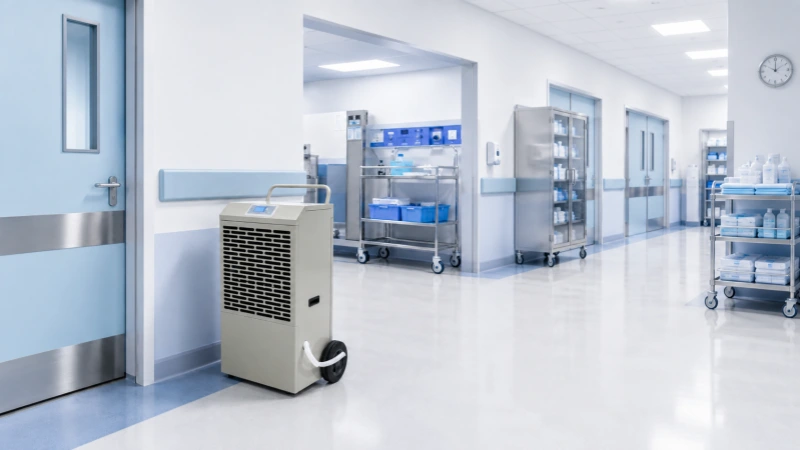
Why Hospital Humidity Control Is Different From General Commercial Dehumidification
A standard commercial humidity problem may start with musty air, damp walls, wet floors, or mold.
A hospital humidity problem is usually more specific. It may affect sterile supplies, surgical comfort, equipment reliability, pressure relationships, and facility records.
High Humidity Creates Visible Site Problems
Facility teams may notice:
- OR temperature reaches setpoint, but RH alarms keep coming back
- Sterile storage packaging feels soft after weekends or humid weather
- Condensation appears near ceiling diffusers, cold ducts, or chilled surfaces
- Wet floors appear near HVAC equipment or drainage points
- Equipment rooms show corrosion around metal parts or electronics
- CSSD or storage rooms recover slowly after door openings or cleaning
These signs usually point to a system issue, not just a room comfort issue.
RH Must Be Controlled Together With Temperature, Airflow, and Pressure
Relative humidity depends on temperature, dew point, outdoor air, airflow, pressure, filtration, and drainage.
In the ventilation table published in the CDC environmental infection control appendix, operating and surgical rooms are listed with outward air movement, minimum outdoor air changes, minimum total air changes, a 30-60% RH range, and a 68-73°F design temperature. For a hospital project, this means humidity control has to work together with airflow, pressure, temperature, filtration, drainage, and monitoring.
| Control Item | Why It Matters in Hospitals |
|---|---|
| RH | Helps prevent damp materials, condensation, and humidity alarms |
| Temperature | Cooler OR conditions can make RH harder to hold |
| Outdoor air | Can bring continuous moisture load into the system |
| Pressure | ORs and sterile areas may require stable pressure relationships |
| Filtration | Humidity control must work with the hospital HVAC filtration path |
| Drainage | Condensate must be removed safely and reliably |
| Monitoring | RH alarms and trend logs help facility teams respond early |
What RH Range Should Operating Rooms Maintain?
There is no single humidity number for every hospital space.
For operating rooms, ASHRAE’s discussion of Standard 170 explains the commonly referenced 20% to 60% RH range, while also emphasizing that temperature must be considered at the same time. This is why a hospital cannot set RH in isolation; the same RH target can require very different supply air conditions at different room temperatures.
Equipment IFUs, local codes, project specifications, and hospital infection-control policies may be stricter.
Why the 60% RH Limit Gets So Much Attention
When RH remains above the required range, hospitals may see:
| Site Condition | What It May Indicate |
|---|---|
| Condensation near diffusers or cold surfaces | Supply air dew point, insulation, or air mixing issue |
| Damp sterile packaging | Storage RH control or recovery problem |
| High RH in equipment rooms | Long-term moisture instability |
| Repeated RH alarms | Control, sensor, drainage, or capacity issue |
| Cool OR but high RH | Temperature is controlled, but moisture removal is not |
The issue is not only the RH number. It is whether the room can hold that number consistently during real operating conditions.
Lower RH Is Not Always Better
Very low RH can create other problems, including static electricity, dry materials, staff discomfort, and conflicts with equipment or supply instructions.
That is why AHRMM’s guidance on OR humidity levels advises hospitals to review the effects on equipment and sterile supplies before reducing operating room RH below 30%. The goal is stable control inside the required range, not maximum dryness.
Which Hospital Areas Commonly Need Dehumidification?
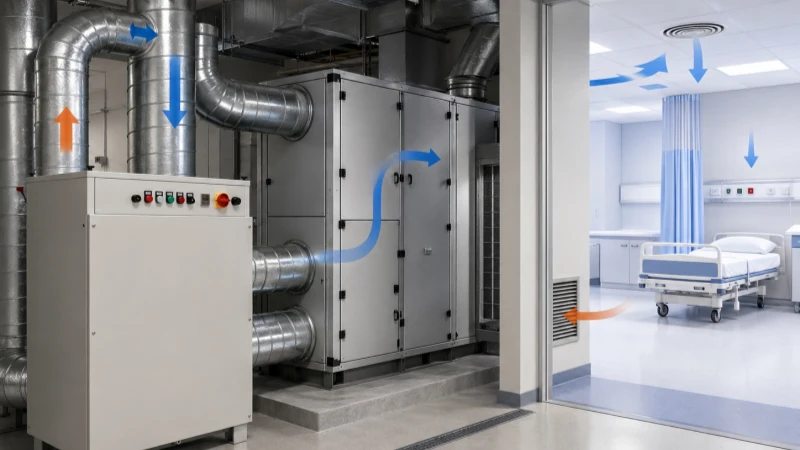
A hospital is not one humidity zone. Different spaces have different moisture sources and risk levels.
Operating Rooms and Surgical Suites
Operating rooms often combine:
- Lower room temperatures
- High outdoor air requirements
- Tight RH limits
- Positive pressure
- Strict filtration
- Continuous monitoring expectations
In many OR projects, dehumidification is integrated into the hospital HVAC system, such as an AHU or DOAS arrangement. A portable room unit should not be treated as the primary OR humidity-control method.
Sterile Storage and CSSD Areas
Sterile storage and CSSD areas are often where humidity issues become visible first.
Common signs include damp packaging, softened cartons, repeated humidity alarms, wet spots near HVAC equipment, and unstable RH after doors open.
For sterile storage humidity control, the system should support stable RH, proper airflow, safe drainage, alarm output, and trend monitoring.
Other Moisture-Sensitive Hospital Support Areas
| Hospital Space | Common Moisture Concern | Dehumidification Focus |
|---|---|---|
| Pharmacy / medicine storage | Moisture-sensitive materials | Stable RH and monitoring |
| Laboratory areas | Equipment protection and condensation risk | Room-level humidity stability |
| Imaging / equipment rooms | Corrosion, electronics reliability | Stable RH and alarms |
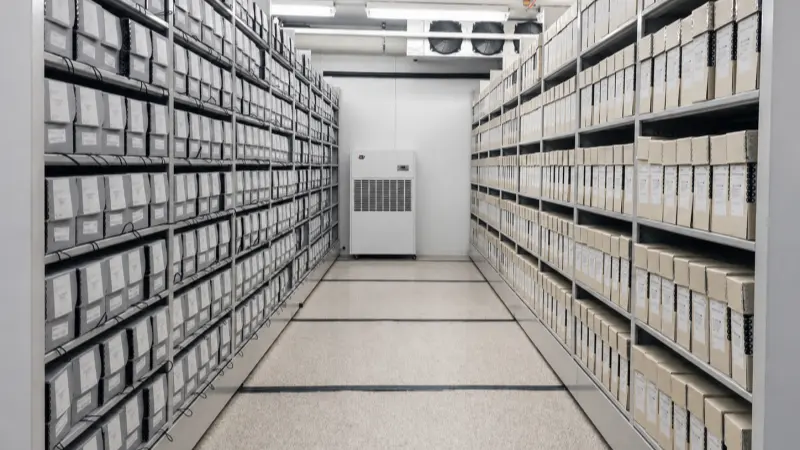
| Archives / records rooms | Mold, paper damage, musty odor | Long-term RH control |
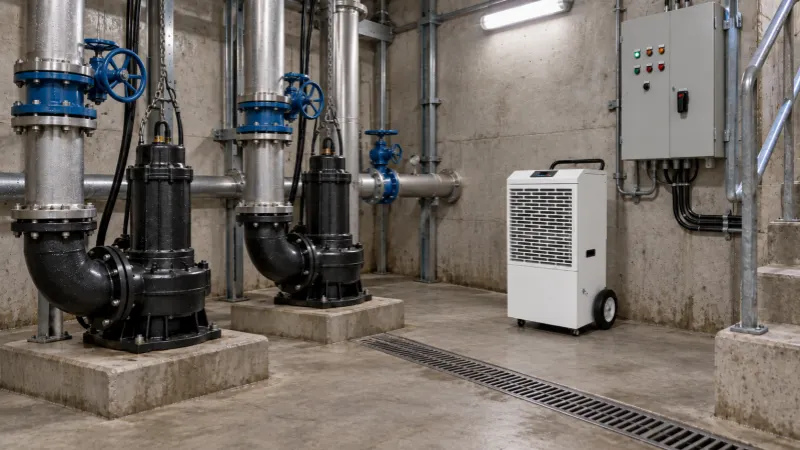
| Plant rooms / lower-level spaces | Wet floors, wall moisture, corrosion | Commercial or industrial dehumidification |
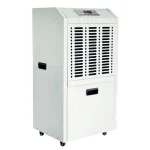
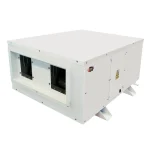
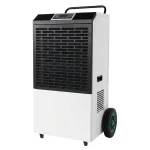
Many support areas do not need the same solution as an operating room. For non-OR spaces with moderate temperature and RH targets, a ducted or floor-standing unit from a commercial dehumidifier manufacturer may be more practical than a low-dew-point desiccant system.
Common Hospital Humidity Problems and What to Check First
Before selecting equipment, start with the site symptom.
| If You See This | It Usually Means | What to Check Next |
|---|---|---|
| OR is cool but RH stays high | Dew point may be too high | Supply air dew point, chilled water condition, desiccant option |
| RH spikes after doors open | Recovery time may be too slow | Airflow, unit capacity, door traffic, control response |
| Sterile packaging feels damp | Storage RH is not stable enough | Sensor location, RH trend, drainage, door use |
| Condensation near diffusers | Surface temperature may be below dew point | Insulation, air mixing, supply air condition |
| Equipment room corrosion | Long-term RH may be too high | Room RH trend, ventilation, dehumidifier sizing |
| Unit runs but RH does not drop | Capacity may not match moisture load | Outdoor air, infiltration, airflow, drainage, controls |
This is often where supplier experience matters. Many buyers send only room size. For hospital spaces, room size is only one input. Outdoor air volume, target RH, room temperature, recovery time, drainage, and BMS requirements usually matter more.
Why Operating Rooms Are Difficult to Dehumidify
Operating rooms are difficult because the HVAC system must control temperature, moisture, airflow, and pressure at the same time.
Cooler Rooms Need Drier Supply Air
Surgical teams may request cooler room conditions. When room temperature drops, the same moisture content in the air produces a higher RH.
The HVAC system may cool the room to the requested temperature, but still fail to remove enough moisture.
That is why OR humidity control often depends on supply air dew point, not only room temperature. HPAC Engineering describes a common OR dehumidification case where an operating room can reach a cooler temperature setpoint, but the air still needs a much lower dew point to hold the desired RH. In that case, adding cooling capacity alone may not solve the problem if the system cannot reach the required dew point.
Outdoor Air Adds Moisture Every Hour
An OR is not a sealed storage room. Outdoor air is brought in for ventilation and pressure control. In humid climates, that outdoor air can carry a large moisture load into the system every hour. A small operating room with high outdoor air load may need more dehumidification capacity than a larger support room with lower ventilation demand.
Pressure Balance Must Stay Stable
Operating rooms are commonly designed to maintain positive pressure relative to adjacent areas. The dehumidification strategy must not disturb supply air, return air, exhaust, or leakage balance. If equipment is added without checking air balance, the room may improve on RH but create a pressure problem.
How to Choose and Size a Dehumidifier for Hospital Spaces
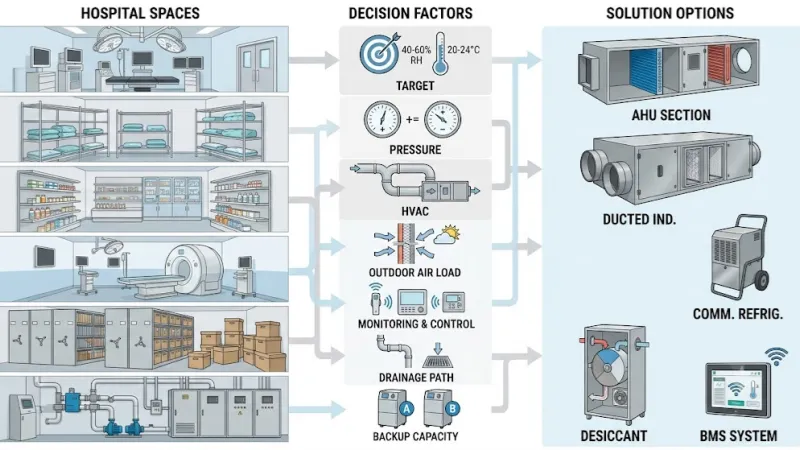
A hospital dehumidifier should be selected from the room condition backward. Start with the space. Define the target air condition. Then choose the equipment type and integration method.
Start With the Hospital Area, Not the Machine
An operating room, sterile storage room, pharmacy, imaging room, archive room, and equipment room should not be sized with the same shortcut.
Ask first:
- Is this a critical clinical space or a support area?
- Does it require positive or negative pressure?
- Is it connected to central HVAC?
- Does it need continuous monitoring?
- What happens if RH goes out of range?
- Does the space need backup capacity?
These questions are part of the same decision process buyers use when they choose an industrial dehumidifier for controlled environments, but hospital spaces usually have tighter consequences when the answer is wrong.
Define RH, Temperature, and Dew Point Together
A target like “50% RH” is incomplete without temperature.
A cooler OR requires drier supply air than a warmer room at the same RH. For hospital HVAC projects, the supplier should know:
- Target RH range
- Room temperature range
- Required dew point, if specified
- Outdoor design condition
- 24/7 or scheduled operation
- Recovery requirement after door openings or cleaning
If the RH alarm happens only during humid weather, after cleaning, or after frequent door openings, the issue may be moisture load and recovery time, not only unit capacity.
Do Not Size by Room Area Alone
For hospitals, square footage is only a starting point.
Hospital sizing should consider:
| Sizing Input | Why It Matters |
|---|---|
| Room volume | Base air volume to condition |
| Outdoor air volume | Major source of moisture load |
| Local climate | Humid climates require more moisture removal |
| Target RH and temperature | Determines required dew point |
| Door openings | Adds moisture and disturbs pressure |
| Adjacent wet areas | CSSD, washing, or cleaning zones can add moisture |
| Operating schedule | 24/7 rooms need more stable control |
| Redundancy need | Critical spaces may need backup capacity |
A simplified way to think about the load is:
Required dehumidification = outdoor air moisture load + infiltration + adjacent moisture migration + process moisture + safety margin
The calculation should be handled by the project engineer, but this framework explains why room size alone is not enough. The same issue appears in many industrial projects, where dehumidifier size depends on moisture load rather than only square meters.
Check Installation Details Before Choosing a Model
Before choosing a hospital dehumidifier, confirm:
- Required airflow
- External static pressure
- Duct connection
- Drainage route
- Condensate pump requirement
- High humidity alarm
- Drainage fault alarm
- Filter pressure alarm
- Sensor fault alarm
- BMS connection
- Modbus or BACnet requirement
- Maintenance access
For ducted projects, external static pressure and drainage route should be confirmed before model selection. A machine can look large enough on paper and still fail in the room if airflow, drainage, sensor location, or control logic is wrong. That is one practical risk behind an over- or undersized industrial dehumidifier.
Desiccant or Refrigerant Dehumidifier: Which Fits Your Hospital Space?
Not every hospital space needs a desiccant dehumidifier.
The better question is: what does the space need the dehumidifier to do?
| Project Condition | More Likely Fit |
|---|---|
| Moderate temperature and moderate RH target | Refrigerant dehumidifier |
| Archive, plant room, equipment room, general storage | Refrigerant or commercial industrial unit |
| Low room temperature | Desiccant dehumidifier |
| Low dew point requirement | Desiccant dehumidifier |
| High outdoor air moisture load | Desiccant or hybrid HVAC solution |
| OR cannot hold RH after temperature is lowered | Check supply air dew point and HVAC design |
| RH issue comes from drainage, sensor, or airflow | Fix system details before oversizing equipment |
When Refrigerant Dehumidification Is Enough
Refrigerant dehumidifiers are often suitable for hospital support spaces with moderate temperature and moderate RH targets.
They are practical when the goal is to reduce dampness, prevent condensation, protect materials, or maintain a stable commercial indoor environment in equipment rooms, archives, plant rooms, and some storage areas.
When Desiccant Dehumidification Should Be Considered
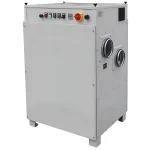
Desiccant dehumidification should be considered when the project involves low room temperature, low dew point, high outdoor air moisture load, strict RH stability, or HVAC systems where cooling alone cannot remove enough moisture.
The equipment decision is similar to the broader refrigerant vs desiccant dehumidifier comparison, but hospital projects add pressure, filtration, alarms, and commissioning requirements.
When the Issue Is the HVAC System, Not Just the Dehumidifier
For operating rooms, a desiccant dehumidifier can support the hospital HVAC system by pre-treating moist air or helping achieve lower dew point conditions.
But OR performance depends on the full HVAC design, controls, airflow, pressure, filtration, commissioning, and local code requirements.
For contractors, distributors, and system integrators working on low-dew-point hospital projects, a desiccant dehumidifier manufacturer can provide the equipment platform, while the final system design remains project-specific.
Before You Request a Quote: Hospital Dehumidifier Project Checklist
A useful quote starts with clear project information.
| Item | Why the Supplier Needs It |
|---|---|
| Hospital space type | Determines risk level and equipment type |
| Room size and ceiling height | Helps estimate room volume |
| Target RH | Defines control objective |
| Temperature range | Affects dew point and equipment selection |
| City / climate | Helps estimate outdoor air moisture load |
| Outdoor air volume | Critical for hospital HVAC sizing |
| Operating hours | 24/7 or scheduled operation |
| Current humidity problem | Alarm, condensation, damp packaging, corrosion, wet floor |
| Voltage / phase | Ensures electrical compatibility |
| Drainage condition | Determines gravity drain or pump requirement |
| BMS requirement | Determines communication and alarm outputs |
| Redundancy requirement | Important for critical spaces |
The next step is not choosing the biggest unit. It is sharing the room type, target RH, temperature, airflow, climate, voltage, drainage condition, and control requirements.
With those details, Rinwang can help review whether the project is better suited for a commercial refrigerant unit, an industrial ducted unit, a desiccant dehumidifier, or a custom HVAC-integrated solution. Send your hospital space type, target RH, temperature range, outdoor air volume, voltage, drainage condition, and BMS requirements to get a preliminary dehumidifier selection for your project.
FAQ
Can a Portable Dehumidifier Be Used in an Operating Room?
A portable unit should not be treated as the primary method for operating room humidity control. OR humidity control usually depends on the central HVAC system, airflow, pressure, filtration, controls, and commissioning.
What Information Is Needed to Size a Hospital Dehumidifier?
The supplier should know the room type, room size, target RH, temperature range, outdoor air volume, local climate, operating schedule, drainage condition, and whether BMS connection or redundancy is required.
When Should a Hospital Consider a Desiccant Dehumidifier Instead of Adding More Cooling?
A desiccant dehumidifier should be considered when the room can reach the temperature setpoint but still cannot hold RH, when the required dew point is too low for the existing cooling system, or when outdoor air moisture load is the main problem. Adding more cooling may not solve the issue if the system cannot reach the required dew point.
Does a Hospital Dehumidifier Need Medical Certification?
A dehumidifier is usually part of the HVAC system, not a medical device. The key is whether the equipment can meet the project’s HVAC, electrical, safety, control, and documentation requirements. Local regulations and project specifications should always be confirmed.
Should a Hospital Dehumidifier Connect to BMS?
For critical hospital spaces, BMS integration is strongly recommended. Facility teams often need RH trend data, high-humidity alarms, drainage fault alarms, filter alarms, and sensor fault alerts before humidity becomes a larger operational issue.