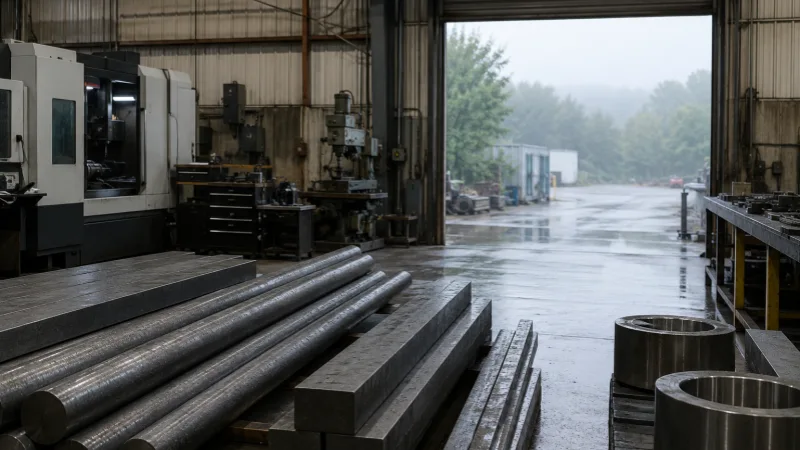
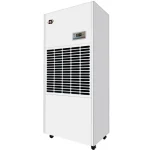
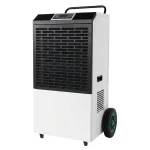
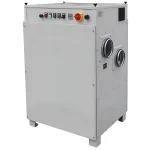
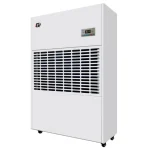
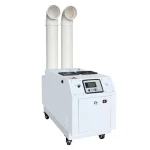
In a cold storage facility, a dehumidifier looks like it should be straightforward. Match the rated capacity to the room. Plug it in. Walk away.
In practice, the buyers we talk to keep running into the same patterns. Frost builds on the coil within hours. Water output drops mid-shift. Room humidity bounces back up between defrost cycles. The compressor sounds fine, but the room never holds its target — slippery floors near the door, damp cartons on the first pallet row, frost on the evaporator above the staging area.
Defrost is not just an anti-icing feature. In a cold-storage dehumidifier, it determines continuous moisture removal, real energy cost, and — less obviously — the survival of the compressor itself.
What Defrost Actually Does in a Cold-Storage Dehumidifier
When a refrigerant dehumidifier runs below roughly 10°C, frost on the evaporator coil is not an exception. It is the normal physical result of cooling already-cold air below its dew point. The ASHRAE Refrigeration Handbook treats this as a planned operating condition in walk-in cooler and freezer applications: any cooling surface below the surrounding air’s dew point will accumulate frost as part of normal duty. The question is not whether frost forms. It is how the unit clears it without stopping moisture control.
Planned defrost is the controlled version of that clearing: the unit detects frost, runs a warming cycle, melts and drains the meltwater, then returns to dehumidifying. Uncontrolled freeze-up is something else — the coil ices over faster than the unit can clear it, airflow stops, and dehumidification stops with it. Repeated thick ice, localized freezing, or a unit that won’t recover between cycles all point to an industrial dehumidifier that’s freezing up for application or airflow reasons, not a defrost design problem.
One thing to set straight before going further: this is the dehumidifier’s own defrost cycle, not the cold room’s evaporator defrost. The refrigeration system’s coils have their own defrost cycle, scheduled and powered separately. Both interrupt their respective functions and both add heat to the room, but they are sized, controlled, and serviced as two distinct systems.
How Defrost Affects Real Moisture Removal Capacity
Two units with the same nameplate L/day can deliver dramatically different real-world output in the same cold room.
Most rated capacity figures — 80 L/day, 150 pints/day — come from standard test conditions, typically 27–30°C and 60% RH. In a 2°C cold room, the dehumidifier’s coil is already operating below freezing just to reach the dew point of the surrounding air. Water that would normally drain off as liquid freezes onto the fins instead. A cold-storage unit doesn’t have occasional defrost events the way a chilled warehouse unit might — it has a defrost duty cycle, woven into normal operation.
The performance chain
Here is what actually happens when frost builds on the coil:
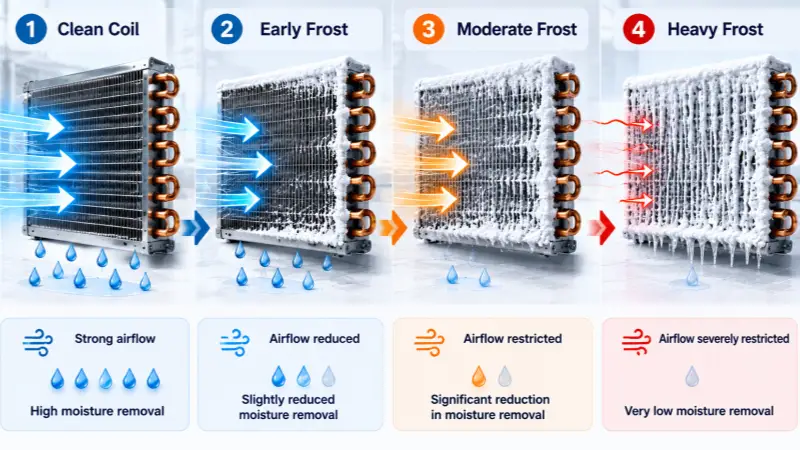
- Frost narrows the gaps between fins → airflow drops
- Frost insulates the coil → heat transfer falls
- Less air, less heat transfer → less water removed per minute
- Runtime extends to compensate → room RH stays unstable
- Frost grows faster as the coil gets colder → defrost is triggered → no water is removed during the cycle
The machine isn’t broken when this happens. It is losing capacity in real time — running normally, sounding fine, but producing less water as the shift goes on. (Low water output in a room well above freezing usually points to a different problem; an industrial dehumidifier that isn’t collecting water covers drainage, refrigerant charge, and sensor causes that don’t involve defrost.)
What this means for procurement
If you compare two units only by nameplate L/day, you can pick the wrong one. The right comparison is net 24-hour capacity at your actual operating condition.
| Question to ask | Why it matters |
|---|---|
| “How much water should a dehumidifier collect in a day?” | Useful framing — but the answer depends entirely on the operating condition |
| “How much water can this unit collect per 24 hours at 5°C / 70% RH, including defrost cycles?” | This is the number that predicts what you’ll actually see on-site |
| “What percentage of operating time does the unit spend in defrost at my room condition?” | A unit losing 15–20% of operating time to defrost is delivering far less than its nameplate suggests |
A unit rated at 150 pints/day under test conditions can deliver as little as 50–75 pints/day at 15°C / 40% RH. In a 2°C cold room with frequent door cycles, two machines with identical nameplate capacity can differ by 20–30% in real 24-hour output — purely because of how their defrost systems are designed.
The Mechanical Stability Risk — Liquid Slugging and Oil Return
Defrost in a cold-storage dehumidifier does more than clear ice. It protects the compressor from two failure modes that don’t appear until the equipment is months into operation — and that buyers rarely ask about.
Liquid slugging
A refrigerant compressor is designed to compress gas. Gas is compressible. Liquid is not.
When the evaporator is heavily frosted, it can no longer absorb enough heat from the air to fully boil the liquid refrigerant inside. Some refrigerant arrives at the compressor still in liquid form. The compressor tries to compress it. Valves, connecting rods, and scroll plates can crack or seize within a single cycle.
Timely defrost keeps the evaporator’s heat transfer intact, ensures refrigerant fully evaporates, and prevents liquid carryover. Without it, you are not just losing dehumidification — you are gradually destroying the compressor.
Oil return at low temperatures
Refrigeration compressors rely on a continuous trickle of lubricating oil that travels with the refrigerant and returns to the crankcase. In cold-storage conditions, two things make this harder.
First, oil viscosity rises sharply at low temperatures. The oil thickens and starts pooling at the bottom of the evaporator and in U-bends. Second, frost-induced airflow loss reduces refrigerant velocity in the suction line, so there isn’t enough flow to carry the pooled oil back to the compressor.
The two mechanisms reinforce each other. Pooled oil films inside the coil add their own thermal resistance, which makes frost build faster, which drops airflow further, which leaves less oil making it home. The compressor crankcase gradually runs lower on lubricant.
This is why several industrial dehumidifier control systems run a forced defrost cycle after a set number of operating hours, regardless of whether the coil actually needs clearing. The primary purpose isn’t ice removal. It’s an active oil-return cycle: a short defrost burst with high-temperature, high-velocity refrigerant scours the pooled oil back toward the compressor. It’s one of the structural reasons how long industrial dehumidifiers last in cold-storage service depends so heavily on defrost design, not just on compressor brand or motor quality.
Two cold-storage dehumidifiers with the same rated capacity can have very different compressor service lives. The one with the smarter defrost cycle is often the one whose compressor lasts longer.
Electric vs Hot-Gas Defrost — The Parasitic Heat Load Problem
The defrost method itself — how the unit warms the coil — has a large impact on both energy cost and cold-room stability. Two methods dominate industrial dehumidifier designs.
Electric resistance defrost uses heating elements next to or inside the coil. They are simple, reliable, and cheap to manufacture. But there’s a thermal penalty buried in how they work: only about 30% of the heat actually goes into melting frost. The other 70% radiates into the cold-room space as parasitic heat load. The room’s main refrigeration system then has to remove it — burning additional energy to undo what the dehumidifier just did. This invisible cost is one of the reasons published numbers on how much electricity an industrial dehumidifier uses can understate the real bill in cold-storage service. A single electric defrost cycle typically runs 20–45 minutes.
Hot-gas bypass defrost uses the compressor’s own hot discharge gas, redirected back through the coil from the inside. Melting happens at the metal surface, contained within the coil itself. Heat doesn’t broadcast into the room. Cycle times drop to 5–12 minutes. Less room temperature swing, less wasted energy, faster return to active dehumidification. The high-velocity gas flow also helps oil return — a secondary benefit when running below freezing.
| Dimension | Electric defrost | Hot-gas bypass defrost |
|---|---|---|
| Typical cycle length | 20–45 min | 5–12 min |
| Useful heat for melting frost | ~30% | ~95% |
| Parasitic heat load to the room | High | Minimal |
| Cold-room temperature swing during cycle | Noticeable | Small |
| Effect on continuous moisture removal | Significant downtime | Minor downtime |
| Compressor oil-return benefit | None | Active scour effect |
On the industrial refrigeration side, Danfoss’s published guidance for cold storage makes the same call from a system-design angle: electric defrost stays popular because it’s cheap to install, but for any cold-room application with real load and run hours, hot-gas defrost is the more economical choice once parasitic heat costs are accounted for. For chilled rooms with light frost loads around 10°C and above, electric defrost can still be acceptable. As room temperature drops and frost loads rise, the case for hot-gas bypass becomes clear in monthly energy bills and room stability data.
Defrost Control Logic — The Variable That Doesn’t Show Up on the Spec Sheet
Two units can use the same defrost method — hot-gas bypass on both, say — and still spend very different amounts of time in defrost. The difference is in the controller: how it decides when to start a defrost cycle, and when to stop it.
There are three common control levels:
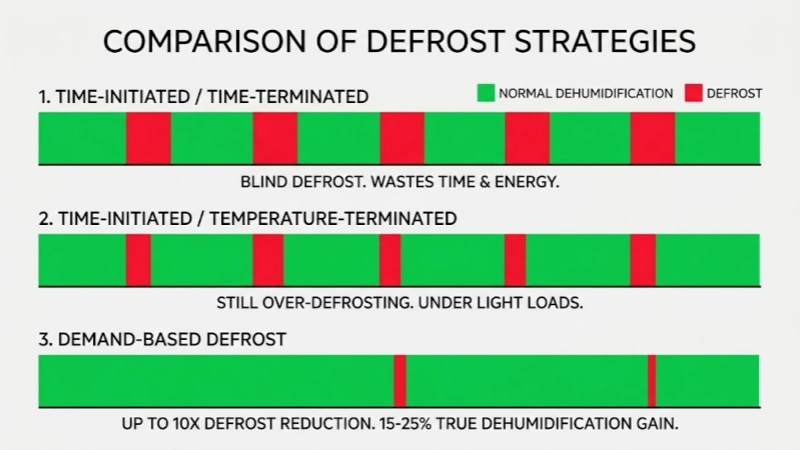
Time-initiated, time-terminated
The unit defrosts on a fixed schedule (for example, every two hours for 20 minutes), regardless of whether frost has actually built up. Cheap and simple. It wastes time on unnecessary defrosts during light load and overruns short defrosts when load is heavy.
Time-initiated, temperature-terminated
Defrost starts on the clock, but ends as soon as a coil sensor reads above freezing. Better than pure timer. It still over-defrosts when load is light.
Demand-based defrost
The unit reads coil temperature, refrigerant pressure differential, or airflow signals to decide when defrost is actually needed and when it’s actually complete. Auto defrost mode of this kind can reduce total defrost time by 50% or more compared to time-based control. Some advanced refrigerant dehumidifier designs report up to 10× fewer defrost cycles than conventional units operating in the same conditions.
The energy savings are well-documented. ORNL’s Demand Defrost Strategies report on supermarket refrigeration found that demand-based controllers cut defrost cycles substantially compared to timer-based controllers in the same conditions — savings that translate directly to refrigerant dehumidifiers in cold-storage service, since the underlying frost mechanics are identical.
This is what hides behind “auto defrost” on a spec sheet — the same two words can mean wildly different controllers.
If two cold-storage dehumidifiers use the same defrost method but different control logic, their real 24-hour output can differ by 15–25%.
What Good Defrost Design Looks Like — and What to Ask Suppliers
A well-designed cold-storage dehumidifier balances two things: defrosting often enough to keep the coil clear, and rarely enough to keep dehumidification continuous. Too little defrost means frost wins. Too much defrost means active drying time gets eaten by recovery cycles.
The table below pairs the design feature to look for with the specific question to ask a supplier. The benchmarks are starting points for a real cold-storage spec discussion.
| What good defrost design includes (with benchmarks) | What to ask the supplier |
|---|---|
| Published capacity curves at 2°C, 5°C, and 10°C — not only at standard test conditions | “Can you send me your rated capacity at 5°C / 60% RH?” |
| 24-hour net capacity figures that already net out defrost downtime | “Does the published capacity number include defrost cycles?” |
| Demand-based defrost initiation (coil temperature or pressure differential), not pure clock-based | “How does the controller decide when to start a defrost cycle?” |
| Hot-gas bypass defrost for rooms below ~5°C; typical cycle length 5–12 minutes | “What’s the expected defrost cycle length at our operating point?” |
| Fan behavior matched to room temperature (running for >0°C rooms, stopped for sub-zero) | “What does the fan do during defrost, and how is meltwater drained at low temperature?” |
| Compressor restart delay of at least 3 minutes after defrost ends | “Is there a compressor protection delay after defrost ends?” |
| Defrost frequency and duration log readable on the controller | “Can we see defrost history during normal operation?” |
| Documented temperature floor (e.g. “minimum 2°C with hot-gas defrost”) | “What’s the lowest room temperature this unit is rated for?” |
If a supplier can’t give clear answers to the right-hand column — with specific numbers — that itself is information about whether they’re working from real cold-storage operating data.
Practical Ways to Reduce Defrost Stress
Once a unit is installed, the operational habits below consistently extend defrost intervals and improve net capacity:
- Keep filters and coils clean. Dirty surfaces cut airflow and accelerate frost.
- Don’t block intake or discharge. Pallets, plastic curtains, and packaging stacked too close to the unit are common offenders.
- Avoid placing the unit in an airflow dead zone. Door corners and aisle ends look convenient, but the unit can’t grab moisture if air isn’t reaching it.
- Inspect drain slope, drain pan, and drain line. Meltwater that refreezes inside the unit creates the next ice problem.
- Coordinate with main refrigeration defrost, washdown, and loading schedules. Two systems defrosting at the same time double the heat load on the room.
- Reduce moisture entry first. Door discipline, air curtains, and vestibule conditioning often do more for net capacity than upsizing the dehumidifier.
These habits target defrost stress specifically. The broader industrial dehumidifier maintenance checklist covers everything else — filter changes, drain line inspection, electrical checks, seasonal servicing.
When Frequent Defrost Means the Application Is Wrong, Not the Equipment
Sometimes the issue isn’t the unit. The defrost system can be working exactly as designed, and still not keep up because the room is asking it to operate outside its design envelope.
Operational symptoms that point this way:
- Net 24-hour output dropping over weeks under unchanged room conditions
- Defrost cycles starting before the previous frost layer has fully drained
- Room RH not recovering between cycles even with capacity headroom
- Drain lines refreezing despite adequate slope and heat tracing
In a 2°C-and-warmer chilled room, this is usually solved by sizing differently or moving to a better defrost design. In rooms approaching or below 0°C with tight dew-point targets, refrigerant dehumidification runs into its physical envelope — and the comparison stops being about defrost optimization. It becomes a refrigerant vs desiccant dehumidifier question, with different trade-offs.
Key Takeaways
- Defrost protects continuous dehumidification. Without it, real capacity collapses within hours of running below the air dew point.
- Defrost affects efficiency and machine life, not just reliability. Parasitic heat load, room stability, anti-slugging protection, and oil-return support all depend on how the unit handles frost.
- In cold storage, compare net 24-hour performance under your actual conditions. Catalog capacity and nominal kWh figures don’t predict what you’ll see on-site.
If your cold room needs stable humidity control near or below freezing, share your room temperature, RH/dew point target, door schedule, and drainage layout with our engineering team — we’ll work out which low-temperature dehumidifier configuration actually fits the load.
FAQ
Why does a dehumidifier go into defrost mode?
When the coil drops below 0°C while pulling moisture from the air, condensed water freezes onto it as frost. Defrost is the cycle that melts that frost off so the unit can keep absorbing heat — and removing moisture.
What does auto defrost mean on a dehumidifier?
The unit decides on its own when to run a defrost cycle, based on coil temperature, airflow, or runtime signals. The label tells you nothing about how good that decision is — a fixed-timer controller and a demand-based sensor both qualify as “auto.”
How often should a cold-storage dehumidifier defrost?
In a stable 2–5°C room with moderate door cycling, 2–6 cycles per 24 hours is normal for a well-controlled unit. More than 10–12 per day points to overload, control-logic mismatch, or moisture entering faster than the unit can handle.
Should the fan keep running during defrost?
For rooms above 0°C, leaving the fan running speeds up melting by circulating warmer air across the coil. For sub-zero rooms (around −18°C and below), the fan should stop — running it pushes meltwater into the room where it refreezes on cold surfaces.
How long should a single defrost cycle take?
Hot-gas bypass: 5–12 minutes. Electric resistance: 20–45 minutes. Significantly longer than that usually means frost has built up beyond normal, drainage is clogged so the unit is melting and refreezing, or the heat source is underperforming.