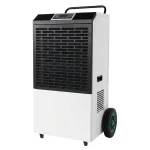
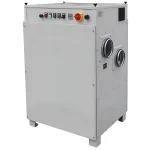
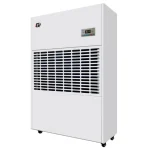
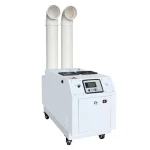
A fitness room can reach its temperature setpoint while mirrors stay fogged, rubber flooring feels tacky, and metal handrails remain damp after a full class. That is a warning that the cooling system has handled temperature but not the moisture load.
The right gym dehumidifier is selected by the control task, not floor area alone. Warm, occupied fitness zones usually need equipment that can respond to peak people and outdoor-air loads. Maple courts need a narrow, stable relative humidity (RH) range across the seasons. Sports spaces with ice or other cold surfaces must control dew point, because condensation begins when the air’s dew point rises above the surface temperature.
These are different engineering problems. Treating all of them as “keep the gym at one RH number” can produce poor equipment choices, uneven control, or unnecessary energy use.
Identify the Moisture-Control Task Before Choosing Equipment
Start by classifying the space according to what must be protected. This prevents a general fitness center, a school gymnasium, and an ice rink from being sized as though they have the same moisture behavior.
| Control task | Typical spaces | Main design variable | Usual first equipment route | Common mistake |
|---|---|---|---|---|
| People-driven moisture control | Weight rooms, cardio areas, cycling rooms, group exercise studios | Peak occupancy, class schedule, outdoor air, and recovery time | Dedicated refrigerant dehumidification is often evaluated in warm spaces with moderate RH targets | Sizing from floor area or average daily attendance |
| Wood-floor stability | Basketball, volleyball, badminton, and school courts | Seasonal RH range and rate of change | Humidification and dehumidification may both be required at different times of year | Treating summer high RH as the only floor risk |
| Cold-surface condensation control | Ice rinks, curling rinks, and mixed-use spaces over chilled slabs | Air dew point compared with the coldest surface | A low-dew-point or desiccant approach may need evaluation | Controlling by room RH alone |
| Source and pressure control | Locker rooms, showers, and aquatic zones | Exhaust, makeup air, pressure relationship, and source evaporation | Correct ventilation and source control first; add dehumidification when the remaining load requires it | Installing a recirculating unit without correcting the air balance |
For general mold prevention, the U.S. Environmental Protection Agency advises keeping indoor RH below 60%, ideally between 30% and 50% where practical. That is a useful screening benchmark, but the EPA moisture guidance is not a universal sports-facility design setpoint. A wood court, an occupied studio, and a cold arena can require different limits.
This application-specific approach also keeps the article distinct from Rinwang’s broader guide to industrial dehumidifiers by application, which compares moisture sources across multiple industries.
Calculate Where the Moisture Enters the Facility
Sweat is only one part of a gym’s latent load. Outdoor air, door traffic, wet cleaning, shower areas, and moisture transferred from neighboring zones can equal or exceed the load generated by occupants.
ASHRAE Standard 62.1 illustrates why outdoor air deserves its own calculation. Its current sports and entertainment table lists a people outdoor-air component of 20 cfm per person (10 L/s per person) for a gym play area, aerobics room, and weight room, in addition to an area component. The adopted edition and local code still need to be checked for each project, but the official ASHRAE ventilation table makes the design implication clear: a crowded class can bring in a large stream of humid outdoor air at the same time that participants are producing moisture.
| Moisture source | Data to collect | Why it changes the design |
|---|---|---|
| Occupants | Peak people count, activity type, class length, and time between classes | High-intensity classes create short, concentrated moisture peaks |
| Outdoor ventilation air | Supply airflow, outdoor design temperature and humidity, and operating schedule | Ventilation can become a major latent load in humid weather |
| Infiltration | Exterior door size, opening frequency, vestibules, and building pressure | Repeated door cycles can overwhelm a design based on a sealed room |
| Showers and locker areas | Exhaust airflow, makeup-air path, door position, and pressure relationship | Moisture may migrate into exercise zones if the wet area is not contained |
| Pools, spas, or saunas | Water surface, operating temperature, covers, and operating hours | Evaporation is continuous and needs a separate load method |
| Cleaning and wet materials | Floor-cleaning schedule, drying time, damp towels, mats, and laundry handling | Moisture can peak when the building is lightly occupied and cooling demand is low |
| Existing HVAC | Coil duty, supply-air condition, fan schedule, and measured latent performance | Existing equipment may already remove part of the load, or may stop too early |
Use the peak design period, not a 24-hour average. A cycling studio that fills for 50 minutes and empties for 10 minutes needs enough moisture-removal and air-distribution capability to recover before the next class. A unit selected from average daily attendance can be too slow even when its daily capacity appears adequate.
Control High-Occupancy Fitness Zones Without Overcooling
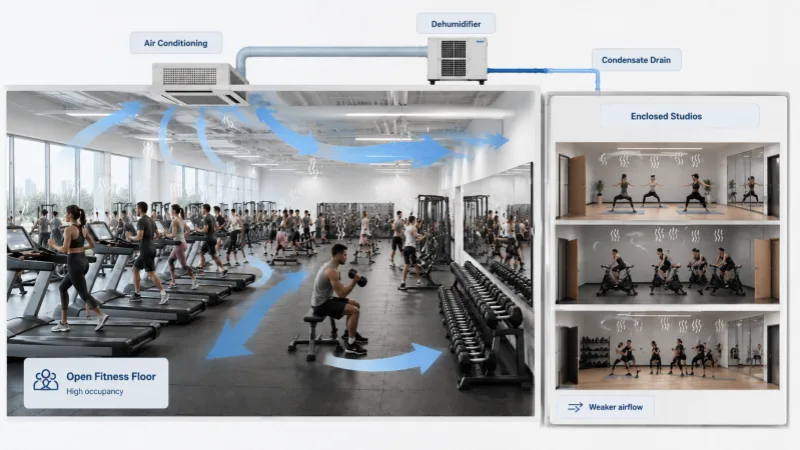
People-driven spaces often have a low sensible heat ratio: a large share of their load is latent moisture rather than temperature change. Standard cooling equipment can therefore reach the thermostat setpoint before it has removed enough water vapor. The result is a room that feels cool but clammy.
The project team should first determine whether the existing air-conditioning or dedicated outdoor-air system can provide the required latent capacity at peak occupancy and during mild, humid weather. If it cannot, dedicated dehumidification can be staged by humidistat, class schedule, or both. The objective is not to run every unit continuously. It is to hold the planned humidity limit and provide a predictable recovery period without overcooling the space.
In a warm fitness room with a moderate RH target, a refrigerant dehumidifier is often the starting point. The equipment cools air below its dew point, drains the condensed water, and returns drier air to the space. However, the final choice still depends on actual temperature, target humidity, ventilation load, and required supply-air condition.
Do not assume that one unit serving an open floor will also control closed studios. Doors, partitions, acoustic treatments, mirrors, and equipment can create weak-circulation zones. A high moisture-removal rating does not compensate for air that never reaches the return inlet.
Protect Maple Courts by Limiting Seasonal RH Swing
Maple sports floors need stability, not simply “lower humidity.” The Maple Flooring Manufacturers Association recommends maintaining indoor temperature between 55 and 75°F and keeping RH within a 15-percentage-point range, using 35% to 50% as its example for optimal performance.
This changes the operating strategy in two important ways.
First, humid summer air can make wood absorb moisture and expand. Dehumidification may be required even when the court is unoccupied or closed for a school break. Turning the HVAC system off for extended periods can expose the floor to wider seasonal swings than it experiences during normal operation.
Second, winter air can become too dry. Dehumidification cannot correct shrinkage caused by low RH; the facility may need humidification instead. A supplier that recommends year-round dehumidification without reviewing the annual climate, heating season, floor specification, and HVAC schedule is solving only half of the problem.
Monitor RH at court level and in representative perimeter zones rather than relying only on a sensor in a return duct. Review the floor manufacturer’s requirements, vapor control below the floor, known leaks, expansion provisions, and the building’s shutdown schedule before equipment is selected.
Use Dew Point When Cold Surfaces Decide Condensation
RH alone does not predict whether a surface will sweat. Condensation occurs when the surface temperature is below the air’s dew point. A mixed-use arena can therefore show an acceptable room RH while a chilled slab, glass panel, steel member, or cold supply diffuser remains wet.
When a sports facility contains ice or another persistently cold surface, define the maximum allowable dew point and the coldest surface temperature. Do not use the general fitness-room setpoint or select equipment only from a catalog’s liters-per-day value.
Rinwang’s existing guide to ice rink and curling rink dehumidifier selection covers that application in detail. For a mixed-use sports facility, keep the gym dehumidifier scope separate from the rink’s low-dew-point system, then coordinate pressure and transfer air between the zones.
The technology decision should also stay condition-specific. A refrigerant system is often efficient in warmer air with a moderate target, while a desiccant system is commonly evaluated for colder conditions or lower dew points. The refrigerant versus desiccant comparison provides the broader decision framework without turning this application article into a duplicate technology guide.
Fix Adjoining Zones Before Adding Room Dehumidification
Some sports-facility moisture problems begin outside the exercise room. A dehumidifier can remove airborne moisture, but it cannot replace required exhaust, repair a leak, insulate a cold surface, or contain pool evaporation.
| Zone or symptom | First action | Where dehumidification fits |
|---|---|---|
| Shower or locker room | Verify exhaust, makeup air, pressure, door transfer, and wet-surface drying | Supplement the corrected ventilation system if the remaining load still exceeds its latent capacity |
| Indoor pool or spa | Calculate evaporation and check corrosion-resistant HVAC design | Use a dedicated pool solution rather than a general gym unit |
| Hot or intentionally humid studio | Define the class setpoint and the post-class dry-down sequence | Evaluate dehumidification for recovery and adjacent-space protection, not automatically for the occupied class |
| Condensation on a roof, window, or duct | Compare surface temperature with dew point; inspect insulation and air leakage | Lower dew point only after the envelope and air path are understood |
| Repeated dampness after cleaning | Review cleaning volume, timing, floor drainage, and fan schedule | Stage dehumidification during dry-down if the HVAC system cannot recover in time |
| One humid corner in an otherwise controlled room | Measure airflow and inspect blocked supply or return paths | Correct distribution before adding capacity |
Aquatic zones are especially easy to misclassify. Pool evaporation, chloramine exposure, air distribution across glazing, and corrosion resistance require a dedicated review. Rinwang’s guide to indoor pool dehumidification should carry that selection intent.
Size a Gym Dehumidifier From the Moisture Balance
A defensible capacity calculation adds the peak moisture entering or generated in the control zone, then subtracts the latent removal that the existing HVAC system can reliably provide under the same conditions.
In practical terms:
Required dehumidification duty = occupants + outdoor air + infiltration + internal moisture + transfer moisture – verified HVAC latent removal
The calculation should use simultaneous design conditions. Do not combine peak occupancy from one hour with an unrelated outdoor condition, or use an annual average when the project must survive a humid design day.
The current ASHRAE load-calculation guidance notes that ventilation makeup air, infiltration, recirculated-air moisture, and internal sources such as showers can all affect latent load. It also explains why air mass and humidity ratio are more reliable than a simple room-volume multiplier. The ASHRAE load-calculation chapter is the appropriate technical basis for a project calculation.
Before comparing models, request capacity at the actual entering-air temperature and RH. A catalog value measured in warm, humid air can be much higher than the same unit’s output in a cooler, drier gym. The rating condition must stay attached to every capacity number.
Rinwang’s general guide to industrial dehumidifier sizing explains capacity units, rating conditions, and the difference between moisture removal and airflow. The gym project should use that method without copying its broad cross-industry sizing tables.
Plan Airflow, Drainage, Noise, and Controls as One System
Moisture-removal capacity answers how much water the equipment can remove. Airflow and distribution answer whether it can reach the entire control zone. Both must be checked.
| Selection item | What to verify | Project consequence |
|---|---|---|
| Capacity | Output at the project’s entering temperature and RH | Prevents selection from an inflated rating condition |
| Airflow | Supply and return path, throw, zoning, and room obstructions | Determines recovery speed and uniformity |
| External static pressure | Fan performance at the proposed duct resistance | Prevents a ducted unit from losing required airflow |
| Supply-air temperature | Effect on occupied comfort and existing cooling | Helps avoid overcooling or unwanted heat gain |
| Drainage | Gravity fall, trap, pump need, route, freeze risk, and alarm | Supports uninterrupted operation without creating a new floor hazard |
| Noise | Sound data at the intended operating point and mounting location | Protects instruction, announcements, and member experience |
| Controls | Humidistat location, scheduling, alarms, interlocks, and trend logging | Allows the system to follow classes and diagnose recovery problems |
| Service access | Filter, coil, drain pan, sensor, and electrical clearances | Reduces maintenance disruption above courts or occupied rooms |
A ceiling or ducted installation can protect floor space and distribute dry air across a studio or court, but the design must confirm structural support, service clearances, condensate routing, and available static pressure. The ceiling-mounted dehumidifier range is a configuration reference, not a substitute for the load and duct calculation.
For large or partitioned facilities, several zoned units can be more controllable than one oversized unit. Zoning also lets operators reduce runtime in empty areas while preserving the court, studio, or locker-area conditions that still require control.
Prepare a Project Data Package Before Requesting a Model
The fastest route to a useful proposal is a complete control-zone brief. Provide:
- Floor plan, room dimensions, ceiling height, partitions, and door locations.
- Measured temperature and RH trends during occupied, unoccupied, and cleaning periods.
- Target RH or dew point, including the floor or process requirement that sets the target.
- Peak occupancy, activity type, class duration, class schedule, and required recovery time.
- Outdoor design temperature and humidity for the project location.
- Measured or scheduled outdoor-air, exhaust, and transfer-air quantities.
- Pools, showers, wet cleaning, damp materials, open water, or other internal moisture sources.
- Existing HVAC type, supply-air condition, fan schedule, and any verified latent capacity.
- Coldest known surface temperature and locations where condensation appears.
- Available electrical service, installation space, drainage route, noise limit, and control interface requirements.
This information lets the supplier separate a temporary dry-down problem from permanent humidity maintenance and compare equipment at the conditions the facility will actually experience.
Frequently Asked Questions
Does a gym need a dehumidifier if it already has air conditioning?
Sometimes. A gym needs dedicated dehumidification when the air-conditioning system cannot hold the planned RH or dew point during peak classes, humid mild weather, cleaning, or unoccupied periods. Trend temperature and RH together before adding equipment.
Should a gym dehumidifier run continuously?
Not necessarily. Permanent systems are usually controlled by a humidistat, schedule, or building control sequence so they run when the moisture load requires it. Wood courts or 24-hour facilities may still need control during nominally unoccupied periods.
Is one large dehumidifier better than several smaller units?
Only when one unit can reach every zone at the required airflow and static pressure. Partitioned studios, tall courts, and facilities with different schedules often benefit from zoned equipment because capacity can follow the active moisture load.
Can a portable commercial dehumidifier handle a fitness studio?
A portable commercial unit can suit a small, open studio or a temporary problem if its capacity, airflow, drainage, noise, and operating condition match the load. A permanent ducted arrangement is often easier to distribute and maintain in larger or repeatedly occupied spaces.
What performance data should a gym dehumidifier supplier provide?
Request moisture-removal capacity at the project’s entering temperature and RH, airflow at the proposed external static pressure, supply-air temperature, electrical input, drainage requirements, sound data, control options, and maintenance clearances. Coverage area alone is not enough for engineering selection.