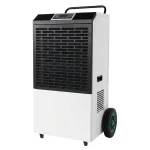
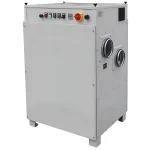
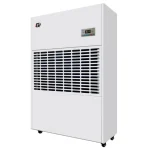
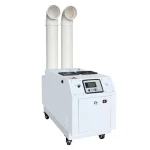
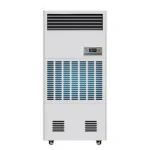
Moisture control for electronics component storage areas is not only about keeping a warehouse dry. It is about keeping stored components, packaging, reels, trays, PCBs, and moisture-sensitive devices in a stable environment before they enter production.
For electronics manufacturers, EMS plants, repair centers, and component distributors, humidity problems often start in storage but appear later during soldering, reflow, rework, inspection, or customer audits.
Common signs include:
- Damp cartons or softened labels
- HIC cards changing color after storage
- Opened reels waiting too long outside dry storage
- Bare PCBs losing solderability margin
- Corrosion or discoloration on leads or contacts
- Extra baking before production
- Unstable RH near doors, racks, or kitting areas
A plant-wide industrial dehumidifier for electronics manufacturing project may focus on workshops, SMT areas, assembly rooms, and packing zones. Electronics component storage needs a narrower strategy: stable warehouse humidity, low-humidity handling areas, dry cabinet support, airflow coverage, sensor placement, and traceable storage records.
The goal is not to make every area as dry as possible. The goal is to match the humidity-control method to the real storage risk.
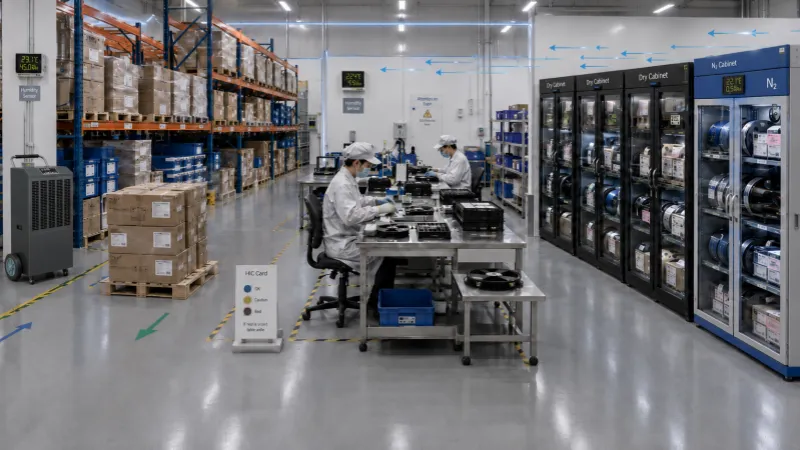
Quick Answer: Which Moisture Control Method Fits Your Storage Area?
Different electronics storage areas need different humidity-control methods. A dry cabinet alone may not protect the handling area. A room dehumidifier may stabilize the warehouse, but may not be enough for opened high-MSL components.
| Storage area / material status | Main humidity concern | Practical control direction |
|---|---|---|
| General sealed component warehouse | Damp cartons, unstable RH, door-zone humidity | Room-level industrial dehumidifier |
| Unopened dry-packed components | MBB integrity, HIC status, packaging condition | Stable warehouse RH + package inspection |
| Opened MSD reels/trays | Floor-life tracking, exposure during handling | Dry cabinet or low-humidity handling area |
| Kitting / repacking area | Components exposed during counting, splitting, and labeling | Low-humidity dry room or controlled workstation |
| Bare PCB storage | Surface finish and solderability window | Follow PCB supplier storage rules + stable RH |
| High-value or oxidation-sensitive ICs | Moisture and oxygen exposure | Dry cabinet or nitrogen cabinet |
| PCBA before thermal rework | Moisture risk before hot-air or BGA rework | Controlled temporary storage + process review |
The main decision is not “How dry can the room become?”
The better decision is: which area needs room-level dehumidification, which area needs low-humidity handling, and which components need cabinet-level protection?
What Humidity Level Is Suitable for Electronics Component Storage?
There is no single RH value for every electronic component storage area.
A sealed warehouse, a kitting room, a dry cabinet, and a nitrogen cabinet have different functions. The starting point should be the component type, packaging condition, MSL level, customer requirement, and production workflow.
| Storage case | Practical humidity target logic |
|---|---|
| General component warehouse | Stable moderate RH is usually enough; many projects target around 30–50% RH depending on internal rules and ESD requirements |
| Sealed dry-packed components | Package condition matters first: MBB, HIC, desiccant, seal date, and label |
| Opened MSD handling area | Lower RH and shorter exposure are preferred; floor-life control is needed |
| Dry cabinet storage | Target RH depends on cabinet class and SOP; recovery time matters as much as RH setpoint |
| Nitrogen cabinet | Used when both humidity and oxidation control are required |
| Bare PCB / surface-finished boards | Follow supplier packaging and storage window requirements |
| PCBA before thermal rework | Review component mix, previous exposure, and next heating process |
For general warehouses, extremely low RH is not always necessary. Very dry air may also need coordination with ESD controls such as grounding, packaging, flooring, ionization, and customer specifications. The goal is stable, appropriate humidity, not simply the lowest possible RH.
Where Humidity Problems Usually Start in Component Storage
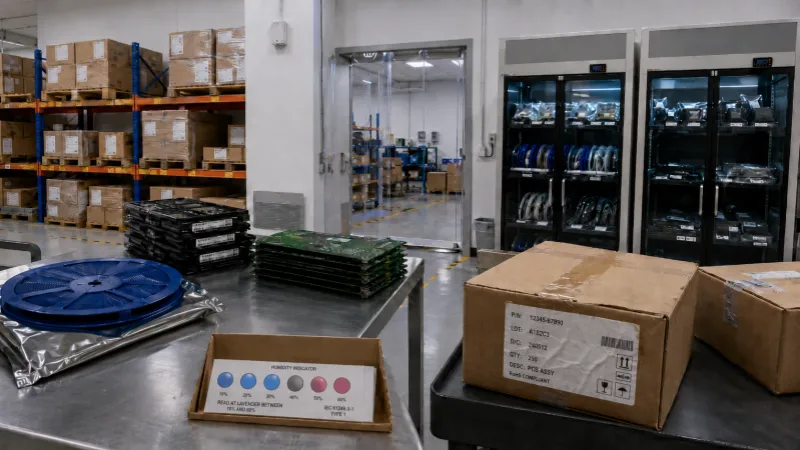
A component warehouse may look clean and organized, but moisture-related issues often appear later.
For moisture-sensitive devices, uncontrolled exposure can reduce usable floor life. For bare PCBs, high humidity can reduce the solderability margin. For cartons, labels, and reels, moisture can damage packaging and make traceability harder. For PCBA waiting for rework, the next thermal process may increase moisture-related risk.
The official IPC/JEDEC J-STD-020E standard explains moisture/reflow sensitivity classification for nonhermetic surface mount devices and the risk of internal vapor pressure during reflow. For storage and handling practices, JEDEC J-STD-033D is commonly referenced for moisture/reflow-sensitive surface-mount devices.
For a dehumidification project, the practical point is simple: opened, sensitive, or high-value components need stricter humidity control than sealed general inventory.
| Material type | Humidity concern | Storage implication |
|---|---|---|
| Moisture-sensitive devices | Absorbed moisture may create reflow risk | Track floor life and use dry storage after opening |
| IC reels and trays | Exposure during kitting or partial use | Control handling area, not only cabinet storage |
| Bare PCBs | Surface finish may lose solderability margin | Follow supplier storage window and keep RH stable |
| Connectors and plated leads | Oxidation or discoloration may affect quality | Avoid long-term high RH and poor packaging |
| PCBA waiting for rework | Next thermal process may increase risk | Review storage condition before BGA or hot-air rework |
| Cartons, labels, and reels | Packaging can absorb moisture or lose traceability quality | Keep warehouse RH stable and avoid damp zones |
Choosing Between Room Dehumidification, Dry Room, Dry Cabinet, and Nitrogen Cabinet
Electronics component storage usually does not rely on one solution. Different areas may need different layers of protection.
| Option | Best used for | Limitation |
|---|---|---|
| Room-level industrial dehumidifier | General warehouse RH stability, cartons, sealed inventory, room recovery | Does not fully protect opened high-MSL parts |
| Low-humidity dry room | Kitting, repacking, frequent handling of opened MSDs | Higher project cost and room sealing requirements |
| Dry cabinet | Opened MSDs, high-MSL parts, line-side buffer | Does not control exposure during handling outside the cabinet |
| Nitrogen cabinet | Oxidation-sensitive high-value parts | Adds nitrogen cost and leakage control requirements |
| Hybrid system | Facilities with sealed stock, opened MSDs, kitting, and high-value components | Requires clear workflow and monitoring rules |
General Component Warehouse: Stabilize Room RH
A general component warehouse stores unopened dry packs, cartons, reels, trays, tubes, labels, and standard inventory. For this area, the main job is to reduce high RH, local damp zones, and unstable humidity caused by doors, outside air, or poor airflow.
| Risk zone | What to check | Control method |
|---|---|---|
| Receiving door | RH spikes during delivery | Local sensor, door control, faster recovery |
| Carton storage | Damp packaging or label damage | Stable room RH and airflow coverage |
| Deep rack area | Weak airflow and hidden high RH | Sensor in rack zone |
| Exterior wall | Cold surface or condensation risk | Dew point and insulation review |
| General aisles | Long-term high RH | Room-level industrial dehumidifier |
When the problem is mainly unstable warehouse air, dock doors, cartons, and long rack aisles, the control logic is similar to warehouse humidity control with industrial dehumidifiers. Electronics component storage adds stricter requirements for packaging checks, MSL status, and batch records.
Low-Humidity Dry Room: Control Exposed Handling
A low-humidity dry room is more suitable when components are opened, counted, split, labeled, repacked, or prepared for production.
This is different from storing sealed cartons. The components are exposed during handling, so the surrounding air matters.
A dry room should be considered when:
- Many MSDSs are opened every day
- Kitting work takes time
- Reels are frequently split or returned
- Operators move materials in and out often
- Dry cabinets are full or are frequently opened
- Floor-life control is difficult in normal room air
For rooms that must maintain lower RH after frequent door opening, a desiccant dehumidifier system is often more suitable than a standard condensation-based dehumidifier.
Dry Cabinet or Nitrogen Cabinet: Protect High-Risk Components
Dry cabinets and nitrogen cabinets are useful for smaller, higher-risk storage groups.
They are often used for high-MSL devices, expensive ICs, opened reels, line-side buffers, oxidation-sensitive materials, and low-volume high-value components.
For dry cabinets, buyers should compare more than the target RH.
| Specification | Why it matters |
|---|---|
| Target RH | Defines storage level |
| Door-open recovery time | Shows whether the cabinet can handle real use |
| Shelf-to-shelf uniformity | Prevents hidden high-RH spots |
| Door seal quality | Reduces moisture ingress |
| Alarm and data logging | Supports traceability |
| Calibration plan | Keeps records reliable |
| Internal layout | Determines reel and tray usability |
A nitrogen cabinet is useful when oxidation control is also required. If humidity is the only concern, the additional nitrogen cost may not be necessary.
How to Size and Configure the Dehumidifier System
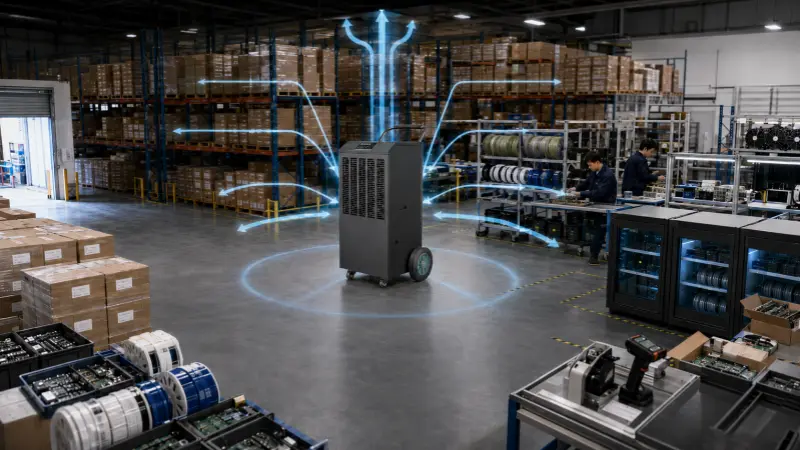
Start with Storage Risk, Not Only Room Size
A common mistake is choosing a dehumidifier only by square meters.
For electronics component storage, room size matters, but it is not enough. The selection should also consider:
- target RH and temperature
- component type and MSL mix
- sealed vs opened material ratio
- kitting or repacking workflow
- door-opening frequency
- existing HVAC or fresh air
- room sealing condition
- recovery time requirement
- sensor and alarm requirements
- BMS, Modbus, SCADA, or MES integration needs
The same logic used to choose an industrial dehumidifier still applies, but component storage adds packaging status, opened-material workflow, and traceability requirements.
Calculate Moisture Load from Real Conditions
Two storage rooms with the same floor area may need different dehumidification systems.
A sealed room with low traffic may need moderate capacity. A busy kitting room with frequent door opening may need stronger moisture removal, better airflow, and faster recovery.
| Moisture source | Practical example |
|---|---|
| Outdoor air infiltration | Door gaps, wall leakage, poor sealing |
| Door opening | Operators, carts, forklifts, deliveries |
| HVAC or fresh air | Untreated ventilation air |
| Packaging materials | Cartons, pallets, foam, paper labels releasing moisture |
| Room envelope | Wall joints, ceiling, floor, cable openings |
| Handling workflow | Frequent kitting, splitting, repacking |
| Target RH | Lower RH requires stronger moisture removal |
| Recovery time | Faster recovery needs higher system response |
Sizing should start after the room target and workflow are clear. A general load method such as what size industrial dehumidifier do I need can support early calculation, but final selection should use project-specific air volume, target RH, sealing, door activity, and recovery-time data.
Choose Refrigerant or Desiccant by RH Target and Recovery Needs
For electronics component storage, both refrigerant and desiccant dehumidifiers can be used. The right choice depends on RH target, temperature, recovery requirement, and airflow design.
| Storage scenario | Better starting point | Why |
|---|---|---|
| General warehouse with moderate RH target | Refrigerant industrial dehumidifier | Energy-efficient for moderate RH control |
| Large stockroom with sealed packages | Industrial warehouse dehumidifier | Stabilizes room RH around cartons and racks |
| Low-humidity dry room | Desiccant dehumidifier | Better for lower RH and faster moisture removal |
| Low-temperature or low-dew-point requirement | Desiccant dehumidifier | More stable when condensation-based removal is limited |
| Small high-value MSD storage | Dry cabinet or nitrogen cabinet | Direct micro-environment control |
The main technology choice is usually refrigerant vs desiccant dehumidifier, followed by capacity, airflow, controls, and monitoring.
Check Recovery Time and Airflow Coverage
A dehumidifier should not only reach a setpoint under ideal conditions.
For component storage, check:
- RH fluctuation band
- recovery time after door opening
- sensor accuracy and calibration
- supply air direction
- return air path
- rack dead zones
- maintenance access
- drainage or exhaust requirements
- alarm and communication function
If dry air short-cycles back into the return inlet, deep rack areas may remain humid even when the equipment display looks normal.
Project Information Needed Before System Recommendation
A component storage project should not start with a model number. It should start with the storage process.
| Project input | Why it matters |
|---|---|
| Room size and ceiling height | Defines air volume and layout |
| Target RH and temperature | Helps decide refrigerant vs desiccant direction |
| Component type and MSL mix | Shows how strict storage control should be |
| Sealed vs opened material ratio | Decides whether room control alone is enough |
| Door opening frequency | Affects recovery capacity |
| Kitting or repacking workflow | Adds exposure risk during handling |
| Existing HVAC or fresh air | Affects total moisture load |
| Sensor and alarm requirements | Affects control system design |
| BMS / Modbus / MES needs | Affects integration plan |
With these inputs, Rinwang can compare room-level dehumidification, desiccant dry rooms, dry cabinet support, and hybrid humidity-control options for the actual storage process.
Monitoring Points for Stable Storage Humidity
A single wall sensor is rarely enough for critical component storage.
Sensor placement should follow risk zones:
| Sensor location | Why it matters |
|---|---|
| Receiving / quarantine area | Detects humid air from deliveries |
| Main component storage area | Tracks general room condition |
| Deep rack zone | Finds airflow dead spots |
| Kitting / repacking workstation | Monitors opened MSD handling |
| Dry cabinet interior | Confirms cabinet-level control |
| PCBA rework buffer | Tracks pre-rework storage condition |
Alarm logic should connect to action. High RH, long door opening, slow recovery, sensor fault, and data loss should trigger inspection, adjustment, or material review.
For high-value or customer-audited storage, humidity records can be connected with batch records, PLC, BMS, SCADA, or MES systems. This helps teams identify which materials were stored in an affected zone and what corrective action was taken.
Buyer Checklist Before Requesting a Dehumidifier Quote
Before asking for a model, prepare the following information:
| Question | Why it matters |
|---|---|
| What components will be stored? | MSL, package type, PCB, PCBA, reels, trays, tubes |
| Are components sealed or opened? | Decides shelf-life vs floor-life control |
| What RH target is required? | Determines equipment type and capacity |
| What recovery time is required? | Important for doors and dry rooms |
| How often are doors opened? | Defines dynamic moisture load |
| Is there kitting or repacking? | Adds exposed MSD handling risk |
| Is the room sealed well? | Poor sealing increases load and instability |
| Is HVAC or fresh air involved? | Fresh air may add moisture load |
| Are data records required? | Affects sensor and communication design |
This checklist helps avoid under-design and over-design.
Next Step: Define the Storage Risk Before Choosing a Model
Moisture control for electronics component storage should be designed around the storage process, not only the room size.
A general component warehouse may only need stable room-level dehumidification. A kitting area with opened MSDs may need a low-humidity dry room. High-value or high-MSL components may still need dry cabinets or nitrogen cabinets. Many electronics facilities need a hybrid solution.
The first step is to define the stored components, MSL mix, opened-material workflow, target RH, door-opening frequency, recovery time, existing HVAC condition, and monitoring requirements.
As an industrial dehumidifier manufacturer, Rinwang can help evaluate whether a refrigerant dehumidifier, desiccant dehumidifier, dry room, dry cabinet support strategy, or hybrid humidity-control system is more suitable for your electronics component storage area.
FAQ
What humidity level is recommended for electronics component storage?
There is no single RH value for every component. Sealed component warehouses often use stable moderate RH control, while opened MSDs, kitting areas, and high-MSL devices may require dry cabinets, low-humidity rooms, or stricter floor-life tracking.
Can a warehouse dehumidifier replace dry cabinets?
Not completely. A warehouse dehumidifier controls the room environment. A dry cabinet controls a smaller micro-environment for opened MSDs or high-risk components.
When is a dry room better than only using dry cabinets?
A dry room is better when many components are opened, split, counted, labeled, or repacked during daily work. Dry cabinets protect stored materials, but they do not control the air around the handling process.
Is a desiccant dehumidifier necessary for electronics component storage?
Not always. For moderate RH control in a general warehouse, a refrigerant dehumidifier may be enough. For low-RH dry rooms, frequent door opening, low dew point, or faster recovery requirements, a desiccant dehumidifier is usually a stronger option.
What information should be prepared before requesting a dehumidifier quote?
Prepare room size, target RH, storage temperature, component type, sealed vs opened material ratio, door-opening frequency, kitting activity, existing HVAC condition, required recovery time, sensor locations, alarm requirements, and communication needs such as Modbus, BMS, SCADA, or MES.