A seed operation usually discovers its humidity problem twice. The first time is visible: seed caking in the bagging hopper, labels lifting off cartons in the packing room, condensation running down the inside face of the cold-store door after a morning of loading. The second time is invisible and arrives months later, as a germination test that comes back several points below the one taken at intake.
The second failure is the one that decides the equipment budget, because it cannot be undone. Seed that has lost vigour in storage cannot be dried back into condition. Every hour spent above the target moisture level is subtracted permanently from the lot’s shelf life, and the loss only becomes measurable once the lot is already sold or already sown.
The equipment decision therefore sits on the dry side of the site: the drying room, the cleaning and grading floor, the weighing and bagging area, and the storage chambers behind them. Those rooms have almost nothing in common with the growing houses on the same property — which is the first thing worth settling.
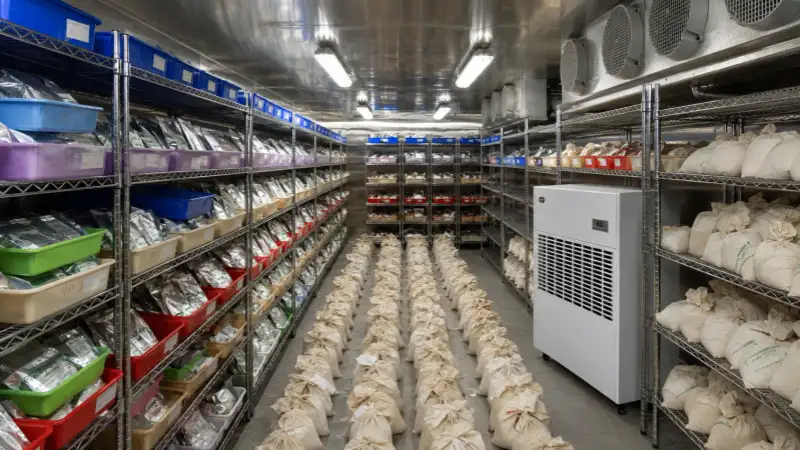
Why a Seed Room and a Growing Room Need Opposite Humidity Targets
Both rooms have a dehumidifier in them, and that is where the similarity ends.
| Growing house or hydroponic room | Seed drying and storage rooms | |
|---|---|---|
| Where the moisture comes from | Plant transpiration, nutrient solution surfaces, irrigation | Envelope leakage, door traffic, incoming fresh air, open product |
| Load behaviour | Continuous and large, swinging with the light cycle | Small and intermittent, dominated by how often the room is opened |
| Typical target | Roughly 50–70% RH, managed against vapour pressure deficit | 25–35% RH in warm drying, near 15% RH for long-term seed |
| What failure looks like | Fungal disease and stalled transpiration | Irreversible loss of germination and vigour |
Relative humidity (RH) is the moisture in the air compared with the maximum that air could hold at the same temperature. A growing house chases a moving moisture source and holds RH high enough to keep plants transpiring. A seed room does the opposite: it defends a dry shell against moisture trying to get in.
The growing side of a seed site is a separate engineering problem with its own control logic, and Rinwang’s guidance on greenhouse humidity control covers it directly. Everything below concerns the dry side.
Target Relative Humidity and Temperature by Seed-Handling Stage
Seed is hygroscopic. It gains and loses water until its moisture content is in equilibrium with the surrounding air, so the room’s RH is the control handle for the seed’s moisture content — not a comfort setting.
The published reference points come from genebank practice, which is the strictest end of the range and the source most commercial seed programmes calibrate against. The FAO Genebank Standards for Plant Genetic Resources for Food and Agriculture specify drying orthodox seed to equilibrium in an environment of 5–20 °C and 10–25% RH depending on species, then holding base collections at −18 ± 3 °C.
| Stage | Room condition commonly targeted | What the room is protecting |
|---|---|---|
| Intake, cleaning, grading | 40–55% RH at ambient temperature | Handling and flow; keeps seed from picking up moisture while exposed |
| Warm pre-drying | Around 30–45 °C, 25–35% RH | Bulk moisture removal before equilibration |
| Final equilibrium drying | Around 15 °C, roughly 15% RH | Bringing seed to its target moisture content |
| Weighing, bagging, sealing | 30–45% RH, stable rather than minimal | The short window when dried seed is open to the room again |
| Medium-term storage | Commonly 5–10 °C, packaging-dependent | Slowing metabolic decline in working inventory |
| Long-term storage | −18 ± 3 °C after drying and sealing | Base collections and parent lines |
These are engineering starting bands, not species-specific setpoints. Recalcitrant and intermediate seed cannot be taken to the low moisture contents in this table at all, and a facility handling both types needs the drying protocol confirmed per species before any equipment is sized. The temperature side of the storage rooms belongs to the refrigeration design, which is a separate exercise covered in Rinwang’s guide to cold storage humidity control.
The 100 Rule: Temperature and Humidity Have to Be Solved as One Equation
The most useful shortcut in seed storage is also the one most often applied to only half the problem. Two long-standing rules of thumb, summarised by the Tallgrass Prairie Center at the University of Northern Iowa in its seed storage and viability guidance, describe how the two variables trade against each other:
- Every 1% rise in seed moisture content roughly halves storage life.
- Every 10 °F (about 5.6 °C) rise in temperature roughly halves storage life.
From these comes the working check often called the 100 rule: storage temperature in °F plus storage RH in % should stay below 100. Both rules of thumb hold within a bounded range — broadly 5–14% seed moisture content and normal above-freezing storage temperatures — and they describe trends, not guarantees for a specific lot.
The practical consequence is a constraint most buyers only half-satisfy. A room held at 50% RH satisfies the 100 rule only if its temperature is also pushed below about 10 °C. A room held at 20 °C (68 °F) needs RH below roughly 32%. Buying a large dehumidifier for an uncooled room, or buying refrigeration for a room with no humidity control, each solves one term of the equation and leaves the other free to run.
This is why a seed project should fix its temperature and RH pair together before anyone quotes equipment. Choosing them independently is how facilities end up with a chiller that condenses moisture onto the product and a dehumidifier that cannot hold its setpoint.
65% RH Only Stops Mould — It Does Not Preserve Germination
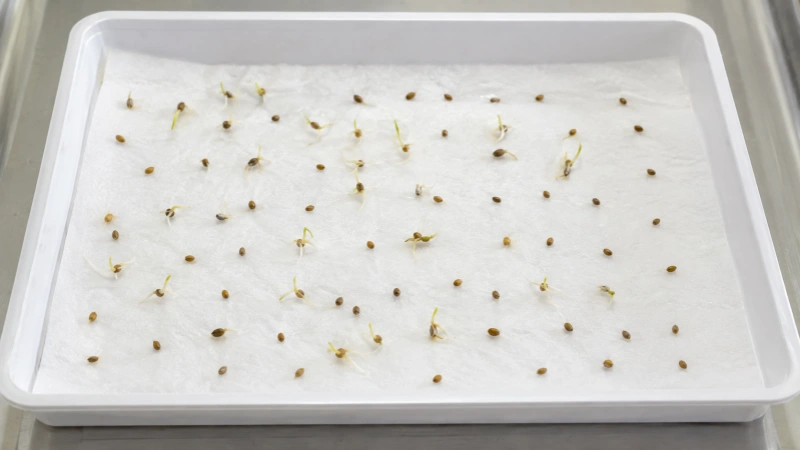
A common substitution is to treat mould prevention as the storage specification. It is not, and the gap between the two is where most avoidable vigour loss happens.
Storage fungi such as Aspergillus and Penicillium begin to grow once seed is in equilibrium with air above roughly 65–70% RH, which FAO’s manual on the prevention of post-harvest grain losses gives as the safe upper equilibrium for long-term storage of foodstuffs. Hold a room at 60% RH and the seed will not go mouldy.
It will still age. The metabolic decline described by the rules above continues across the whole range; it simply does not produce a visible symptom. A lot held at 60% RH and 25 °C is clean, saleable, and losing shelf life at several times the rate of the same lot at 30% RH.
The distinction matters commercially because it separates two different buyers inside the same company. A warehouse manager whose problem is mould and insects can work at 55–60% RH with a refrigerant dehumidifier. A production or germplasm manager whose problem is germination rate on next season’s certificate needs a fundamentally different room. Specifying the first and expecting the second is the most expensive mistake in this category.
Where Refrigerant Dehumidification Stops and Desiccant Has to Take Over
Refrigerant dehumidifiers work by cooling air below its dew point — the temperature at which moisture starts to condense — and draining the condensate. That mechanism has a hard floor: as the target dew point approaches freezing, the coil surface reaches 0 °C, frost forms, and the machine spends its time defrosting instead of drying.
The ASHRAE Handbook—HVAC Systems and Equipment places the boundary explicitly. Chapter 25, Mechanical Dehumidifiers and Related Components, states that mechanical refrigeration dehumidifiers suit applications maintaining dew points of 1.7 to 4.4 °C and above, and directs applications below 1.7 °C to desiccant equipment.
Converting seed room targets into dew points turns that into a selection rule rather than a principle:
| Room condition | Approximate dew point | Where it falls |
|---|---|---|
| 25 °C / 50% RH — packing area | About 14 °C | Comfortably refrigerant |
| 25 °C / 35% RH — warm pre-drying | About 8 °C | Refrigerant |
| 25 °C / 25% RH | About 4 °C | At the edge of the refrigerant band |
| 15 °C / 15% RH — final drying room | About −11 °C | Desiccant only |
| 5 °C / 20% RH — cold conditioning | About −16 °C | Desiccant only |
Two conclusions follow. First, most of a seed site is not a low-dew-point problem: intake, cleaning, packing, and general warehousing all sit inside the refrigerant band, and specifying desiccant equipment for them adds regeneration energy for no gain. Second, the final drying room and any deep-dry chamber sit far outside it, and no amount of extra refrigerant capacity will get them there.
Reaching a genuine 15% RH room condition is normally a configured or multi-unit desiccant arrangement rather than a single standard unit, and the regeneration air path and its humid exhaust have to be designed into the building rather than added afterwards. The general mechanism and energy trade-offs between the two technologies are set out in Rinwang’s refrigerant vs desiccant dehumidifier comparison; what matters here is that a seed site normally needs both, in different rooms.
How the Load Is Calculated in a Seed Room — and Why It Is Not the Grow-Room Formula
Grow-room capacity is estimated from water input, because nearly all irrigation water returns to the air through transpiration. That method does not transfer. A seed drying or storage room has no internal moisture source of any consequence once the product is at target moisture content.
The load is instead the sum of what gets in:
| Load component | What drives it | What reduces it |
|---|---|---|
| Envelope infiltration | Vapour pressure difference across walls, joints, and penetrations | Sealing and vapour retarders on the warm side |
| Door traffic | Number and duration of openings, and the pressure difference across the door | Airlocks, fast doors, batching of movements |
| Mechanical fresh air | Ventilation rate and outdoor design condition | Reducing rate to what the room genuinely needs; treating it separately |
| Open product and packaging | Mass of seed and materials exposed, and how far they are from equilibrium | Scheduling exposure; conditioning materials before they enter |
| People and equipment | Occupancy and internal heat | Layout and access control |
The judgment this produces is worth stating plainly: in a seed room, sealing the door usually beats going one size up on the machine. A drying room at −11 °C dew point sits roughly 25–30 °C of dew point below a normal corridor outside it, so every door cycle admits a load that no realistic oversizing absorbs economically. Facilities that respond to an unstable setpoint by adding capacity typically end up with a larger machine that still cannot hold the room, and a higher energy bill for the privilege.
The general method for turning room conditions into a capacity figure — capacity units, rating conditions, and the relationship between airflow and moisture removal — is covered in Rinwang’s guide to industrial dehumidifier sizing. The seed-specific part is the input list above, and the order of work: seal first, define the door regime second, size third.
How Far Packaging Should Go Before the Room Has to Be That Dry
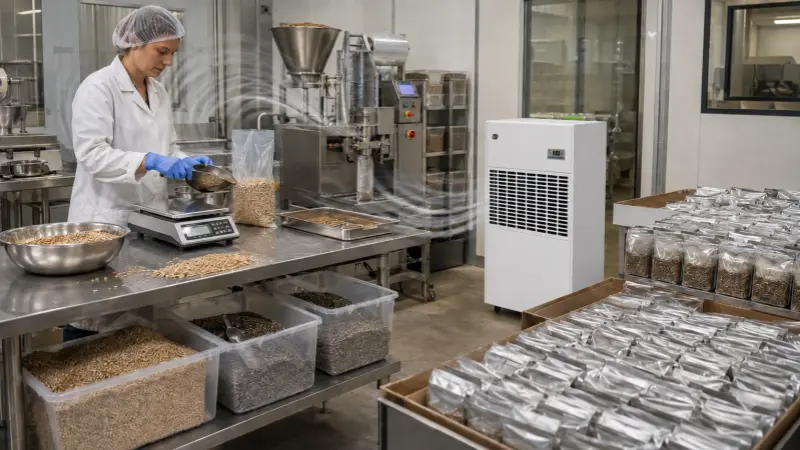
The boundary that changes project cost most is the one between what packaging protects and what the room has to protect.
Packaging materials differ enormously here. A study of moisture adsorption in seeds stored in conventional and hermetic packaging found that seed in hermetic bags — specified at a water vapour transmission rate of 5 g/m²/day or lower — gained only about 1–2% moisture content when held at 90% RH, while paper, polypropylene, jute, and cloth bags allowed increases of roughly 9% under the same conditions.
That result draws a line through the facility. Seed that has been dried to target and hermetically sealed is largely decoupled from the room around it; the storage chamber’s job becomes temperature control plus enough humidity management to keep condensation off packaging and structure. Seed that is open to the air — in the drying room, on the cleaning and grading floor, at the weighing station, in the bagging line, and during sampling — is fully exposed to room conditions and is the only place the low-RH investment actually earns its return.
Two practical consequences:
- Do not specify a deep-dry room for sealed inventory. If the packaging is genuinely hermetic and seals are verified, the storage chamber does not need drying-room conditions, and specifying them multiplies both capital and regeneration energy for no measurable protection.
- Do not run open handling in an untreated room. The bagging and weighing area is the point where dried seed most often re-absorbs moisture, and a short exposure at high RH can undo days of drying. Rinwang’s guidance on humidity control in packaging areas covers the general packaging-room case; the seed-specific requirement is that the room condition be tied to the seed’s target moisture content, not only to packaging behaviour.
Where the packaging specification is uncertain — mixed bag types, unverified seal integrity, long transit legs — the safer assumption is that the room carries the load.
Worked Example: Staging Equipment Across One Seed Site
The following is an illustrative configuration, not a Rinwang project record. It assumes an orthodox field-crop seed operation with a single building housing intake, drying, conditioning, packing, and a chilled store, in a warm humid climate.
| Room | Assumed condition | Approximate dew point | Technology that fits | What to verify before selection |
|---|---|---|---|---|
| Intake and cleaning floor | 25 °C / 50% RH | About 14 °C | Refrigerant | Fresh-air rate; dust loading on filters and coils |
| Warm pre-drying room | 35 °C / 30% RH | About 15 °C | Refrigerant with heat, or ducted refrigerant | Temperature limit for the species; air distribution through the seed mass |
| Final drying room | 15 °C / 15% RH | About −11 °C | Desiccant, configured for the target | Regeneration air path and humid exhaust route; achievable RH at the design airflow |
| Weighing and bagging | 22 °C / 35% RH | About 6 °C | Refrigerant | Exposure time per lot; door relationship to the drying room |
| Chilled store, sealed stock | 5 °C, packaging-led | Set by refrigeration | Low-temperature refrigerant unit for condensation control | Coil frost behaviour and defrost strategy at the design temperature |
Three decisions in that table are worth naming, because they are where staged configurations usually pay off.
The pre-drying room stays refrigerant even though its RH target is low, because its temperature is high enough to keep the dew point in a comfortable band. Bulk moisture is cheapest to remove warm.
The final drying room is the only room that justifies desiccant equipment, and it is deliberately the smallest conditioned volume on the site. Sizing the low-dew-point envelope tightly is the single largest lever on both capital cost and running cost.
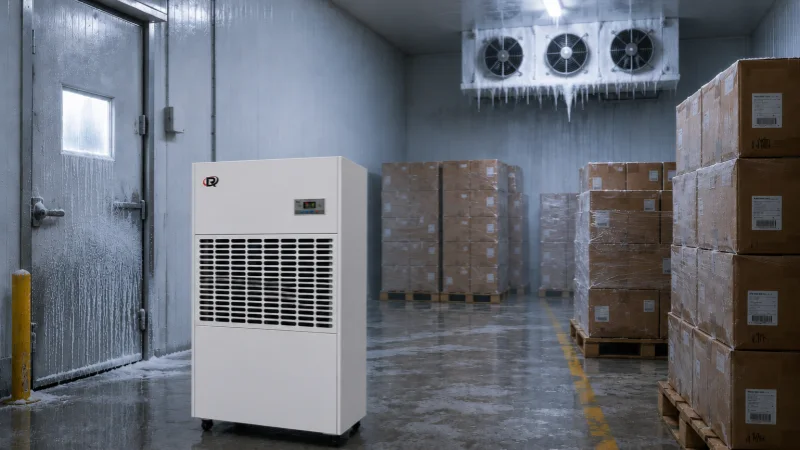
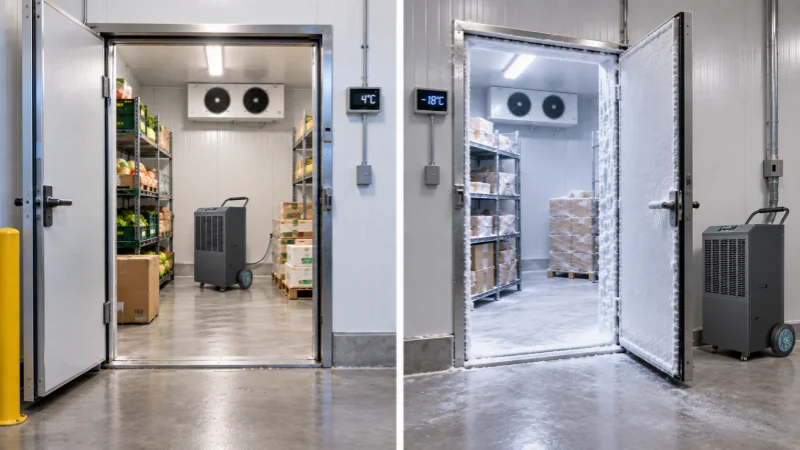
The chilled store’s humidity requirement is driven by condensation control on structure, packaging, and product surfaces during door cycles and warm-up, not by the seed’s moisture target — because the seed is sealed. That is a duty for a low-temperature dehumidifier sized against door traffic, with defrost behaviour confirmed at the room’s actual design temperature.
What to Confirm Before Requesting Equipment Selection
A seed room cannot be selected from floor area. The information that changes the answer:
| Project input | Why it changes the selection |
|---|---|
| Species and seed type — orthodox, intermediate, or recalcitrant | Determines whether low moisture targets are safe at all |
| Target seed moisture content and the room RH that produces it | Converts a biological target into a controllable room condition |
| Design temperature for each room | Fixes the dew point, and therefore the technology |
| Room volume, construction, and vapour barrier status | Sets the infiltration share of the load |
| Door schedule — openings per hour, duration, adjacent room condition | Usually the dominant load in a dry room |
| Fresh-air and exhaust rates, and outdoor design condition | Determines whether outdoor air needs separate treatment |
| Packaging type and whether seals are verified | Decides which rooms need low RH and which only need condensation control |
| Space available for regeneration air and humid exhaust | Constrains whether a desiccant unit can be installed as intended |
| Monitoring and record-keeping requirements | Affects sensor count, placement, and control interface |
With those inputs, room conditions and equipment selection can be worked through as one system rather than room by room. Rinwang builds rotary desiccant dehumidifiers for low-RH process rooms and configures them against project conditions; sending the room list, target conditions, and door regime is enough to begin a selection review.
FAQ
What relative humidity should a seed storage room be held at?
It depends on whether the seed is sealed. Open handling and drying rooms for orthodox seed are commonly targeted between 25% and 35% RH, and final equilibrium drying is often specified near 15% RH at about 15 °C. Once seed is dried and hermetically sealed, the storage room’s humidity requirement drops to whatever prevents condensation on packaging and structure.
Why can’t the dehumidifier from a growing house be reused in a seed drying room?
A growing-house dehumidifier is a refrigerant machine selected to hold roughly 50–70% RH against a large continuous transpiration load, which corresponds to a dew point well above freezing. A seed drying room at 15% RH sits near −11 °C dew point, below the point at which a refrigerant coil frosts instead of condensing. The two rooms need different technologies, not different sizes of the same one.
Does hermetically sealed packaging remove the need for room dehumidification?
Hermetic packaging removes most of the room’s influence on sealed seed, but not the need for dehumidification during open stages. Drying, cleaning, grading, weighing, bagging, and sampling all expose seed directly to room air, and those rooms still need controlled RH regardless of how good the final packaging is.
Is 65% RH low enough for seed storage?
65% RH is close to the threshold at which storage fungi begin to grow, so it addresses mould but not viability. Seed held at that level continues to lose germination and vigour at a rate set by its moisture content and temperature, and the loss is not visible on inspection.
How is a seed room’s target RH converted into a dew point?
Dew point is calculated from the room’s temperature and RH together, and it is the number that determines which dehumidification technology applies. As a reference, 25 °C at 35% RH gives a dew point near 8 °C, while 15 °C at 15% RH gives roughly −11 °C — the same building, two rooms apart, on opposite sides of the refrigerant-to-desiccant boundary.