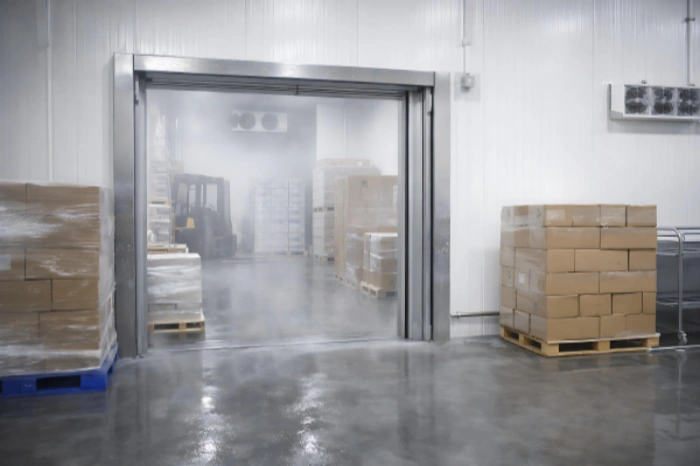
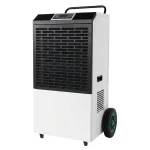
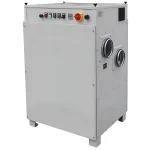
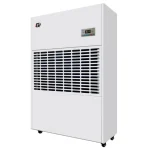
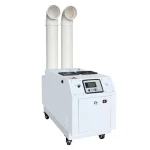
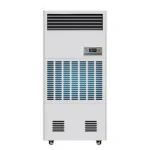
A records room fails quietly. Nobody reports a problem the week the relative humidity starts drifting up. The problem shows up months later as a musty smell near the back wall, foxing on the outer sheets of the boxes in the bottom row, corroded fasteners on a run of binders, and eventually a mould finding in an audit that shuts a bay down for remediation.
By then the question is not “do we need a dehumidifier.” It is “what condition does this room have to hold, and can the equipment we are quoting actually hold it?” Those are two different questions, and most archive dehumidifier projects go wrong in the gap between them. The storage standards are written in temperature and relative humidity. Dehumidifiers are limited by dew point. A target that looks perfectly reasonable in a specification can sit below the point where a refrigerant machine stops being able to condense water at all.
This article maps the humidity targets that apply to archive, records, and document storage, converts those targets into the number that decides equipment selection, and explains where paper storage rooms behave differently from every other space in the building.
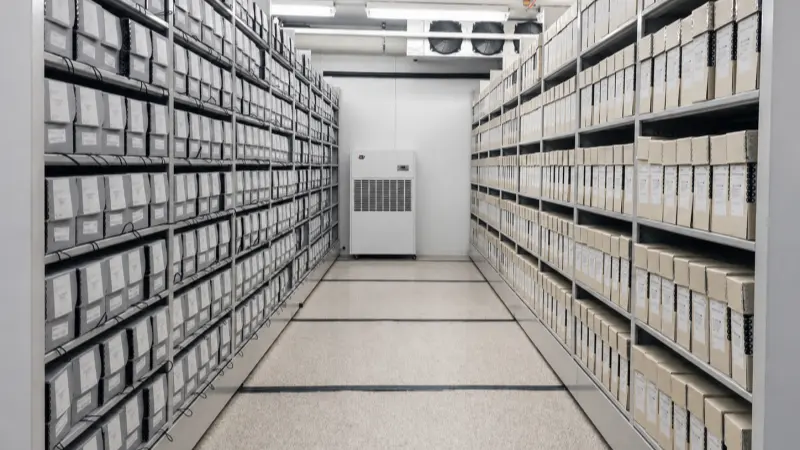
Archive Humidity Fails in Two Directions, Not One
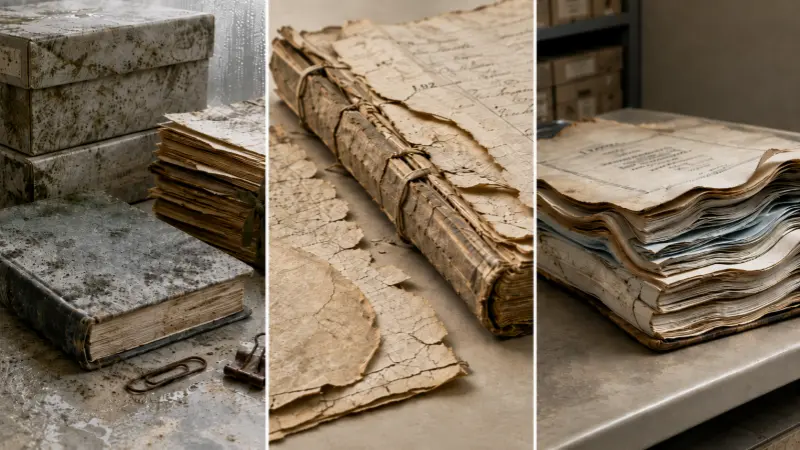
Most storage spaces have one moisture failure mode: too wet. Archives have two, plus a third that is easy to miss.
Too humid. Above roughly 60–65% RH sustained, mould germinates on paper, animal-glue bindings, and leather. Silverfish and booklice become active. Steel shelving uprights, box fasteners, staples, and paperclips corrode. Magnetic media degrade faster. The damage is biological and chemical, and once mould has established, dehumidification alone does not undo it.
Too dry. Below roughly 30% RH sustained, paper, parchment, and leather lose bound water and become brittle. Sheets crack at the fold during ordinary retrieval. Static builds, which is a specific hazard around magnetic tape. Drying a room harder is not a safety margin in an archive — it is a second failure mode.
Fluctuation. Paper is hygroscopic and dimensionally anisotropic. Every RH swing makes it take up or shed moisture, and the surface responds before the core. Repeated cycling produces cupping, warping, cracked bindings, and delamination in composite items. A room that averages 45% RH but swings between 30% and 60% every day is doing more mechanical damage than a room that sits steadily at 55%.
This is why an archive specification is written as a band with a stability requirement, not as a single number. And it is why “how many pints per day does it pull” is the wrong first question. The first question is whether the equipment can hold a condition without hunting across the band.
What the Storage Standards Actually Require
Three documents carry most of the weight in North American and international records projects. They do different jobs, and quoting the wrong one in a bid is a common way to lose credibility with an archivist.
The federal floor: 36 CFR 1234.14
For facilities storing US federal records, 36 CFR 1234.14 sets environmental requirements for records storage facilities. For paper-based temporary records it does not prescribe a set point. It requires that records be stored so that mould growth is prevented, and it names the conditions that cause it: moisture from leaks or condensation, relative humidity above 70%, extremes of heat combined with relative humidity above 55%, and poor air circulation during periods of elevated temperature and humidity.
That framing is unusually useful for equipment selection, because it is a ceiling plus an airflow requirement rather than a precision-control requirement. For paper-based permanent records the rule is stricter: 24-hour, 365-day air conditioning covering temperature, humidity, and air exchange, at the level applied to office space. Non-textual permanent records — microfilm, audiovisual, electronic — are pushed to their own media-specific standards.
The band, not the set point: NARA 1571 Supplement 2
The NARA 1571 Supplement 2 temperature and relative humidity tables give the media-specific numbers, and they state plainly that current research supports moving away from set points and toward bands.
| Storage location | Typical holdings | Temperature | Relative humidity |
|---|---|---|---|
| Textual holdings storage | Paper records, bound volumes | 50–65 °F (10–18 °C) | 30–50% |
| Non-textual holdings storage | B&W paper prints, polyester-based film, glass plate negatives, maps and plans, computer tapes and disks, optical disks, hard drives, video and audio tape | 50–65 °F (10–18 °C) | 30–50% |
| Mixed media storage rooms | Predominantly paper with non-textual items interspersed | 50–65 °F (10–18 °C) | 30–50% |
| Holdings work rooms | Processing, digitization, conservation, research use | 50–75 °F (10–24 °C) | 30–55% |
| Cold storage | Cellulose acetate film, microfilm and microforms, X-rays, colour negatives | 35 °F (2 °C), not below 32 °F | 30–40% |
| Cold storage acclimation room | Holdings moving out of cold storage | Set by dew point calculation; 50 °F (10 °C) for a 35 °F vault | 30–50% |
| Frozen storage | Deteriorated motion picture film | Below 30 °F (−1 °C) | 30–40% |
Two points in that table change project decisions. First, the guidance notes that acidic papers, magnetic media, and many films and plastics have a usable life of only decades when stored at or above 70 °F — which is the argument for spending money on the room, not just on a machine. Second, electronic and magnetic media are classified as low sensitivity, because cold storage does not extend their life and can damage them. Buyers frequently assume tape belongs in the coldest room available. It does not.
ISO 11799:2024, and why a stale citation costs credibility
ISO 11799:2024 is the current third edition and cancels and replaces ISO 11799:2015. It covers siting, construction, renovation, installation, and equipment for repositories used for the long-term storage of archive and library materials. Specifications still circulating that cite the 2015 edition as current are out of date, and an archivist reviewing a bid will notice.
One caution applies across all three documents: standards govern the storage environment, not the dehumidifier. No dehumidifier is “ISO 11799 compliant” or “NARA compliant.” Equipment is selected so that the room can hold the condition the standard calls for; compliance is a property of the facility and how it is operated.
One Room, Several Media: Why a Single RH Set Point Fails
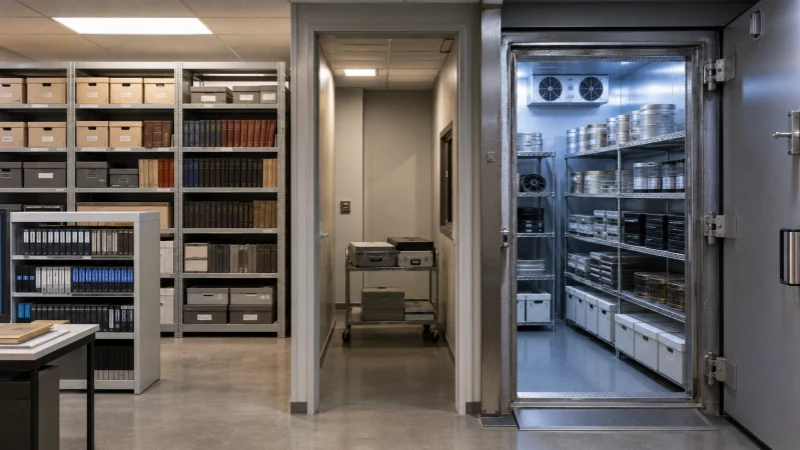
Walk a real records room and you will find paper files, bound volumes, a shelf of microfilm reels, a box of X-rays, some old photographic prints, and a rack of LTO tape. Their preservation bands do not coincide.
- Paper and bound volumes sit comfortably in the 30–50% RH band.
- Cellulose acetate film — microfilm, motion picture and still negatives, X-rays — is a cold-storage medium. Held at room temperature it degrades autocatalytically, and no amount of humidity control at 65 °F substitutes for a cold vault.
- Magnetic and electronic media belong at ordinary storage temperature, not in the cold vault, and are sensitive to static at the dry end of the band.
There are only two honest resolutions. Either you zone — a conditioned stack for paper, a separate cold vault for acetate film, with a dew-point-controlled acclimation room between the vault and the reading room — or you take the intersection and accept that you are storing acetate film at a condition that shortens its life. NARA’s mixed-media room band of 50–65 °F and 30–50% RH is that intersection, written down.
The practical consequence for procurement is the order of work. Build the media inventory first, decide the zoning second, size equipment third. Selecting a dehumidifier before the media inventory exists produces a machine that serves the average of a room that has no average.
Turn the RH Target Into a Dew Point Before Choosing Equipment
This is the step most archive dehumidifier specifications skip, and it is the one that determines whether the quoted equipment can do the job at all.
A refrigerant dehumidifier removes moisture by cooling air below its dew point on an evaporator coil so that water condenses out. The coil surface has to be colder than the dew point of the air entering it. When the target dew point approaches freezing, the coil runs at or below 32 °F, frost forms, and the machine has to stop dehumidifying in order to defrost. A desiccant dehumidifier does not depend on condensation at all — it adsorbs water vapour onto a rotor and drives it off with regeneration air — so it is not bounded by the frost line.
So convert the target before comparing machines:
| Room target | Dew point | What the coil has to do | Practical technology |
|---|---|---|---|
| 75 °F (24 °C) / 60% RH | 60 °F (16 °C) | Easy condensation | Refrigerant |
| 68 °F (20 °C) / 55% RH | 51 °F (11 °C) | Comfortable operating range | Refrigerant |
| 64 °F (18 °C) / 50% RH | 45 °F (7 °C) | Colder coil, reduced capacity | Refrigerant, with low-temperature rating verified |
| 59 °F (15 °C) / 40% RH | 35 °F (2 °C) | Coil near the frost line, frequent defrost | Refrigerant marginal; verify or move to desiccant |
| 54 °F (12 °C) / 35% RH | 27 °F (−3 °C) | Coil below freezing | Desiccant |
| 50 °F (10 °C) / 30% RH | 20 °F (−7 °C) | Coil well below freezing | Desiccant |
Dew points are calculated for the stated air condition at sea-level pressure and rounded to the nearest degree.
Read that table against the NARA band and the point becomes obvious: the upper half of the 50–65 °F / 30–50% RH band is refrigerant territory, and the lower half is not. A specification that names 55 °F and 35% RH has, whether the writer knew it or not, specified a desiccant machine.
Where refrigerant dehumidification stops paying off
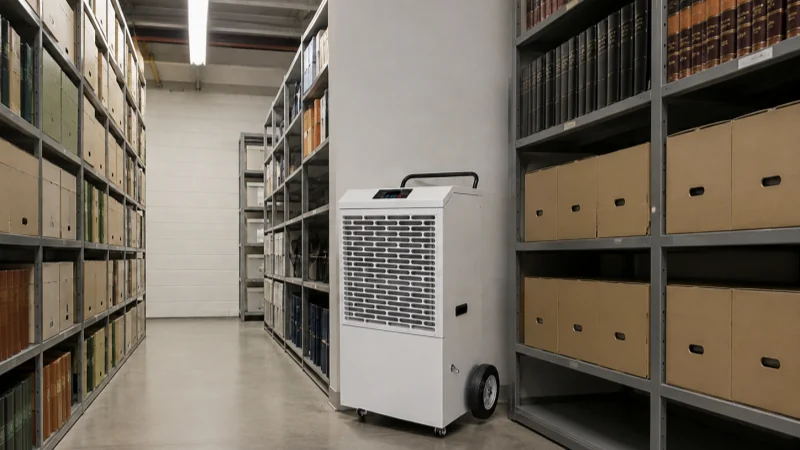
Refrigerant equipment is the right answer for the large middle of this market: commercial records centres, corporate file rooms, hospital medical records stores, law and accounting firm document rooms, basement document storage, and government archives in warm, humid climates. The real operating problem in those rooms is a summer peak that pushes RH past 65–70%, and the job is to bring it back under 55% and hold it there. That sits squarely inside what a refrigerant machine does well and economically.
Two things need verifying before committing, and both get glossed over on datasheets. First, moisture removal capacity is always a rating at a stated condition, and the same unit removes far less at 68 °F / 55% RH than at its 86 °F / 80% RH rating point. Ask for capacity at your design condition and for the full performance curve, not the headline number. Second, ask how the machine behaves when the room gets cold — what triggers defrost, how long a defrost cycle runs, and how much effective capacity remains. A unit that spends a large share of a cold morning in defrost is not dehumidifying, and repeated icing is itself a common cause of a dehumidifier losing capacity.
When desiccant is the only route
Cold vaults for acetate film, unheated basement repositories in cold climates, and any specification written below roughly 40% RH need desiccant dehumidification, because the required dew point is below what a condensing coil can reach without icing. Desiccant equipment carries a regeneration heat load and needs a duct route for the wet regeneration air, so it changes the mechanical room and the building, not just the equipment schedule. The broader trade-off between the two technologies is set out in the refrigerant vs desiccant comparison; for an archive, the deciding input is the dew point in the table above.
Room Reading vs. Box Reading: Compact Shelving and Enclosure Buffering
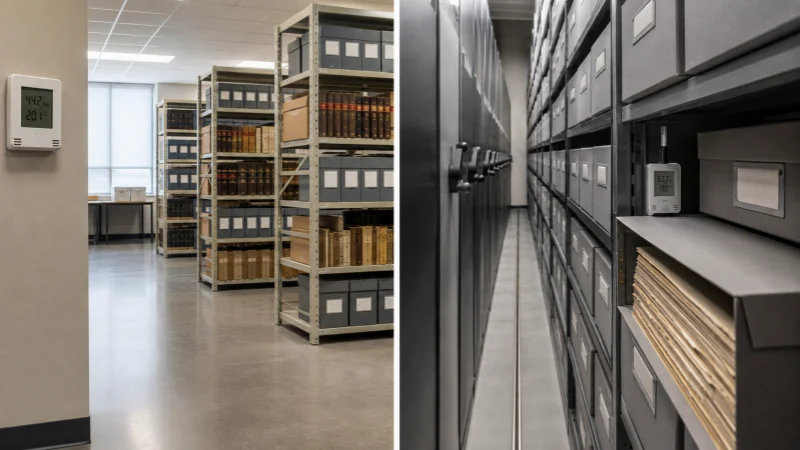
An archive is not an open room with air in it. It is a room densely packed with hygroscopic material inside enclosures, on shelving designed to eliminate the space air would travel through. Two consequences follow, and neither shows up on the wall-mounted humidistat.
Compressed compact shelving forms its own microclimate
Mobile or compact shelving is standard in records centres and government archives because it doubles capacity in the same floor area. It does that by removing the aisles. In the closed position, a bank of carriages is a solid block of paper with almost no air path through it, and it traps both heat and moisture in the middle of the run.
This is exactly the fourth mould factor named in 36 CFR 1234.14 — poor air circulation during periods of elevated temperature and humidity — expressed as a piece of furniture. Some institutions manage it operationally by leaving carriages slightly separated overnight so air can move between the ranges. From an equipment standpoint it means supply air has to be organised along the aisle axis and the return path has to be real rather than assumed. The general method for reading airflow instead of a floor plan is covered in the dehumidifier placement guide; a compact shelving archive is the hardest version of that problem, because the dead zone moves every time someone cranks a carriage open.
A full archival box is a buffer, not a sealed container
Recent measurement work on microclimate behaviour inside archival boxes, books, and paper stacks found that these enclosures behave as semi-permeable systems rather than sealed ones, and that hygroscopic mass changes their response dramatically: an empty box tracks room RH quickly, while a box packed with paper responds slowly.
That cuts both ways, and both directions matter to a buyer.
It is good news for stability. The collection itself buffers the room, which is why a well-loaded archive rides through short excursions better than an empty test space suggests, and why a slow seasonal drift is far less damaging than daily cycling.
It is bad news for verification and recovery. A room-level probe reading 50% RH tells you nothing reliable about a box that has been sitting in the middle of a closed compact shelving run since a wet August. When the room comes back into band after an excursion, the boxes lag. This is the usual explanation for the complaint that the data logger says the room is fine but there is mould inside the cartons — the cause is normally a local dead zone or a cold surface, not insufficient total capacity.
What this changes about sensors and run strategy
Three practical consequences:
- Do not control the room from a single wall sensor near the door. Use a control sensor in representative return air, plus verification points inside the stack depth and at the far end of the longest shelving run.
- Judge the system on how long the room takes to return to band after a door-open or weather event, not on the instantaneous display reading.
- Avoid short-cycling. Enclosure lag means the collection never sees the fast swings the controller is chasing, so a wider control differential with a stable machine protects the material better than tight on/off hunting around a set point.
Match the Equipment to the Records Room You Actually Have
Archive projects are not one buyer. The room type determines the equipment form more than the capacity number does.
| Facility | Usual condition to fix | Typical equipment form | Watch for |
|---|---|---|---|
| Commercial records centre (high-bay, palletised or compact shelving) | Summer RH peaks over 65%; loading dock infiltration | Ducted or ceiling-mounted units serving zones, sized around aisle airflow | Dead zones in closed shelving runs; dock door infiltration; verification sensors deep in the stack |
| Corporate file room in occupied office space | Persistent 60%+ in a low-load interior room; musty complaints | Ceiling-mounted or ducted, unit outside the occupied space | Noise; condensate route with no floor drain; service access |
| Basement or sub-grade document store | Slab and wall vapour transfer; cool surfaces; no ventilation | Floor-standing or ducted industrial unit with continuous drainage | Cold surfaces causing local condensation; drainage lift; unattended operation |
| Hospital medical records and film store | Audit findings; film sticking; paper mould | Zoned control tied to the wider facility strategy | Coordination with the surrounding hospital humidity control scheme; separate band for film |
| Government archive in a hot, humid climate | Wet season RH well above band; large volume; tender-specified targets | Central plant or multiple zone units, redundancy defined | A tender target below 40% RH requires desiccant; verify before bidding |
| Cold vault for acetate film and microfilm | Target dew point below freezing | Desiccant, with an acclimation room between vault and reading room | Acclimation dew point calculation; freeze–thaw micro-condensation |
Cross-application context for how these rooms sit alongside other conditioned spaces is in the industrial dehumidifiers by application guide.
Drainage, Redundancy, and Time to Recover Control
Two engineering questions decide whether an archive installation is safe, and neither is about moisture removal capacity.
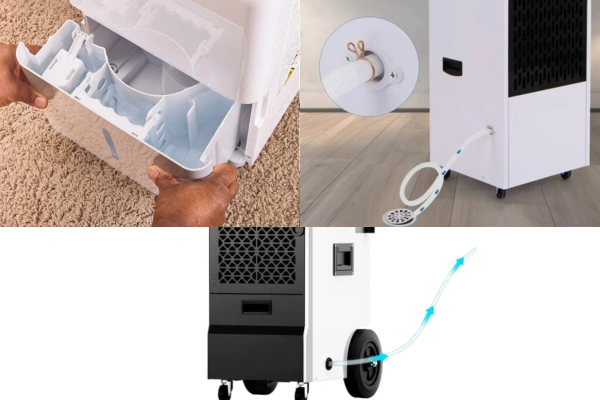
Water has to leave the room with no chance of releasing inside it. A refrigerant dehumidifier makes liquid water continuously, directly above shelving that may hold irreplaceable material. Gravity drainage to a floor drain is first choice. Where the building has no drain at the equipment location, a condensate pump is acceptable only with an overflow interlock that stops the machine and raises an alarm, plus a drip tray beneath the unit. Bucket emptying is not an option in an unattended stack. This is the one specification item where an archive differs sharply from a warehouse: in a warehouse, a drainage failure damages inventory that can be reordered.
Define how long the room may sit out of band. Redundancy is an argument about time, not a rule to be copied. Ask the archivist what the maximum acceptable excursion is — a long weekend, a week, a wet season — and specify from that answer. In a temperate climate with a well-loaded collection, a single unit plus a service agreement and a spare parts kit may be defensible. In a tropical government archive holding permanent records it usually is not, and either a duty/standby arrangement or a defined emergency portable unit belongs in the tender.
There is a related trap in sizing. The machine that dries a room out after a leak is not the machine that maintains it afterwards: initial dry-out is a short, large load, while permanent maintenance is a small, continuous one. Sizing for the dry-out load alone leaves equipment that short-cycles for the next ten years, a failure mode covered in the sizing guidance.
What to Send for an Archive Dehumidifier Recommendation
Floor area alone cannot produce a defensible selection for a records room. These are the inputs that change the answer.
| Project input | Why it changes the recommendation |
|---|---|
| Media inventory by type and volume | Determines whether one band works or the room must be zoned |
| Target temperature and RH band, and the standard or tender it comes from | Converts to dew point, which decides refrigerant vs desiccant |
| Maximum acceptable daily fluctuation | Drives control strategy and sensor count rather than capacity |
| Room volume, ceiling height, and sub-grade or above-grade | Volume and envelope, not floor area, set the load |
| Shelving type — static, compact/mobile, palletised — and aisle layout | Determines airflow route and where dead zones will form |
| Outdoor design conditions and length of the humid season | Sets the peak latent load and the annual run hours |
| Ventilation rate, door opening frequency, and adjacent spaces | Usually the largest moisture source in a sealed stack |
| Existing HVAC and how much latent load it already handles | Avoids specifying capacity the building already provides |
| Drainage route and available lift | Decides gravity, pump, or a change of equipment location |
| Power supply, noise limit, and service access | Decides equipment form as often as capacity does |
| Acceptable time out of band | Decides redundancy and spares |
Send that set with a floor plan marked for shelving runs and door locations, and a selection can be checked against a performance curve instead of a rule of thumb.
Frequently Asked Questions
Is 60% RH acceptable for a records storage room?
It sits below the mould-risk ceiling named in 36 CFR 1234.14 but above the preservation band NARA specifies for textual holdings, which is 30–50% RH. Treat 60% as an alarm threshold rather than an operating target, because paper held near it for long periods still ages faster and leaves no margin for a hot, humid weekend.
Do I need a desiccant dehumidifier for an ordinary office file room?
Usually not. A file room held around 68 °F and 50–55% RH has a dew point near 50 °F, which a refrigerant dehumidifier reaches comfortably. Desiccant equipment becomes necessary when the target drops below roughly 40% RH, or when the room runs cold enough that the coil would ice.
Can one dehumidifier serve both a paper records room and a microfilm or film vault?
No. Cellulose acetate film needs cold storage near 35 °F at 30–40% RH, while paper records are stored at 50–65 °F. The two rooms need separate conditioning, and moving material between them requires an acclimation room held at a dew point that prevents condensation on the cold items.
Do records stored in archival boxes still need room-level humidity control?
Yes. Boxes and full paper stacks are semi-permeable rather than sealed — they slow moisture transfer but do not stop it. The buffering helps a collection ride out short excursions, and it also means a box can stay damp long after the room reading has recovered.
Will a dehumidifier remove the musty smell in a file room?
It removes the condition that causes the smell, not the existing contamination. If mould has already established on boxes or shelving, the affected material needs assessment and remediation; running a dehumidifier will halt further growth, but the odour source remains until the material is treated.
Next Step
If you can describe the room — media types, target band and its source standard, volume, shelving layout, outdoor design conditions, and drainage route — a selection can be checked against real performance data instead of a coverage-area estimate. Send those project details to Rinwang and our engineers will confirm whether refrigerant or desiccant equipment fits the target, and what capacity the design condition actually requires.