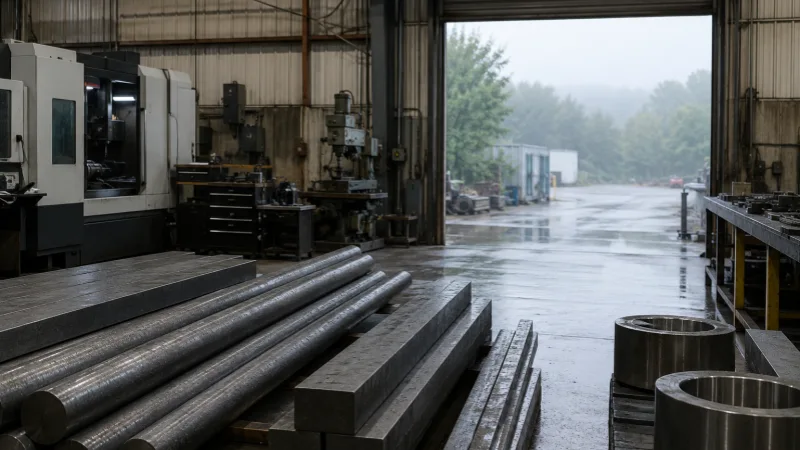
A production floor does not behave like a storage building. Doors open throughout the shift, coolant and wash water evaporate into the room, process exhaust draws in outside air, and cold steel may arrive directly from the yard. That is why a workshop can show rust, coating defects, or a wet floor even when the relative humidity (RH) reading does not look unusually high.
The first step is not choosing a dehumidifier model. It is identifying what is going wrong, where the moisture is coming from, and whether the real problem is high ambient humidity, condensation on a cold surface, or a process with its own environmental requirement.
This guide explains how to identify those conditions, set practical humidity or dew-point targets, estimate the moisture load, and choose the right dehumidification approach for workshops and factory floors.
Why a Workshop Is Not a Warehouse
A workshop and a warehouse may have the same floor area but very different moisture loads. Three differences matter most.
A workshop generates moisture internally. Cutting fluids, rinse tanks, pretreatment lines, washdown, wet parts, and poorly routed process exhaust can all add water to the air.
Doors and exhaust create continuous air exchange. Loading doors may open repeatedly, while process exhaust can put the building under negative pressure and pull humid outdoor air inside.
Cold surfaces may remain below room temperature. Steel stock, fixtures, machine components, and concrete slabs can stay cold long after the surrounding air has warmed, creating condensation risk even at moderate RH.
This is why workshop humidity control cannot be reduced to “keep the room below 60% RH” or “choose a unit by square metres.” Electronics storage and dry rooms follow different rules; see moisture control for electronics component storage.
What Moisture Problems Look Like on a Factory Floor
Before deciding how dry the room should be, identify what you are trying to prevent.
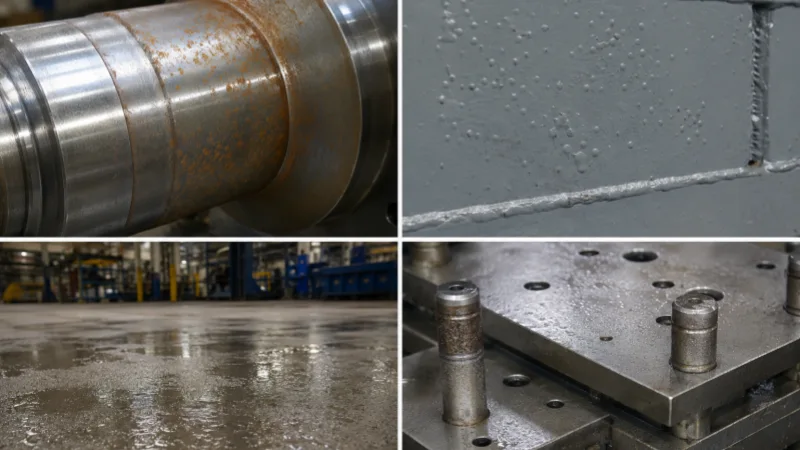
Flash Rust Between Operations
Freshly blasted or cleaned carbon steel has little protection against corrosion. It can begin showing flash rust while waiting for primer or between washing, drying, machining, and packing. The American Galvanizers Association notes that corrosion of carbon steel occurs when relative humidity is 70% to 80% and the air temperature is above 32 °F.
That does not make 60% RH a universal corrosion threshold. For general workshop control, below 60% RH can be used as a practical starting ceiling. The appropriate limit still depends on surface condition, exposure time, temperature, contamination, and the atmosphere inside the plant. Coastal salt, road salt, sulphates, and acidic fumes may require lower humidity because contamination can retain moisture on the metal surface.
Coating and Paint Defects
If steel is below the surrounding air dew point, moisture can form on the surface before coating. Painting over that moisture can contribute to poor adhesion, blistering, blooming, and premature coating failure. High humidity can also slow the drying of water-based coatings.
There is no universal workshop RH number for every coating system. Temperature, airflow, substrate temperature, film thickness, recoat time, and dew-point limits all matter, so the coating manufacturer’s product data sheet should remain the controlling specification.
Sweating Floors and Forklift Safety
A wet factory floor does not always mean there is a leak. When warm humid air enters a building while the concrete slab is still cold, moisture can condense directly onto the floor. This commonly appears around loading areas or during seasonal weather changes.
Wet slabs can affect pedestrian safety and forklift traction, particularly on smooth or sealed floors. Under 29 CFR 1910.22(a)(2), workroom floors are to be maintained in a clean and, to the extent feasible, dry condition.
Tooling, Dies, and Control Cabinets
Machine ways, gauges, dies, tooling, motor terminals, and electrical enclosures may remain cooler than the surrounding air. If their surface temperature falls below the air dew point, condensation can form. Even without visible droplets, prolonged high humidity can increase corrosion risk on exposed metal.
Welding consumables are a separate moisture-sensitive case. Low-hydrogen electrodes still require heated storage according to the manufacturer’s requirements. Room dehumidification can improve the surrounding storage environment, but it does not replace a rod oven or heated quiver. See Lincoln Electric’s guidance on storing and redrying electrodes.
Why Dew Point Matters for Cold Surfaces
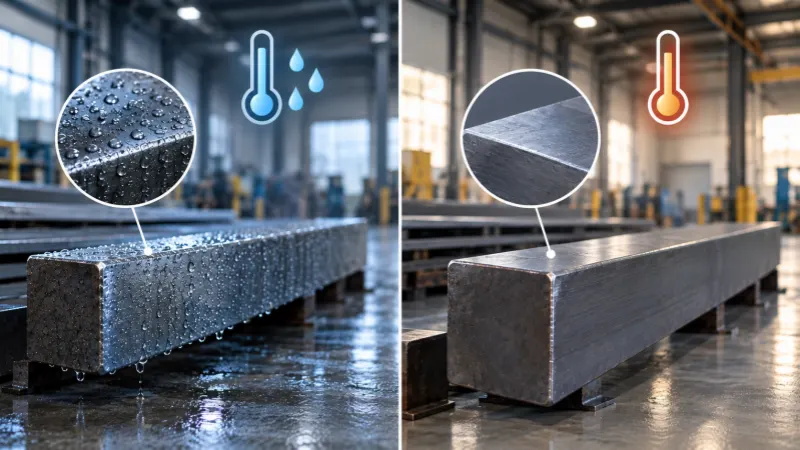
If water is appearing on steel, a floor slab, a mould, or another cold surface, RH alone does not tell the whole story. Relative humidity changes with air temperature. Condensation depends on a different comparison:
Is the surface temperature above or below the air dew point?
Why 50% RH Can Still Cause Condensation
Suppose steel arrives at 5 °C and is moved into a workshop at 22 °C and 50% RH. The air dew point is approximately 11 °C.
The room RH looks moderate, but the steel is still below the dew point, so moisture can condense until the material warms above it. The same principle applies to concrete slabs. A ground-coupled floor can warm much more slowly than the room air, leaving the RH gauge looking acceptable while the slab is wet.
Keep the Surface Above the Dew Point
The Unified Facilities Guide Specification for high-performance coating of steel structures requires the contractor to maintain steel surface temperature more than 3 °C (5 °F) above the dew point of the ambient air during specified coating operations and early cure.
The wider principle is simple:
If condensation must be prevented, the vulnerable surface needs to stay above the air dew point, with whatever safety margin the process requires.
There are two ways to increase that margin:
- warm the surface;
- lower the dew point of the air.
Heating helps when it actually warms the slab or metal. Simply heating the air lowers the displayed RH without removing water vapour. Dehumidification removes water from the air and lowers the dew point, which is why it is effective when cold surfaces are the problem. For chilled moulds, see preventing mold sweating in injection molding.
Where the Moisture Is Coming From
Once the problem is clear, identify where the water is coming from. A larger dehumidifier is not always the best first solution.
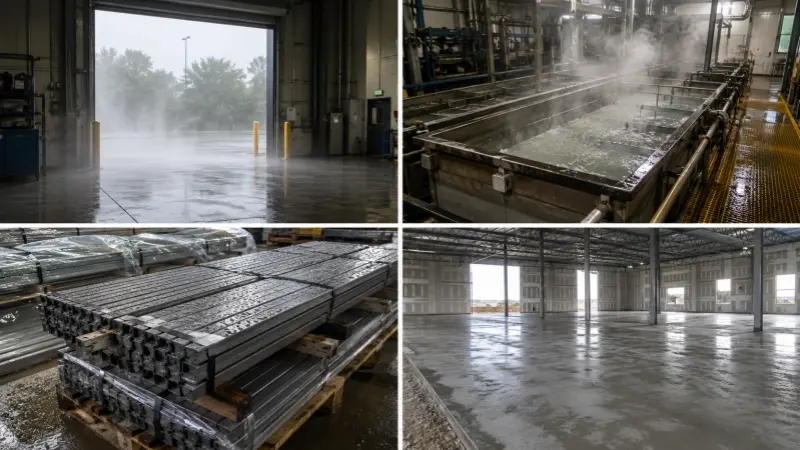
Infiltration Through Doors and Exhaust
Loading doors, damaged seals, building gaps, and negative pressure from process exhaust can continuously bring humid outdoor air inside. A dehumidifier sized for a closed building may run continuously and still fail if a large door remains open during humid weather. Where practical, reduce infiltration first with better seals, rapid doors, strip curtains, vestibules, or properly balanced make-up air.
Process Moisture
Workshop processes can add substantial moisture from:
- cutting and grinding fluids;
- open rinse and pretreatment tanks;
- wet parts;
- washdown;
- wet floors;
- and process exhaust returned to the building.
Where one process is the dominant source, check whether it can be covered, contained, or locally exhausted before increasing room dehumidification capacity.
Wet or Cold Incoming Material
Rain-exposed steel, wet pallets, and damp packaging can bring liquid water directly into the workshop. Cold material creates a different problem. Even when dry outdoors, steel arriving below the indoor dew point can begin collecting condensation as soon as it enters the room.
Temporary Construction Moisture
Fresh concrete and wet construction materials can release substantial moisture during initial dry-out. That load is temporary. Permanent equipment should therefore be checked against normal long-term operation rather than sized only for the construction or commissioning period.
What Conditions Should You Control To?
Different areas may require different conditions.
| Area or operation | Starting control approach | Why |
|---|---|---|
| Blasted or cleaned steel awaiting coating | Maintain the surface-to-dew-point margin required by the coating specification | Prevent condensation and flash rust |
| Coating and flash-off area | Follow the coating manufacturer’s temperature, RH, dew-point, ventilation, and recoat limits | Coating performance depends on the complete process |
| General machining, assembly, metal stock, and tooling | Below 60% RH as a practical starting ceiling | Reduces prolonged high-humidity exposure |
| Coastal, salt-contaminated, or chemically aggressive areas | A lower ceiling may be required; 45–50% RH can be an initial range where appropriate | Contamination can retain moisture at lower RH |
| Low-hydrogen welding consumables | Follow the manufacturer’s heated-storage requirements | Room dehumidification is supplementary |
| Cold floor slabs | Keep air dew point below slab temperature | Prevents floor condensation |
| Chilled fixtures or tooling | Keep air dew point below the coldest vulnerable surface | Prevents condensation |
These values are starting points, not universal specifications. A general fabrication hall, coating-preparation zone, tool room, and chilled process do not necessarily need the same condition.
What Determines Dehumidifier Capacity?
Knowing the target condition still does not tell you how large the dehumidifier needs to be. Capacity depends on how much moisture enters or is generated inside the controlled zone. Before asking for a recommendation, collect:
| Input | Why it matters |
|---|---|
| Floor area and clear height | Helps define volume, air distribution, and pull-down requirements |
| Insulation and heating status | Affects temperature, surface conditions, and equipment selection |
| Door size and open time | Can be one of the largest outdoor-air moisture loads |
| Shift pattern | Affects operating and recovery time |
| Process water sources and open tanks | Defines internal moisture generation |
| Exhaust and make-up air | Determines how much humid replacement air enters |
| Current temperature and RH | Establishes the starting condition |
| Target condition | Defines the control duty |
| Coldest surface temperature | Required for condensation control |
| Outdoor design conditions | Defines the peak outside-air load |
Two workshops with the same floor area can therefore need very different equipment. Capacity should also be compared at the actual operating temperature and RH, not only at the manufacturer’s headline rating condition. For the calculation itself, see what size industrial dehumidifier you need.
Refrigerant or Desiccant?
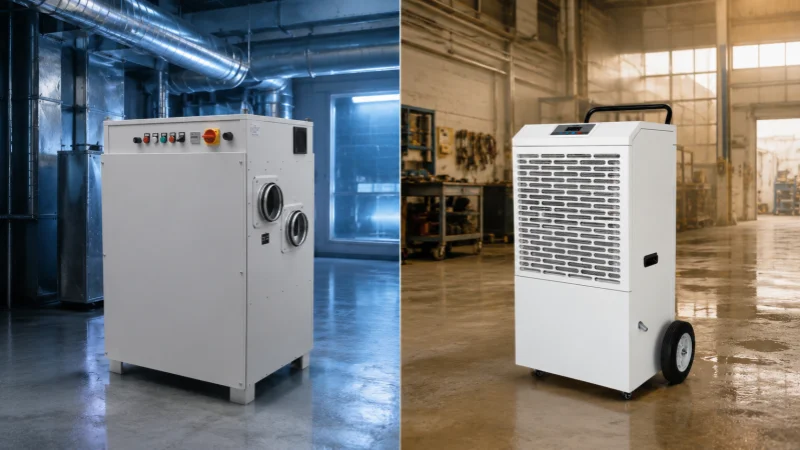
Once the moisture load and target condition are known, technology selection becomes much simpler.
Refrigerant dehumidifiers cool air below its dew point so water condenses on the coil. They are generally the first option for warm, humid production areas. Their moisture-removal capacity falls as the entering air becomes colder or drier, so the manufacturer’s published operating and performance range should be checked against actual workshop conditions.
Desiccant dehumidifiers remove moisture with a desiccant rotor and remain effective at lower temperatures and lower dew points. A practical starting rule is:
- Warm, heated workshop: evaluate refrigerant equipment first.
- Cold or partly heated workshop: check whether refrigerant equipment can still operate effectively at the lowest expected temperature.
- Low-dew-point process: evaluate desiccant equipment, usually with a more tightly controlled enclosure or zone.
If a refrigerant unit repeatedly frosts, first rule out dirty filters, restricted airflow, fan problems, or refrigeration faults. If the unit is working correctly but the entering condition is outside its operating range, the application may require a different design or technology.
For more detail, see refrigerant vs desiccant dehumidifiers.
Treat the Critical Zone, Not Automatically the Whole Hall
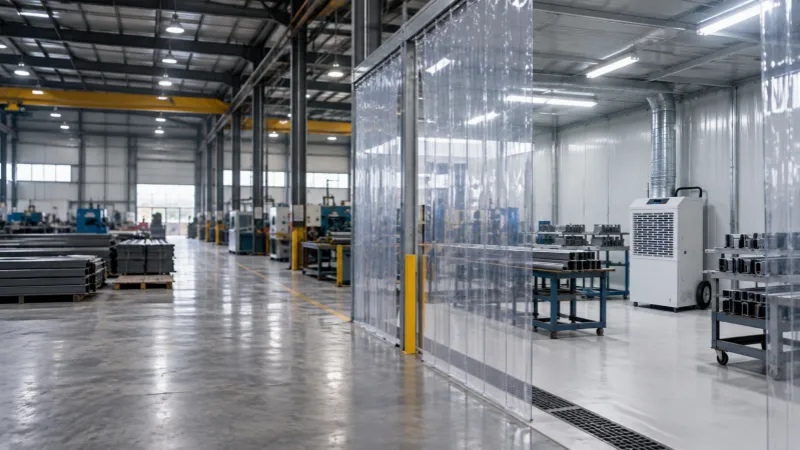
The whole factory does not necessarily need the same condition. A coating-preparation bay or tool room may need tighter control than the surrounding fabrication hall. Pulling the entire building down to the most demanding requirement can unnecessarily increase equipment capacity, energy use, and installation cost. Treating the critical zone separately is often more practical.
Air Distribution Inside the Zone
Dry air still has to reach the surfaces that matter.
Deliver conditioned air toward condensation-critical areas. Cold stock racks, dock-side slabs, tooling areas, and poorly mixed corners need exposure to controlled air.
Control concentrated moisture sources locally where practical. Open rinse tanks and wash stations should first be evaluated for covers, exhaust, or containment. Blowing high-velocity air directly across an open water surface can increase evaporation.
Avoid short-circuiting the airflow. Supply and return points should be arranged so air crosses the controlled zone before returning to the unit.
For more detail, see dehumidifier placement and sensor zoning.
When a Dehumidifier Is Not the Right Fix
Not every wet factory condition should be solved with a standard room dehumidifier.
Spray Booths and Hazardous Areas
Spray booths and solvent-processing areas may be classified as hazardous locations. A standard industrial dehumidifier should not be assumed suitable for installation inside them. Any equipment used in a classified area must be selected for that specific classification.
A Building That Cannot Be Closed
If large doors stay open for long periods, humid outdoor air may dominate the load. Reduce uncontrolled air exchange first, then calculate the dehumidification requirement.
Ground Moisture Coming Through the Slab
If moisture is rising through a slab because below-slab moisture protection is missing or damaged, dehumidification may reduce room humidity but does not fix the source.
When the Air Is Already Dry Enough
If the air dew point is already below the slab temperature, additional dehumidification may not solve the remaining floor problem. Air movement or controlled heating may be more useful.
Processes That Require a Low Dew Point
Low-dew-point processes often need desiccant dehumidification, a dedicated enclosure, controlled make-up air, and pressure management rather than a conventional room unit serving an open hall.
What to Confirm Before Ordering
If dehumidification is the right solution, confirm four items before production.
Power Supply
Confirm voltage, phase, frequency, rated current, protection, and connection method at the actual installation point. For the full electrical specification process, see industrial dehumidifier voltage, phase, and frequency requirements.
Continuous Drainage
Choose gravity drainage or a condensate pump and confirm the actual discharge route, lift, distance, and overflow protection before installation.
Filtration and Coil Protection
Workshop air may contain metal fines, grinding dust, oil mist, coolant aerosol, or corrosive fumes. Check the required filtration, service access, and whether the heat exchanger needs additional corrosion protection.
Controls and Monitoring
Decide whether the unit will use its own humidistat, an external sensor, dew-point control, or a plant monitoring system. If condensation on a slab or cold metal is the real concern, RH alone may not be enough. The control system needs enough information to compare air dew point with the critical surface temperature.
Next Step
Do not select a workshop dehumidifier by floor area alone. Send the key site conditions — room size and height, door opening, process moisture sources, exhaust arrangement, current temperature and RH, target condition, coldest surface temperature, and outdoor design conditions — so the system can be sized against the actual moisture load.
Rinwang supplies industrial dehumidifiers for workshop and factory applications. Send your site details for an application review.
Frequently Asked Questions
Is a workshop dehumidifier different from residential units?
Yes. Workshop units are built for higher moisture loads, longer operating hours, continuous drainage, and harsher environments than typical residential dehumidifiers.
Do industrial dehumidifiers use a lot of electricity?
Power use varies by capacity, runtime, temperature, and moisture load. Larger industrial units draw more power, but proper sizing and control reduce unnecessary operating hours.
What type of maintenance is required for industrial units?
Typical maintenance includes cleaning or replacing filters, inspecting coils, checking drainage, and periodic servicing. Dirty airflow paths can reduce moisture-removal capacity and efficiency.
Is installation complicated for industrial dehumidifiers?
Portable units are usually simpler to install, while fixed or ducted systems require planned drainage, electrical supply, airflow, and professional commissioning.