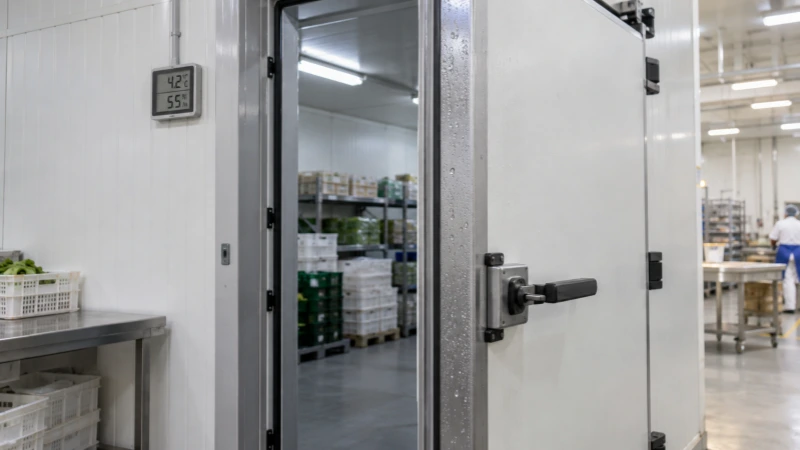
A room can show 55% relative humidity and still have water forming on a cold pipe, door frame or wall panel. The humidity sensor may be working normally. The problem is that relative humidity tells you how humid the air is at its current temperature, but it does not directly tell you whether a colder surface will stay dry.
For that, dew point is more useful. If the temperature of a surface falls below the dew point of the surrounding air, moisture can condense on it. This is why dew point matters in cold rooms, chilled production areas, loading zones and other facilities where temperature and humidity do not stay uniform. This guide explains what dew point means, when it matters more than RH, how to set a practical target, and what information a dehumidifier supplier needs before recommending equipment.
What Is Dew Point?
Dew point is the temperature at which the moisture already in the air begins to condense as the air is cooled. The US National Weather Service defines it as the temperature to which air must be cooled, at constant pressure, to reach saturation.
A simple example is a cold drink taken out of a refrigerator. Water appears on the outside of the glass even though the glass is not leaking. The air around it contains water vapour, and when that air touches a surface colder than its dew point, some of the vapour turns into liquid water.
Dew point is useful because, at roughly the same pressure, it gives a clearer picture of how much moisture is actually in the air. If you simply heat a room without adding or removing water, the RH falls but the dew point stays almost unchanged. Heating can therefore make an RH reading look better without actually making the air drier.
Dew Point vs. Relative Humidity
Relative humidity and dew point answer different questions. Relative humidity tells you how close the air is to saturation at its current temperature. Dew point tells you how much moisture the air contains and how cold a surface can become before condensation becomes a risk.
| Question | Better value to look at | Why |
|---|---|---|
| Is stored material within its required humidity range? | Relative humidity | Many storage specifications are written as RH |
| Did the air actually become drier? | Dew point | Heating alone can reduce RH without removing moisture |
| Will a cold pipe or door frame sweat? | Dew point + surface temperature | Condensation depends on whether the surface falls below the dew point |
| Does a process meet its humidity requirement? | The value named in the process specification | Requirements may be expressed as RH, dew point or another moisture value |
For example, air at 18°C and 80% RH has a dew point of about 14.4°C. If that same air is heated to 26°C without removing moisture, the RH falls to roughly 49%. Looking only at RH, the room appears much drier. But its dew point is still about 14.4°C. A pipe or door frame at 10°C can therefore still collect condensation. If you want a fuller explanation of how temperature changes RH, see our relative humidity guide.
Why Surface Temperature Matters

For condensation control, the room dew point is only half of the problem. You also need to know how cold the surfaces in the room become.Suppose the air dew point is 12°C. A wall at 20°C stays dry, while a chilled pipe at 7°C can become wet. A metal door frame at 10°C may also collect condensation even though the RH reading in the centre of the room appears acceptable.
This is why the coldest important surface usually determines the condensation requirement. In industrial buildings, this may be a cold-room panel, metal frame, refrigerant line, structural thermal bridge, concrete slab or refrigerated machine surface.
The practical rule is simple:
If the surface temperature falls below the surrounding air dew point, condensation can occur.
Dehumidification is only one part of the solution. If the cold surface is caused by poor insulation, damaged vapour barriers, thermal bridging or uncontrolled outdoor-air leakage, those problems should also be addressed. Our guides to cold storage condensation and loading dock condensation cover these causes in more detail.
When Should You Use RH and When Should You Use Dew Point?
Not every facility needs dew point control. In an ordinary warehouse with stable temperature and no unusually cold surfaces, RH is often easier to use and entirely adequate.
Dew point becomes more useful when the main concern is condensation, actual moisture content or a process that operates across changing temperatures.
| Site condition | Usually more useful | Reason |
|---|---|---|
| Stable warehouse or production area | RH | Product and storage limits are commonly written as RH |
| Cold-room entrance or chilled equipment | Dew point | The main risk is condensation on cold surfaces |
| Room temperature changes significantly | Dew point, if actual moisture is the concern | RH changes even when no water is removed |
| Product specification requires a defined RH band | RH | The product requirement still has to be met |
| Very dry industrial process | Dew/frost point | It gives a clearer indication of low moisture levels |
| Facility has both product and condensation requirements | Both | RH protects the product; dew point helps protect cold surfaces |
Temperature change alone does not mean RH should be abandoned. If a stored product must remain between 45% and 55% RH, that requirement still applies. Dew point becomes an additional control value when cold surfaces or process conditions create another risk.
For general warehouse targets, see our guide to warehouse humidity levels.
How to Set a Dew Point Target

A useful dew point target should come from the actual site rather than from a generic chart. For condensation control, the starting point is the coldest surface that must remain dry.
1. Find the Coldest Important Surface
Look for the location where condensation is most likely to occur. This may be a cold-room door frame, chilled pipe, panel joint, concrete floor or cold machine component.
You are not looking for the average room temperature. You are looking for the lowest surface temperature that matters to the operation.
2. Measure It Under Real Operating Conditions
A surface that is normally 12°C may fall to 8°C during refrigeration pull-down, heavy door traffic or particular outdoor conditions. A single measurement during a quiet period may therefore miss the real risk.
Measure the surface across the operating conditions that matter and consider instrument accuracy and temperature differences between different points. Where the margin is small, contact measurement is often more reliable than infrared measurement on shiny metal surfaces.
3. Keep the Dew Point Below That Surface Temperature
If repeated measurements show that the surface can fall to about 8°C, a dew point target of exactly 8°C leaves no allowance for sensor error, control deadband or short-term moisture changes.
The target should therefore be set below the lowest credible surface temperature by an appropriate operating margin. If the project uses a 2°C margin, for example, the maximum dew point would be around 6°C.
The basic relationship is:
Maximum dew point < minimum critical surface temperature
There is no single safety margin that suits every site. A stable enclosed room may need less allowance than a loading dock with frequent door opening and rapidly changing moisture loads.
4. Check the Product or Process Requirement
Condensation may not be the only limit. A coating, powder, adhesive, electronic component or stored material may already have its own humidity requirement.
If one requirement is given in RH and another in dew point, the two values should not be compared directly. They need to be compared at the actual operating temperature so the project team can determine which condition requires drier air.
A dehumidifier supplier can then check whether equipment can achieve that condition, but deciding the controlling surface temperature, building corrections and final safety margin remains a project engineering responsibility.
How Is Dew Point Measured?
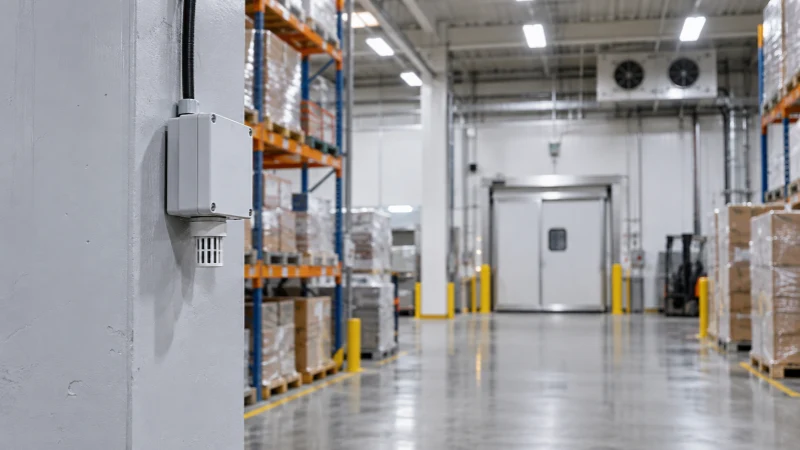
In many industrial facilities, dew point is not measured directly. A sensor measures air temperature and relative humidity and then calculates dew point. For ordinary warehouses and production spaces, this is usually a practical method.
As conditions become extremely dry, measurement becomes more difficult. Small RH errors can create larger uncertainty in the calculated dew point, which is why low-humidity processes may use instruments designed specifically for dew or frost point. Vaisala explains this issue in more detail.
Sensor location matters just as much as sensor type. A transmitter in the centre of a room may represent average conditions but fail to show what is happening near a cold-store entrance or dock door. If condensation is localised, the measurement point should represent the air around that risk area. Calibration should also be documented where readings are used for commissioning, quality control or contractual acceptance.
What Determines the Dew Point You Can Reach?

Once the target is known, the next question is whether the facility can actually maintain it. Two things matter: how much moisture keeps entering the space and what the selected equipment can do under the real operating condition.
Outdoor air entering through doors, ventilation imbalance, damaged seals, washdown, wet products and production processes can all add moisture continuously. If one of these loads is excessive, installing a larger dehumidifier without correcting the source may simply increase energy use while the underlying problem remains.
The normal approach is therefore to reduce avoidable moisture loads first and then size the equipment for what remains. Door management, vapour-barrier repair, pressure control and source capture can sometimes reduce the required dehumidification capacity significantly.
Refrigerant or Desiccant Dehumidification?
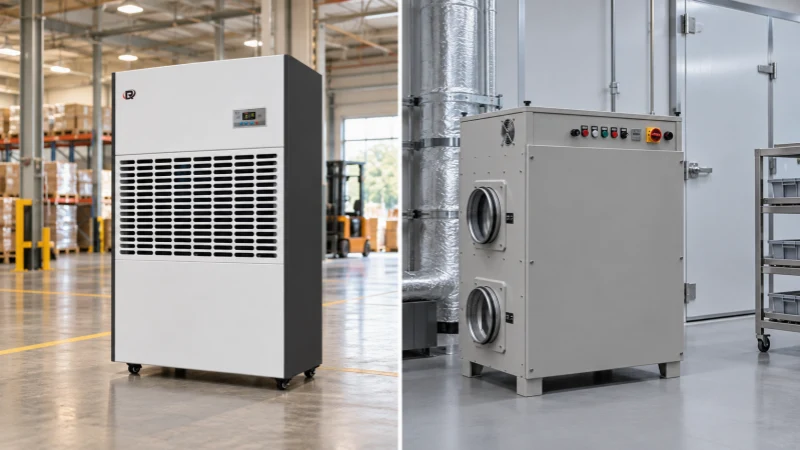
A refrigerant dehumidifier cools air below its dew point so that water condenses on a cold coil. This approach is often efficient in warmer rooms with moderate humidity requirements.
As the entering air becomes colder and drier, however, refrigerant dehumidification becomes less effective. There is less water available to condense, and the evaporator has to operate within a practical temperature range without excessive frosting.
A larger refrigerant unit can help when the existing system simply lacks moisture-removal capacity. But if the problem is that the required dew point is approaching the practical limit of the refrigeration process, adding more of the same equipment does not automatically produce much drier air.
Desiccant dehumidifiers remove moisture by adsorbing water vapour onto a drying material and regenerating it with heat. They are therefore commonly considered for lower-temperature or lower-dew-point applications.
There is no universal dew point at which every project should change technologies. The decision depends on inlet temperature, inlet humidity, target dew point, airflow, moisture load, operating hours and energy strategy. Our refrigerant vs desiccant dehumidifier guide covers this decision in more detail.
Whichever technology is used, the headline L/day or kg/h rating should not be treated as the capacity the machine will deliver under every condition. A unit rated at 30°C and 80% RH will normally remove much less water in a 15°C room approaching 50% RH.
For this reason, equipment should be checked at the actual design condition. See our guides to industrial dehumidifier sizing and industrial dehumidifier selection for more detail.
What Should Be Written Into a Dew Point Specification?
A specification that only says “maintain 6°C dew point” is incomplete. The supplier still needs to know the room temperature, inlet humidity, moisture load and where the condition will be measured.
A useful specification should include:
| Information | Why it matters |
|---|---|
| Target dew point | Defines how dry the air must be |
| Maximum value or control range | Shows how tightly the condition must be maintained |
| Room temperature range | Strongly affects equipment performance |
| Design inlet temperature and humidity | Allows equipment to be compared under the same condition |
| Moisture load and main sources | Determines required removal capacity |
| Coldest critical surface temperature | Explains how the target was selected |
| Measurement method and sensor location | Defines how performance will be checked |
| Acceptance and logging period | Defines what counts as successful operation |
| Atmospheric or pressure dew point | Prevents room-air and compressed-air specifications being confused |
The final point is particularly important. Compressed-air dryers are often specified using pressure dew point, including classifications under ISO 8573-1:2010. That is not the same as an atmospheric room-air dew point.
A −40°C pressure dew point from a compressed-air specification should therefore not be copied directly into a room dehumidification requirement without first confirming what the project actually means.
Check the Requirement Before Comparing Equipment
If a facility has condensation even though the RH looks acceptable, the first step should not be to buy a larger dehumidifier. Identify where the water appears, measure how cold that surface becomes, determine what dew point would keep it dry, and estimate how much moisture is entering the space.
Once the room temperature range, target dew point, moisture load and operating conditions are known, a dehumidifier supplier can evaluate whether refrigerant equipment is suitable, whether a desiccant system should be considered, and what performance can realistically be expected. See our industrial dehumidifier range or send us your site conditions and target for review.
Frequently Asked Questions
How is dew point calculated from temperature and humidity?
Dew point is commonly calculated from air temperature and relative humidity using the Magnus equation. Most modern industrial humidity transmitters perform this calculation automatically.
What is the difference between dew point temperature and wet bulb temperature?
Dew point shows when condensation begins, while wet-bulb temperature represents cooling caused by evaporation. Both approach the dry-bulb temperature as air reaches saturation.
Does air pressure or altitude affect the dew point?
Yes. Pressure can affect dew point calculations, although the effect is usually small in normal buildings and becomes more important at altitude or in pressurised systems.
How do you calculate relative humidity from dew point?
Relative humidity can be calculated from air temperature and dew point using their saturation vapour pressures. Most psychrometric calculators perform this conversion automatically.
What is a comfortable dew point?
For human comfort, dew points below about 13°C generally feel comfortable. Higher dew points increasingly feel humid, although comfort also depends on temperature and air movement.