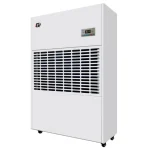
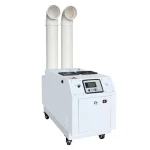
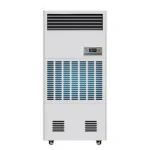
Laboratory humidity problems do not look the same in every room. A balance room may have unstable readings or powders sticking to containers. An instrument room may develop condensation around chilled pipes or optical components. A reagent store may have damp labels, clumped materials or corroded containers.
These rooms also do not need the same dehumidifier. An enclosed storage or instrument room may be controlled effectively with a stand-alone unit. A balance room may need quieter equipment with low air velocity. A conditioning room may require coordinated temperature and humidity control rather than dehumidification alone.
A laboratory with high continuous exhaust is one important exception. Humid replacement air may enter faster than a room unit can remove the moisture. In that case, the exhaust and incoming-air load must be included in the equipment selection.
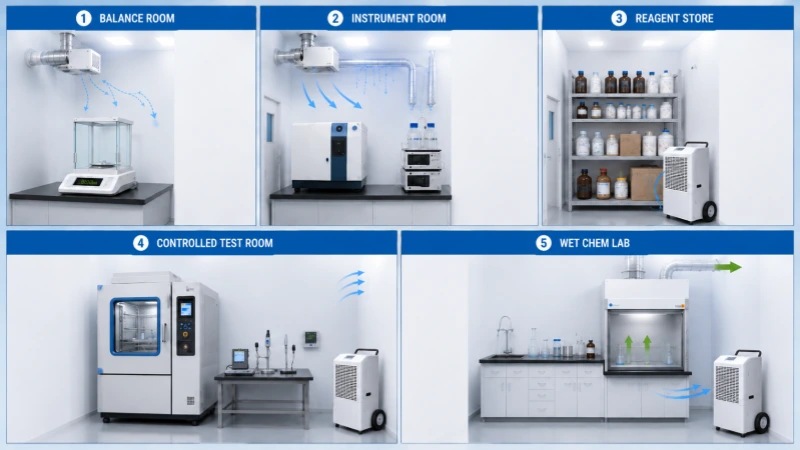
The following table gives a quick starting point.
| Laboratory condition | First solution to evaluate |
|---|---|
| Enclosed balance, instrument or storage room | Stand-alone or ducted dehumidifier |
| Limited floor space or sensitive workstations | Ceiling-mounted or remotely ducted unit |
| Narrow temperature and RH tolerance | Temperature-resistant dehumidifier |
| Low operating temperature | Low-temperature or desiccant system |
| Low dew-point requirement | Desiccant or hybrid system |
| High continuous exhaust | Include exhaust and replacement-air moisture in the selection |
What Humidity Problems Occur in Laboratories?
Humidity problems are often first noticed through changes in laboratory work rather than through the RH display.
Typical signs include:
- Condensation on chilled pipes or instrument surfaces
- Fogging on lenses, windows or optical components
- Powders sticking to containers or becoming difficult to transfer
- Unstable balance readings
- Damp labels, cartons or sample records
- Clumping of moisture-sensitive powders
- Corrosion on exposed metal parts
- A dehumidifier running continuously without reaching the target
- RH rising quickly after doors open
- Room temperature increasing while RH falls
The visible symptom does not always identify the real cause.
Condensation may result from high room dew point, a very cold surface or both. A continuously running unit may be undersized, but it may also be operating at a colder or drier condition than its catalogue rating. RH may remain high because doors open frequently or because humid air enters through the ventilation system.
The equipment should therefore be selected from the room condition and moisture source—not from the symptom alone.
What RH Range Should the Laboratory Maintain?
There is no universal RH setting for every laboratory.
A reagent store may need only an upper RH limit. A balance room may require both upper and lower limits. A conditioning room may need a narrow temperature-and-RH range throughout the year.
Set the RH Target From the Laboratory Work
Start with the requirements that directly affect the activity:
- Test or conditioning method: Does it specify a temperature and RH range?
- Instrument instructions: What operating limits does the equipment manufacturer require?
- Sample specification: Is the material hygroscopic, moisture-reactive or condensation-sensitive?
- Chemical documentation: Could humidity affect storage, stability or safe handling?
- Laboratory SOP: What conditions trigger an alarm, investigation or retest?
- Static-control requirements: Could low RH affect weighing, powder transfer or electronics?
- Recovery requirement: How quickly must the room return to range after a door opens?
Why Lower RH Is Not Always Better
High RH can cause condensation, fogging, corrosion and moisture absorption by samples, powders and packaging.
Excessively low RH can create a different set of problems:
- Increased static accumulation
- Powders adhering to containers
- Unstable weighing
- Inconsistent powder transfer
- Static-related risks around sensitive electronics
The target is not the lowest RH the dehumidifier can achieve.
The target is a stable range that protects the test, sample and instrument without creating a new low-humidity problem.
Compliance note:
ISO/IEC 17025 requires laboratories to control environmental conditions when those conditions affect laboratory activities or result validity. It does not prescribe one RH value for every laboratory, and it is not a product certification for a dehumidifier.
Where Does a Stand-Alone Laboratory Dehumidifier Work Best?
A stand-alone dehumidifier is generally most effective when:
- The room is enclosed.
- Air can recirculate.
- Continuous exhaust is limited.
- Doors normally remain closed.
- The target is within the unit’s operating range.
- The room cooling system can absorb the heat released by the unit.
- The equipment can drain continuously.
Different laboratory rooms still require different equipment characteristics.
| Laboratory space | Typical problem | Stand-alone unit suitability | Main selection focus |
|---|---|---|---|
| Wet chemistry laboratory | RH rises during hood operation | Conditional | Exhaust and replacement-air load |
| Balance or weighing room | Static, unstable readings, powder adhesion | Often suitable | Low airflow, quiet operation and stable control |
| Analytical instrument room | Condensation near chilled lines or optics | Often suitable | Heat output and instrument limits |
| Reagent or sample-storage room | Damp labels, clumping and corrosion | Usually suitable | Continuous control and material protection |
| Conditioning or controlled test room | Temperature and RH leave a narrow band | Partially suitable | Coordinated temperature and humidity control |
| Laboratory cold-room anteroom | Fog, wet floors and frost | Suitable with correct equipment | Low-temperature capacity and defrost |
| Low-dew-point process room | RH target cannot be maintained by refrigeration alone | Limited | Desiccant or hybrid system |
Wet Chemistry Laboratories
A wet chemistry laboratory may contain sinks, washing processes, open water sources and ducted fume hoods.
A room dehumidifier may be suitable when the moisture problem is local and the room has limited continuous exhaust.
However, if RH rises mainly while the fume hoods operate, humid replacement air may be the dominant load. The room unit can still support local control, but the exhaust airflow and incoming-air condition must be included in the capacity review.
Under OSHA’s Laboratory Standard, laboratory hoods are protective devices used to draw contaminated air away from the work area. A dehumidifier must not disturb the airflow needed for safe containment.
When requesting equipment selection for a wet laboratory, provide:
- Number of fume hoods
- Exhaust airflow, if available
- Hood operating schedule
- Room dimensions
- Target temperature and RH
- Outdoor design condition
- Internal wet processes
- Door-opening frequency
A larger room unit should not be selected until these loads are understood.
Balance and Weighing Rooms
Balance rooms are often good candidates for stand-alone or ducted dehumidification because they are usually enclosed and have limited continuous exhaust.
The main requirement is stable control—not maximum moisture-removal capacity.
A poorly positioned or oversized unit may create:
- Air movement across the weighing pan
- Local temperature changes
- Noise and vibration
- Short cycling
- RH below the acceptable lower limit
- A stable reading near the sensor but unstable conditions at the balance
A suitable balance-room dehumidifier should provide:
- Low air velocity near the workstation
- Quiet operation
- Stable temperature and RH
- Adequate capacity turndown
- A representative control sensor
- Continuous drainage
The dry-air outlet should control the room without blowing directly across the balance.
Analytical Instrument Rooms
Instrument rooms may contain microscopes, mass spectrometers, X-ray systems, optical benches or other equipment with chilled surfaces and significant heat output.
Typical humidity problems include:
- Condensation on chilled-water pipes
- Fogging on lenses or optical components
- Moisture near cold stages
- RH increasing after instruments shut down
- Condensation following door opening
A stand-alone or ducted dehumidifier may be suitable when the room can recirculate air.
The selection must also account for:
- Instrument heat output
- Available room cooling capacity
- Manufacturer temperature and RH limits
- Airflow around sensitive equipment
- Noise and vibration
- Condensate drainage
- Alarm requirements
A dehumidifier that lowers RH but pushes the room temperature outside the instrument’s operating range has not solved the environmental problem.
The instrument manufacturer’s environmental limits should take priority over a generic laboratory RH recommendation.
Reagent and Sample-Storage Rooms
Enclosed reagent and sample rooms are often among the strongest applications for independent dehumidification.
Moisture commonly enters through:
- Door opening
- Humid adjacent spaces
- Packaging brought into the room
- Small air leaks
- Moist materials or containers
Visible warning signs may include:
- Clumped powders
- Damp carton edges
- Wrinkled or detached labels
- Corroded metal containers
- Moisture-sensitive standards requiring frequent replacement
- RH rising rapidly after access
The target condition should come from:
- Supplier storage instructions
- Material specifications
- Safety data sheets
- Internal SOPs
- Sample-retention requirements
An enclosed support room normally needs a stable, continuously draining commercial dehumidifier rather than a small residential unit designed for intermittent use.
Where corrosive vapours may be present, review:
- Casing material
- Heat-exchanger protection
- Coil coating
- Electrical enclosure
- Fan and fastener materials
- Drainage components
Protective materials should match the chemicals actually present. Stainless steel or special coatings should not be specified only because the room is called a laboratory.
Conditioning and Controlled Test Rooms
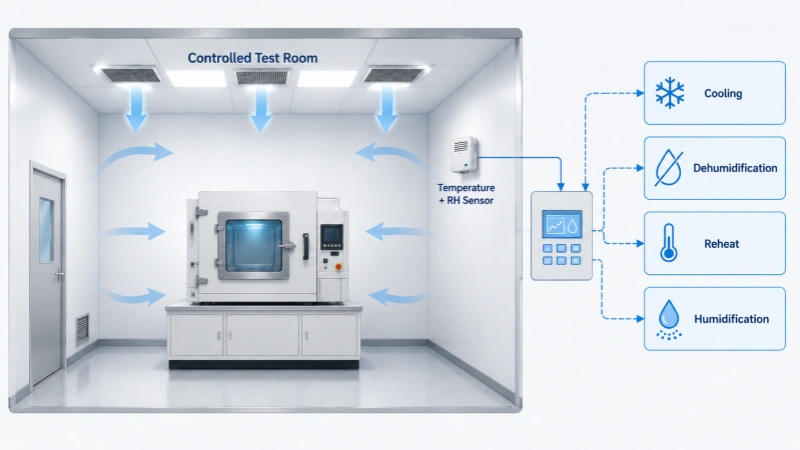
A controlled test room may need more than moisture removal.
The required condition may move in both directions:
- Dehumidification when RH is high
- Humidification when RH is low
- Cooling when room temperature rises
- Reheat after moisture removal
- Uniform airflow throughout the test area
ASTM D618, for example, covers conditioning practices for plastics before testing. It demonstrates why the required environmental condition should come from the test method rather than a universal laboratory setting.
A conventional dehumidifier can reduce RH but cannot correct an overly dry room.
Rooms requiring coordinated cooling, moisture removal and temperature stabilization are better suited to temperature-resistant dehumidifiers or a complete temperature-and-humidity control system.
Laboratory Cold-Room Anterooms
When a laboratory cold-room or freezer door opens, warm humid air enters and contacts colder surfaces.
This can cause:
- Fog near the doorway
- Water on the floor
- Frost around door seals
- Ice on frames
- Slippery access zones
- Longer defrost cycles
The unit should not be selected from its capacity at a warm catalogue condition.
The buyer should verify:
- Minimum operating temperature
- Defrost method
- Moisture-removal capacity at the actual temperature and RH
- Door-opening recovery time
- Continuous drainage
- Low-temperature sensor performance
A purpose-built low-temperature dehumidifier is more reliable near refrigeration temperatures than a standard unit that may lose capacity or develop coil icing.
Which Type of Laboratory Dehumidifier Should You Choose?
The correct configuration depends on room temperature, RH target, airflow, floor space and required control accuracy.
| Dehumidifier type | Suitable laboratory applications | Main limitation | Key buyer question |
|---|---|---|---|
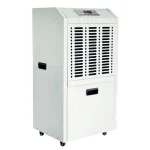
| Stand-alone refrigerant dehumidifier | Enclosed storage, instrument and support rooms | Adds heat to the room | Can the room cooling system absorb the heat output? |
| Ducted dehumidifier | Balance rooms, instrument rooms and multi-point airflow layouts | Requires ductwork and service access | Can dry air be distributed without disturbing workstations? |
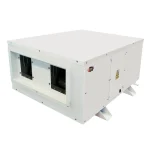
| Ceiling-mounted dehumidifier | Rooms with limited floor space | Installation and maintenance access must be planned | Can the unit be drained and serviced safely? |
| Temperature-resistant dehumidifier | Conditioning rooms and temperature-sensitive test spaces | More complex controls | How are cooling, moisture removal and reheat coordinated? |
| Low-temperature dehumidifier | Cold rooms and cold-room anterooms | Capacity must be verified at low temperature | What is the actual-condition capacity and defrost method? |
| Desiccant dehumidifier | Low temperature or low dew-point applications | Regeneration energy and integration complexity | Does the room require a lower dew point than refrigerant equipment can maintain? |
Stand-Alone Refrigerant Dehumidifiers
Stand-alone refrigerant units are generally suitable when:
- The room is enclosed.
- Air can recirculate.
- The operating temperature is within the unit’s specified range.
- The RH target is moderate.
- The room cooling system can absorb the unit’s heat.
- Noise and airflow are acceptable.
They are often practical for:
- Reagent stores
- Sample rooms
- Instrument rooms
- Balance rooms
- Small QC laboratories
- Retrofit projects
The unit should include continuous drainage and controls suitable for unattended operation.
Ducted and Ceiling-Mounted Dehumidifiers
A ducted unit can be installed outside the controlled room or connected to several supply and return points.
This may be useful when:
- Direct airflow could disturb a balance.
- Equipment noise should remain outside the laboratory.
- Floor space is limited.
- The room requires more even air distribution.
- Maintenance should occur outside the work area.
Where floor-mounted equipment is impractical, ceiling-mounted dehumidifiers can save space. Drainage, maintenance clearance and access above the ceiling must be planned before installation.
One unit should not be connected casually to several laboratory rooms. Shared ductwork may create problems when the rooms have different:
- RH targets
- Pressure relationships
- Chemical risks
- Operating hours
- Temperature conditions
Rooms served by one unit should have compatible requirements and separate monitoring where necessary.
Temperature-Resistant Dehumidifiers
A standard refrigerant dehumidifier normally returns heat to the room.
That may be acceptable in a storage area, but it can become a problem in a balance room, instrument room or controlled test room.
A temperature-controlled system may be more suitable when:
- Temperature and RH must remain inside a narrow range.
- The laboratory already has a high internal heat load.
- Moisture removal causes unacceptable room-temperature rise.
- Cooling and reheat need to be coordinated.
- The test method specifies both temperature and RH.
The supplier should explain how the unit controls temperature during dehumidification and whether the cooling capacity includes the dehumidifier’s own heat output.
Low-Temperature and Desiccant Dehumidifiers
Refrigerant dehumidifiers lose capacity as entering-air temperature and RH decrease.
Low-temperature applications may therefore require:
- Hot-gas defrost
- Special coil control
- Low-temperature sensors
- Reduced-temperature performance data
- A desiccant system
Desiccant equipment becomes more relevant when the project requires a lower dew point or operates under conditions where refrigeration performance is limited.
The choice between refrigerant and desiccant dehumidifiers should be based on operating temperature, target dew point, outdoor climate and energy use—not on the word “laboratory” alone.
What Data Is Needed to Select the Right Capacity?
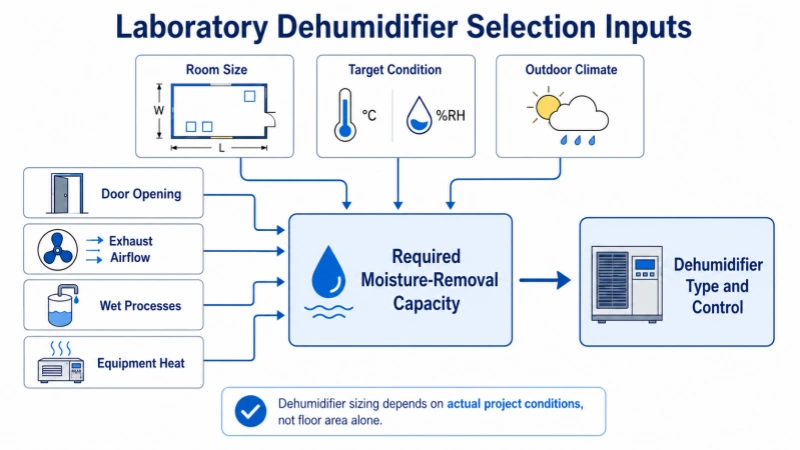
A laboratory dehumidifier should not be selected from floor area alone.
Two rooms with the same dimensions may have very different loads because of door opening, wet processes, exhaust airflow, equipment heat and target RH.
Reliable industrial dehumidifier sizing requires the actual project condition.
| Category | Information to provide | Why it matters |
|---|---|---|
| Room | Length, width, height and room function | Defines air volume and application |
| Current condition | Existing temperature and RH | Shows the starting condition |
| Target condition | Required temperature, RH or dew point | Defines the control objective |
| Outdoor climate | Design temperature and humidity | Affects infiltration and incoming air |
| Doors | Size and opening frequency | Determines moisture pulses |
| Exhaust | Airflow and operating schedule, if present | May add a continuous moisture load |
| Wet processes | Sinks, washing, open water or damp materials | Adds internal moisture |
| Instruments | Heat output and chilled surfaces | Affects cooling and condensation |
| Operation | Hours per day and recovery requirement | Influences capacity and controls |
| Controls | Alarms, BMS, Modbus or dry contacts | Defines the control package |
Allow for Recovery After Door Opening
A unit may hold the target while the room is closed but recover too slowly after normal access.
The buyer should define:
- Normal door-opening frequency
- Typical access duration
- Maximum acceptable RH excursion
- Required recovery time
Recovery performance is especially important in:
- Sample stores
- Reagent rooms
- Cold-room anterooms
- Controlled test rooms
- Laboratories with frequent staff movement
The selection should be based on both steady-state load and normal disturbances.
What Specifications Should Laboratory Buyers Verify?
Operating Temperature and Defrost
Check:
- Minimum operating temperature
- Defrost method
- Capacity reduction at lower temperatures
- Low-temperature restart behaviour
These points are particularly important for cold rooms and cold-room anterooms.
Heat Released Into the Room
An in-room refrigerant dehumidifier returns heat to the space.
Before selecting the unit, confirm:
- Total heat rejection
- Available room cooling capacity
- Maximum acceptable temperature rise
- Whether condenser heat can be rejected elsewhere
- Whether temperature-controlled equipment is required
Airflow and Noise
High airflow may disturb balances, open samples or powder-handling workstations.
Check:
- Supply-air velocity
- Fan-speed options
- Noise level
- Duct connection options
- Air-distribution layout
The highest airflow is not automatically the best airflow.
Sensor Accuracy and Control Tolerance
A statement such as “±1% RH” is incomplete without a definition.
It may refer to:
- Display resolution
- Sensor measurement accuracy
- Controller deadband
- Performance at one test point
- Whole-room uniformity
These values are not interchangeable.
Ask the supplier to define:
- Sensor accuracy
- Controller tolerance
- Expected steady-state fluctuation
- Calibration options
- External sensor capability
Drainage and Unattended Operation
For continuous control, check:
- Gravity drainage
- Condensate-pump option
- Drain-fault protection
- Automatic restart after power interruption
- High-RH alarm
- Equipment-fault alarm
Filtration and Corrosion Protection
Where the room contains powders, vapours or corrosive materials, confirm:
- Filter type and access
- Coil coating
- Casing material
- Electrical enclosure
- Fan and fastener material
- Cleaning requirements
A structured industrial dehumidifier selection should provide three clear results:
- The suitable equipment configuration
- The required capacity at the actual operating condition
- The controls and installation conditions needed to maintain the target
How Should a Laboratory Dehumidifier Be Installed and Tested?
Correct capacity cannot compensate for poor airflow or an unrepresentative sensor position.
Avoid Direct Airflow Across Sensitive Work
Do not direct dry air toward:
- Analytical balances
- Open samples
- Powder-handling stations
- Optical benches
- Sensitive probes
High local air velocity may interfere with laboratory work even when the average room RH is within range.
Prevent Supply and Return Air Short-Circuiting
Do not place the dry-air outlet immediately beside the unit inlet.
This can cause the same small volume of air to pass through the dehumidifier repeatedly while remote shelves, benches or corners remain humid.
Dry air should move through the controlled zone before returning to the unit.
Install the RH Sensor in a Representative Location
Avoid placing the control sensor:
- Directly in the dry-air discharge
- Beside a door
- On a cold exterior wall
- Above a sink
- Beside a heat-producing instrument
- In a stagnant corner
Critical rooms may use:
- A control sensor at a representative return-air location
- A verification sensor near the critical work or storage zone
- A risk-point sensor near a doorway or known condensation area
Test the Room Under Normal Operation
Do not accept the installation only because the unit switches on and produces condensate.
Verify the room while normal doors, instruments and exhaust systems are operating.
At minimum, record:
- Steady-state temperature and RH
- Differences between critical room locations
- Recovery after normal door opening
- Room-temperature change while the unit runs
- Drainage performance
- Alarm operation
- Restart after a power interruption
The final result should be based on room performance, not only on the humidity reading at the dehumidifier inlet.
What’s the Difference Between Dew Point and Relative Humidity?
Relative humidity changes with air temperature, while dew point reflects actual moisture content. For condensation-sensitive laboratories, dew point is often the clearer control limit.
What Is a Humidistat?
A humidistat measures room humidity and controls the dehumidifier around a setpoint. Critical laboratories should verify conditions with a separate calibrated humidity sensor.
Does a Humidistat Override a Thermostat?
It can request dehumidification even when room temperature is acceptable, depending on the control design. Coordinated controls prevent humidity correction from causing temperature excursions.
What Is the Average Lifespan of a Dehumidifier?
Service life depends on operating hours, maintenance, corrosion exposure and room conditions. Laboratory buyers should confirm replaceable components, spare-part availability and service support.
Do Dehumidifiers Help With Mold?
They reduce the moisture conditions that support mold growth, but do not remove existing contamination. Laboratories should correct leaks, condensation sources and affected materials separately.
The right laboratory dehumidifier depends on the room type, target RH and actual operating conditions. Stand-alone, ducted, temperature-controlled and desiccant systems suit different laboratory needs. Confirm the moisture load and room requirements before selecting a model.