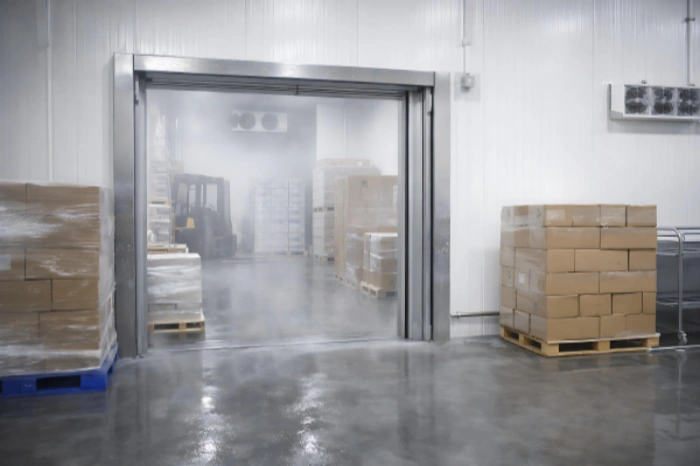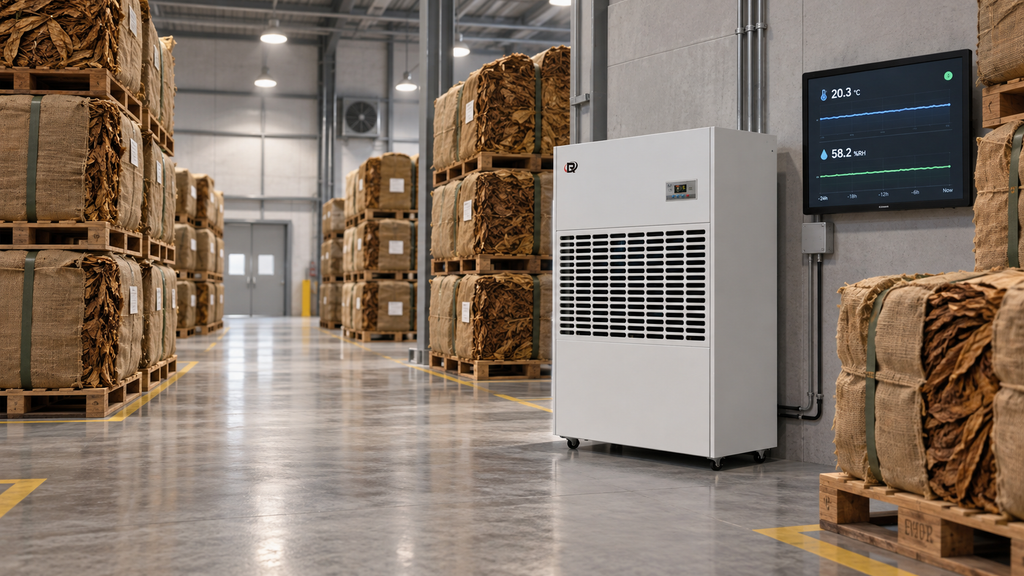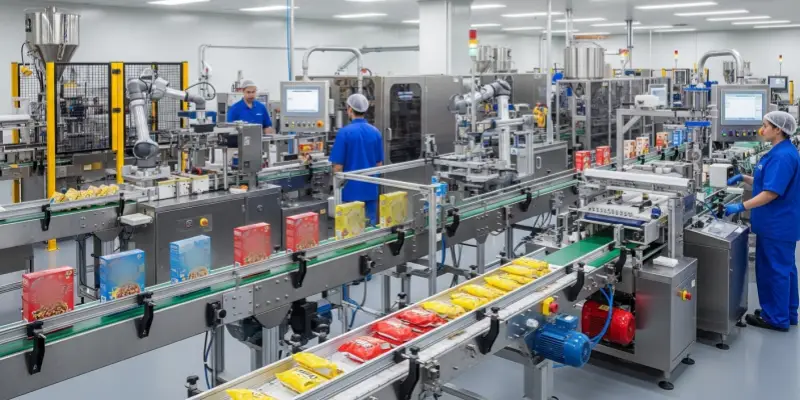
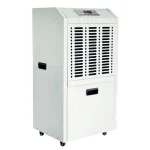
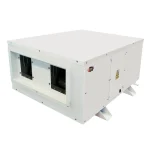
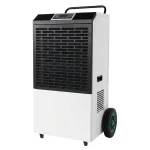
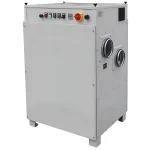
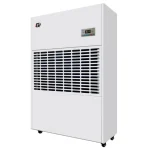
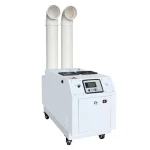
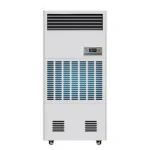
A process drying room is designed to remove moisture from a product as part of a manufacturing process. This is different from a warehouse or storage room, where the main objective is simply to keep the surrounding air below a target humidity.
In a drying room, the main moisture load often comes from the product itself, so sizing the system only by room area, room volume or a target RH can lead to an undersized or poorly matched system. The selection should begin with the production data: batch weight, incoming and target moisture content, required drying time, operating temperature and the way the product releases moisture during the cycle. From there, room infiltration, ventilation, airflow distribution and target dew point can be added to determine the required capacity and whether refrigerant or desiccant dehumidification is more appropriate.
This guide explains how to calculate that load and what information a buyer should prepare before requesting a drying-room dehumidifier selection.

What Determines the Moisture Load in a Drying Room
In a humidity-controlled room the moisture load is an unwanted leak, and most of the engineering effort goes into making it smaller. In a process drying room the moisture load is the point of the room, and the engineering effort goes into removing it on schedule without damaging what is being dried.
| Room type | Where the moisture comes from | What sets the load | What success looks like |
|---|---|---|---|
| Storage, warehouse, packing | Envelope leakage, door traffic, fresh air, hygroscopic stock | Door regime and envelope tightness | Relative humidity (RH) stays under a ceiling value |
| Condensation control zones | Warm humid air meeting cold surfaces | Surface temperature relative to room dew point | No wet surfaces, no drips |
| Structural dry-out after water damage | Water absorbed by the building fabric — finite and non-recurring | How wet the fabric is when work starts | Materials return to a dry standard, then the equipment leaves |
| Process drying room | Water inside the product, put there by the process | Batch mass, moisture content in and out, cycle time | The batch reaches target moisture content on schedule without quality defects |
The first three rows are already familiar territory for most buyers, and two of them are separate engineering problems with their own logic — condensation on cold tooling in a molding hall is covered in Rinwang’s guidance on injection molding humidity control, and one-off building dry-out is covered under water damage drying. Everything below concerns the fourth row.
Three things that are often filed under “process drying” are outside this article on purpose, because they are different equipment classes rather than different sizes of room dehumidifier: resin hopper dryers built into a molding machine, dedicated hot-air supply systems for spray-drying towers, and ultra-low dew point battery dry rooms. A room dehumidifier does not substitute for any of the three.
Start From the Water in the Product, Not the Volume of the Room
The first number in a drying room calculation is not room volume, air changes or floor area. It is the mass of water the batch has to lose. Where moisture content is quoted on a wet basis — water as a fraction of total mass, which is how food, timber, ceramics and most agricultural products are specified — the water removed per batch is:
Water removed (kg) = incoming batch mass × (moisture in − moisture out) ÷ (1 − moisture out)
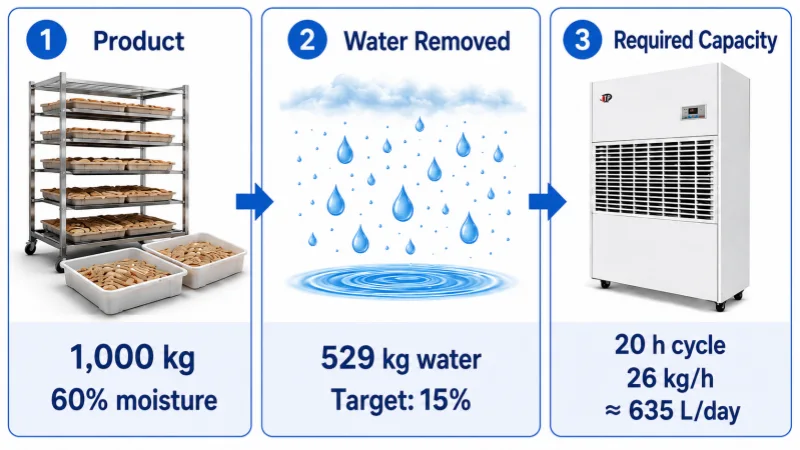
Take an illustrative batch of 1,000 kg entering at 60% moisture and leaving at 15%, on a 20-hour cycle. That batch has to give up 1,000 × (0.60 − 0.15) ÷ (1 − 0.15) ≈ 529 kg of water, an average of about 26 kg per hour. Expressed in the units most dehumidifier data sheets use, that is roughly 635 L/day of moisture removal before anything else is added.
Two cautions on that arithmetic, both of which change the answer materially:
- Confirm the basis. If moisture content is quoted on a dry basis — water as a fraction of bone-dry solids, common in timber and some chemical processes — the formula is different: water removed equals dry-solid mass multiplied by the difference in the two dry-basis moisture ratios. Applying the wet-basis formula to dry-basis figures at high moisture contents produces a large error in the wrong direction.
- The other loads still exist. Envelope infiltration, door openings and any mechanical fresh air all add on top of the product load, and they are calculated the same way as in any other room. The general method — capacity units, rating conditions, and how infiltration and fresh air are handled — is set out in Rinwang’s guide to industrial dehumidifier sizing.
What changes in a drying room is the ranking. In a storage room the envelope and the doors are usually the whole load, so sealing the room is the first move. In a process drying room the product is usually the dominant term by a wide margin, so getting the product load right comes first, and the envelope work follows.
| Project input | Why it changes the capacity figure |
|---|---|
| Batch mass entering the room | Sets the total water directly |
| Moisture content in and out, and the basis they are quoted on | Sets the fraction of that mass that has to leave |
| Required cycle time | Converts a mass into an hourly rate |
| Number of batches per day and any overlap between them | Determines whether the room ever returns to a low-load state |
| Product form — sheet, particle, coated part, packed tray | Governs how fast the water can reach the surface |
| Room temperature during the cycle | Sets the dew point, and therefore which technology applies |
Size for the Highest Drying Load, Not the Average
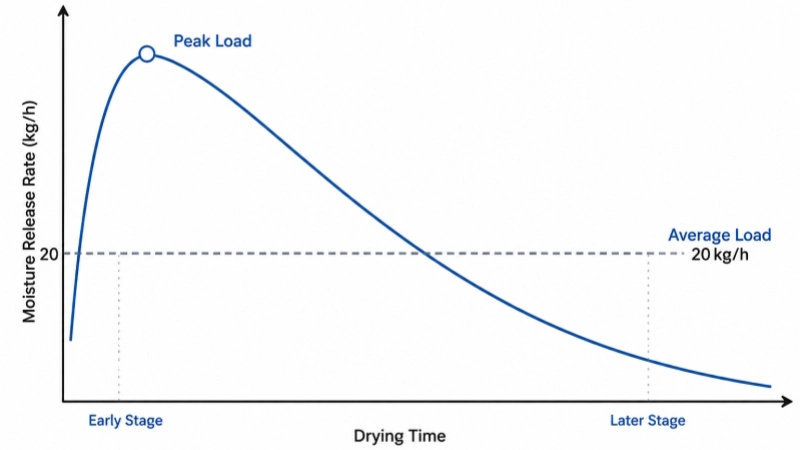
The moisture load in a drying room changes during the drying cycle. At the beginning, the product usually releases water faster because more moisture is available near the surface. As drying continues, the rate slows down because the remaining moisture has to move from inside the product to the surface.
So if a batch removes an average of 20 kg of water per hour, the actual load during the first few hours may be much higher. If the dehumidifier is selected only from the batch average, it may not have enough capacity during the wettest part of the cycle. This can cause higher room humidity, longer drying time, and uneven drying between racks.
The most reliable way to check the peak load is to weigh a representative product, tray, or rack several times during one complete drying cycle. The period with the fastest weight loss shows the highest moisture release rate.
| Option | What it means | When it makes sense |
|---|---|---|
| Size for the peak load | The dehumidifier can handle the highest hourly moisture release | When drying time must stay consistent |
| Use staged drying | Part of the moisture is removed before the main drying stage | When the early-stage load is much higher than the rest of the cycle |
| Accept a longer cycle | Use a smaller system and allow more drying time | When equipment cost matters more than maximum throughput |
The key point is simple: do not size the dehumidifier only by dividing total water removal by total drying time. The highest hourly moisture load is usually more important.
How Humidity Affects Drying Speed and Product Quality
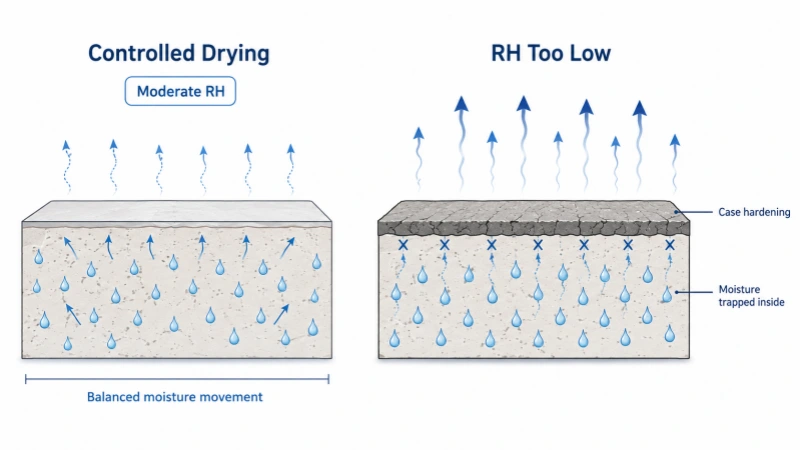
The instinct in a slow drying room is to ask for a drier room. Past a point specific to each product, that instinct destroys the batch.
Water leaves a product from the surface, but it has to arrive at the surface first. If the room is held so dry that surface evaporation outruns internal migration, the outer layer shrinks and hardens into a barrier, and the remaining moisture is sealed inside. Food processors call this case hardening; wood processors see the same physics as surface checking and, later, internal cracking.
FAO’s guidance on date dehydration states the constraint as a band rather than a floor: relative humidity should be maintained by recirculating the drying air at over 40%, but not exceeding 60% at the cold end, specifically to avoid case hardening and for fuel economy. Both ends of that band are engineering requirements. The lower one exists because product quality fails below it.
The same logic governs timber, where it has been formalised into published schedules. The USDA Forest Products Laboratory’s Wood Handbook describes a kiln schedule as a series of temperatures and relative humidities that are applied at various stages of drying, with temperature gradually increased and relative humidity gradually decreased as the batch proceeds, and warns that if relative humidity is too low in the early stages, excessive shrinkage may occur and cause surface and end checking. The same source gives typical pre-dryer conditions as 27–38 °C at 65–85% RH — a deliberately humid room whose whole purpose is drying.
| Stage of the batch | What limits the drying rate | What the room condition has to do | What happens if RH is set too low |
|---|---|---|---|
| Early, surface still wet | How fast the air removes surface moisture | Hold a moderate RH so evaporation does not outrun migration | Surface hardens or checks; internal moisture is trapped |
| Middle, after the surface dries | Migration of water from the interior | Lower RH progressively as the product’s own resistance rises | Marginal gain; the product, not the air, is now the bottleneck |
| Final conditioning | Equilibrium between product and room air | Hold the RH that corresponds to the target moisture content | Over-drying, weight loss, brittleness, or an out-of-spec product |
Two conclusions follow for procurement. First, the correct control specification for a drying room is a schedule with setpoints per stage, not a single RH figure — and a request that begins “we need 20% RH” should be checked against the product before it is priced. Second, genuinely low-RH rooms do exist, but they sit at the final-conditioning end of the process, where the product is already near its target moisture content and the room’s job is to hold an equilibrium. Rinwang’s guidance on seed drying and storage rooms covers one such case in detail.
Airflow Is as Important as Dehumidification Capacity
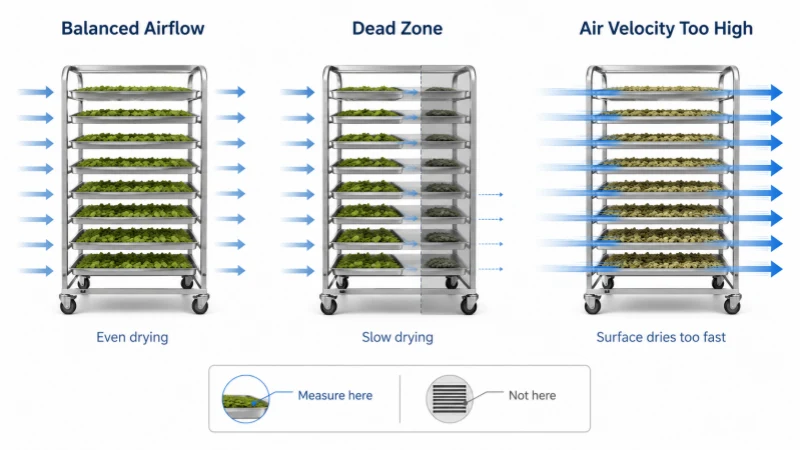
Moisture-removal capacity, in kg/h or L/day, describes what leaves the room. Air velocity across the product describes whether water can leave the product in the first place. They are set by different parts of the design, and a correctly sized machine will still dry unevenly if the second one is wrong.
FAO’s account of the same date-drying process puts all three variables on an equal footing: drying time and drying rate are a function of temperature, relative humidity and the velocity of the air. The Wood Handbook is more specific about what goes wrong at each end. If air circulation is too slow, the drying rate is slower than necessary and mould can develop on the product surface. If it is too fast, energy is wasted and surface checking and other drying defects can appear when relative humidity and air velocity are not coordinated with each other.
That produces two failure modes with the same symptom — a batch that finishes unevenly — and different fixes:
- Dead zones. Racks packed too tightly, product blocking its own air path, or a supply throw that does not reach the far end of the room. Trays in the shadow lag behind, and the room is judged by its slowest tray. The fix is loading pattern and air distribution, not more capacity.
- Over-velocity at the product face. Air moving fast enough over freshly loaded wet product to drive surface evaporation past what the product can supply from inside. The fix is lower velocity or higher RH in the early stage, and it usually costs nothing.
Two practical points follow. Measure velocity at the product surface, not at the discharge grille, because the two are rarely the same once a room is loaded. And treat the loading pattern as part of the design: a drying room commissioned empty tells you very little about how it will behave full.
Heat-and-Exhaust or Closed-Loop Dehumidification?
This is the fork that decides the shape of the whole installation, and it should be settled before equipment is selected.
Heat-and-exhaust draws in outdoor air, heats it, passes it over the product and blows the moisture-laden air outside. It is mechanically simple, but the room condition it can reach is capped by how much moisture the outdoor air already carries. Heating air does not remove any water from it; it only raises the amount the air could hold, which lowers RH without touching the moisture content.
The following figures are calculated from standard psychrometric relations at sea-level pressure and rounded, to show how strongly the outdoor condition constrains this approach:
| Outdoor air condition | Moisture in that air | Best RH reachable at 45 °C by heating alone |
|---|---|---|
| 32 °C, 85% RH — humid tropical afternoon | About 26 g of water per kg of dry air | About 42% RH |
| 28 °C, 80% RH — warm humid climate | About 19 g/kg | About 32% RH |
| 10 °C, 80% RH — temperate winter | About 6 g/kg | About 10% RH |
Two judgments come out of that table. Ventilation drying is genuinely effective where outdoor air is cold or dry, and it is the cheaper answer in those conditions. In a humid climate it hits a wall: a room targeting 45 °C at 30% RH needs air holding about 18 g/kg, which is drier than the outdoor air in the first two rows, so no amount of ventilation will get there. And even where it works on a design day, the room condition moves with the weather — which is acceptable for a shed and unacceptable for a repeatable production process with a quality specification attached.
The exhaust airflow that heat-and-exhaust requires follows directly from the same numbers: mass airflow equals the water removal rate divided by the moisture the air is allowed to pick up between inlet and exhaust. Small permitted pickups mean very large airflows, and every cubic metre of that air has to be heated from outdoor temperature to room temperature and then thrown away.
Closed-loop dehumidification recirculates the room air through a dehumidifier instead. The room condition becomes independent of outdoor weather, the airflow is set by distribution rather than by moisture pickup, and the latent heat released when moisture is condensed or adsorbed returns to the room as sensible heat instead of leaving through a stack — which in a warm drying room is useful output rather than waste. FAO’s date-drying guidance assumes recirculation for exactly this combination of quality control and fuel economy.
There is one boundary where the choice is not open. Where the product carries flammable solvents — solvent-borne coatings, adhesives, printing inks — the room must be ventilated regardless of what dehumidification would do for the schedule. US OSHA requires that freshly sprayed articles be dried only in spaces provided with adequate ventilation to prevent the formation of explosive vapors. Local requirements differ, and the applicable rule is the one in the jurisdiction where the room is built, but the principle is general: a solvent-laden drying room is a ventilation problem first and a humidity problem second. Where dehumidification equipment is placed in or serving a classified area, the equipment itself has to suit the area classification, which is what explosion-proof dehumidifiers are built for. Water-borne processes carry no such restriction and are where closed-loop drying rooms are normally applied.
Matching Technology to the Drying Room: Two Worked Examples
Once the load, the RH schedule and the air path are settled, the technology choice is narrow and it is decided by dew point — the temperature at which the room air would begin to condense. Refrigerant dehumidifiers work by cooling air below its dew point, so they lose ground as the target dew point approaches freezing; desiccant units adsorb moisture instead and are unaffected by that limit. The general mechanism and energy trade-off is set out in Rinwang’s refrigerant vs desiccant dehumidifier comparison. The point that matters here is that a warm drying room can hold a low RH and still sit at a high dew point:
| Room condition | Approximate dew point | Where that lands |
|---|---|---|
| 50 °C, 40% RH — warm drying room | About 33 °C | Comfortably within refrigerant territory |
| 25 °C, 30% RH — ambient-temperature drying | About 6 °C | Refrigerant, near the lower end |
| 20 °C, 15% RH — low-humidity finishing room | About −7 °C | Desiccant |
A warm, high-load drying room
Illustrative case, not a Rinwang project record: the 1,000 kg batch above, dried at 50 °C to a 20-hour cycle, with the room held near 45% RH during the wet phase and stepped down afterwards.
The load is roughly 26 kg/h at peak-adjusted capacity, and the room dew point sits around 35 °C. Nothing about that condition calls for desiccant equipment. The binding constraint is not the humidity target at all — it is the ambient temperature the machine has to survive and still perform in. A standard industrial unit rated for comfort-range operation will derate or trip long before it runs out of capacity, which is why this duty belongs to a high temperature dehumidifier rated for continuous operation at drying-room temperatures. The specification to check on the quotation is the moisture removal figure at the room’s actual temperature and RH, not the headline rating.
A low-humidity finishing room
Illustrative case: 200 kg of product per batch moving from 15% to 8% moisture content over 24 hours, in a room held at 20 °C and 15% RH.
The total water is about 15 kg, an average under 1 kg/h. In pure capacity terms that is a very small machine. But the room dew point is around −7 °C, which is below what a refrigerant coil can hold without frosting, so capacity is not the selection criterion at all — achievable RH is. This room needs a desiccant unit chosen for the humidity it can hold at the design airflow, with the regeneration air path and its humid exhaust designed into the building rather than added afterwards.
The envelope also matters far more here than in the first example. This room sits roughly 20 °C of dew point below a normal corridor outside it, so infiltration through doors and joints can easily exceed the product load — the reverse of the situation in the warm room.
The contrast is the useful part. The first room needs a large machine that can survive heat. The second needs a small machine that can reach a low dew point. Both rooms are drying rooms, both would be described as “process drying” in an enquiry, and selecting either from floor area would produce the wrong equipment.
What to Confirm Before Requesting Equipment Selection
A drying room cannot be quoted from room dimensions. The information that changes the answer:
| Project input | Why it changes the selection |
|---|---|
| Product, batch mass, and moisture content in and out with the basis stated | Produces the total water to be removed |
| Required cycle time and number of batches per day | Converts that mass into the hourly rate the equipment must meet |
| Measured weight-loss curve for one full cycle, if it exists | Gives the peak rate instead of an assumed factor |
| Target temperature and RH for each stage of the schedule | Fixes the dew point and therefore the technology |
| Product quality limits — maximum temperature, minimum RH, defect history | Prevents a specification that dries the batch and ruins it |
| Room dimensions, construction, and rack or trolley loading pattern | Determines air distribution and where dead zones will form |
| Whether the process involves flammable solvents | Decides whether the room must be ventilated and whether area classification applies |
| Outdoor design conditions at the site | Determines whether heat-and-exhaust is even capable of the target |
| Fresh-air, exhaust and drainage constraints in the building | Constrains where equipment and regeneration ducting can go |
| Available power, and whether waste heat or steam is available on site | Affects the regeneration and heating strategy |
With those inputs, the load, the schedule, the air path and the equipment can be worked through as one system instead of separately. Rinwang manufactures industrial and commercial desiccant dehumidifiers and high-temperature refrigerant units for process rooms and configures them against project conditions; sending the batch data, the target schedule and the room layout is enough to begin a selection review.
FAQ
What relative humidity should a process drying room be held at?
There is no single figure, because the correct value changes through the batch and depends on the product. Published guidance for date dehydration keeps the drying air between 40% and 60% RH specifically to avoid case hardening, while published timber kiln schedules start humid and step the humidity down as drying progresses. A drying room specification should be written as a staged schedule rather than one setpoint.
How is a dehumidifier sized for a drying room?
Start from the mass of water the batch has to lose, calculated from batch mass and the moisture content entering and leaving, then divide by the cycle time to get an hourly rate. Envelope infiltration and any mechanical fresh air are added to that figure. The result should be checked against the peak hourly rate rather than the batch average, because moisture release is heaviest at the start of a cycle.
Does raising the drying room temperature reduce the dehumidification load?
No. The mass of water that has to leave the product is fixed by the batch and its target moisture content, and heating the room does not change it. Higher temperature speeds up how quickly the product releases that water and raises the room’s dew point, which usually makes the equipment selection easier — but it increases the hourly load rather than reducing the total.
Should a drying room recirculate its air or exhaust it?
Recirculation with dehumidification is normal for water-borne processes, because it makes the room condition independent of outdoor weather and returns the latent heat to the room instead of exhausting it. Exhaust ventilation is mandatory where flammable solvent vapours are present, and it can be the cheaper choice where outdoor air is cold or dry enough to reach the target condition on its own.
Is a process drying room the same as a battery dry room?
No. Battery manufacturing dry rooms are specified in dew point rather than RH and commonly run tens of degrees below freezing, which is a different class of equipment and a different building design. Most process drying rooms — food, timber, coated parts, powders, packaging — operate in a moderate humidity band where the design problem is moisture load and schedule, not ultra-low dew point.